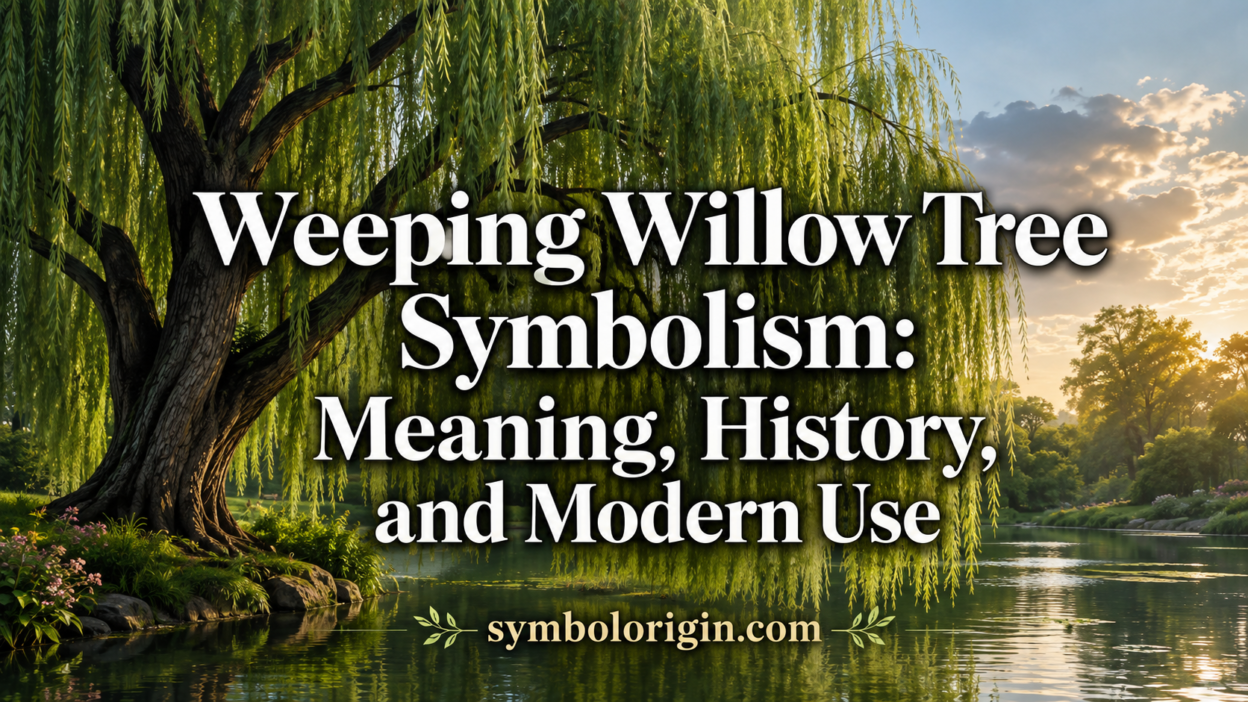
Few trees have a silhouette as recognizable as the weeping willow. Its long branches fall toward the ground, narrow leaves move with the slightest breeze, and mature trees often spread over ponds, streams, lawns, and garden paths. Weeping willow tree symbolism grows largely from these physical qualities: the tree can look as though it is bowing, sheltering, or quietly crying.
In the United States, the weeping willow most strongly suggests grief, remembrance, reflection, endurance, and recovery after loss. Yet sadness is only part of its story. Because willows grow rapidly, favor moist ground, bend rather than appearing rigid, and can regenerate vigorously, they have also become natural images of adaptability and renewal.
Its meaning has been shaped by Chinese traditions, European literature, biblical associations, American mourning art, cemetery design, and modern tattoo culture. Those traditions overlap, but they do not all assign the tree the same meaning.
Quick Answer
Weeping willow tree symbolism commonly represents grief, remembrance, emotional reflection, resilience, and renewal in modern American culture. Historically, willow imagery has also been connected with mourning, separation, spring, regeneration, religious tradition, and the ability to endure difficult circumstances.
TL;DR
- Weeping willows most commonly symbolize grief, remembrance, and emotional reflection.
- Their flexible branches also suggest adaptability and endurance.
- New growth gives the tree associations with recovery and renewal.
- American mourning art strongly linked willows with memorial symbolism.
- Chinese traditions connect willows with spring, farewell, and attachment.
- Modern tattoos often combine sorrow with survival and personal growth.
Why the Weeping Willow Looks Symbolic
The symbolism begins with the tree’s shape. Weeping willows develop long, flexible branches that sweep downward, sometimes reaching nearly to the ground. From a distance, those branches can resemble lowered arms, hanging hair, a bowed head, or streams of tears.
That visual resemblance made the tree especially suitable for art about sorrow. Unlike an upright oak or sharply pointed evergreen, a willow appears soft and yielding. It creates an enclosed space beneath its canopy, which can feel private and contemplative.
Water adds another layer. Willows are strongly associated with moist soils and streambanks, so they often appear beside ponds, rivers, and lakes. In visual art, that pairing can suggest reflection in both senses of the word: a mirrored landscape and a person looking inward.
The familiar Salix babylonica originated in China, despite the scientific name’s reference to Babylon. In addition, some trees Americans casually call weeping willows are hybrids rather than pure S. babylonica.
What the Weeping Willow Commonly Symbolizes
The tree does not have one fixed meaning. Context determines whether it feels mournful, peaceful, romantic, or hopeful.
| Context | Meaning in the USA | Common Associations | Notes |
|---|---|---|---|
| Memorials | Grief and remembrance | Loss, mourning, memory | One of its strongest historical meanings |
| Tattoos | Survival and personal change | Grief, healing, endurance | Meaning often depends on the wearer’s story |
| Gardens | Peace and reflection | Water, shade, solitude | Usually less mournful than cemetery imagery |
| Art and literature | Sorrow or separation | Lost love, longing, death | Reinforced by European literary traditions |
| Personal symbolism | Resilience and renewal | Flexibility, recovery, growth | Largely a modern interpretation |
| Chinese cultural contexts | Spring and parting | Farewell, attachment, return | Meanings differ from Western mourning imagery |
These meanings can coexist. A memorial tattoo, for example, might use a willow both to acknowledge grief and to represent continuing life after bereavement.
Grief, Mourning, and Remembrance
Grief is the weeping willow’s most recognizable symbolic meaning in American culture.
Its common name itself encourages that interpretation. The branches appear to droop like a grieving figure, while their flowing leaves can visually resemble falling tears. Artists could therefore communicate sorrow without showing dramatic expressions of pain.
By the late eighteenth and early nineteenth centuries, willow imagery became especially visible in Anglo-American mourning culture. It appeared alongside urns, tombs, memorial inscriptions, grieving figures, and cemetery scenes. Surviving American decorative objects and memorial needlework show weeping willows used specifically as emblems of mourning.
The image sometimes communicated more than despair. In memorial compositions, living branches surrounding a tomb could imply that memory continues after death. Some historical American works even paired the willow’s mourning symbolism with ideas of resurrection or continuing hope.
That combination explains why the willow remains suitable for memorial tattoos and remembrance artwork today. It can acknowledge sorrow without suggesting that grief is the end of the story.
Resilience and the Ability to Bend
Resilience is a more contemporary interpretation, but it fits the physical character of willow trees.
Willow branches are notably flexible. Rather than presenting the stiff, massive form associated with trees such as oaks, they move readily in wind. This has encouraged a metaphor familiar in modern self-help, tattoo, and personal symbolism: survival does not always require rigidity.
Under this interpretation, the willow represents adapting without surrendering one’s identity.
There is also a biological basis for associating willows with recovery. Many willows grow vigorously and can regenerate from vegetative material. An especially striking example comes from Hiroshima, where a weeping willow near the 1945 atomic blast later produced new shoots from its roots after being felled by the explosion.
That event should not be turned into a universal historical meaning for the species. Still, it illustrates why people can convincingly use the willow as an image of survival after severe disruption.
Renewal, Regrowth, and New Beginnings
A tree associated with mourning might seem like an unlikely emblem of renewal, yet the two ideas naturally fit together.
Willows are fast-growing deciduous trees. They lose their leaves, pass through winter, and return with fresh growth. Their strong association with water and early seasonal greenery also makes them feel connected with returning life.
For this reason, renewal usually appears as a secondary meaning rather than a replacement for grief. The symbolic sequence is often:
loss → adaptation → regrowth
Someone choosing a willow after bereavement, divorce, illness, relocation, or another difficult transition may therefore interpret it as evidence that sadness and new beginnings can exist together.
This distinction matters. Renewal does not mean forgetting what happened. Willow symbolism more often suggests carrying memory forward while continuing to grow.
Solitude, Reflection, and Inner Life
Not every weeping willow represents death.
In gardens, parks, paintings, and photography, a large willow beside water often creates an atmosphere of solitude. Its hanging branches form something like a natural room, separating the space beneath the canopy from the surrounding landscape.
That makes the tree useful as a symbol of introspection.
A person sitting beneath a willow in an illustration may appear withdrawn, but not necessarily devastated. The scene can communicate contemplation, emotional privacy, quietness, or a desire to step away from noise.
This is one reason contemporary willow imagery often feels calming despite its long connection with mourning. The same downward branches that resemble tears can also resemble protection or enclosure.
Lost Love, Separation, and Literary Symbolism
Long before modern tattoo culture, the willow had strong associations with disappointed love and separation in European literature.
William Shakespeare helped preserve that connection for English-speaking audiences. In Othello, Desdemona recalls and sings a traditional willow song associated with a woman abandoned by her lover shortly before Desdemona herself dies. In Hamlet, a willow stands beside the brook in the description of Ophelia’s drowning.
The willow was already associated with sorrow in the culture surrounding these works; Shakespeare did not invent the connection. His plays, however, helped keep the image recognizable.
As a result, willow imagery can signify more than death. It can represent heartbreak, unreturned affection, separation, loneliness, or love that remains after a relationship ends.
In modern use, these meanings are usually poetic rather than formal. There is no rule that a willow tattoo or drawing automatically signifies romantic rejection.
How the Willow Became a Mourning Symbol in the West
The willow’s Western mourning symbolism developed through several overlapping influences rather than one single origin story.
First, its drooping appearance made it visually suitable for sorrow. Second, older songs and literature connected willow imagery with abandoned lovers and unfortunate women. Third, biblical translations describing trees beside the rivers of Babylon reinforced associations with exile, tears, longing, and displacement.
During the eighteenth and nineteenth centuries, Western memorial art increasingly favored sentimental imagery instead of the harsher skeletons, skulls, and hourglasses used in earlier memento mori traditions.
The weeping willow fitted that change perfectly.
Rather than confronting viewers directly with decay, it expressed bereavement through landscape. A hanging tree beside an urn could communicate death, affection, memory, and quiet sorrow at the same time.
The Weeping Willow in American Mourning Culture
The willow became especially recognizable in early American memorial imagery.
Historic American mourning pictures and embroidered memorials frequently placed grieving figures beside urns or grave monuments beneath drooping willow branches. Mourning jewelry also shifted toward softer imagery such as urns and weeping willows as older, more graphic symbols of mortality became less fashionable.
Willow designs also appeared on gravestones. Their presence helped connect personal mourning with the nineteenth-century ideal of cemeteries as landscaped places for memory, contemplation, and visits by the living.
This historical background still affects American interpretation today, even when people do not consciously know where the association originated. A black silhouette of a willow beside a grave can communicate mourning almost immediately because generations of memorial imagery established the visual language.
At the same time, Americans also planted weeping willows simply because of their dramatic form. George Washington, for example, recorded plans to plant weeping willows in the landscape at Mount Vernon in the eighteenth century.
The tree therefore should not be treated as exclusively funerary.
Biblical and Religious Associations
The relationship between the weeping willow and the Bible requires careful explanation.
Psalm 137 describes exiles mourning beside the rivers of Babylon and hanging their musical instruments on trees translated in some English Bibles as “willows.” Other translations use “poplars,” reflecting uncertainty over the precise tree intended.
The scientific name Salix babylonica helped strengthen the later connection between the familiar weeping willow and Babylon. Botanically, however, the species is native to China rather than ancient Mesopotamia. The name should therefore not be treated as proof that today’s Chinese weeping willow was the biblical tree.
Willows also have an authentic place in Jewish religious practice. Willow branches are among the Four Species used during Sukkot, and additional willow customs appear during Hoshana Rabbah.
Those traditions concern willows generally, not specifically the ornamental weeping willow familiar from American gardens.
Christians may interpret willow imagery through themes such as sorrow, hope after death, or resurrection, especially when it appears in historical memorial art. Still, Christianity does not assign one universal doctrinal meaning to the weeping willow tree.
Weeping Willow Meaning in Chinese Culture
Chinese traditions provide an important counterbalance to the Western focus on death.
Willows have long been associated with spring, departure, attachment, and the sorrow of separation in Chinese poetry and cultural practice. One well-known association comes from the similarity in sound between the Chinese word for willow, liǔ, and a word connected with staying or remaining, liú. Giving or breaking a willow branch therefore became associated with farewells and the wish that someone would remain.
Willows can also signal spring because they produce fresh growth as the season changes. Their flexibility and vitality have supported additional associations with persistence and returning life.
These ideas resemble Western willow symbolism in one respect: both traditions connect the tree with separation and emotion. However, Chinese willow imagery should not simply be reduced to the American idea of a “sad tree.”
Its meanings developed within Chinese language, poetry, seasonal traditions, landscape art, and social customs.
What Weeping Willow Tattoos Mean
Weeping willow tattoos usually communicate a personal story rather than one standardized definition.
For memorial tattoos, the tree may represent someone who has died. Initials, dates, birds, water, gravestones, or other imagery can make that intention clearer.
For someone recovering from hardship, the same tree may represent resilience. The hanging branches acknowledge difficulty, while the living trunk and new leaves suggest continued growth.
Common tattoo interpretations include:
- grief after losing someone
- remembrance of a loved one
- surviving emotional hardship
- adapting to major life changes
- healing without forgetting
- solitude or introspection
- connection with nature
- moving forward after heartbreak
Design choices change the tone. Bare branches tend to feel more severe or mournful. Green foliage emphasizes life and endurance. Roots can symbolize ancestry or stability, while water often adds reflection, emotion, or transition.
Because tattoo symbolism is personal, viewers should avoid assuming someone’s willow represents bereavement unless the wearer says so.
Willow Imagery in Jewelry, Art, and Home Decor
Outside memorial contexts, modern Americans often choose weeping willow imagery simply because it creates a calm and recognizable landscape.
Wall art may show the tree beside a lake at sunrise or sunset, emphasizing tranquility rather than sorrow. Jewelry can reduce the form to a delicate tree silhouette, which allows meanings such as family, memory, personal growth, or nature to take precedence.
The tree also works well in photography because its hanging branches naturally frame people, water, benches, bridges, and paths.
In these settings, symbolism depends heavily on surrounding elements. A willow beside a headstone communicates something very different from a sunlit willow beside children playing near a pond.
Context matters more than the tree alone.
Emotional and Psychological Meaning
Psychologically, the weeping willow often appeals to people who want a symbol that makes room for difficult emotions rather than denying them.
Its posture is not triumphant. It does not stand rigidly upright in the visual language commonly used for strength. Instead, its branches hang downward while the tree remains alive.
That creates an alternative model of resilience: a person can grieve, bend, withdraw, or feel vulnerable and still continue.
The enclosing canopy can also represent emotional privacy. For some people, that feels comforting. For others, it may suggest loneliness or isolation.
This duality is central to the tree’s appeal. The willow can feel sad without being hopeless and peaceful without being cheerful.
Is the Weeping Willow a Positive or Negative Symbol?
It can be either, but describing it as simply “negative” misses most of its meaning.
Its darker associations include mourning, separation, loneliness, death, and disappointed love. These meanings are well established, particularly in Western art and literature.
Its positive associations include resilience, adaptation, remembrance, renewal, spring, peaceful reflection, and continued attachment to people who are absent.
Sometimes both sides appear at once. A memorial willow is sad because a loss occurred, but loving because the person remains remembered.
For that reason, the symbol is better described as bittersweet than negative.
Common Misunderstandings About Weeping Willow Symbolism
One common mistake is assuming that every weeping willow represents death. The tree has been planted ornamentally for centuries and can symbolize beauty, shade, water, peace, or landscape without any funerary message.
Another mistake is claiming that the weeping willow originated in ancient Babylon because of its scientific name. The familiar species Salix babylonica is native to China.
It is also inaccurate to treat biblical references to willow trees as definite references to modern weeping willows. Biblical translations themselves vary between willow and poplar.
Finally, meanings from Chinese culture, Jewish religious practice, European literature, and American cemetery art should not be merged into one supposed universal tradition. They developed in different historical and cultural settings.
How the Meaning Has Changed Over Time
The willow’s symbolism has never remained completely fixed.
In older Chinese traditions, willow imagery became closely tied to spring, friendship, departure, and separation. European songs and literature emphasized abandoned love and sorrow. Biblical imagery contributed associations with exile and lament, although the tree species involved remains uncertain.
Later, Anglo-American memorial art turned the drooping willow into a recognizable emblem of bereavement. It appeared on decorative objects, needlework, jewelry, and gravestones.
Modern use has broadened the meaning again.
People now use weeping willows in tattoos, illustrations, jewelry, photography, memorial designs, and digital artwork to represent not only grief but also resilience, healing, adaptability, emotional honesty, and starting over.
The older association with sadness remains visible, but sadness is no longer the symbol’s only message.
Frequently Asked Questions
What does a weeping willow symbolize spiritually?
There is no single universal spiritual definition. People may use the tree to represent mourning, renewal, humility, emotional acceptance, or continued life after loss, while specific religious traditions involving willows have their own meanings.
What does a weeping willow tattoo symbolize?
A weeping willow tattoo often represents remembrance, grief, resilience, personal healing, or surviving a difficult life transition. Additional elements such as names, dates, roots, birds, or water usually reveal more about the wearer’s intended meaning.
Does a weeping willow symbolize death?
It can symbolize death and mourning, particularly because weeping willows became established motifs in Western and American memorial art. However, the tree can also represent remembrance, renewal, peaceful solitude, and survival.
What does the weeping willow symbolize in love?
In literary and romantic symbolism, willow imagery can suggest separation, heartbreak, longing, or love that cannot continue in its original form. This association was reinforced by older European willow songs and famous literary scenes involving lost or endangered love.
Is the weeping willow a biblical symbol?
Willows appear in biblical texts and Jewish religious tradition, but the modern ornamental weeping willow should not automatically be identified with every biblical reference. Psalm 137 is translated with either willows or poplars depending on the Bible version, while Salix babylonica itself originated in China.
Why are weeping willows associated with grief?
Their drooping branches visually resemble a bowed or crying figure, making them suitable symbols for sorrow. Centuries of European literature and later American mourning art strengthened that association until the willow became recognizable memorial imagery.
Can a weeping willow symbolize resilience?
Yes. Modern symbolism often focuses on the willow’s flexible growth, ability to regenerate, and living form despite its downward-hanging branches. In that context, it represents adapting to hardship rather than remaining untouched by it.
Conclusion
The weeping willow carries an unusual combination of sorrow and continuing life. Its hanging branches explain why people associate it with tears, grief, separation, and remembrance, while its flexibility, rapid growth, seasonal renewal, and living canopy support meanings of resilience, adaptation, and recovery.
American mourning art gave the tree one of its strongest historical roles, but Chinese traditions, literary imagery, religious references, gardens, tattoos, and modern design have added different interpretations. Understanding those distinctions keeps weeping willow tree symbolism from being reduced to a simple equation of willow equals sadness.
Perhaps that balance explains the tree’s lasting appeal: it does not erase loss or pretend that change is painless. It represents the possibility of remaining alive, flexible, and capable of new growth while still carrying the memory of what came before.