
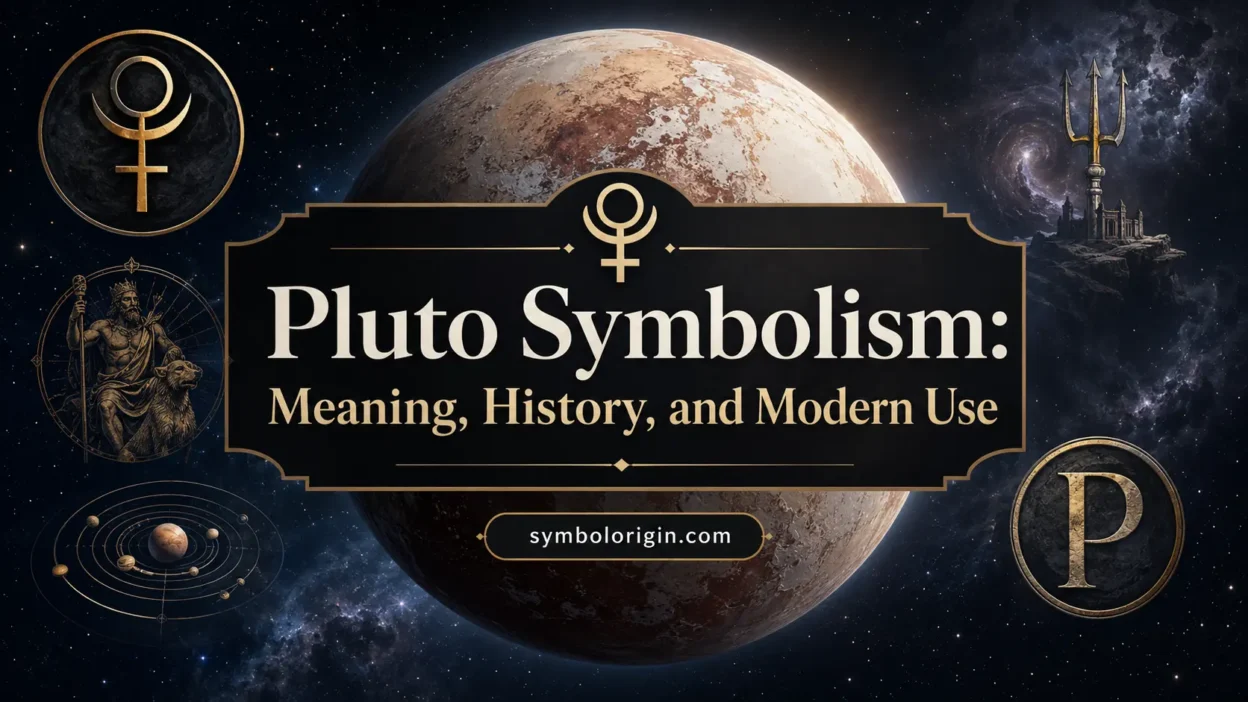
Pluto symbolism centers on transformation, endings, hidden forces, power, renewal, and what lies beneath the surface. Those meanings come from several overlapping sources: Pluto’s name from the classical ruler of the underworld, its extreme distance from the Sun, its role in modern astrology, and its unusual place in American space culture.
Scientifically, Pluto is a dwarf planet in the Kuiper Belt, far beyond Neptune. It was discovered in 1930, treated as the ninth planet for more than seven decades, reclassified as a dwarf planet in 2006, and visited by the New Horizons spacecraft in 2015. Those events gave Pluto a modern cultural identity that goes well beyond mythology.
This makes Pluto unusual as a symbol. It can suggest death without necessarily meaning literal death, darkness without automatically meaning evil, and destruction as part of a larger process of change. It can also represent outsiders, hidden value, difficult transitions, and the discovery that something distant or misunderstood is far more complex than it first appears.
Quick Answer
Pluto symbolism commonly represents transformation, endings, hidden power, renewal, and confronting what has been buried or avoided. Historically, these meanings connect to the classical god of the underworld and hidden wealth, while modern astronomy and astrology have added associations with distance, change, discovery, and regeneration.
TL;DR
- Pluto often represents transformation, endings, renewal, and hidden forces.
- Its underworld meaning comes from Greek and Roman mythology.
- Ancient Pluto also had connections with underground wealth.
- Astrology associates Pluto with power, regeneration, and major change.
- Americans often see Pluto as an astronomical underdog.
- Pluto tattoos can symbolize surviving profound personal transitions.
What Pluto Looks Like and Why Its Appearance Matters
Pluto is a small, icy world with mountains, valleys, glaciers, plains, craters, and a thin atmosphere. Its surface includes reddish-brown areas as well as unusually bright regions. The most recognizable feature is Tombaugh Regio, a vast light-colored area whose shape resembles a heart.
Those physical qualities affect modern symbolism even though they did not create Pluto’s ancient mythological meanings.
Its remote location encourages associations with isolation, secrecy, solitude, and the unknown. Its frozen landscape can suggest stillness or emotional distance. Meanwhile, its surprisingly varied geology works against the idea that something remote or dark must also be empty.
That contrast is important. Pluto looks distant and inhospitable from Earth, yet close observation revealed a complicated world. As a modern metaphor, it can therefore represent hidden complexity: the idea that what appears cold, insignificant, or unreachable may contain far more than expected.
What Pluto Commonly Symbolizes
Pluto does not have one universal meaning. Different contexts emphasize different aspects.
| Context | Common Meaning | Main Association | Important Note |
|---|---|---|---|
| Mythology | Underworld, death, hidden wealth | Pluto/Hades | Ancient religious tradition |
| Astrology | Transformation, power, regeneration | Personal or collective change | Astrological interpretation |
| Astronomy | Distance, discovery, changing categories | Dwarf planet | Scientific context |
| Tattoos | Survival, rebirth, inner change | Personal identity | Meaning varies by wearer |
| Popular culture | Outsider status, resilience | 2006 reclassification | Modern cultural interpretation |
Across these contexts, one theme repeatedly appears: something changes after going beneath the surface.
In mythology, the journey is into the underworld. In astrology, it becomes a metaphorical process of confronting hidden issues. In personal symbolism, it may describe surviving an ending and building something new afterward.
Ancient Roots: Pluto and the Underworld
The name Pluto connects the dwarf planet to a much older religious and mythological tradition.
The Roman Pluto corresponds closely to the Greek Hades, ruler of the underworld. Greek tradition also used Plouton as a name for the underworld god. The name carried associations with wealth, especially resources hidden beneath the ground. Ancient sources and later classical scholarship distinguish this figure from Plutus, a separate personification of wealth.
That distinction matters because Pluto was not simply an ancient embodiment of evil.
He governed the realm of the dead. Death was part of his domain, but underground riches were also connected with the earth beneath human feet. Metals, minerals, seeds, buried resources, and the dead all occupied the unseen world below.
This created a surprisingly broad symbolic field: death and wealth, absence and abundance, endings and fertility.
Those tensions still shape how Pluto is interpreted today.
Why Pluto Represents Death and Endings
Pluto’s association with death comes most directly from the underworld god for whom the astronomical body was named.
Yet symbolic death usually means more than physical mortality.
An ending can be the loss of a relationship, identity, career, belief, habit, social role, or previous version of oneself. In this sense, Pluto can represent the point at which returning to an earlier condition is no longer possible.
That is why the symbol fits transitions that feel irreversible.
Pluto can mark the ending of one chapter before the next has become clear. It is less suited to minor adjustments and more often used for changes involving surrender, separation, or the dismantling of something established.
This interpretation is especially common in astrology and modern tattoo symbolism. It should be understood metaphorically rather than as a prediction of literal death.
Hidden Wealth: Pluto Has an Older Meaning People Often Miss
One of the most interesting aspects of the classical Pluto is his connection with wealth.
The Greek name Plouton was linked with the idea of wealth or riches. Because valuable metals and agricultural abundance ultimately came from the earth, the ruler beneath the earth could also be understood as possessing its hidden resources.
This creates a meaning that differs considerably from the modern image of Pluto as only dark or destructive.
Symbolically, Pluto can represent value that is buried rather than immediately visible.
That might mean an overlooked ability, difficult experience that eventually produces insight, resources waiting to be uncovered, or something valuable hidden behind an unimpressive exterior.
The association also explains why darkness and abundance are not opposites within Pluto’s older symbolism. The underground could contain both graves and riches.
Pluto in Astrology: Transformation, Power, and Regeneration
Modern Western astrology gives Pluto some of its best-known contemporary meanings.
Astrological traditions commonly associate Pluto with transformation, regeneration, death and rebirth, hidden matters, power, control, and forces working beneath conscious awareness.
Its astronomical orbit contributes to the way astrologers interpret it. Pluto takes about 248 Earth years to orbit the Sun, so it moves slowly through the zodiac. Because many people born across a span of years can share the same Pluto sign, astrologers often discuss it as a generational influence rather than merely an individual personality marker.
Astrology is an interpretive or divinatory system, not a scientific explanation of personality or events. Pluto’s astrological meanings should therefore be separated from astronomical facts about the dwarf planet.
Within that symbolic system, however, Pluto rarely represents comfortable, superficial change. It usually points toward removing something old, exposing what has been concealed, and restructuring what remains.
The Psychological Meaning of Pluto
Outside formal astrology, Pluto can function as a psychological metaphor.
People may use it to describe experiences involving suppressed emotions, uncomfortable truths, fear of losing control, grief, major identity changes, or parts of themselves they would rather avoid examining.
The metaphor works because Pluto’s traditional imagery involves descent.
Instead of remaining in familiar territory, a person metaphorically goes underground. There, the task is not to pretend everything is fine but to identify what has been hidden.
In practical terms, someone might choose Pluto as a personal symbol after leaving a damaging relationship, recovering from a major failure, changing careers, abandoning an old identity, or rebuilding life after loss.
That does not mean Pluto scientifically causes psychological change. The value is metaphorical: it provides an image for experiences involving endings, confrontation, and reconstruction.
Pluto and the Symbolism of Power
Power is another major modern association.
The underworld ruler possesses authority over a realm humans cannot escape forever. Modern astrology expanded this idea into themes involving control, influence, coercion, secrecy, and struggles over who holds power.
Pluto can therefore represent power in two very different forms.
The constructive form is self-command: recognizing difficult truths, abandoning destructive patterns, setting boundaries, or refusing to let fear determine every decision.
The darker form involves domination, obsession, manipulation, secrecy, or attempts to control other people.
For that reason, Pluto is not automatically a positive symbol of becoming stronger. Its meaning often depends on how power is being used.
Pluto Symbolism in the United States
American interpretations of Pluto mix science education, nostalgia, humor, mythology, and personal identity.
For generations of Americans educated before 2006, Pluto was memorized as the ninth planet. Its reclassification therefore felt unusually personal for what was technically a scientific classification decision.
Pluto also has a strong American discovery connection. Clyde Tombaugh discovered it in 1930 while working at Lowell Observatory in Flagstaff, Arizona. The name itself was suggested by 11-year-old Venetia Burney in England and then forwarded to the observatory.
The 2015 New Horizons flyby strengthened Pluto’s cultural presence again. Instead of remaining a fuzzy point seen through telescopes, Pluto became a visually recognizable world with mountains, glaciers, varied terrain, and a famous heart-shaped region.
As a result, Americans may encounter Pluto as several things at once: a childhood planet, a scientific case study, an underdog, an astrological archetype, and a symbol of exploration.
The 2006 Reclassification and Pluto as an Underdog
In 2006, the International Astronomical Union adopted a definition of a Solar System planet under which Pluto did not qualify as one of the eight planets. It has remained officially classified as a dwarf planet.
The scientific change produced an unexpected cultural meaning.
Pluto became an underdog.
Jokes, cartoons, shirts, classroom discussions, and internet memes began treating it like a small character that had been unfairly expelled from the planetary family. Even discussions around the New Horizons mission acknowledged the widespread memes and public attachment surrounding Pluto.
This is a distinctly modern interpretation rather than an ancient one.
For some people, Pluto now symbolizes continuing to matter after a label changes. Its scientific importance did not disappear when its classification changed. In that sense, the dwarf planet works as a metaphor for worth that does not depend entirely on status.
Pluto’s Heart and the Symbolism of Unexpected Tenderness
New Horizons imagery made one Pluto feature especially famous: its enormous heart-shaped region.
Known as Tombaugh Regio, the bright formation dominates many modern images of Pluto. Its name honors Clyde Tombaugh.
Visually, the heart creates an appealing contradiction.
A world associated with darkness, death, freezing temperatures, and enormous distance appears to carry a heart across its surface.
That coincidence has encouraged modern visual interpretations involving affection beneath a guarded exterior, unexpected softness, or warmth found in an unlikely place.
Those meanings are poetic rather than scientific—the terrain did not form as a message or intentional heart symbol. Still, the resemblance is real enough that it has become part of Pluto’s popular visual identity.
For tattoos and illustrations, this can create a subtler message than the traditional underworld theme: a person may appear distant or hardened while still having a vulnerable center.
What the Pluto Glyph ♇ Means
Pluto also has a recognizable glyph: ♇.
The design combines the letters P and L. They represent the beginning of the name Pluto while also matching the initials of Percival Lowell, whose work helped inspire the search for the object once called Planet X.
The glyph gives Pluto a compact visual form suitable for birth charts, illustrations, jewelry, tattoos, and symbolic graphics.
Someone using ♇ today may intend several different meanings:
- personal transformation
- astrology or a birth-chart placement
- fascination with astronomy
- hidden strength
- endings and renewal
- power and self-mastery
- connection with the underworld archetype
Because the glyph has both astronomical history and astrological use, context matters. A Pluto symbol on an astronomy poster does not necessarily carry the same message as the same glyph in a tattoo.
Pluto Tattoos, Jewelry, and Personal Style
Pluto works particularly well as personal symbolism because its meanings are not limited to one emotion.
A Pluto glyph tattoo may represent transformation or an important astrological placement.
A realistic Pluto tattoo can show interest in astronomy, exploration, or the distant edges of the Solar System.
A design featuring Pluto’s heart may combine themes of emotional reserve and hidden tenderness.
A darker design using Pluto, Cerberus, keys, pomegranates, or underworld imagery usually leans more heavily toward classical mythology.
Pluto jewelry tends to be less visually dramatic. A small ♇ pendant or ring can serve as a private reminder of a difficult period, personal reinvention, or fascination with astrology.
There is no standardized tattoo meaning, however. Personal context remains more important than any fixed symbolic dictionary.
Cross-Cultural Meaning Requires Care
Pluto should not be presented as though every culture has historically given it the same symbolic meaning.
The astronomical name comes from the Greco-Roman tradition, and the meanings of death, underworld rule, and hidden wealth discussed here largely develop from that heritage.
Modern naming on Pluto has become more international. Official surface-feature names approved after the New Horizons mission include references to underworld traditions, explorers, scientists, spacecraft, and legendary journeys from different parts of the world.
That global naming system does not mean those cultures traditionally considered Pluto itself sacred or symbolic.
This distinction prevents a common mistake: taking a story from one culture and claiming it is evidence of a universal Pluto belief.
A better approach is to recognize that many societies have traditions involving death, underground realms, ancestors, or journeys beyond ordinary life while allowing each tradition to retain its own identity.
Pluto in Modern Digital and Popular Culture
Pluto thrives in online culture partly because its story is easy to personify.
It is small, remote, visually distinctive, and famously reclassified. That combination makes it easy to portray Pluto as rejected, forgotten, stubborn, lonely, cute, misunderstood, or determined.
This treatment differs considerably from the severe ruler of the classical underworld.
Modern illustrations may give Pluto a face, surround it with hearts, or turn its dwarf-planet status into a joke about exclusion. Space-themed merchandise also uses its reddish surface and heart-shaped region rather than traditional mythological imagery.
Astrology adds another digital layer. Birth-chart graphics, social posts, jewelry, and tattoos frequently use ♇ as shorthand for transformation, power, and regeneration.
Together, these uses show how symbols change. Pluto moved from ancient underworld language to twentieth-century astronomy and then into twenty-first-century digital identity culture.
Common Misunderstandings About Pluto
The biggest misconception is that Pluto simply means death.
Death is part of its mythological background, but the broader symbolic field includes endings, hidden wealth, authority, transition, regeneration, distance, and discovery.
Another mistake is calling Pluto a symbol of evil. The classical ruler of the underworld should not automatically be treated as a devil figure. He governs the realm of the dead; that role is different from embodying moral evil.
It is also inaccurate to treat astrological symbolism as astronomical science. Astronomy describes Pluto as a physical dwarf planet. Astrology assigns interpretive meanings to its placement.
Finally, Pluto’s reclassification did not mean scientists discovered that Pluto was unimportant. It changed the category into which the object fits. Exploration after that decision revealed an unexpectedly varied and geologically interesting world.
Understanding those distinctions makes the symbol more interesting, not less.
How Pluto’s Meaning Evolved
Pluto’s symbolic story can be divided into several stages.
First came the classical underworld figure, connected with death, hidden riches, and the unseen world beneath the earth.
Then came astronomy. After Pluto’s discovery in 1930, an ancient divine name became attached to an actual distant world. Venetia Burney suggested the name, and its association with the Roman underworld god became part of the object’s identity.
Modern astrology subsequently developed Pluto into an archetype of transformation, power, elimination, regeneration, and hidden psychological processes.
The 2006 reclassification introduced another meaning: the cultural underdog whose label changed but whose fascination remained.
Finally, New Horizons transformed public imagery again in 2015. Pluto was no longer merely a dim distant object. Its glaciers, mountains, unusual terrain, and famous heart gave artists and ordinary viewers new visual material.
Each layer remains active today.
Frequently Asked Questions
Is Pluto a positive or negative symbol?
Pluto can carry either meaning depending on context. It may symbolize loss, control, fear, or destruction, but it can also represent renewal, resilience, hidden resources, and rebuilding after an ending.
What does Pluto symbolize spiritually?
In contemporary spiritual and astrological settings, Pluto is often used as a symbol of letting go, transformation, confronting hidden issues, and beginning again after major change. These interpretations are modern metaphysical beliefs rather than scientific properties of the dwarf planet.
What does a Pluto tattoo mean?
A Pluto tattoo often represents personal transformation, survival, hidden strength, astrology, or fascination with space. Designs using the ♇ glyph usually emphasize astrology or transformation, while realistic Pluto imagery may emphasize astronomy and exploration.
Does Pluto symbolize death?
Yes, but primarily because Pluto is named after the classical ruler of the underworld. In modern symbolic use, death frequently functions as a metaphor for irreversible endings rather than literal physical death.
Why is Pluto associated with wealth?
The ancient name Plouton was connected with wealth and the resources believed to come from beneath the earth. This association included agricultural abundance and underground riches, giving Pluto a lesser-known connection with hidden value.
Why does Pluto symbolize transformation in astrology?
Modern Western astrologers interpret Pluto through themes of destruction, regeneration, power, and rebirth. Its underworld name and slow movement through the zodiac reinforce the idea of changes that are gradual, extensive, or difficult to reverse.
What does the Pluto symbol ♇ stand for?
The ♇ glyph combines the letters P and L, referring both to Pluto and to Percival Lowell. Today it appears especially in astrology, astronomy-related designs, tattoos, and jewelry.
Conclusion
Pluto’s meanings are unusually layered because mythology, astronomy, astrology, and popular culture all contribute something different. Its oldest associations involve the underworld and hidden wealth; later interpretations added transformation, regeneration, concealed power, distance, discovery, and difficult endings.
In modern American culture, Pluto symbolism can also express resilience and worth beyond labels. The dwarf planet lost its familiar status as the ninth planet, yet exploration only made it more interesting, revealing glaciers, mountains, complex terrain, and the unmistakable heart-shaped Tombaugh Regio.
Perhaps that is Pluto’s most useful modern metaphor: what is distant, buried, reduced, or misunderstood can still contain discoveries that completely change how we see it.