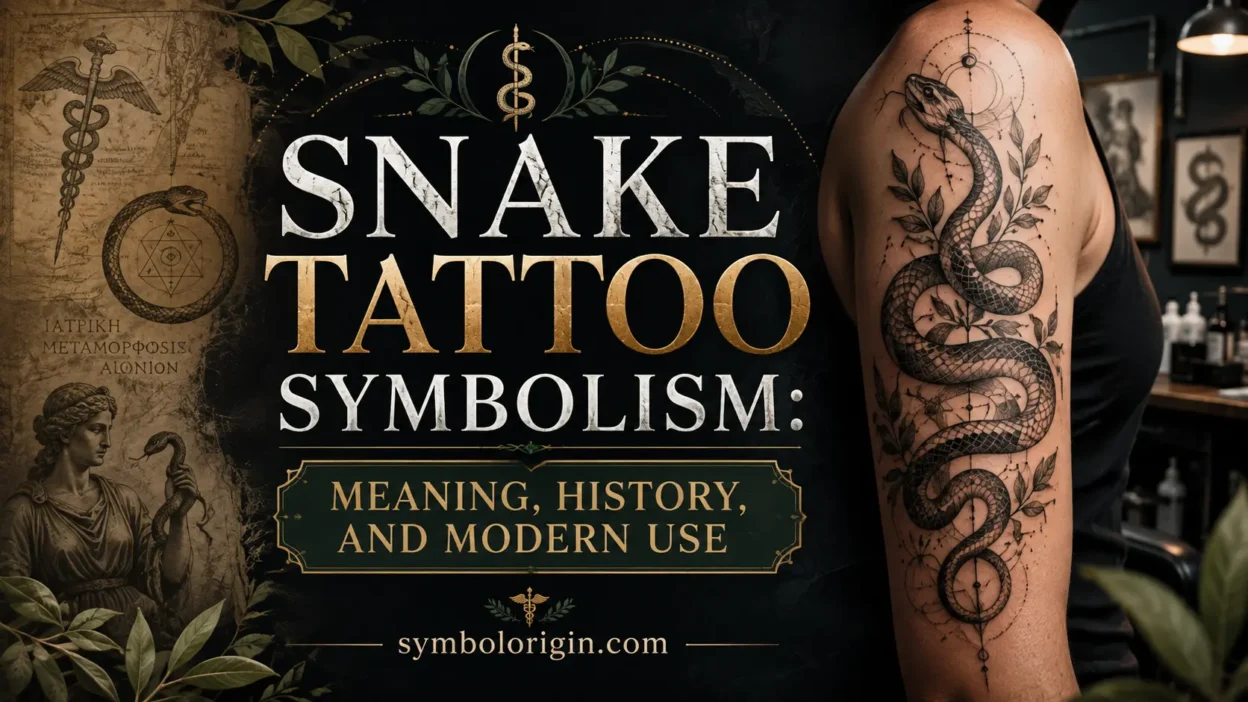
Snake tattoo symbolism can communicate transformation, survival, protection, danger, healing, temptation, or personal strength. Unlike designs with one fixed interpretation, the snake carries several meanings because people have viewed serpents as both threatening animals and creatures capable of renewal.
That contrast helps explain why snake tattoos remain visually and emotionally versatile. A coiled rattlesnake may suggest self-defense, while a snake shedding its skin can represent leaving an old identity behind. A serpent wrapped around a medical staff points toward healing, and an ouroboros—a snake biting its own tail—usually emphasizes cycles, continuity, or renewal.
In the United States, the meaning often depends less on one ancient tradition and more on the wearer’s personal story, tattoo style, accompanying imagery, and the snake’s pose.
Quick Answer
Snake tattoo symbolism most commonly represents transformation, rebirth, resilience, protection, and controlled danger in modern American tattoo culture. Historically, serpents have also been associated with healing, royalty, temptation, wisdom, death, renewal, and repeating cycles in different religious and cultural traditions.
TL;DR
- Snakes often represent transformation because they shed their skin.
- Coiled snakes can communicate readiness, boundaries, and self-protection.
- Ancient serpent imagery included healing, royalty, danger, and renewal.
- Christian imagery often connects serpents with temptation and moral conflict.
- Tattoo pose and surrounding objects can completely change the meaning.
- Modern wearers frequently give snake designs highly personal interpretations.
What Snake Tattoos Commonly Mean in the United States
There is no single American meaning for a snake tattoo. Several interpretations appear repeatedly, however.
| Tattoo Context | Common Meaning in the USA | Typical Associations | Notes |
|---|---|---|---|
| Shedding snake | Transformation | Growth, reinvention, recovery | Often linked with major life changes |
| Coiled snake | Protection | Boundaries, readiness, confidence | Can feel defensive rather than aggressive |
| Striking snake | Danger | Power, warning, survival | Usually creates a more confrontational image |
| Snake with flowers | Duality | Beauty, danger, life, vulnerability | Meaning changes with the flower |
| Snake and medical staff | Healing | Medicine, recovery, health professions | Design details matter historically |
| Ouroboros | Cycles | Renewal, continuity, endings and beginnings | Usually shown biting its own tail |
For many Americans, the snake works particularly well as a personal symbol because it can communicate vulnerability and strength simultaneously. A snake survives close to the ground and often avoids confrontation, yet it can defend itself quickly when threatened.
That makes the animal useful for people who want a tattoo about resilience without choosing a traditional symbol of brute force.
Why Shedding Skin Became a Symbol of Transformation
One of the easiest snake meanings to understand comes from actual snake biology.
Snakes periodically shed the outer layer of their skin as they grow. The animal does not literally become a different creature, but the visual effect of leaving an old covering behind naturally encourages comparisons with renewal.
In tattoo culture, that can represent leaving a difficult period, relationship, addiction, belief system, career, or former identity behind.
The meaning is usually closer to personal transformation than immortality. Someone may choose the image after recognizing that an earlier version of life no longer fits.
The symbolism can also include discomfort. Shedding is not simply a picture of effortless improvement. As a tattoo metaphor, it can suggest that change requires releasing something familiar before moving forward.
Danger, Power, and the Importance of Boundaries
Snakes can also symbolize danger because some species possess venom and many people instinctively treat them with caution.
Tattoo designs often turn that fear into a message about boundaries.
A coiled snake can communicate:
- Do not underestimate me.
- I will defend myself when necessary.
- Respect my space.
- Strength does not require constant aggression.
This distinction matters. A defensive snake is not automatically a symbol of violence.
In American imagery, rattlesnakes are especially effective at communicating warning and resistance because a rattlesnake signals danger before striking. The animal therefore lends itself to ideas about independence, readiness, and refusing unnecessary conflict.
A striking cobra or viper creates a different impression. Open fangs, raised posture, or an attacking pose usually emphasizes danger, intimidation, aggression, or survival more strongly.
Healing and the Serpent’s Medical Meaning
The relationship between snakes and healing is much older than modern tattooing.
In Greek tradition, Asclepius became closely associated with medicine and was represented with a staff around which a single serpent coils. The serpent-entwined staff has remained a medical emblem for more than two millennia.
For someone working in medicine, recovering from illness, or marking a difficult health experience, a serpent can therefore represent healing rather than danger.
There is an important design distinction.
The Rod of Asclepius normally has one snake and no wings. The caduceus, associated historically with Hermes, usually shows two snakes around a winged staff. In the United States, the two have often been confused in medical imagery despite having different classical origins.
That difference matters if historical accuracy is important to the wearer.
A medical snake tattoo can also carry an interesting contradiction: the same animal capable of causing injury became an emblem of healing. That tension contributes to the snake’s broader symbolism of opposing forces existing together.
Temptation, Knowledge, and Christian Associations
For Americans raised around Christian imagery, the serpent can immediately recall the Garden of Eden.
In Genesis, the serpent persuades Eve to eat from the forbidden tree. As a result, later Christian interpretation strongly connected serpent imagery with temptation, deception, sin, and disobedience.
The original Genesis narrative and later theological interpretations should not always be treated as identical, however. Scholars have noted that the serpent in the Genesis story was not initially presented in exactly the same way that later Christian tradition identified it with Satan.
As tattoo imagery, this tradition creates several possibilities.
A snake with an apple may symbolize temptation or forbidden desire. It can also represent curiosity, moral conflict, gaining knowledge at a cost, or choosing personal freedom despite consequences.
Some people use the image critically rather than devotionally. Others use it as a straightforward religious warning about temptation.
Context determines the difference.
Ancient Egyptian Serpents Represented Authority and Protection
Ancient Egyptian serpent imagery provides another meaning very different from the biblical association with temptation.
The upright cobra known as the uraeus appeared prominently in royal imagery. It represented the cobra goddess Wadjet and became closely connected with kingship, authority, and protection. When placed on the ruler’s forehead, the raised cobra appeared prepared to defend the king.
A modern cobra tattoo inspired by Egyptian imagery can therefore suggest sovereignty, vigilance, protection, or personal authority.
That does not mean every cobra tattoo automatically represents ancient Egyptian religion. Contemporary designs frequently borrow the dramatic silhouette without carrying its original cultural meaning.
If a tattoo deliberately uses Egyptian crowns, deities, hieroglyphs, or royal imagery, however, the historical association becomes much more relevant.
The Ouroboros and the Meaning of Endless Cycles
A snake forming a circle and consuming its own tail is generally called an ouroboros.
The image appeared in Egyptian and later Greco-Egyptian traditions and became particularly important in philosophical, magical, and alchemical imagery. Academic treatments describe the tail-eating serpent as an image connected with perpetuity, circularity, and unified or repeating processes.
Modern tattoo meanings often include:
Life and death: Every ending becomes part of another beginning.
Repetition: A person recognizes a cycle that continues until deliberately changed.
Renewal: Destruction and creation are understood as connected processes.
Continuity: Something important survives changing circumstances.
Wholeness: Opposites become parts of one complete system.
Not every ouroboros tattoo means eternity. Someone who has escaped a repeating destructive pattern might use the same image to acknowledge the cycle rather than celebrate it.
Personal context remains essential.
Serpents in Mesoamerican Traditions
Serpent imagery also played major roles in Mesoamerican cultures, although these traditions should not be compressed into one generic “ancient snake meaning.”
The feathered-serpent tradition associated with figures such as Quetzalcoatl developed complex connections with religion, rulership, wind, learning, creation, fertility, and political life across different periods and societies.
That symbolism is much more specific than an ordinary realistic snake tattoo.
A feathered serpent copied from Mesoamerican art may carry cultural and religious associations that a generic cobra, rattlesnake, or python does not. Anyone using historically specific imagery should understand what the design represents rather than treating all Indigenous American serpent traditions as interchangeable.
The safest interpretation is therefore precise: a Mesoamerican feathered serpent belongs to particular cultural traditions, while a modern snake tattoo may simply be a contemporary personal symbol.
The Psychological Appeal of Snake Imagery
Snake tattoos frequently work as identity statements because snakes produce strong reactions.
Some people fear them. Others admire their movement, patience, camouflage, hunting ability, or unusual appearance.
Choosing an animal that others find intimidating can communicate comfort with qualities that society often rejects.
Psychologically, that may translate into themes such as:
- accepting a tougher side of oneself
- refusing to appear harmless for other people’s comfort
- rebuilding confidence after vulnerability
- learning when to retreat and when to defend oneself
- becoming comfortable with change
A snake can also symbolize emotional privacy. Unlike animals commonly associated with packs or social groups, snakes are often imagined as solitary and self-contained.
For that reason, a minimalist serpent may appeal to someone who values independence more than dominance.
How a Snake’s Pose Changes the Meaning
The position of the snake can communicate almost as much as the species.
Coiled Snake
A coiled snake looks prepared without necessarily attacking. It usually suggests alertness, stored power, boundaries, or defense.
Striking Snake
Exposed fangs and forward movement emphasize aggression, danger, retaliation, or the willingness to fight.
Calm, Extended Snake
A relaxed snake can appear elegant rather than threatening. These designs often emphasize adaptability, sensuality, nature, movement, or personal transformation.
Snake Wrapped Around the Body
A serpent winding around an arm, leg, shoulder, or torso takes advantage of the body’s shape. Symbolically, it can suggest protection, something permanently carried, transformation surrounding the wearer, or simply appreciation for the snake’s natural movement.
Circular Snake
A snake forming a complete circle moves the meaning toward cycles, repetition, eternity, or wholeness—especially when it bites its tail.
Design is therefore not merely decorative. Pose creates narrative.
What Snake Tattoos Mean With Flowers, Skulls, and Daggers
Combining a snake with another object often produces a meaning that neither symbol carries alone.
Snake and Rose
A rose introduces beauty, affection, desire, romance, or vulnerability. The combination often expresses attraction mixed with danger or the idea that beautiful experiences can also carry risk.
Snake and Skull
A skull moves the design toward mortality, death, survival, or awareness of life’s limits. The snake may either intensify the danger or introduce renewal beside death.
Snake and Dagger
This combination often feels more confrontational. It may communicate conflict, betrayal, survival, courage, or overcoming an enemy or hardship.
Snake and Moon
The moon can bring cycles, nighttime, intuition, femininity, or natural change into the design. Interpretations depend heavily on the specific lunar phase and artistic style.
Snake and Apple
The biblical association becomes difficult to miss. Temptation, forbidden knowledge, desire, choice, and consequences become the central ideas.
The additional object acts almost like a sentence modifier: it narrows the broad snake image into a more specific message.
Color Can Shift the Emotional Tone
Color does not create a universal tattoo code, but it influences how viewers read the design.
A black snake often feels serious, graphic, dangerous, or restrained.
A red snake can emphasize aggression, passion, warning, blood, or intensity.
A green snake tends to connect more easily with nature, growth, camouflage, forests, or renewal.
A gold snake can suggest luxury, authority, sacred imagery, or royalty depending on the surrounding design.
A brightly colored snake may focus attention on the animal’s natural beauty instead of its threatening reputation.
Species matters as well. A coral snake, python, cobra, rattlesnake, and viper do not create the same emotional impression, even when drawn in similar styles.
Traditional, Realistic, and Minimalist Designs Send Different Signals
American tattoo styles also shape interpretation.
Traditional tattooing often uses strong outlines, simplified forms, exaggerated fangs, and bold movement. A snake in this style can feel defiant, rebellious, or connected with classic tattoo culture.
Realistic designs encourage viewers to focus on the actual animal. Species, scales, posture, and behavior become more important, making the tattoo suitable for someone interested in wildlife or a specific snake.
Minimalist snakes usually remove much of the aggression. A simple curved line or small serpent can communicate change, independence, or elegance without producing the same threatening effect as a large striking cobra.
Ornamental snakes may prioritize symmetry and body placement. Their meaning can remain personal even when their main function is aesthetic.
A tattoo does not require an elaborate historical explanation to be meaningful. Sometimes choosing an animal because its shape works beautifully on the body is reason enough.
Snake Tattoos Can Represent Survival After a Difficult Period
Among modern personal interpretations, survival is one of the most adaptable snake meanings.
The animal can represent someone who learned to protect themselves, adapted to new circumstances, or emerged from a difficult experience with a changed identity.
This interpretation differs slightly from transformation.
Transformation focuses on becoming different.
Survival focuses on remaining present despite what happened.
A person may combine both meanings: the old skin represents what was lost, while the living snake represents the person who continued forward.
Because the image can be defensive without appearing fragile, it often works for people who want to mark hardship without placing the hardship itself at the center of the tattoo.
Are Snake Tattoos Positive or Negative?
They can easily be either—or both.
Positive interpretations include healing, resilience, renewal, wisdom, independence, protection, and adaptability.
Negative interpretations include deception, danger, betrayal, temptation, fear, poison, and aggression.
Yet reducing the snake to “good” or “evil” misses why the image has remained useful.
Its strongest quality is duality.
A snake may heal or harm. It can hide or strike. Its old skin is discarded while the animal continues living. Religious traditions have presented serpents as threats in some contexts and sacred or protective beings in others.
A wearer does not necessarily have to choose one side of that contradiction. The tattoo may deliberately acknowledge both.
Common Misunderstandings and Cultural Considerations
One common mistake is assuming that every snake tattoo has a secret criminal, occult, or sexual meaning.
There is no universal code.
Tattoo meanings vary by individual, community, culture, geography, and design. A snake may commemorate recovery for one person and represent nothing more complicated than admiration for reptiles for another.
Another mistake is treating ancient traditions as interchangeable. Egyptian cobra imagery, Greek medical serpents, biblical snakes, and Mesoamerican feathered serpents developed within different religious and cultural systems.
Borrowing a general snake shape is not the same as reproducing a sacred or culturally specific design.
This distinction becomes especially important when a tattoo incorporates identifiable Indigenous religious imagery, sacred objects, deity representations, or ceremonial patterns.
Understanding what an image originally meant allows the wearer to make a more informed choice.
How Snake Meaning Has Changed in Modern Tattoo Culture
Historically, serpent meanings were often tied closely to religion, mythology, medicine, rulership, or specific cultural stories.
Modern tattooing allows those traditions to coexist with individual meanings.
Tattoos themselves have been used across societies for thousands of years for decoration, identity, social position, spirituality, protection, punishment, and belonging. Contemporary American tattoo culture gives individuals even more freedom to combine inherited symbolism with personal experience.
A modern wearer might choose a snake after a breakup without thinking about ancient Egypt.
A physician might deliberately choose the serpent of Asclepius.
Someone else may get an ouroboros after recognizing repeating patterns in their life.
Another person may simply love rattlesnakes.
The image has therefore moved from culturally defined symbolism toward a mixture of historical reference, artistic style, and individual storytelling.
FAQs
What does a snake tattoo usually symbolize?
A snake tattoo most often represents transformation, resilience, protection, danger, or rebirth. The exact interpretation depends on the snake’s species, pose, surrounding imagery, and the wearer’s personal reason for choosing it.
What does a snake tattoo mean spiritually?
Spiritual interpretations vary considerably by tradition. Serpents have been connected with healing, renewal, sacred authority, temptation, mortality, and cyclical existence, so the specific religious or cultural context should always be identified.
Does a snake tattoo mean rebirth?
It can. The association comes largely from the snake’s ability to shed its outer skin, which makes it an intuitive metaphor for leaving an old stage of life and entering a new one.
What does a snake and rose tattoo mean?
A snake and rose often combines danger with beauty, attraction with risk, or vulnerability with self-protection. Individual interpretations may also involve love, passion, heartbreak, or learning from a difficult relationship.
Are snake tattoos associated with evil?
Some Christian and Western imagery links serpents with temptation, deception, and evil, but that is not a universal interpretation. Other traditions have associated serpent imagery with protection, medicine, authority, renewal, or sacred knowledge.
What does a coiled snake tattoo symbolize?
A coiled snake generally represents readiness, vigilance, boundaries, or defensive strength. Because the animal has not yet struck, it can communicate controlled power rather than uncontrolled aggression.
What does an ouroboros snake tattoo mean?
An ouroboros usually represents cycles, continuity, renewal, or the connection between endings and beginnings. Some people also use it to acknowledge repeating personal patterns they have experienced or overcome.
Conclusion
The enduring appeal of snake tattoo symbolism comes from the animal’s ability to hold opposite meanings at once. A snake can represent healing or danger, transformation or mortality, temptation or knowledge, quiet self-control or sudden defensive power.
Historical traditions add additional layers, but modern American tattoo culture gives the wearer considerable freedom to decide which of those layers matters. Species, pose, color, artistic style, and accompanying imagery can turn the same basic animal into a statement about recovery, boundaries, identity, faith, survival, or change.
The most meaningful interpretation is therefore not simply “What do snakes mean?” but “Why was this particular snake chosen, and what story is its design meant to carry?”