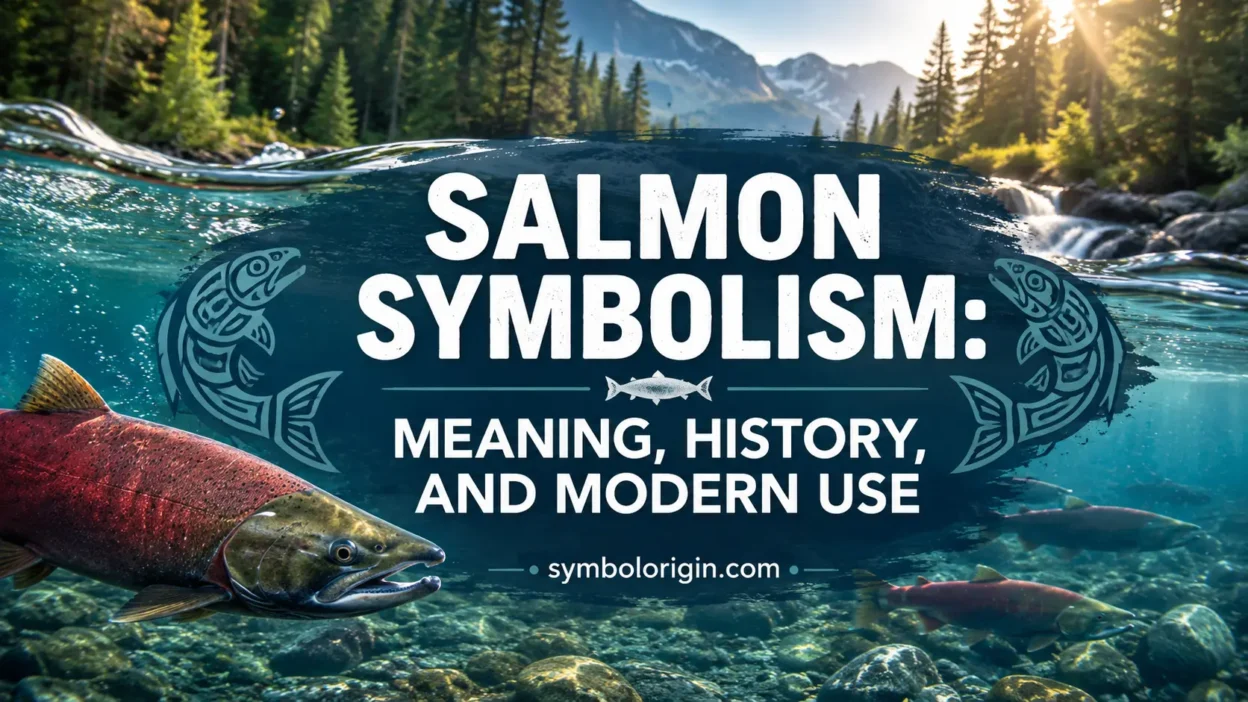
Salmon symbolism commonly centers on perseverance, return, renewal, abundance, and a strong connection to home. These meanings grow naturally from the fish itself: salmon travel between freshwater and the ocean, undertake demanding migrations, and in many species return to the waters where their lives began.
In the United States, the salmon carries an additional layer of meaning. It is closely tied to the Pacific Northwest and Alaska, where it represents regional identity, healthy rivers, food, livelihood, and environmental responsibility. For many Indigenous nations of the Pacific Northwest, however, salmon is far more than a general nature symbol. It is connected to specific cultural traditions, ceremonies, histories, identities, and relationships with the land and water.
Outside North America, salmon appears prominently in Irish tradition, where the famous Salmon of Knowledge connects the fish with wisdom. These different traditions explain why a salmon image can suggest everything from determination and homecoming to knowledge, responsibility, and continuity.
Quick Answer
Salmon symbolism commonly represents perseverance, returning home, renewal, abundance, and determination in modern American culture. Historically, salmon has also carried major cultural importance among specific Indigenous peoples of the Pacific Northwest and has represented wisdom in Irish mythology.
TL;DR
- Salmon often represents perseverance and overcoming difficult journeys.
- Returning upstream gives it strong associations with homecoming.
- Pacific Northwest traditions connect salmon with food, community, and responsibility.
- Irish folklore links salmon with knowledge and wisdom.
- Modern conservation gives salmon a meaning of ecological recovery.
- Tattoos often emphasize resilience, roots, movement, or personal transformation.
What the Salmon’s Life Cycle Adds to Its Meaning
Much of the symbolism surrounding salmon begins with its unusual life cycle. Many salmon hatch in freshwater, migrate toward the ocean as they mature, spend part of their lives at sea, and later return to freshwater to reproduce. Salmon can travel great distances, and returning adults often find their way toward their natal waters using environmental cues that include smell.
This journey makes the salmon particularly suited to meanings involving return, persistence, orientation, and belonging.
The fish does not simply drift with the water. During its spawning migration, it may move against strong currents and pass physical obstacles. That familiar image of a salmon swimming upstream has become an especially effective metaphor for continuing toward a goal when the easier path runs in the opposite direction.
Many Pacific salmon also undergo dramatic physical changes during spawning and die after reproducing. Their bodies then contribute nutrients to rivers and surrounding ecosystems.
That biological cycle helps explain modern associations with completion, sacrifice, renewal, and one generation supporting the next.
What Salmon Commonly Means in the United States
For many Americans, especially in western states, salmon is first associated with determination and resilience.
The idea comes from the upstream migration. A person compared with a salmon may be someone willing to work against resistance rather than simply follow the crowd.
Salmon can also represent home and origins. Because returning fish move toward the waters connected with their birth, the salmon can suggest coming back to family, community, homeland, or an earlier sense of identity.
Its major modern meanings can be summarized this way:
| Context | Common Meaning in the USA | Association |
|---|---|---|
| Upstream migration | Perseverance | Working through resistance |
| Return to spawning waters | Homecoming | Roots, family, belonging |
| Reproduction and life cycle | Renewal | Continuity between generations |
| Food and fishing | Abundance | Provision, livelihood, community |
| River restoration | Recovery | Healthy ecosystems and conservation |
| Personal imagery | Independence | Choosing a difficult individual path |
These meanings overlap, but they are not identical. A salmon tattoo chosen for persistence, for example, does not necessarily carry the same cultural meaning as salmon represented within an Indigenous ceremonial tradition.
Why Salmon Represents Perseverance
Few behaviors associated with salmon are as visually memorable as swimming upstream.
The fish may face strong water, changes in river flow, predators, natural barriers, and human-built obstacles as it moves toward spawning habitat. That journey has made salmon an intuitive symbol for continuing despite resistance.
In everyday American interpretation, this meaning can apply to education, business, athletic training, recovery after failure, or any long-term goal that requires effort without an immediate reward.
It can also represent independence. Someone who feels unwilling to follow social expectations might identify with the salmon because the fish appears to move against the direction everything else is flowing.
That reading is largely metaphorical. Salmon are not deliberately rebelling against a group. Their migration is biological behavior. Still, symbolic meaning often develops by translating visible animal behavior into human experience.
Returning Home, Roots, and Belonging
The salmon’s return migration creates another important meaning: homecoming.
Adult salmon often return toward the freshwater systems associated with their earlier life stages. This biological homing behavior is well documented and is one reason salmon imagery works so well as a symbol of origins.
For people, “home” does not always mean a physical house. A salmon can therefore symbolize returning to a hometown, reconnecting with relatives, rediscovering a cultural heritage, or recovering personal values after a period of change.
This interpretation can be especially meaningful for someone who has lived far from where they grew up.
The salmon does not represent staying in one place. Its life involves leaving and returning. That makes it a more complex symbol of belonging: identity can survive distance, movement, and transformation.
Renewal, Continuity, and the Next Generation
Salmon also carries associations with continuity between generations.
For many Pacific salmon, the spawning journey is the final stage of life. Adults reproduce, die, and contribute nutrients that become part of river and forest food webs. Marine-derived nutrients carried inland by spawning salmon can influence freshwater and terrestrial ecosystems.
Symbolically, this creates a different form of renewal than the familiar image of something dying and literally returning unchanged.
The salmon suggests that one generation can create conditions for another.
That makes the fish appropriate for themes involving ancestry, parenting, inheritance, teaching, and leaving something useful behind.
It can also symbolize completion. Reaching the destination matters because the journey serves something larger than the individual fish.
Salmon in Pacific Northwest Indigenous Traditions
Salmon holds exceptional cultural importance for numerous Indigenous nations of the Pacific Northwest, but there is no single universal “Native American salmon meaning.”
Different nations have distinct languages, ceremonies, stories, fishing traditions, artistic practices, and teachings.
Among Native communities in the Pacific Northwest, salmon has long been connected with food, trade, spiritual responsibility, community identity, and relationships with waterways. Some peoples describe themselves as Salmon People, emphasizing how closely salmon, culture, and survival are connected.
First Salmon ceremonies remain especially important in a number of communities. Such ceremonies can express gratitude and respect for returning salmon while recognizing the responsibilities people have toward the fish and their environment.
Within Columbia River traditions, salmon is also included among First Foods, connecting it with an ordered relationship among water, animals, plants, people, and the land.
These traditions should not be reduced to generic phrases such as “salmon means spirituality.” The more accurate idea is relationship: salmon can connect community identity, food systems, ceremony, responsibility, ancestry, and place.
Salmon, Treaty Rights, and American History
In the United States, salmon also carries political and historical meaning because access to salmon fisheries became central to major disputes over Indigenous treaty rights.
During the twentieth century, Native fishers in the Pacific Northwest challenged restrictions that interfered with treaty-protected fishing. Activism associated with the region’s “Fish Wars” helped bring national attention to those rights. Later court decisions affirmed major treaty fishing protections and strengthened tribal participation in fisheries management.
Because of this history, salmon may represent more than conservation.
In some settings it can also stand for sovereignty, treaty obligations, cultural survival, and the right of communities to continue traditional practices.
That history remains relevant because protecting fishing rights has little practical meaning if salmon populations and habitats disappear.
The symbol therefore links legal rights with ecological conditions in a way few American wildlife symbols do.
Abundance, Food, and Community
Salmon has supported human communities as food for thousands of years, making abundance and provision another natural symbolic association.
Historically, major salmon runs supported communities along rivers and coastal areas, particularly across the North Pacific. In the Columbia River system, salmon also played an important role in gathering and trade.
This meaning differs from luxury symbolism.
Salmon generally represents abundance because of seasonal return, nourishment, shared harvest, and dependence on healthy waterways rather than because the fish is inherently associated with wealth.
In a household or community setting, the symbolism can therefore suggest:
- having enough to share,
- benefiting from seasonal cycles,
- receiving from the natural world,
- and accepting responsibility for maintaining what provides for you.
The last point matters. Traditional relationships with salmon often involve reciprocity rather than unlimited consumption.
Salmon as a Modern Conservation Symbol
In the American West, salmon has become one of the clearest symbols of river health and ecological restoration.
Salmon depend on connected habitats extending from freshwater spawning areas through rivers and estuaries to the ocean. Dams, blocked passages, degraded water quality, habitat loss, and changing environmental conditions can interfere with different stages of that journey.
As a result, restoring salmon often means restoring an entire connected landscape.
The Elwha River in Washington provides a well-known example. Removal of two dams reopened more than 70 miles of habitat, and salmon began moving into areas that had been inaccessible for generations.
Large-scale dam removal on the Klamath River has created another prominent modern example of reconnecting salmon habitat.
These projects have strengthened a newer interpretation of salmon: ecological recovery is possible when damaged connections are restored.
This does not make salmon merely an environmental logo. For tribal nations connected with these rivers, ecological restoration can also be cultural restoration.
Wisdom and the Salmon of Knowledge in Irish Tradition
A very different salmon meaning appears in Irish mythology.
In the story commonly known as the Salmon of Knowledge, a special salmon acquires extraordinary knowledge. The young Fionn, who later becomes one of the great figures of Irish legendary tradition, unexpectedly receives its wisdom.
Because of this story, salmon in an Irish or Celtic-inspired context may symbolize:
wisdom, learning, inspiration, insight, and knowledge gained through experience.
This association should not automatically be applied to every salmon image. A salmon on a Pacific Northwest conservation poster and a salmon used in an Irish-inspired design come from very different cultural backgrounds.
Context determines which meaning makes sense.
Emotional and Psychological Meaning
On a personal level, salmon tends to communicate determination without aggression.
A bear, lion, or wolf often suggests strength through physical dominance. Salmon represents strength differently. Its symbolic force comes from endurance, direction, and persistence.
That can make the fish especially appealing to people whose identity is built around continuing rather than conquering.
Emotionally, salmon imagery can suggest:
- confidence in one’s direction,
- attachment to home,
- acceptance of difficult change,
- persistence after setbacks,
- responsibility to family,
- or willingness to take an unconventional route.
It can also carry a bittersweet quality. The spawning journey combines return with an ending, making salmon suitable for reflections on aging, legacy, parenthood, or finishing an important chapter of life.
What a Salmon Tattoo Can Represent
A salmon tattoo often emphasizes resilience, homecoming, individuality, or personal roots.
Someone who has overcome a difficult period may choose an upstream-swimming salmon to represent persistence. A person living far from their birthplace might use the fish as a reminder of home. Others may connect it with fishing, Alaska, Washington, Oregon, family traditions, or life spent near a particular river.
Irish-inspired designs sometimes use salmon to represent knowledge because of the Salmon of Knowledge tradition.
Cultural context matters when borrowing Indigenous visual styles. Traditional Northwest Coast art is not simply a collection of decorative animal shapes. Designs may be connected with particular artists, communities, stories, families, and cultural practices. Contemporary Native artists continue to represent salmon through both traditional and newer media.
A general naturalistic salmon tattoo is different from copying culturally specific imagery without understanding where it comes from.
Salmon in Art, Design, and Regional Identity
Across the Pacific Northwest, salmon functions almost like a regional emblem.
Its shape appears in public art, environmental programs, educational materials, restaurants, fishing culture, outdoor brands, and community design. The fish immediately connects viewers with rivers, forests, coastal landscapes, and the wider North Pacific environment.
Native artists also continue to represent salmon in contemporary works, showing that salmon imagery is not merely a survival from the distant past. It remains part of living cultural expression.
For non-Native regional audiences, the fish often represents wilderness, local food, recreational fishing, or environmental stewardship.
These interpretations can coexist, but they should not be treated as interchangeable. The same animal may function as a regional nature icon in one setting and carry specific cultural responsibilities in another.
Common Misunderstandings About Salmon Meaning
One common mistake is claiming that salmon has one fixed spiritual meaning everywhere.
It does not.
Irish folklore, Pacific Northwest Indigenous traditions, contemporary tattoo culture, environmental activism, and ordinary fishing culture use salmon in different ways.
Another misunderstanding is that every upstream-swimming salmon represents rebellion. Persistence is usually the clearer interpretation. Salmon migrate because of their biological life cycle, not because they are symbolically refusing conformity.
It is also misleading to describe all Indigenous salmon traditions as one belief system. Native nations are culturally distinct, and their relationships with salmon should be discussed specifically whenever possible.
Finally, conservation imagery can sometimes make salmon seem like a symbol belonging only to environmental organizations. In many Pacific Northwest communities, the fish is simultaneously ecological, economic, political, familial, and cultural.
How the Meaning of Salmon Has Changed
The salmon’s meaning has expanded rather than simply been replaced.
Long before modern conservation campaigns, salmon already mattered because people depended on annual fish runs for food, trade, ceremony, and community life. Indigenous peoples of the Pacific Northwest developed detailed cultural relationships with salmon and their habitats over generations.
Later American settlement, commercial fishing, river development, dams, legal conflicts, and declining salmon runs changed the cultural context.
The fish increasingly became associated not only with abundance but also with what could be lost.
Today, salmon often represents restoration, responsibility, and reconnection alongside older meanings of food, return, and continuity. Modern river-restoration projects make the fish a visible measure of whether damaged ecosystems can function again.
That evolution explains why salmon can now represent both natural abundance and environmental vulnerability.
FAQs
Is salmon a symbol of good luck?
Salmon is not a universal good-luck symbol in American culture. It is more commonly associated with perseverance, abundance, successful return, and renewal, although those ideas can give it a positive or fortunate meaning in personal symbolism.
What does a salmon swimming upstream symbolize?
A salmon swimming upstream usually represents persistence, determination, and continuing toward a goal despite resistance. It can also suggest independence or choosing a difficult path rather than taking the easiest one.
What does salmon symbolize spiritually?
There is no single spiritual meaning shared across cultures. Specific Pacific Northwest Indigenous traditions connect salmon with relationships among people, food, ceremony, land, water, and responsibility, while Irish mythology famously associates salmon with wisdom.
What does a salmon tattoo mean?
A salmon tattoo often represents resilience, returning to one’s roots, personal transformation, or commitment to a difficult journey. Its meaning may also reflect regional identity, fishing heritage, Irish folklore, or a personal connection with rivers and the ocean.
Why is salmon important in Pacific Northwest culture?
Salmon has supported food systems, trade, community life, ceremony, and identity across the region for generations. For numerous Indigenous nations, salmon remains connected with living cultural traditions as well as contemporary efforts to protect waterways and treaty rights.
Does salmon symbolize wisdom?
It can, especially in an Irish cultural context. The association comes from the traditional Salmon of Knowledge story, in which the fish is connected with extraordinary knowledge and the legendary figure Fionn.
Conclusion
Salmon symbolism brings together several ideas that fit the fish’s actual life: persistence through difficulty, returning to familiar waters, continuity between generations, and dependence on healthy rivers. In modern American culture, those meanings have expanded to include regional identity and environmental recovery.
The salmon also carries meanings that belong to particular traditions rather than to symbolism in general. Pacific Northwest Indigenous relationships with salmon involve distinct histories, ceremonies, rights, communities, and responsibilities, while Irish tradition gives the fish a separate association with wisdom.
What makes the salmon especially recognizable as a symbol is its journey. It leaves, travels far, faces resistance, and returns to the waters connected with its beginning—a pattern that gives the fish lasting meaning wherever people use it to think about home, endurance, responsibility, and renewal.