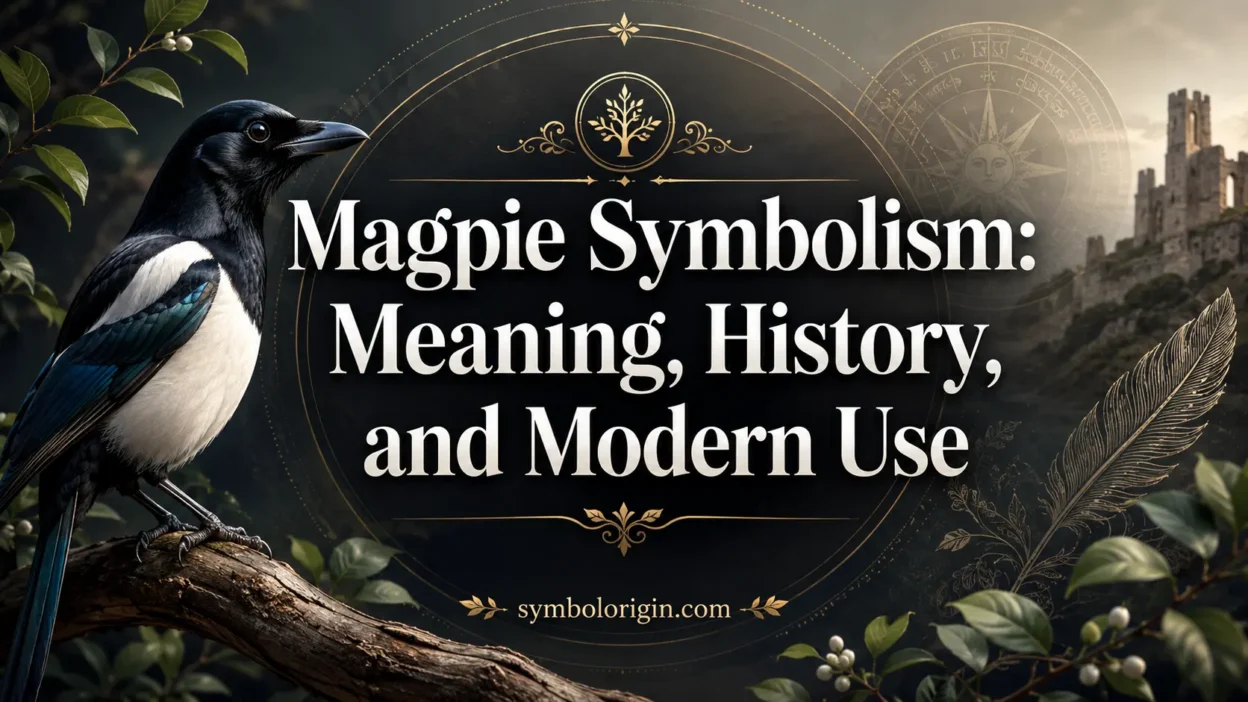
Magpie symbolism often centers on intelligence, curiosity, communication, adaptability, and the tension between good and bad fortune. The bird’s bold black-and-white appearance, loud voice, social behavior, and reputation for collecting unusual objects have made it a memorable figure in folklore, art, and everyday language.
In the United States, magpies are most familiar as living birds of the West rather than as universal omens. People may see them perched on fence posts, moving through ranchland, visiting towns, or calling loudly from open country. Their behavior encourages modern associations with awareness, confidence, resourcefulness, and an ability to thrive near people.
Their cultural meaning is not fixed, however. British folklore often treats the number of magpies seen as a sign of coming sorrow or happiness, while Chinese and Korean traditions more commonly connect the bird with joy, good news, marriage, and good fortune. These contrasting traditions explain why a magpie may appear cheerful in one artwork and unsettling in another.
Quick Answer
Magpie symbolism commonly represents intelligence, curiosity, communication, and adaptability in modern American culture. Historically, magpies have also represented omens, sorrow, joy, good news, marriage, fortune, and social commentary in European and East Asian traditions.
TL;DR
- Magpies commonly represent intelligence, curiosity, and adaptability.
- American meanings emphasize boldness, awareness, and Western landscapes.
- European folklore connects magpie numbers with changing fortune.
- Chinese art often presents magpies as messengers of joy.
- Korean traditions associate them with good news and protection.
- The shiny-object stereotype is greatly exaggerated.
What a Magpie Looks Like
True magpies belong to the corvid family, which also includes crows, ravens, and jays. Most people picture a long-tailed black-and-white bird with glossy feathers that can appear blue, green, or purple when light strikes them.
North America has two especially recognizable species. The black-billed magpie lives across much of western North America, where it inhabits grasslands, sagebrush country, open woodlands, ranches, and towns. The yellow-billed magpie has a bright yellow bill and lives only in California, particularly in oak woodlands, valleys, and foothill habitats.
Their physical contrast contributes directly to their symbolic appeal. The clean division between dark and light suggests opposition: sorrow and joy, caution and confidence, secrecy and openness. Their iridescent feathers complicate that contrast because what looks black from a distance can reveal unexpected color up close.
This makes the magpie an effective symbol of appearances that are more complicated than they first seem.
Core Meanings at a Glance
| Context | Meaning in the USA | Common Associations | Notes |
|---|---|---|---|
| Nature and wildlife | Intelligence and adaptability | Awareness, survival, resourcefulness | Especially relevant in the American West |
| Personal symbolism | Curiosity and individuality | Confidence, observation, self-expression | Common in tattoos and jewelry |
| European folklore | Changing fortune | Sorrow, joy, omens, counting rhymes | Meaning may depend on the number seen |
| Chinese tradition | Happiness and good news | Marriage, celebration, joyful messages | Pairs often strengthen the positive meaning |
| Korean tradition | Good news and social voice | Protection, prosperity, humor, commentary | Often paired with a tiger |
| Modern language | Talkativeness or collecting | Chatter, eclectic taste, gathering objects | Can be playful or mildly critical |
What Magpies Commonly Mean in the United States
There is no single nationwide American belief that seeing a magpie guarantees either luck or misfortune. The bird’s meaning is shaped more by regional experience, imported folklore, personal spirituality, art, and wildlife observation.
In western states, a magpie may represent familiarity with open country. Its image can evoke ranch fences, mountain valleys, roadside cottonwoods, sagebrush, and changing seasons. Someone choosing a magpie design may therefore be expressing attachment to a place rather than belief in an omen.
The bird can also represent a person who is alert and difficult to deceive. Magpies are conspicuous, vocal, and quick to respond to changes around them. Symbolically, that translates into watchfulness, mental agility, and an ability to notice opportunities others miss.
For some Americans, the bird has a rebellious quality. It does not appear delicate or quiet. It takes up space, announces itself, and adapts to human-altered environments. That makes it an appealing emblem for someone who values independence, social confidence, or unconventional beauty.
Intelligence, Curiosity, and Problem-Solving
Magpies are members of a bird family widely studied for complex learning, memory, flexible behavior, and social intelligence. These abilities have helped make the bird a symbol of an active, questioning mind rather than passive wisdom.
Unlike an owl, which often represents quiet knowledge, the magpie suggests intelligence in motion. It investigates, remembers, calls to others, watches human activity, and adjusts its behavior to changing surroundings.
As a personal symbol, it can represent:
- Learning through direct experience
- Looking beyond first impressions
- Finding unconventional solutions
- Remembering useful details
- Adapting quickly to unfamiliar conditions
- Combining ideas from different sources
The bird’s intelligence can carry a warning as well. Cleverness without restraint may become manipulation, distraction, or opportunism. A magpie symbol can therefore ask whether intelligence is being used carefully or merely to obtain immediate advantage.
Communication and the Need to Be Heard
Magpies are highly vocal birds. Black-billed magpies use harsh calls and rapid, raspy chatter, while groups may become especially noisy when responding to danger or social activity.
That behavior has made the bird a natural symbol of speech, storytelling, gossip, warnings, and public presence. Even the English word magpie can describe a person who chatters or collects a miscellaneous assortment of things.
In a positive sense, the magpie represents speaking clearly and refusing to remain invisible. It can suit writers, performers, journalists, teachers, organizers, and anyone whose identity depends on exchanging information.
Its negative side is excessive noise. The bird may symbolize talking without listening, repeating rumors, revealing secrets, or filling silence simply to attract attention.
The distinction depends on purpose. Is the voice warning the community, sharing useful knowledge, or merely demanding notice? That question gives the symbol more psychological depth than a simple association with talkativeness.
The Meaning of Black, White, and Iridescent Feathers
The magpie’s coloring creates an immediate visual duality. Black and white can suggest clear opposites: truth and deception, grief and celebration, restraint and display, certainty and ambiguity.
Yet its dark feathers are not entirely black. In sunlight, they may reveal blue-green or purple iridescence. Symbolically, this supports the idea that identity changes with perspective. Something that initially appears plain, severe, or one-dimensional may contain color that becomes visible only under the right conditions.
A black-and-white magpie design can therefore communicate:
- Balance between opposing qualities
- Acceptance of personal contradictions
- The difference between appearance and reality
- Clarity gained through close observation
- Beauty that does not depend on softness
- Movement between serious and playful moods
This interpretation is especially common in contemporary art and personal design, where visual contrast may matter more than traditional superstition.
European Folklore and the Counting of Magpies
British and Irish folklore gave the magpie one of its best-known Western associations: a person could supposedly predict fortune by counting how many birds appeared.
The familiar “one for sorrow, two for joy” tradition has existed in changing forms since at least the late eighteenth century. Different regions added weddings, births, silver, gold, wishes, secrets, and other outcomes to later lines.
A single bird often carried the most uneasy meaning. Customs developed around greeting, saluting, or speaking respectfully to a lone magpie to neutralize possible bad luck. These actions belong to folk practice, not evidence that the bird controls future events.
The symbolism probably endured because magpies are conspicuous and socially noticeable. Seeing one alone feels different from seeing a noisy pair or group. Folklore turned that ordinary observation into a system of prediction.
In modern American culture, the rhyme is usually encountered through books, television, music, family traditions, or people with British and Irish cultural connections. It is better understood as inherited folklore than as a standard American belief.
Christian Folklore Versus Religious Teaching
European stories sometimes portrayed the magpie as vain, worldly, dishonest, or spiritually suspect. Medieval bestiary traditions could use its behavior to illustrate human folly, while later folk tales claimed that it failed to show proper sorrow during biblical events.
These stories should not be confused with formal Christian doctrine. The Bible does not assign the magpie a central symbolic role, and interpretations vary widely by period and community.
When the bird appears in Christian-inspired art today, it may represent temptation, restless speech, attachment to possessions, or the moral difficulty of judging by appearances. It may also be used more neutrally as part of creation, wildlife, or seasonal imagery.
The most accurate approach is to describe negative religious associations as regional folklore rather than universal Christian meaning.
Chinese Associations With Happiness and Marriage
Chinese symbolism offers a striking contrast to the darker European reputation. In Chinese decorative art, magpies commonly function as messengers of joy, happiness, celebration, and favorable news.
Pairs of magpies can suggest married happiness or mutual affection. When combined with flowering branches, especially plum blossoms, their placement may create visual wordplay connected with happiness and celebration. Museum interpretations of historic Chinese prints describe magpies as bringers or messengers of joy, often shown in pairs.
The bird also appears in the Qixi story of the Cowherd and Weaver Girl. In popular versions, magpies form a bridge that allows the separated lovers to reunite. This gives the bird associations with reunion, devotion, and overcoming distance.
For Chinese American families or artists, a magpie image may therefore carry a distinctly auspicious message. Context matters: a paired composition among blossoms will likely communicate something very different from a solitary bird in a dark Gothic design.
Korean Meaning: Good News, Protection, and Social Commentary
In Korean culture, the magpie has traditionally been associated with welcome news and good fortune. It appears prominently in folk paintings beside a tiger, creating one of Korea’s most recognizable animal pairings.
In these compositions, the tiger may represent mountain power, protection, authority, or an important official. The magpie may act as a messenger, an envoy of protective deities, or the voice of ordinary people. Some paintings are respectful and auspicious; others use humor to make the tiger look foolish while the magpie speaks boldly from a branch.
The pairing can therefore communicate several ideas at once:
- Good news arriving
- Protection of the household
- Prosperity in the coming year
- Humor directed at authority
- The voice of common people
- Balance between power and cleverness
The motif received renewed international attention through the 2025 animated musical KPop Demon Hunters, which introduced a stylized tiger-and-magpie duo to a large American audience. That modern use reflects an older Korean artistic tradition rather than a newly invented pairing.
Indigenous North American Context Requires Specificity
It is inaccurate to claim that the magpie has one universal “Native American meaning.” Indigenous nations have distinct languages, ceremonial systems, histories, and relationships with local birds.
In at least some Plains traditions, magpies have held ceremonial importance. The Arapaho Language Project, for example, describes the magpie as especially important in ceremonial use, ranking close behind the eagle among birds.
That example should not be generalized to every nation. A symbol may represent protection, assistance, bravery, ceremonial authority, or something else depending on the community and the specific story.
Modern articles sometimes combine unrelated Indigenous traditions into a single vague claim about “spirit messengers.” That approach removes cultural context. Anyone using a particular tribal design, story, or ceremonial interpretation should consult material produced by that nation or its recognized cultural authorities.
Emotional and Psychological Meaning
Psychologically, the magpie often represents a mind that scans, gathers, and connects. It suits people who are attentive to fragments: words, memories, visual details, useful objects, or ideas that others overlook.
This can be a strength. Collectors, designers, researchers, and writers often build new work by bringing separate pieces together. A “magpie mind” can describe creative synthesis rather than theft.
The same tendency may become emotionally exhausting. Constant scanning can turn into distraction. Gathering can become clutter. Alertness can become anxiety, and curiosity can cross into intrusion.
The bird may therefore symbolize the need to choose carefully:
- Which information deserves attention?
- Which possessions have genuine value?
- Which stories should remain private?
- Which opportunities are worth pursuing?
- When does curiosity become avoidance?
For someone in a period of change, the magpie can represent learning to distinguish useful possibilities from attractive distractions.
Magpies in Tattoos and Personal Style
A magpie tattoo rarely has only one meaning. Its interpretation depends on the bird’s number, posture, surroundings, color palette, and the wearer’s cultural background.
A single magpie may represent independence, grief, survival, or deliberately confronting the “one for sorrow” superstition. Two birds can suggest partnership, friendship, joy, or married happiness. A flying magpie may symbolize movement and freedom, while a perched bird can communicate vigilance and patience.
Common companion elements alter the message:
- Plum blossoms: joy, resilience, or East Asian cultural symbolism
- Tiger: Korean heritage, protection, humor, or resistance to authority
- Moon: intuition, solitude, or changing emotional states
- Keys: secrets, discovery, or access to hidden knowledge
- Jewels: attraction, collecting, beauty, or material temptation
- Wildflowers: independence and connection to place
- Skull imagery: mortality, omens, or Gothic aesthetics
People should avoid copying sacred, ceremonial, or culturally specific imagery without understanding its origin. Appreciation is strongest when the chosen design retains its context.
Jewelry, Decor, Fashion, and Digital Culture
In jewelry, a magpie can be an elegant symbol of curiosity and uncommon taste. Black enamel, silver, iridescent stones, and contrasting materials naturally echo the bird’s plumage.
Home decor often uses the bird in one of three ways. Rustic American designs connect it with western wildlife. Botanical prints draw from European natural history and folklore. East Asian-inspired works may emphasize paired birds, blossoms, joyful messages, or the tiger-and-magpie motif.
Fashion frequently treats the magpie as an emblem of eclectic collecting. A “magpie style” mixes eras, textures, found objects, vintage jewelry, or unexpected references. The term can be complimentary when it describes imaginative combination, but critical when it implies careless borrowing.
On social media, magpies appear in wildlife photography, tattoo imagery, folklore videos, dark-academic aesthetics, and posts about signs or synchronicity. Such content often blends cultural traditions without distinguishing their origins. Viewers should separate personal interpretation from documented historical meaning.
The Myth That Magpies Steal Shiny Objects
One of the bird’s strongest stereotypes is that it cannot resist jewelry, coins, foil, or other glittering objects. The image has influenced language, opera, fiction, and the idea of a person who collects attractive things indiscriminately.
Actual behavior is less dramatic. Experimental research found no evidence that Eurasian magpies were naturally drawn to shiny objects; unfamiliar items often made them cautious instead.
Magpies are opportunistic and curious, so an individual bird may investigate or move an unusual item. That is different from a species-wide compulsion to steal anything that sparkles.
Symbolically, the myth remains useful because it describes recognizable human behavior: attraction to novelty, collecting without purpose, or mistaking surface shine for lasting value. The metaphor survives even though the biological claim has been exaggerated.
Positive and Negative Interpretations
The magpie’s meaning is unusually balanced between admiration and suspicion.
Positive interpretations include intelligence, courage, communication, good news, partnership, adaptability, creativity, observation, and resourcefulness. These meanings grow from the bird’s actual behavior and from auspicious East Asian traditions.
Negative interpretations include gossip, theft, vanity, restlessness, opportunism, bad luck, intrusion, and excessive attachment to possessions. Many of these come from European folklore, literary stereotypes, and human frustration with noisy or visible corvids.
Neither side is complete by itself. The bird is not inherently lucky, unlucky, honest, or deceptive. Symbolism turns its noticeable traits into human lessons.
The most balanced reading is that the magpie represents intelligence that requires direction. Curiosity can lead to discovery or distraction. Speech can warn or wound. Collecting can preserve beauty or create clutter.
How the Meaning Has Changed
Early symbolic meanings developed from direct encounters with a bold, vocal bird that lived close to farms, settlements, and human food sources. Because magpies were easy to notice, people turned their appearance and numbers into stories about luck, morality, news, and social behavior.
European traditions gradually emphasized suspicion and uncertain fortune. Chinese and Korean traditions placed greater weight on happiness, welcome messages, marriage, protection, and prosperity.
In the United States, these traditions now overlap. Wildlife knowledge contributes ideas of intelligence and adaptation. Immigration and cultural exchange bring East Asian meanings into American art and family traditions. British folklore continues through nursery rhymes, books, and popular entertainment.
Environmental awareness has added another layer. The yellow-billed magpie, found only in California, has suffered a major long-term population decline, making it increasingly relevant as a symbol of regional wildlife and conservation responsibility.
The modern magpie is therefore less a fixed omen than a flexible symbol shaped by place, heritage, and personal experience.
FAQs
Is seeing a magpie good luck or bad luck?
It depends on the cultural tradition. British folklore may treat a lone magpie as unlucky, while Chinese and Korean traditions generally connect magpies with happiness, good news, and favorable fortune.
What does a magpie tattoo symbolize?
A magpie tattoo commonly represents intelligence, curiosity, independence, communication, or adaptability. Its meaning changes with the number of birds and accompanying elements such as blossoms, tigers, keys, moons, or jewels.
What do two magpies mean?
Two magpies are often associated with joy, partnership, friendship, or romantic harmony. In Chinese-inspired art, paired magpies may communicate married happiness or welcome news.
Does the magpie have a biblical meaning?
The Bible does not give the magpie a major symbolic role. Negative Christian associations largely come from later European folklore and moralized animal stories rather than direct biblical teaching.
Why are magpies associated with sorrow?
The connection comes mainly from British and Irish counting traditions in which one magpie predicts sorrow and larger numbers predict different events. It is a folk superstition, not a claim supported by bird behavior.
Do magpies really collect shiny things?
Magpies may investigate unfamiliar objects, but research has not found a special attraction to shiny items. The familiar image of a jewel-stealing bird is primarily a cultural stereotype.
What does a magpie symbolize in Korean culture?
It commonly represents good news, fortune, and a lively social voice. When paired with a tiger, it may also contribute to themes of protection, prosperity, humor, and criticism of authority.
Conclusion
The magpie carries contrasting meanings because people have interpreted the same visible traits in different ways. Its intelligence can look like wisdom or cunning. Its voice can suggest communication or gossip. Its striking plumage can represent balance, contradiction, or beauty hidden inside an apparently simple form.
In modern American culture, magpie symbolism is most convincingly connected with curiosity, adaptability, observation, self-expression, and the intelligent use of opportunity. European omens and East Asian traditions add sorrow, joy, marriage, good news, protection, and fortune to that foundation.
The bird’s most useful lesson is not that an encounter predicts the future. It is that attention, speech, and curiosity all carry consequences, depending on how they are used.