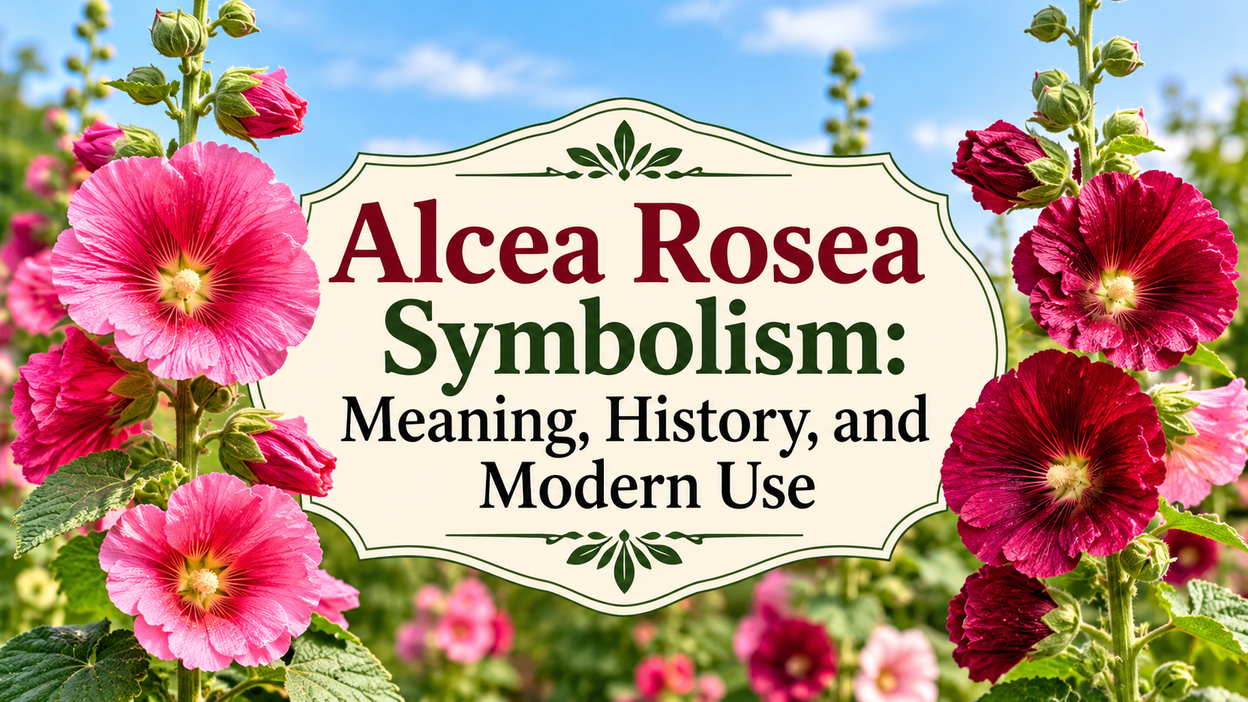
Alcea rosea symbolism centers on ambition, fertility, abundance, and the welcoming character of home. Better known as the hollyhock, Alcea rosea is a tall flowering plant with large, colorful blooms arranged along upright stems. It often appears in cottage gardens, along fences, beside old houses, and in landscapes where its height gives a garden a distinctive, traditional look.
The flower’s meaning comes partly from its physical form. Hollyhocks grow upward, produce many blossoms, and often return in gardens through self-seeding. These characteristics make them natural symbols of growth, aspiration, and a life filled with activity. Their long association with domestic gardens also connects them with hospitality, family life, and the continuity of a place.
In the United States, hollyhocks often evoke nostalgia for older neighborhoods, country gardens, and the work of people who cultivate beauty around their homes. Their symbolism is not fixed, however. A hollyhock can represent personal ambition in one setting and family heritage or simple summer beauty in another. Understanding the flower means looking at its botanical qualities, its history in gardens, and the meanings people have attached to it.
Quick Answer
Alcea rosea symbolism commonly represents ambition, fertility, abundance, and a welcoming home, especially in traditional garden settings. In Victorian flower language, hollyhocks were associated with fertility, while their tall stems and abundant blooms also lend themselves to modern interpretations of growth, aspiration, and domestic continuity.
TL;DR
- Hollyhocks commonly symbolize ambition, fertility, abundance, and home life.
- Their tall stems suggest aspiration and steady personal growth.
- Victorian flower dictionaries associated hollyhocks with fertility.
- Traditional American gardens connect them with nostalgia and family heritage.
- Flower color can influence interpretation, but meanings are not universal.
- Today, hollyhocks appear in garden design, artwork, gifts, and personal expression.
What Alcea Rosea Looks Like and Why Its Shape Matters
Hollyhocks are recognizable for their height and their large, rounded flowers, which grow in a column along a sturdy central stem. Depending on the variety, the blossoms may be single or double and can appear in shades of pink, red, purple, yellow, white, and nearly black. The plant belongs to the mallow family, Malvaceae, which also includes plants such as hibiscus, cotton, and okra.
Its upright form is central to many modern interpretations. While low-growing flowers spread across the ground, hollyhocks rise above other garden plants. This vertical growth can suggest reaching toward a goal, gaining confidence, or developing beyond earlier limits. A row of mature hollyhocks may look like a series of colorful columns, each carrying numerous blossoms.
The flowers also bloom in succession along the stem rather than appearing as a single isolated display. That pattern lends itself to ideas of abundance, continuity, and gradual progress. One blossom fades as another opens, creating a changing display over the flowering season.
These associations are interpretations rather than scientific facts about the plant’s meaning. Still, they help explain why hollyhocks work so well as symbols of growth and aspiration in garden art and personal writing.
The Core Symbolism of Hollyhocks
Hollyhocks are most often associated with ambition, fertility, abundance, and domestic life. These meanings overlap, but each emphasizes a different aspect of the flower.
Ambition reflects the plant’s height and upright growth. It can represent the desire to improve one’s circumstances, pursue a goal, or keep developing over time.
Fertility has a more specific historical connection. Victorian flower-language traditions assigned meanings to individual blooms, and hollyhocks were associated with fertility. The idea may also feel visually fitting because the plant produces many flowers and can spread through seed.
Abundance comes from the plant’s generous floral display. A stem covered in blooms can suggest a full garden, a productive household, or a period of plenty.
Home and belonging emerge from the hollyhock’s place in traditional gardens. Because it is often planted near fences, walls, and entrances, it can evoke the care people invest in their homes and the memories attached to familiar places.
These meanings are not interchangeable in every context. A hollyhock used in a wedding arrangement may suggest fertility or a flourishing shared life, while a painting of hollyhocks beside an old farmhouse may communicate memory, continuity, and attachment to home.
Ambition and the Desire to Grow
Ambition is one of the easiest modern meanings to connect with the hollyhock. Its tall stem stands above many neighboring plants, creating a visual impression of upward movement. This makes the flower a useful image for describing personal development, professional goals, creative work, or the determination to build a better future.
Unlike a symbol of sudden success, the hollyhock can suggest gradual progress. A plant needs time to establish itself, grow, and flower. Its appearance therefore suits a message about patience as well as achievement.
In a garden, hollyhocks may be planted against a wall or fence, where their blooms rise into view. In symbolic artwork, that same vertical shape can represent someone striving beyond present circumstances. A writer might use a hollyhock beside a childhood home to suggest a character’s wish to leave, grow, and eventually return with a different perspective.
The association with ambition should not be confused with arrogance. The flower’s height can signify aspiration without implying that a person considers themselves superior to others. In a personal gift or illustration, it may simply express encouragement: keep growing, make room for your plans, and allow your efforts to develop in their own time.
Fertility, Family, and a Flourishing Life
Hollyhocks have a documented place in Victorian flower language as symbols of fertility. In the nineteenth century, floral dictionaries helped people assign messages to bouquets, and flowers could communicate sentiments that were difficult to express directly. Fertility in this context could refer to the capacity to produce children, but it can also be interpreted more broadly as fruitfulness and the ability to create or nurture something.
Today, the meaning can be used in different ways. Someone may associate hollyhocks with parenthood, family growth, or the hope of a thriving household. Others may understand fertility metaphorically: a fertile imagination, a productive period of work, or a new project that begins to flourish.
The distinction matters because flowers do not carry the same message for everyone. A hollyhock can be a welcome symbol for someone celebrating a growing family, yet feel uncomfortable to someone dealing with infertility or a difficult family history. The flower itself does not make a personal prediction or promise.
In modern American settings, the broader idea of a flourishing life often offers the most inclusive interpretation. Hollyhocks can represent the growth of relationships, creative plans, community ties, or a home filled with activity. Their meaning depends on what the person choosing or receiving the flower wants to express.
Abundance, Prosperity, and Generosity
A mature hollyhock can carry many blossoms on one stem. In a group, several plants may create a dense wall of color. This abundance makes the flower a natural visual expression of plenty.
In symbolic terms, abundance does not have to mean wealth. It may refer to a garden that produces flowers year after year, a kitchen filled with food, a household where guests are welcome, or a life rich in friendship and shared experiences. The flower’s generous display makes it well suited to messages about having enough to share.
Hollyhocks may also suggest generosity because they often appear in informal garden spaces rather than carefully controlled displays alone. Their presence beside a fence or path can make a space feel open and lived in. A cluster of blooms near a front entrance can be interpreted as an invitation to pause, visit, or enjoy the season.
Claims that hollyhocks universally attract money or guarantee prosperity should be treated cautiously. There is no single, widely accepted rule that gives the flower that power. Prosperity is better understood as a modern interpretation of its abundance and long-standing role in cultivated home landscapes.
Home, Hospitality, and Belonging
The hollyhock’s association with home is especially clear in traditional garden design. Tall stems are often placed at the back of flowerbeds, beside walls, or along fences. These locations allow the blooms to frame a property without requiring a formal garden layout.
For many American readers, hollyhocks call to mind older houses, rural communities, and gardens maintained by parents or grandparents. A flower seen repeatedly near a childhood home can become tied to memories of summer afternoons, family routines, or a particular neighborhood. In this case, its personal meaning may be stronger than any meaning found in a flower dictionary.
Hollyhocks can also symbolize hospitality. Flowers beside an entryway soften the appearance of a building and suggest that someone cares for the place. This does not mean every hollyhock garden communicates a deliberate invitation, but the setting can create that impression.
The connection with belonging may be particularly meaningful for people who have moved away from a hometown. A hollyhock in a photograph, painting, or garden can recall the appearance of a familiar street or the person who once tended the plants. The flower then becomes a marker of place, memory, and continuity.
Historical Origins and the Development of Meaning
Alcea rosea has a long history of cultivation, with origins generally traced to parts of Asia and the Near East. Its exact early route into European gardens is not fully settled. Historical accounts connect its spread with trade and travel, and some traditions link its arrival in western Europe to the period of the Crusades. The familiar name “hollyhock” has also been explained through older words associated with the plant and its supposed journey, although the precise etymology is debated.
Hollyhocks were valued for practical as well as decorative reasons. Plants in the mallow family have a history of traditional use, and hollyhocks were grown in gardens where useful plants and ornamental flowers often shared space. Over time, the tall stems and conspicuous blooms made them attractive additions to cultivated landscapes.
Their symbolic associations developed alongside their use. A plant that produces many blossoms can be linked to fruitfulness, while one that rises prominently in a garden can suggest distinction or aspiration. Such associations do not necessarily begin with a single story or religious event. They can emerge gradually from a plant’s appearance, its practical role, and the places where people grow it.
It is therefore more accurate to describe hollyhock symbolism as a collection of historical and cultural associations than as a single ancient code passed unchanged from one civilization to another.
Hollyhocks in Victorian Flower Language
The Victorian language of flowers became fashionable in Britain and America during the nineteenth century. Flower dictionaries assigned meanings to specific plants, allowing bouquets to carry messages about affection, character, hope, or social relationships. The practice appealed to people living in a culture where etiquette could limit direct emotional expression.
Hollyhocks were associated with fertility in this floral vocabulary. This historical meaning remains useful when interpreting period illustrations, old-fashioned bouquets, and writing that draws on Victorian conventions. It is a more firmly grounded association than many modern online claims that assign a separate, universal meaning to every flower color.
Flower dictionaries did not always agree with one another. Meanings could vary by publication, region, and period, so there was no single official dictionary followed by everyone. The message also depended on the arrangement and the relationship between the people exchanging flowers.
For modern readers, Victorian symbolism provides historical context rather than a strict set of rules. A hollyhock in a nineteenth-century-inspired design may intentionally refer to fertility or a flourishing household. In an ordinary contemporary garden, however, the same plant may simply be admired for its color, height, and familiar appearance.
What Hollyhocks Mean in American Culture
In the United States, hollyhocks are closely associated with traditional gardens, small-town landscapes, and the decorative planting around homes. They have been cultivated in American gardens for generations. Thomas Jefferson recorded hollyhocks in his garden calendar at Monticello in the eighteenth century, showing that the plant was already part of the cultivated landscape of early America.
Their cultural meaning is not limited to formal estates or historic gardens. Hollyhocks can grow beside modest houses, rural fences, and community spaces. Their height makes them visible from a distance, and their colorful flowers can give a garden a distinctly old-fashioned character.
This setting encourages associations with continuity and personal care. A hollyhock garden may remind someone of a relative who saved seeds, a neighbor who maintained a flowerbed, or a house that has remained in a family for decades. For another person, it may simply represent a relaxed, colorful alternative to a highly structured landscape.
Hollyhocks do not have one official national symbolic meaning in the United States. Their significance comes from local gardening traditions, personal memories, historical flower language, and the meanings individuals attach to the places where they encounter them.
Hollyhock Colors and Their Possible Meanings
Hollyhocks appear in a broad range of colors, and people often use color to refine the message of a flower. These interpretations are flexible rather than universal. A color may carry a familiar association in one setting and a different personal meaning in another.
| Hollyhock color | Possible symbolic association | Common context |
|---|---|---|
| Pink | Affection, tenderness, warmth | Home gardens, thoughtful gifts, romantic artwork |
| Red | Vitality, passion, confidence | Bold garden designs and expressive floral imagery |
| White | Simplicity, sincerity, remembrance | Minimalist arrangements and reflective settings |
| Purple | Individuality, dignity, creativity | Decorative gardens and artistic compositions |
| Yellow | Cheerfulness, optimism, welcome | Summer gardens and bright seasonal displays |
These meanings draw on broader color associations and common design conventions, not on a universal hollyhock-specific code. For example, white does not automatically mean mourning, and red does not always indicate romantic love. The surrounding flowers, the occasion, and the recipient’s own associations all affect interpretation.
When choosing hollyhocks for a gift or design, it is reasonable to use color to express a feeling. It is less reliable to assume that a recipient will decode the color in exactly the same way.
Cross-Cultural Connections and Important Distinctions
Hollyhocks have been cultivated in different regions, including parts of Asia, the Middle East, and Europe. Their uses and associations have varied with local gardening practices, traditional plant knowledge, and artistic conventions. In some communities, the plant has been valued for practical purposes as well as for its flowers.
It is important to distinguish Alcea rosea from other plants that share the name “mallow” or have similar-looking flowers. Related plants may have their own histories and cultural meanings. A symbol attached to a different species should not automatically be treated as a traditional meaning of the garden hollyhock.
The Japanese hollyhock leaf motif, often called aoi, is another example of why botanical precision matters. It is associated with particular Japanese cultural and historical traditions, including heraldic imagery and festival customs. The leaf motif is not necessarily a direct statement about the symbolic meaning of the flower spikes of Alcea rosea.
Similarly, traditional medicinal uses of hollyhocks in various regions do not prove that the plant carries a universal spiritual meaning. Practical knowledge, decorative use, and symbolism can overlap, but they are not the same thing. Respectful interpretation begins by identifying the plant and the cultural setting before assigning a meaning.
Emotional and Psychological Associations
The emotional meaning of hollyhocks often develops through familiarity. A person who grew up seeing them along a garden fence may experience comfort or nostalgia when encountering them later. Someone who has never lived near hollyhocks may instead notice their unusual height and bright colors.
This difference illustrates an important principle of personal symbolism: the same object can produce different responses because people connect it with different experiences. The flower’s appearance provides a starting point, but memory and context shape the final interpretation.
Hollyhocks may also suggest patience. Their growth and flowering take place over time, making them suitable images for projects that develop gradually. A gardener who plants them each year may associate the flowers with care, persistence, and the satisfaction of seeing a living thing mature.
These are reflective interpretations, not psychological diagnoses or scientifically established effects. A hollyhock cannot reveal someone’s personality or predict future events. Its value as a symbol lies in the way it helps people express feelings and experiences that matter to them.
Hollyhocks in Art, Tattoos, and Home Decor
Hollyhocks appear in paintings, botanical illustrations, textiles, greeting cards, and garden-inspired home decor. Their tall stems and recognizable flowers make them useful visual elements, especially in designs that celebrate traditional gardens, rural life, or the changing seasons.
In a tattoo, a hollyhock may represent personal growth, family memories, fertility, or an attachment to a particular home. Someone might choose the flower because it grew outside a childhood house, while another person may simply appreciate its shape and color. The meaning does not have to match a traditional flower dictionary to be genuine.
In jewelry and decorative objects, hollyhock imagery can communicate a preference for nature-inspired design. A pendant or printed fabric featuring the flower may evoke a cottage garden or a softer, more informal aesthetic. In paintings and wall art, hollyhocks can establish a sense of place, particularly when shown beside an old fence, porch, or farmhouse.
The setting changes the interpretation. A hollyhock tattoo paired with a family date may emphasize remembrance, while a botanical illustration may focus on the plant’s form. There is no universal rule that every hollyhock image must symbolize ambition or fertility.
Seasonal Meaning and the Continuity of the Garden
Hollyhocks are associated with the warmer months because their flowering season commonly falls in summer, though the timing varies by climate and growing conditions. In many gardens, their blooms become part of the seasonal landscape, appearing alongside other summer flowers and providing height at the back of a border.
This seasonal role can connect hollyhocks with renewal and continuity. The individual blooms do not last forever, but the plant’s flowering period unfolds over time. In favorable conditions, hollyhocks may self-seed, allowing new plants to appear in later seasons. That natural cycle can suggest a garden that continues beyond the efforts of one person.
For families who pass gardening traditions from one generation to another, this continuity may carry personal meaning. Seeds saved by one gardener can become part of a later garden, creating a tangible link between past and present. The symbolism comes from the actual practice of growing and caring for the plants, not from a belief that the flowers preserve memories by themselves.
Hollyhocks are not guaranteed to return in the same place every year, and their life cycle varies with conditions and variety. Still, their ability to reseed in some gardens makes them fitting symbols for renewal, inheritance, and the gradual continuation of family or community traditions.
Common Misunderstandings About Hollyhock Symbolism
One common mistake is treating every symbolic meaning found online as an established historical fact. Hollyhocks have documented associations with fertility in Victorian flower language, and modern interpretations often connect their height with ambition. Other meanings, such as prosperity, protection, or spiritual transformation, may be personal or contemporary associations rather than widely documented traditions.
Another misunderstanding is assuming that flower colors have fixed meanings. Color symbolism changes across cultures, occasions, and individuals. A white hollyhock might suggest simplicity to one person and remembrance to another. The flower’s color alone cannot establish the sender’s intention.
It is also misleading to describe hollyhocks as a universal religious symbol. Although plants and flowers have religious significance in many traditions, that does not mean Alcea rosea carries the same sacred meaning across religions or countries. A specific association should be tied to a particular cultural or historical context.
Finally, symbolic meaning should be kept separate from claims about medicinal benefits or supernatural effects. Hollyhocks have a history of practical use, but traditional use does not automatically establish medical effectiveness. Nor does planting a hollyhock guarantee fertility, good fortune, or protection. The flower’s symbolism is best understood as a way people communicate ideas and feelings, not as a promise about what will happen.
How to Interpret a Hollyhock in a Specific Setting
The most useful way to interpret a hollyhock is to consider where it appears, how it is presented, and what the person using it may want to communicate. A flower in an old family photograph may have a different meaning from the same flower on a modern greeting card.
Consider these questions:
- Where does the flower appear? Beside a house, it may suggest home and belonging; in a formal botanical illustration, it may emphasize natural beauty.
- What is happening around it? A family gathering may support an interpretation connected with continuity, while a design about personal goals may emphasize growth and ambition.
- Does the color matter to the creator? Pink, red, white, purple, and yellow may add emotional associations, but those meanings are not fixed.
- Is there a historical reference? A Victorian-style illustration may intentionally draw on flower language, including the hollyhock’s association with fertility.
- Does it have a personal history? A flower connected to a relative or childhood home may hold a meaning that no general symbolism guide can fully explain.
These questions help separate traditional associations from personal interpretations. They also prevent the common mistake of assuming that a symbol must have one correct meaning in every situation.
Frequently Asked Questions
What does Alcea rosea symbolize?
Alcea rosea, commonly called the hollyhock, is associated with ambition, fertility, abundance, and domestic life. Its upright growth and plentiful blooms also make it a natural image of aspiration and a flourishing garden.
What did hollyhocks mean in Victorian flower language?
Hollyhocks were associated with fertility in Victorian floral symbolism. Because nineteenth-century flower dictionaries sometimes differed, this meaning should be understood as a documented historical association rather than a universal rule followed by everyone.
Do hollyhocks symbolize ambition?
They can symbolize ambition in modern interpretation because their tall stems rise above surrounding plants. This visual quality makes them suitable for expressing aspiration, gradual growth, and the pursuit of personal goals.
What does a hollyhock tattoo mean?
A hollyhock tattoo may represent growth, family, fertility, home, or a cherished memory. Its meaning often depends on the wearer’s personal experiences, the flower’s color, and any additional imagery included in the design.
Do different hollyhock colors have different meanings?
People may associate pink with affection, red with vitality, white with simplicity, purple with individuality, and yellow with cheerfulness. These are flexible color associations, not a universal code specific to hollyhocks.
Are hollyhocks considered spiritual symbols?
Hollyhocks can carry spiritual meaning for individuals who connect them with renewal, family continuity, or the beauty of nature. However, they do not have one universally accepted religious meaning across cultures and traditions.
Do hollyhocks symbolize good luck or prosperity?
Some people may interpret their abundant flowers as signs of plenty or a flourishing home. However, good luck and prosperity are not universal, established meanings of the hollyhock, and the plant should not be treated as a guarantee of future success.
Conclusion
Alcea rosea symbolism brings together ambition, fertility, abundance, and the familiar comforts of home. Its tall stems offer a natural image of aspiration, while its many blossoms help explain its association with fruitfulness and a flourishing life. Victorian flower language gave the hollyhock a specific connection with fertility, and traditional gardens helped establish its place in everyday cultural memory.
In modern American life, the hollyhock may be appreciated for its history, its appearance, or the memories it brings back. It can appear in a garden, a painting, a tattoo, or a family keepsake without carrying exactly the same message in each setting.
The most meaningful interpretation considers both the flower’s established associations and the context in which it appears. A hollyhock can symbolize growth and abundance, but its personal significance ultimately comes from the people, places, and experiences connected with it.