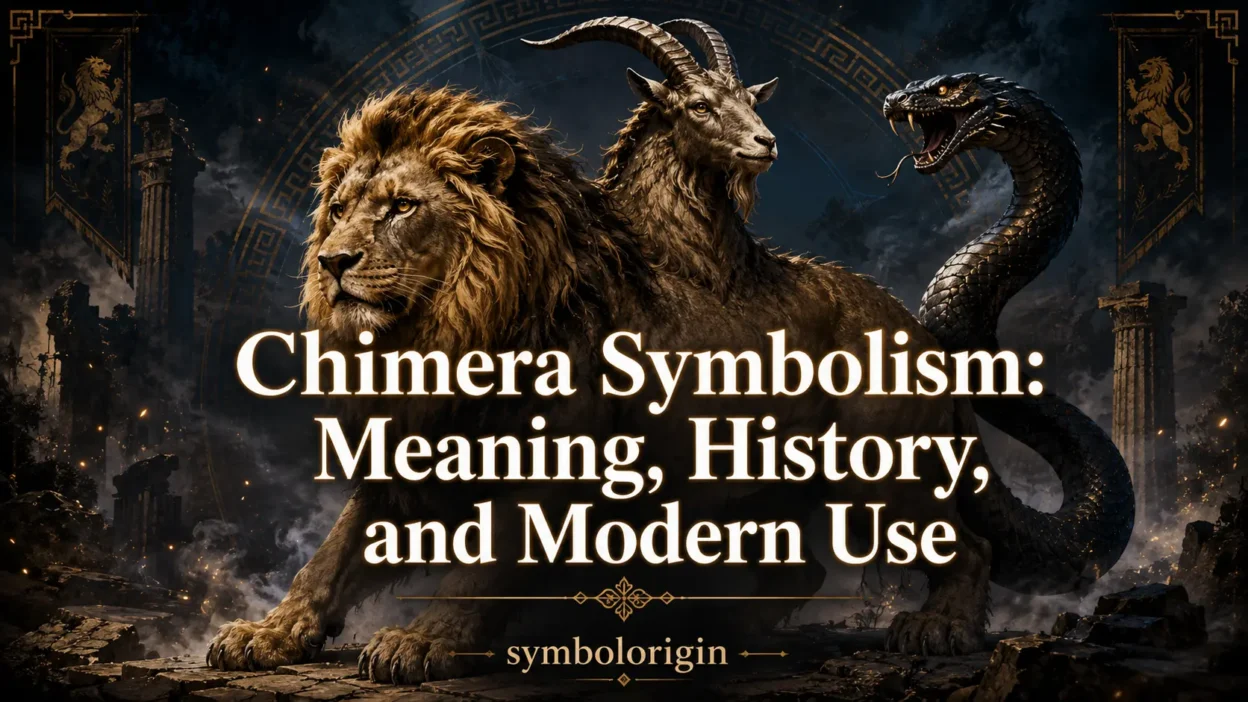
Chimera symbolism centers on incompatible forces joined into one body. In modern American culture, the creature can represent complexity, inner conflict, dangerous ambition, creative fusion, or an identity that cannot be reduced to a single category.
The image comes from Greek mythology, where the Chimera was a fire-breathing monster combining a lion, goat, and serpent. Its defeat by Bellerophon became a story about confronting a threat that appeared to possess several kinds of power at once.
Today, the Chimera appears in tattoos, fantasy stories, games, scientific language, and discussions of mixed identity. Its meaning changes with context: the same creature may look like a warning against disorder or a celebration of unconventional combination.
Quick Answer
Chimera symbolism commonly represents mixed identity, internal contradiction, dangerous imagination, and the joining of radically different elements. Historically, the Greek monster also stood for a seemingly impossible threat overcome through courage, strategy, and divine assistance.
TL;DR
- The Chimera combines lion, goat, and serpent features.
- It often represents contradiction, hybridity, or uncontrolled forces.
- Greek myth connects it with Bellerophon and Pegasus.
- American culture frequently treats it as a complex hybrid.
- Science uses “chimera” for genetically distinct tissues.
- Its meaning can be threatening, creative, or identity-affirming.
What the Chimera Looks Like
The classical Chimera is usually shown with a lion’s body and head, a goat’s head rising from its back, and a tail ending in a serpent or dragon head. Ancient descriptions also emphasize its ability to breathe fire. Different artists adjusted the arrangement, but the creature’s defining quality remained its composite anatomy.
Unlike many mythological animals, it is not simply an enlarged or supernatural version of one species. Its body visibly joins animals associated with different behaviors and environments. The lion suggests physical dominance, the goat introduces an unexpected middle element, and the serpent adds danger from behind.
Ancient Greek artists placed the monster on pottery, cups, plates, and other objects. Some images show it alone, while others present the battle in which Bellerophon attacks from Pegasus. The myth appeared in Greek art by the early archaic period and remained recognizable across centuries of classical imagery.
Modern versions may add wings, horns, scales, multiple tails, or extra heads. These changes move beyond the original Greek design, but they preserve the basic idea of several creatures fused into one.
Its Meanings at a Glance
The Chimera does not carry one fixed message. Its interpretation depends on whether the viewer emphasizes its mixed body, destructive behavior, imagined nature, or eventual defeat.
| Context | Common Meaning in the USA | Main Associations | Typical Use |
|---|---|---|---|
| Greek mythology | A dangerous, unnatural opponent | Fire, destruction, heroic combat | Classical art and education |
| Personal identity | Several sides existing in one person | Complexity, adaptability, contradiction | Tattoos and self-expression |
| Psychology | Conflicting desires or an invented fear | Anxiety, fantasy, inner tension | Essays, art, and storytelling |
| Creative work | Unusual elements successfully combined | Experimentation, originality, fusion | Design, fashion, and music |
| Everyday language | An unrealistic hope or imagined creation | Illusion, fantasy, impossibility | Formal speech and writing |
| Biology and medicine | Genetically distinct cells in one organism | Mixed tissues, transplantation, development | Clinical and scientific language |
Modern interpretations often move between two poles. One treats combination as unstable and threatening. The other sees it as flexible, inventive, and resistant to simple classification.
Ancient Greek Roots and the Lycia Story
The Chimera appears in early Greek literature, including the Iliad. Homer describes a creature with lion, goat, and serpent features that breathes fire and is destroyed by Bellerophon. Later mythographers supplied additional details about its attacks and the circumstances surrounding the hero’s mission.
The monster was associated with Lycia, a region in ancient Anatolia, now part of Turkey. In the story, it endangered the land and was considered too formidable for an ordinary fighter. King Iobates sent Bellerophon against it partly because he expected the mission to end in the hero’s death.
Some traditions identify the Chimera as an offspring of Typhon and Echidna, figures connected with several Greek monsters. This genealogy placed it within a broader mythic family representing threats that challenged human communities and heroic order.
The Greek name Khimaira was related to a word for a she-goat. Over time, the name came to identify the entire composite creature rather than only its goat element.
Although modern readers often approach the story as fantasy, ancient audiences encountered it through poetry, religious traditions, public storytelling, and decorated objects. Its familiar visual form allowed the monster to communicate danger even when no written explanation accompanied the image.
Bellerophon, Pegasus, and the Defeat of an Impossible Threat
Bellerophon’s encounter with the Chimera gives the creature much of its symbolic weight. He does not defeat a normal animal in direct combat. He faces an opponent with several bodies’ worth of abilities and attacks it while riding the winged horse Pegasus.
In later accounts, Bellerophon uses flight to gain a tactical advantage. Rather than approaching the monster entirely on its own ground, he fights from above. This detail turns the episode into more than a test of strength: success depends on perspective, mobility, and the ability to find an approach the enemy cannot easily counter.
The battle has therefore been interpreted as order overcoming destructive nature, intelligence overcoming force, or disciplined courage overcoming terror. Getty’s account of the myth notes that it endured in classical art as an allegory involving such contrasts as culture and nature or right and might.
In a modern personal reading, Bellerophon may represent the focused self confronting a problem with many interconnected parts. The Chimera can stand for a crisis involving fear, anger, pride, and uncertainty at the same time.
The story also contains a warning beyond the victory. Bellerophon’s later tradition includes isolation and downfall, so the hero is not a simple model of permanent triumph. Defeating one danger does not make a person immune to pride or poor judgment.
Why the Composite Body Matters
The Chimera’s mixed anatomy is not decorative detail. It is the source of the creature’s identity.
A lion alone would suggest strength, sovereignty, or aggression. A serpent might suggest hidden danger, transformation, or cunning. A goat could evoke stubbornness, appetite, wilderness, or sacrifice depending on the cultural setting. The Chimera forces these associations into one form without making them fully harmonious.
That physical mismatch can symbolize a personality containing several competing drives. Someone may feel courageous in one situation, defensive in another, and vulnerable beneath both reactions. A Chimera image gives those differences a single body without pretending they are identical.
It can also represent an organization, idea, or project assembled from parts that do not naturally cooperate. In that context, the symbol asks whether the combination will become innovative or collapse under its contradictions.
This uncertainty is central to its appeal. The creature does not automatically prove that mixture is bad. It shows that combination creates consequences. What matters is whether the parts produce strength, instability, or both.
Fire, Destruction, and Uncontrolled Force
Fire separates the Chimera from a merely strange hybrid. Its breath turns physical difference into active danger.
Symbolically, fire may represent anger, destruction, feverish ambition, or a conflict that spreads faster than expected. When paired with the creature’s multiple animal parts, it suggests that several sources of pressure have combined and are now producing one destructive result.
A Chimera may therefore symbolize a problem that has moved beyond private tension. Resentment, fear, and pride may remain manageable when separated, but their combination can erupt into harmful behavior.
The fire can also represent intensity rather than evil. In tattoos and fantasy art, flames may communicate passion, survival, defiance, or creative drive. The surrounding imagery determines whether the heat appears uncontrolled or intentionally directed.
A defeated, wounded, or restrained Chimera usually emphasizes mastery over volatile emotion. One shown breathing fire freely is more likely to signal aggression, rebellion, danger, or refusal to be contained.
From Mythological Monster to Metaphor
The word “chimera” eventually expanded beyond the Greek creature. In formal modern English, it can describe an illusion, an unrealistic hope, or something constructed in the imagination. Dictionaries also use it for entities made from strikingly different parts.
This figurative meaning developed because the original monster appeared impossible by ordinary standards. A lion, goat, and serpent could be imagined together, but no such natural animal was expected to exist.
Calling a plan “a chimera” usually questions its realism. The speaker is suggesting that the idea may be attractive or elaborate but cannot be achieved in its present form.
The term can also describe a confusing combination. A building mixing unrelated architectural styles, for example, might be called a chimera without implying that it is literally dangerous.
This broader usage changed the symbol’s emotional range. It no longer referred only to a monster that attacked a region. It became a name for imagined fears, impractical dreams, unstable combinations, and inventions that resist familiar categories.
What It Commonly Means in the United States
American audiences usually meet the Chimera through mythology lessons, fantasy entertainment, games, tattoos, science reporting, or figurative language. As a result, its meaning is less tied to religious practice than to storytelling and visual identity.
In American fantasy culture, it commonly represents a high-level threat. Multiple heads or animal parts imply that ordinary defenses will not be enough. The creature may possess several attack methods, making it a convenient image for adaptable danger.
In art and design, the mixed body can express experimentation. Musicians, fashion designers, and visual artists may use hybrid creatures to suggest that their work crosses styles or refuses a single label.
The symbol also fits American discussions of self-invention. A person may choose it to represent an identity shaped by several communities, experiences, or roles. In this interpretation, being composite is not a defect. It is an honest description of a life that cannot be explained through one category.
A more negative American use treats the creature as a warning against plans assembled without coherence. A business, policy, or product may combine impressive parts yet fail because those parts do not work together.
Why It Appears in Tattoos and Personal Identity
A Chimera tattoo can represent internal complexity. The wearer may see different traits within themselves that appear contradictory but remain part of one identity.
For someone who has adapted to several environments, the image can communicate survival through flexibility. The lion may reflect courage, the serpent caution, and the goat persistence. These readings are modern personal interpretations rather than fixed meanings inherited directly from ancient Greece.
The creature can also mark victory over a complicated struggle. A person recovering from overlapping hardships may identify with either side of the myth: the Chimera as the problem survived or Bellerophon’s opponent as the force they learned to face.
Design choices substantially change the message:
- A roaring Chimera emphasizes defiance or aggression.
- A wounded creature may represent suffering or endurance.
- Flames suggest anger, energy, or transformation.
- Pegasus introduces strategy, freedom, or heroic resistance.
- Broken chains make the image about release from control.
- Several balanced heads can emphasize integrated identity.
Because the symbol can appear monstrous, wearers should consider how others may read it. A design intended to mean complexity may be interpreted as danger, chaos, or hostility when no personal explanation is available.
Popular Culture, Fantasy, and Creative Design
The Chimera fits naturally into fantasy because its anatomy can be redesigned almost endlessly. Writers and game designers may change its heads, powers, wings, size, or behavior while keeping the recognizable principle of a composite monster.
Its presence often tells an audience that established natural rules have been broken. The creature may have been produced by magic, experimentation, mutation, or interference with the boundaries between species.
That flexibility makes it different from mythological figures with highly fixed appearances. A modern dragon can vary, but it generally remains dragonlike. A Chimera is defined by variation itself.
In horror, it may represent bodily violation or forced transformation. In adventure stories, it becomes a difficult opponent. In science fiction, the word may identify an engineered organism, blended technology, or human identity altered by biological intervention.
Branding and visual design sometimes use it to communicate versatility. A composite creature can imply that one product or organization performs several functions. However, the same image may accidentally suggest confusion when the relationship among those functions is unclear.
The Scientific Meaning of Chimera
In biology, a chimera is not a mythical animal or simply a crossbred organism. The term generally refers to an individual containing cells or tissues with different genetic origins. This differs from mosaicism, in which genetically distinct cell lines arise from the same original zygote.
Chimerism can occur naturally or through medical treatment. During pregnancy, small numbers of cells may pass between a fetus and the pregnant person and persist afterward, a phenomenon known as fetomaternal microchimerism. Chimerism is also monitored after stem-cell and organ transplantation.
The scientific term borrows the mythological idea of one body containing biologically different components. Yet the emotional associations of monsters and unnatural danger can distort public understanding.
Human-animal chimera research, for example, raises genuine questions involving animal welfare, human cell development, moral status, organ production, and research oversight. It should not be described as though scientists are creating the fire-breathing creature of Greek myth. Reviews of the ethical debate show that the actual issues are more specific and varied than sensational headlines often suggest.
Using precise language matters here. “Chimera,” “hybrid,” “genetically modified organism,” and “mosaic” describe different biological conditions and should not be treated as interchangeable.
Emotional and Psychological Interpretation
Psychologically, the Chimera can represent a fear assembled from several smaller fears. An imagined threat may feel overwhelming because it combines memories, predictions, and insecurities into one mental image.
This interpretation connects with the figurative definition of a chimera as something created by the mind. The fear may produce real distress even when the imagined outcome is unlikely.
The creature may also symbolize compartmentalized identity. A person can behave differently at work, at home, with friends, and in private. The Chimera becomes a way to acknowledge that these versions belong to one person rather than proving that the person is false.
For others, the image expresses unresolved conflict. The heads pull in different directions, each demanding control. This reading may fit situations involving mixed loyalties, conflicting goals, or tension between instinct and reason.
A more constructive interpretation emphasizes integration. Psychological growth does not always require eliminating every contradiction. It may involve recognizing competing needs, deciding which should guide action, and preventing one part of the self from harming the whole.
Cross-Cultural Legacy, Evolution, and Misunderstandings
Although the creature began in Greek mythology, its image circulated beyond Greece through Roman, Etruscan, and later European art. One famous example is the bronze Chimaera of Arezzo, an Etruscan work that demonstrates how widely the figure traveled within the ancient Mediterranean world.
Images of a mounted hero defeating a composite beast also contributed to a broader artistic tradition. Getty materials note similarities between Bellerophon’s combat and later Christian representations of Saint George attacking a dragon, although the figures and religious meanings are not identical.
One common misunderstanding is that every mixed mythological creature is a Chimera. A griffin, centaur, sphinx, or mermaid combines different anatomical elements, but each has its own name, story, and cultural history. “Chimera” can function as a broad category in modern fantasy, yet the classical figure refers to a particular Greek monster.
Another mistake is assuming that the three animals had one universally agreed symbolic code in ancient Greece. Modern interpretations often assign detailed meanings to each head, but surviving classical sources focus more clearly on the creature’s appearance, fire, destructiveness, and defeat.
The meaning has gradually shifted from a specific enemy in an ancient heroic story to a flexible metaphor. It can now describe biological composition, impossible hopes, unstable projects, imagined fears, or identities composed of several influences.
That evolution explains why the symbol can feel negative in one context and affirming in another. Ancient viewers saw a destructive monster. Modern viewers may also see adaptability, experimentation, or a self that refuses simplification.
FAQs
Is the Chimera a positive or negative symbol?
It depends on the context. In Greek myth, it’s mainly a destructive creature and an enemy to be defeated — so the classical reading leans negative. Modern art and tattoos flip that script, using the same image for positive meanings like adaptability, individuality, creative combination, and acceptance of a complex identity.
What does a Chimera tattoo usually mean?
A Chimera tattoo most often represents mixed identity, inner conflict, survival through adaptability, or several personal qualities coexisting at once. The specific meaning shifts with the details: flames suggest intensity or transformation, a wounded pose suggests endurance, and Pegasus in the design adds a layer of strategy or hard-won freedom.
Does the Chimera symbolize chaos?
It can, since its body combines incompatible creatures and its fire threatens everything around it. That said, “complexity” or “unstable combination” is usually a more precise reading than chaos — especially in modern personal symbolism, where the creature is often about managing contradiction rather than pure disorder.
Is the Chimera connected with evil or the devil?
Not originally. The classical Chimera belongs to Greek mythology, entirely separate from the traditions behind the Christian devil. Later viewers sometimes projected evil onto its horns, serpent tail, or monstrous form, but that association is a later overlay rather than the creature’s ancient meaning.
What is the difference between a Chimera and a hybrid?
In casual usage, the two words often get used interchangeably to mean “combined elements.” Scientifically, though, they’re distinct: a hybrid typically develops from parents of different genetic groups (like a mule), while a chimera contains cells that originate from genuinely separate genetic sources within one organism.
What does defeating the Chimera symbolize?
Defeating it usually represents overcoming a problem with several interlocking causes, managing conflicting emotions at once, or using strategy against a threat too large to face head-on. Pegasus’s role in the myth is key here — it specifically emphasizes perspective and an unconventional approach over raw strength.
Why does the Chimera have three different animal parts specifically?
Ancient Greek tradition settled on the lion, goat, and serpent combination early, and the choice likely reflects the different kinds of threat each animal represented — physical dominance, an unpredictable middle element, and hidden danger from behind. The specific pairing became fixed enough in art and literature that later Chimera imagery, even heavily modified, still traces back to this original three-part design.
Is a Chimera the same thing as a griffin or a sphinx?
No — each is a distinct mythological creature with its own name, origin story, and symbolic tradition, even though all combine features from different animals. A griffin (eagle and lion) and a sphinx (human head, lion body) come from separate mythologies and carry different meanings; “Chimera” specifically refers to the Greek lion-goat-serpent monster, though it’s sometimes used loosely as a catch-all term in modern fantasy.
What does it mean to call a plan or idea “a chimera”?
Calling something a chimera in modern English is a way of questioning its realism — suggesting the idea is elaborate or appealing but ultimately can’t be achieved as imagined. It’s often used for ambitious plans, unrealistic hopes, or proposals that look impressive on paper but fall apart once their incompatible parts are examined closely.
Are chimera humans or human-animal chimeras real?
Yes, in the scientific sense — human chimerism occurs naturally, including cases where cells pass between a fetus and pregnant parent and persist afterward, and it’s also monitored following stem-cell or organ transplants. Human-animal chimera research is a real and ongoing area of science, but it involves cellular-level mixing under careful ethical oversight, not the creation of any creature resembling the mythological monster.
Conclusion
The Chimera has survived for nearly three thousand years for a simple reason: it asks a question that never stops being relevant. What happens when genuinely different forces occupy the same body? Ancient Greek audiences answered that question with fire and defeat — a monster whose incompatible parts made it dangerous, and a hero whose strategy made the danger survivable.
Modern culture hasn’t abandoned that tension so much as opened it up. The same creature that once stood only for destruction now stands equally well for a scientific phenomenon, a psychological state, a design philosophy, and a way of describing an identity built from more than one influence. That range isn’t a dilution of the symbol — it’s the symbol doing exactly what it was always built to do, holding contradiction without resolving it.
That’s the real staying power of the Chimera: it never asks you to pick a side between unity and difference. It just asks whether the different parts of you, your work, or your circumstances are going to fight each other, coexist uneasily, or become something none of them could have been alone.