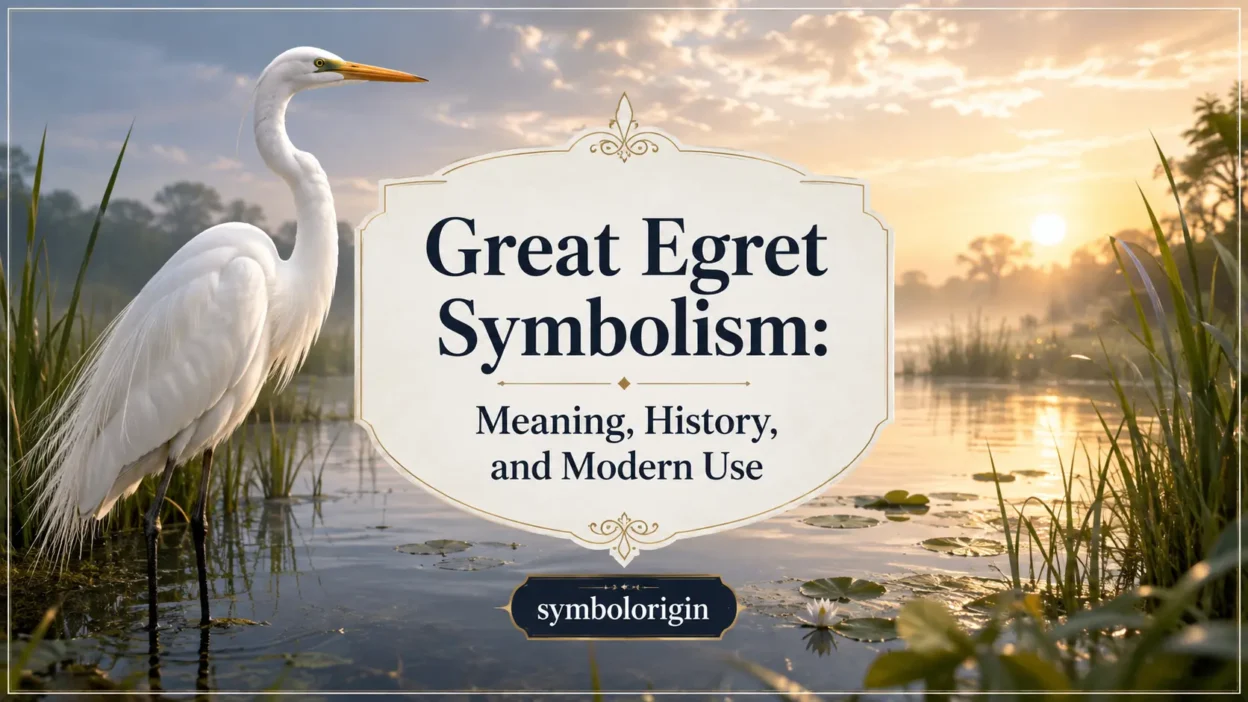
The great egret symbolism most Americans recognize centers on patience, calm focus, independence, purity, and resilience. The bird’s striking white plumage and habit of standing almost motionless in shallow water make it a natural image for composure, while its dramatic recovery from the plume trade gives it a distinctly American connection to conservation.
Great egrets are not simply graceful white birds used in decorative art. Their actual behavior helps explain many of the qualities people attach to them. They can wait quietly for prey and then strike with remarkable speed, creating an easy visual metaphor for patience followed by decisive action.
Their history adds another layer. In the United States, great egrets became closely linked with the early bird-protection movement after hunters killed huge numbers for ornamental feathers. That history transformed an image of elegance into one that could also represent survival, responsibility, and protection of the natural world.
Quick Answer
Great egret symbolism commonly represents patience, clarity, self-control, independence, and graceful confidence in modern American culture. Because the species survived severe losses caused by the feather trade, it can also symbolize recovery, conservation, and the responsibility to protect wildlife.
TL;DR
- Great egrets commonly represent patience, focus, and quiet confidence.
- Their white feathers encourage associations with clarity and cleanliness.
- Hunting history gives the bird strong American conservation associations.
- East Asian art sometimes connects white egrets with moral integrity.
- Tattoos may express independence, resilience, balance, or personal renewal.
- Cultural meanings should never be treated as universally identical.
What the Great Egret Looks Like and Where It Lives
The great egret (Ardea alba) is a large member of the heron family. Adults have completely white feathers, long black legs, a long S-shaped neck, and a yellowish-orange bill. During breeding season, adults develop long ornamental feathers along the back that are displayed during courtship.
The species lives around freshwater and saltwater wetlands, including marshes, ponds, lakes, rivers, coastal areas, flooded fields, and tidal flats. In the United States, people commonly encounter it in places such as Florida, Louisiana, Texas, California, the Atlantic Coast, and many inland wetland regions.
Its hunting style is especially important to its modern interpretation. A great egret may walk very slowly through shallow water or remain almost motionless while watching for fish, frogs, and other prey. When an opportunity appears, the bird rapidly extends its neck and strikes.
That contrast between stillness and sudden precision explains why patience and decisive action fit the bird better than generic ideas of passivity.
Symbolic Meanings at a Glance
| Context | Common Meaning in the USA | Association | Important Note |
|---|---|---|---|
| Personal symbolism | Patience | Waiting for the right moment | Inspired by hunting behavior |
| White plumage | Clarity | Cleanliness, simplicity, openness | Not a universal religious meaning |
| Solitary appearance | Independence | Self-reliance and confidence | Egrets also nest socially |
| Movement | Grace | Balance and controlled action | Comes from its visual appearance |
| Conservation | Recovery | Survival and environmental protection | Strongly connected to U.S. history |
| Tattoos and art | Renewal | Calm change and resilience | Meaning depends on the wearer |
These meanings work best as interpretations rather than fixed definitions. Unlike a national flag or road sign, an animal does not carry one official symbolic message.
What It Commonly Means in the United States
In contemporary American symbolism, the great egret often suggests patience with purpose.
Its still posture makes the bird seem peaceful, yet it is actively watching its surroundings. Because of that behavior, the egret can represent staying composed while remaining alert.
Several related meanings naturally follow: patience comes from its ability to wait without unnecessary movement; focus comes from its attention to prey; independence comes from the frequent sight of a single bird feeding alone; grace comes from its long body, controlled movements, and slow flight; resilience is reinforced by its conservation history; and clarity is often associated with its bright white appearance.
These interpretations explain why the bird works well in personal art, photography, tattoos, environmental branding, and spaces designed to suggest calmness.
Why Stillness Became a Symbol of Patience
A feeding egret can look almost meditative. It may stand quietly in a marsh while water moves around its legs, apparently doing very little.
In reality, the bird is concentrating.
Its stillness allows it to observe movement beneath the water. Once prey comes within range, the slow scene changes instantly. The neck shoots forward and the bill strikes.
That behavior creates a more specific symbolic lesson than simply “be patient.” The egret represents waiting while remaining prepared.
Someone may therefore identify with the bird during a period when progress depends on observation rather than constant action. It can suggest choosing the right moment instead of reacting to every opportunity.
The symbolism is particularly useful for people who value deliberate decision-making. Calmness, in this interpretation, is not weakness. It is control.
White Plumage and the Meaning of Clarity
The great egret’s white plumage strongly shapes how people perceive it.
In modern American visual culture, white is frequently associated with cleanliness, simplicity, peace, openness, and fresh beginnings. When those ideas are projected onto an entirely white bird, clarity becomes an understandable interpretation.
However, white does not mean the same thing everywhere. Color meanings depend on culture, religion, setting, and historical period. White may signify celebration in one context and mourning in another.
For that reason, describing the egret as universally representing “spiritual purity” goes too far.
A more grounded interpretation is that the bird’s uncluttered appearance can communicate clear intention, emotional simplicity, or a desire to remove distractions.
That makes it especially suitable for minimalist artwork and personal symbols associated with starting over.
Independence, Precision, and Self-Control
Great egrets are frequently seen feeding alone. That solitary image encourages associations with independence and self-reliance.
Yet calling the species a completely solitary bird would be inaccurate. Great egrets commonly nest in colonies and may share nesting areas with other wading birds.
Symbolically, then, the bird can represent something more nuanced: the ability to function independently without rejecting community.
Its hunting method also supports ideas of precision. The egret does not continuously rush after prey. It watches, adjusts its position, and acts when conditions are favorable.
As a personal symbol, this can stand for maintaining emotional control, choosing actions deliberately, trusting personal judgment, avoiding unnecessary conflict, and knowing when to act independently.
The bird’s calm appearance makes those qualities feel composed rather than aggressive.
From Fashion Victim to Conservation Icon
The most historically significant American meaning of the great egret comes from a much darker period.
During the late nineteenth and early twentieth centuries, ornamental bird feathers became fashionable decorations for women’s hats. Great egrets were especially vulnerable because their long breeding plumes were highly desirable.
Hunters killed enormous numbers of egrets and other waterbirds to supply the millinery trade. The killing became so severe that great egret populations in the United States were brought dangerously low.
Public opposition to the feather trade helped stimulate organized bird conservation. Women including Harriet Hemenway and Minna Hall challenged feather fashion in Massachusetts during the 1890s, helping encourage the growing Audubon movement.
The National Audubon Society later adopted a flying Great Egret as its symbol in 1953, specifically connecting the species with the struggle to protect birds from exploitation.
This history gives the bird a symbolism few decorative interpretations capture: it can represent what happens when public attitudes toward wildlife change.
How Its American Meaning Changed Over Time
The great egret has moved through several distinct cultural roles in the United States.
At one point, its feathers represented luxury. Their beauty made them valuable fashion objects.
That same beauty then became the reason the species was being destroyed.
As the conservation movement expanded, the egret’s image changed from a source of ornamental material into evidence that wildlife needed protection. Eventually, the returning bird became an example of successful conservation.
Its symbolic evolution can therefore be summarized as: beauty → exploitation → public concern → protection → recovery.
That sequence explains why resilience is especially appropriate when the bird appears in an American environmental context.
The egret does not merely symbolize surviving difficulty. Its history illustrates the possibility of correcting harmful human behavior.
Wetlands, Environmental Protection, and Ecological Awareness
Today, an egret standing in shallow water immediately evokes wetland habitat.
That makes the bird useful as a broader symbol of marshes, estuaries, rivers, wildlife refuges, and healthy aquatic ecosystems.
Great egrets depend on productive feeding areas and suitable nesting habitat. Although the species is currently widespread and considered of relatively low conservation concern overall, wetlands remain vulnerable to habitat alteration, pollution, changing water management, and other pressures.
In nature photography, educational material, environmental organizations, and conservation art, the egret can therefore represent more than a single species. It may stand for the interconnected health of clean water, fish and amphibian populations, marsh vegetation, nesting colonies, coastal habitats, and migratory bird communities.
This ecological interpretation is especially relevant in the United States because the bird already occupies such an important place in conservation history.
East Asian Art and the White Egret
White egrets and closely related white herons have a long presence in East Asian art.
It is important not to assume that every historic image represents Ardea alba specifically. Traditional artists often portrayed egrets or herons as broader artistic categories rather than modern scientific species.
In Japanese art, white herons and egrets appeared in hanging scrolls, textiles, woodblock prints, and bird-and-flower paintings. Their immaculate feathers could suggest dignity and moral uprightness, particularly because the birds remained visually white while feeding in muddy wetland environments.
One nineteenth-century Japanese print tradition explicitly used white egrets to suggest moral integrity through that contrast between clean feathers and muddy surroundings.
Egrets also appear in Japanese literary and theatrical traditions. The medieval story associated with the Noh play Sagi presents the bird in an auspicious court setting, showing that its cultural identity was broader than one fixed meaning.
Chinese Associations With Status and Achievement
Chinese artistic traditions offer another example of why cultural context matters.
During the Qing dynasty, an egret could appear on an official rank badge indicating the sixth civil rank. In that setting, the bird did not simply mean serenity or purity; it communicated an actual position within the imperial bureaucracy.
Chinese visual culture also used linguistic wordplay. In some artworks, the word for egret participated in rebuses connected with advancement or prosperity through official position.
These examples demonstrate a basic rule of symbolic interpretation: meaning comes from context.
An egret on a modern American tattoo, an imperial Chinese textile, and a Japanese woodblock print may depict similar birds while communicating very different ideas.
Why Indigenous Meanings Should Not Be Generalized
Online symbolism guides sometimes claim that the egret has one universal “Native American meaning.”
That approach is misleading.
Indigenous peoples of North America represent many distinct nations, languages, histories, artistic traditions, and relationships with birds. A story or ceremonial role documented in one community cannot automatically be assigned to every other Indigenous culture.
Herons and related waterbirds do appear in Indigenous stories and traditions, but their meanings vary. Interpretation should therefore identify the specific nation, community, story, or object whenever possible.
Statements such as “the egret means wisdom to Native Americans” remove that context and turn culturally specific traditions into generic spiritual language.
For modern readers, the safer principle is simple: tribal traditions should be discussed on their own terms rather than blended into a single animal-symbol dictionary.
Emotional and Psychological Meaning
People often choose animal symbols because an animal’s behavior reflects something they want to strengthen in themselves.
The egret works especially well for someone who values emotional restraint without emotional numbness.
Its posture can communicate composure (remaining steady when circumstances are unsettled), awareness (watching carefully before responding), personal space (being comfortable alone without becoming isolated), confidence (acting decisively when the moment arrives), renewal (moving forward after a difficult period), and balance (combining quiet observation with purposeful action).
The bird may appeal especially to people entering a slower, more deliberate phase of life after experiencing stress, change, or instability.
Its symbolic message is less about dramatic transformation than controlled adjustment.
Great Egret Tattoos and Personal Meaning
A great egret tattoo can carry several meanings depending on its pose and surrounding imagery.
A standing egret may suggest patience, observation, or self-possession. An egret in flight can represent release, transition, freedom, or moving beyond an earlier stage of life. An egret beside water may emphasize reflection, emotional balance, or connection with wetlands and nature. A minimalist white-bird design may represent simplicity or clarity.
Someone aware of the species’ conservation history might choose it as a symbol of survival or environmental responsibility.
Flowers, reeds, water, moons, fish, or other birds can change the interpretation significantly. A tattoo therefore does not have one automatic definition; personal history remains more important than a symbolism list.
Jewelry, Decor, Photography, and Digital Culture
The great egret’s clean silhouette makes it particularly adaptable to visual design.
In jewelry, the long neck and wings create elegant shapes that can communicate refinement without requiring heavy ornament.
In home decor, prints of egrets are common in coastal, wetland, minimalist, and nature-inspired interiors. A solitary white bird against water often creates a feeling of visual quiet.
Wildlife photography emphasizes another side of the symbolism. Images showing an egret waiting beside reflective water can suggest stillness, while photographs of hunting or territorial behavior reveal that the bird is considerably more active than its graceful reputation implies.
On social media, egrets often appear in birding photography and wetland conservation posts. The bird’s brightness against dark water makes it visually striking, which helps preserve its modern association with clean natural spaces and attentive observation.
Common Misunderstandings and Distorted Claims
Several popular claims about egrets deserve caution.
First, seeing one is not historically proven to predict an upcoming event. Claims that an egret guarantees money, romance, pregnancy, or spiritual awakening belong to modern personal belief rather than established historical symbolism.
Second, great egrets should not automatically be described as symbols of complete peacefulness. They are predators. They also defend feeding and nesting areas, and competition among young birds can be severe.
Third, white plumage does not make the species universally sacred.
Finally, egrets and herons are often confused. The great egret belongs to the heron family, but not every white heron shown in historic art should be identified specifically as a great egret.
Recognizing these limits makes the symbolism more interesting, not less. The strongest interpretations are those connected to actual behavior, historical events, or clearly identified cultural traditions.
Frequently Asked Questions
Is seeing a great egret a good sign?
Many people interpret an encounter positively, since the bird’s calm, focused presence naturally suggests patience, composure, or well-timed action. There’s no established historical or cultural tradition that treats every sighting as an omen, though, so that reading is best understood as a modern, personal association rather than a proven prediction.
What does a great egret symbolize spiritually?
In personal spiritual interpretation, it’s often associated with stillness, heightened awareness, renewal, or staying centered before an important decision. These readings are modern and individual rather than tied to one established religious doctrine, so the meaning tends to reflect what the bird’s behavior evokes for the person interpreting it.
What does a great egret tattoo mean?
A tattoo commonly represents patience, independence, graceful confidence, resilience, or a fresh start, with the specific pose shaping the message considerably. An egret in flight tends to emphasize freedom or transition, while one standing beside still water leans more toward reflection, patience, and emotional self-control.
Does the great egret have a biblical meaning?
No — the great egret doesn’t hold a major established symbolic role anywhere in the Bible. Some modern Christian interpretations connect a white bird generally with purity or peace, but that association shouldn’t be presented as a specific, scripturally grounded meaning tied to this particular species.
Is a great egret a symbol of good luck?
It can function that way personally, especially for people drawn to the idea of favorable timing reflected in the bird’s patient, precise hunting style. That said, “good luck” isn’t a universal or historically documented meaning attached to the species — it’s a modern interpretation people apply rather than an inherited tradition.
What is the difference between egret and heron symbolism?
Since egrets are members of the heron family, their symbolism tends to overlap considerably around patience, wetlands, independence, and careful observation. White egrets pick up additional associations with clarity and elegance specifically because of their plumage, while different cultural traditions may assign more specific meanings to particular species within the broader family.
Why does the great egret specifically represent American conservation history?
The connection is direct and historically documented rather than a loose modern association — the species was hunted to dangerously low populations for the millinery trade, and public backlash against that practice helped launch the organized Audubon bird-conservation movement in the 1890s. The National Audubon Society’s continued use of a flying great egret as its symbol keeps that specific history attached to the bird rather than letting it fade into generic wildlife imagery.
Why do East Asian and American interpretations of the white egret differ so much?
Each tradition built its meaning from a different starting point — American symbolism grew largely out of the bird’s real conservation history and observable hunting behavior, while Japanese and Chinese traditions developed their meanings through artistic convention, wordplay, and even bureaucratic rank systems like Qing dynasty official badges. Neither reading is more “correct”; they simply reflect what each culture actually used the bird’s image to communicate.
Is it accurate to say egrets are peaceful birds?
Not entirely, and it’s a common oversimplification worth correcting. Great egrets are effective predators that strike prey with real speed and force, and they can be territorial and even aggressive toward competitors near feeding and nesting sites — their outward calm reflects controlled patience, not passivity or a lack of capacity for conflict.
Can egret symbolism be applied the same way across all Indigenous North American traditions?
No, and this is a common overgeneralization to avoid. Indigenous nations across North America have distinct languages, histories, and relationships with waterbirds, so any specific story or ceremonial meaning documented for one community shouldn’t be assumed to apply universally. The more accurate and respectful approach names the specific nation or tradition being referenced rather than treating “Native American symbolism” as one unified system.
Conclusion
The great egret earns its symbolism through an unusually tight fit between what it actually does and what people say it means. Its stillness isn’t passivity — it’s concentration that ends in a strike fast enough to catch a fish mid-swim. Its solitary feeding doesn’t mean it rejects community — the same bird nests in noisy colonies alongside other wading birds. Even its purity reading comes with a real historical asterisk: this is a species that was nearly wiped out precisely because humans found its beauty valuable enough to kill for.
That last fact is what separates the egret from most animals used as generic symbols of grace. Its story isn’t just about what it looks like standing in a marsh — it’s about what happened when an entire industry decided that beauty was worth more than the bird wearing it, and what changed when enough people decided otherwise. The flying egret on the Audubon Society’s own emblem isn’t decoration; it’s a record of that specific reversal.
That history is what makes “resilience” more than a flattering word choice here. The great egret doesn’t just survive — it stands as proof that a species pushed to the edge by human behavior can come back when human behavior changes too. Few symbols carry a lesson that specific, or that earned.