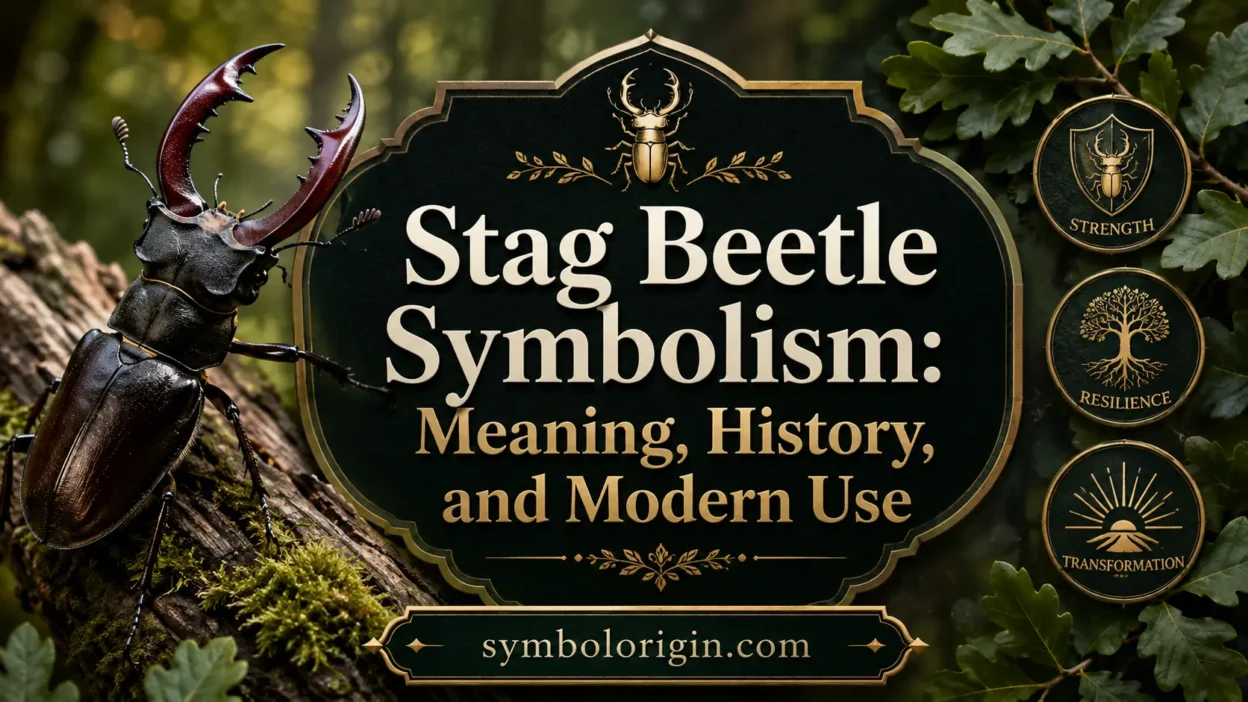
A stag beetle is hard to mistake for an ordinary insect. Males carry oversized, antler-like mandibles above a dark armored body, giving them a striking combination of elegance and toughness. Stag beetle symbolism has grown largely from those physical traits: strength, persistence, protection, competition, and the ability to stand firm under pressure.
Yet its meaning is not limited to modern interpretations. Stag beetles appear in ancient references, European folk beliefs, medieval and Renaissance art, and later popular culture. Their reputation has ranged from protective amulet to thunder-bringing creature, Christian emblem, collectible insect, and contemporary tattoo motif.
In the United States today, the stag beetle does not carry one official cultural meaning. Instead, its symbolism tends to be personal and visual. Its armored form suggests resilience, while the dramatic mandibles suggest courage, boundaries, and readiness to defend what matters.
Quick Answer
Stag beetle symbolism commonly represents strength, resilience, determination, and self-protection in modern American culture, especially in tattoos, insect art, jewelry, and nature-inspired design. Historically, the beetle has also been connected with protective amulets, thunder and lightning folklore, Christian imagery, and European traditions.
TL;DR
- Stag beetles commonly represent strength, endurance, and controlled power.
- Their antler-like jaws naturally suggest courage and competition.
- Ancient traditions sometimes treated them as protective amulets.
- European folklore linked them with thunder, lightning, and supernatural danger.
- Japanese culture celebrates stag beetles as admired childhood insects.
- Modern tattoos often emphasize resilience, protection, and personal determination.
What Makes the Stag Beetle So Symbolically Distinctive?
Stag beetles belong to the family Lucanidae. Males of many species develop enlarged mandibles that resemble the antlers of deer, which explains their common name. Those jaws are not simply decorative: males use them when competing with other males, often attempting to lift or dislodge a rival.
That behavior helps explain why people readily interpret the insect as a symbol of strength or combat. Its silhouette resembles a tiny armored animal carrying a pair of weapons.
The symbolism becomes more interesting when appearance and behavior are considered together. A stag beetle can look aggressive without being a serious threat to people. This creates a useful distinction between having strength and using it unnecessarily.
Its dark exoskeleton contributes another visual idea: armor. In art and body imagery, that hard exterior can suggest emotional protection, toughness, survival, or strong personal boundaries.
Stag beetles are also closely connected with old and decomposing wood. In North America, for example, the giant stag beetle Lucanus elaphus depends on forest habitat containing suitable dead wood for its development.
What It Commonly Means in the United States
There is no ancient, universally accepted American doctrine assigning one specific meaning to the stag beetle. Modern U.S. interpretations usually develop from the insect’s actual appearance, life cycle, ecological setting, and fighting behavior.
Strength is the clearest association. Resilience follows naturally because of the beetle’s armored body and prolonged development. Protection comes from its formidable outline, while perseverance can be inferred from a life spent developing largely out of sight before adulthood.
For someone choosing the insect for a tattoo, print, pendant, or personal emblem, these ideas can become more individual. One person might use it to remember surviving a difficult period. Another may choose it simply because it communicates confidence without requiring a familiar animal such as a lion or wolf.
| Context | Common U.S. Meaning | Why It Fits |
|---|---|---|
| Tattoo | Resilience and strength | Armored body and fighting mandibles |
| Jewelry | Protection and confidence | Strong, symmetrical silhouette |
| Nature art | Wildness and biodiversity | Close connection with woodland habitats |
| Personal emblem | Determination | Males visibly compete rather than retreat |
| Dark or Gothic design | Mortality and nature | Earthy colors, exoskeleton, decaying-wood habitat |
These are modern interpretations rather than fixed religious rules. Contemporary tattoo and jewelry culture frequently attaches strength, resilience, and transformation to stag beetle imagery, but an individual wearer may give the design an entirely different meaning.
Strength, Courage, and Controlled Power
The stag beetle’s strongest symbolic theme comes directly from biology.
Male stag beetles use their enlarged mandibles as weapons during competition. Rather than simply biting an opponent, they may grapple with another male and attempt to lift or throw him away from a desirable position. Research on Japanese stag beetles has documented how success in these contests can affect access to mates.
This makes strength a more defensible interpretation than many vague spiritual claims attached to insects online.
Symbolically, the stag beetle can represent the willingness to confront a challenge when necessary. Because its exaggerated weapons are associated with rivalry rather than random aggression, the image can also suggest controlled force: strength held in reserve.
The male’s conspicuous jaws can additionally create associations with masculine competition, status, and physical confidence. That interpretation should not be treated as a universal gender symbol, however. In modern American design, the beetle is used by people of any gender and often represents personal toughness rather than masculinity specifically.
Patience, Resilience, and Growth Out of Sight
Another modern interpretation comes from the stag beetle’s development.
Unlike an animal whose entire life is lived visibly above ground, stag beetles spend an important part of their lives developing in or around decomposing wood. North America’s giant stag beetle, for example, has been documented developing in rotting logs and at the boundary between soil and dead wood.
That biology lends itself to the modern metaphor of growth that happens before anyone sees the result.
Someone recovering from failure, building a career, learning a skill, or changing personally may identify with that idea. Progress can occur quietly before becoming visible.
Transformation is therefore reasonable in contemporary symbolic use, but it needs qualification. Stag beetles are not historically equivalent to the Egyptian scarab, whose connection with regeneration and renewed life came from a specific religious tradition.
With stag beetles, transformation is mostly a modern metaphor based on insect development rather than an ancient universal belief.
Protection, Armor, and Personal Boundaries
The stag beetle’s protective meaning is partly visual and partly historical.
Its hardened exterior resembles natural armor. Its large mandibles create the appearance of something able to guard itself even though male mandibles are primarily associated with competition.
For modern users, that combination can symbolize emotional boundaries: being open to life without being defenseless.
Protection also has genuine historical precedent. Classical evidence suggests stag beetles or their body parts were used as amulets. Pliny the Elder described beetles with prominent pincers and referred to beetle objects being worn around children’s necks as remedies against illness. Archaeological scholarship has explored the possibility of stag beetles functioning as magical or medicinal pendants in the Roman world.
That does not mean wearing a stag beetle image historically guaranteed protection. It means the insect was incorporated into protective belief systems long before the modern tattoo era.
Ancient Mediterranean Roots and Protective Amulets
The cultural history of the stag beetle reaches back farther than medieval Europe.
Classical writers were familiar with large horned beetles. Later scholarship examining Roman magical practice has connected descriptions by Pliny and other ancient authors with stag beetles and the practice of wearing beetle heads or bodies as pendants.
This early history matters because it changes how the symbol should be understood. The stag beetle was not always viewed primarily as a warrior.
Its unusual anatomy could make it seem rare, protective, medicinal, or supernatural. Large mandibles that look startling even today would have appeared equally remarkable in societies where animal materials were frequently incorporated into charms and amulets.
The protective interpretation therefore has older roots than many modern ideas such as self-improvement or personal transformation.
At the same time, ancient beetle terminology can be difficult to translate into modern species categories. Historical writers did not classify insects using today’s taxonomy, so claims that every ancient reference to a “beetle” describes a stag beetle should be avoided.
Thunder, Lightning, and European Folklore
European folk belief gave the stag beetle a much more unpredictable reputation.
In some traditions it became associated with thunder and lightning. German folklore connected the beetle with Donar or Thor, the thunder god, while British traditions also linked stag beetles with storms.
The association could be positive or threatening.
Some beliefs treated stag beetle parts as protection against lightning. Elsewhere the insect itself was feared as a creature capable of carrying burning material, starting fires, attracting storms, or bringing trouble.
The contradiction is typical of folklore. A creature associated with dangerous forces may also be imagined as protection against those same forces.
Its dramatic jaws probably helped these stories survive. To people unfamiliar with insect behavior, a large horned beetle appearing at dusk could easily look less like a harmless woodland animal and more like a creature equipped for supernatural mischief.
Consequently, historical European meaning includes both protection and danger, rather than one consistently positive interpretation.
Christian Art and the Idea of Victory Over Evil
The stag beetle also acquired a place in European Christian art.
Research into historical depictions has identified stag beetles in fifteenth-century German religious paintings. One interpretation connects the insect with the stag: because its mandibles resemble deer antlers, associations attached to the stag could be transferred to the beetle. Within this artistic context, the animal has been interpreted as representing Christ’s victory over evil.
A particularly interesting example appears in an altarpiece associated with the painter Stefan Lochner, where a male stag beetle appears near the lower edge of the composition.
Later artists also treated the insect as worthy of close observation. Albrecht Dürer’s famous early-sixteenth-century stag beetle study became an influential example of detailed European nature art.
These examples show how the insect gradually moved beyond superstition. It could function as religious imagery, a natural curiosity, and eventually an independent artistic subject.
Stag Beetles in Japanese Culture
Japan offers a very different cultural context.
Stag beetles are known broadly as kuwagatamushi or kuwagata, and they belong to a larger Japanese tradition of noticing, collecting, and raising insects. Rather than primarily appearing as frightening folk creatures, stag beetles are familiar to many Japanese children as summer insects, pets, collectibles, and subjects of popular entertainment.
Their popularity became especially strong among children during the twentieth century. Japanese government cultural material notes that rhinoceros beetles and stag beetles became particularly popular with children from the 1960s onward. Their large jaws, hard wing cases, and machine-like appearance contributed to that appeal.
This creates associations with childhood curiosity, summer and outdoor exploration, strength and competition, insect collecting, and respect for distinctive natural forms.
Beetle culture also intersects with modern entertainment. Japan’s long enthusiasm for insect collecting contributed to cultural environments in which creature-catching games and beetle-based characters could flourish; Pokémon creator Satoshi Tajiri has specifically discussed childhood insect collecting as an inspiration for the franchise.
For American audiences familiar with Japanese games, anime, or insect collecting, this cultural layer may influence how stag beetles are perceived today.
Why Stag Beetles Appear in Tattoos, Jewelry, and Design
The stag beetle is exceptionally well suited to visual design.
Viewed from above, it has a recognizable symmetrical shape. The body is compact and armored, while the mandibles create a dramatic crown-like outline. Artists can render it realistically, geometrically, botanically, or in blackwork without losing its identity.
Contemporary tattoo culture commonly interprets the stag beetle through strength, resilience, courage, and overcoming adversity. Jewelry makers similarly use its shape as a symbol of strength or transformation.
A tattoo can therefore carry several different personal messages.
A closed-wing beetle may emphasize armor, stability, and protection. An image combined with flowers can soften the aggressive silhouette and suggest a balance between toughness and vulnerability. Geometric versions often emphasize order and symmetry, while darker realistic designs can highlight mortality and the less polished side of nature.
The beetle also works for people who want an unconventional symbol. A bear, eagle, or lion announces strength immediately. A stag beetle communicates a similar theme in a less obvious way.
Emotional and Psychological Meaning
Psychologically, stag beetle imagery works because it combines vulnerability and defense.
The insect is small compared with the animals normally used as symbols of strength, yet its body looks prepared for confrontation. That contrast can make it appealing to someone who identifies with persistence rather than dominance.
It may symbolize the feeling: I do not have to be the largest presence to defend my position.
The armor can represent emotional self-protection. The jaws can signify boundaries. Male combat can represent rivalry or the need to prove oneself. Development within decaying wood can be interpreted as rebuilding from difficult circumstances.
These are psychological readings, not clinical principles or universal meanings.
The symbol can also carry a warning. Strength can become unnecessary defensiveness. Competition can turn into obsession with status. Armor can become emotional isolation.
For that reason, the beetle can represent both resilience and the question of when to stop fighting.
Why the Stag Beetle Is Not the Same as the Egyptian Scarab
One of the most common mistakes in beetle symbolism is combining every beetle tradition into a single story.
The sacred scarab of ancient Egypt was associated especially with dung beetles and with Khepri, the rising sun, regeneration, and cyclical renewal. That tradition has an extensive Egyptian religious context.
A stag beetle belongs to a different biological group and developed different cultural associations. Its stronger documented themes include amulets, thunder folklore, antler imagery, Christian European art, insect collecting, and modern interpretations based on its fighting behavior.
Therefore, claims that stag beetles were sacred Egyptian symbols of the sun or resurrection confuse separate insects.
A modern artist is free to combine scarab-inspired rebirth imagery with a stag beetle design. What should be avoided is presenting that modern combination as ancient historical fact.
This distinction makes the symbolism more interesting, not less. The stag beetle has enough cultural history of its own.
Controversies, Distorted Meanings, and Political Appropriation
Symbols can be reused in ways far removed from their earlier meanings.
One particularly sensitive chapter occurred in twentieth-century Germany. Stag beetle imagery and nature filmmaking could be reframed through militaristic ideas involving battle, strength, blood, oak trees, forests, and victory. During the National Socialist period, some of these themes were incorporated into ideological interpretations of nature.
That political use should not be mistaken for the insect’s inherent meaning.
Stag beetles had appeared centuries earlier in Christian painting, folklore, natural history, amulet traditions, and art. Their association with authoritarian ideology was an appropriation of selected characteristics, especially fighting and perceived strength.
Modern readers should apply the same caution to internet claims.
Statements that the stag beetle has one universal “spiritual message,” guarantees good luck, predicts future events, or belongs to every ancient religious tradition usually go beyond the historical evidence.
The safest interpretation separates three things: documented cultural history, symbolism inferred from the animal’s biology, and personal meaning created by modern users.
How Its Meaning Has Changed Over Time
The stag beetle’s cultural meaning has never remained completely fixed.
In ancient Mediterranean settings, its unusual anatomy could support medicinal or protective amulet traditions. European folklore later connected it with dangerous natural forces such as fire, thunder, and lightning. Medieval and early Renaissance artists could place it within Christian imagery, while naturalists and artists increasingly appreciated the beetle as an object worthy of close observation.
In Japan, stag beetles became highly familiar through childhood insect collecting and pet culture rather than primarily through European-style religious symbolism. Their popularity expanded considerably in the twentieth century and remains visible in summer insect activities and popular culture.
In the United States today, older traditions are usually secondary. The beetle is more commonly interpreted through its appearance and biology.
Strength comes from the mandibles. Protection comes from the armored body. Persistence comes from its demanding life cycle. Competition comes from male combat. Transformation comes from development and emergence.
This evolution explains why modern interpretations can feel meaningful without claiming to reproduce an ancient belief.
Frequently Asked Questions
Is a stag beetle a good luck symbol? It can function that way in personal or modern decorative use, but “good luck” was never a consistent historical meaning for the insect. Older European traditions were genuinely mixed — sometimes treating stag beetle parts as protective, other times fearing the beetle itself as a bringer of storms, fire, or trouble.
What does a stag beetle tattoo mean? A stag beetle tattoo commonly represents resilience, strength, protection, courage, or quiet determination, with the specific design refining the message. A closed-wing beetle leans toward armor and stability, one paired with flowers softens the aggressive silhouette into something about balance, and darker, more realistic renderings can lean into mortality and the rawer side of nature.
Does a stag beetle symbolize transformation? It’s a reasonable modern reading, since beetles genuinely pass through distinct developmental stages largely out of sight before reaching adulthood. It’s worth being careful not to conflate this with the ancient Egyptian scarab tradition, though — that regeneration symbolism belonged to a specific religious system tied to Khepri and the sun, not to stag beetles.
What does seeing a stag beetle mean spiritually? There’s no established historical or scientific basis for treating an encounter as a spiritual sign. Someone may personally read the sighting as a reminder about persistence, boundaries, or quiet strength, but that’s a modern, individual interpretation rather than a documented prophetic tradition.
Are stag beetles associated with Christianity? Yes, in a specific and documented way — stag beetles appear in some fifteenth-century German religious paintings, including an altarpiece associated with Stefan Lochner. Scholars have interpreted this through the beetle’s resemblance to a stag, whose antler-like mandibles let it inherit imagery connected with Christ’s victory over evil in that particular artistic tradition.
Why are stag beetles associated with thunder? Several European folk traditions linked the insect with thunder and lightning, including German beliefs connecting it to the thunder god Donar or Thor. The association went both ways — some traditions treated stag beetle parts as protection against lightning, while others feared the beetle itself as something that could attract storms or carry fire.
What is the difference between stag beetle and scarab symbolism? They come from entirely separate traditions despite both being beetles. The Egyptian scarab is tied specifically to Khepri, the rising sun, and cyclical regeneration within Egyptian religion, while stag beetle symbolism developed independently through protective amulets, European storm folklore, Christian art, and modern ideas about strength and resilience — the two shouldn’t be blended as if they’re variations on one ancient beetle-worship tradition.
Was the stag beetle ever used for political or ideological purposes? Yes, and it’s worth knowing this history honestly rather than glossing over it. During the National Socialist period in Germany, stag beetle imagery and nature filmmaking were sometimes reframed through militaristic themes of battle, strength, and victory. That appropriation selected and distorted specific traits — fighting behavior, perceived toughness — rather than reflecting the insect’s actual, much older cultural history in folklore and art.
How does stag beetle symbolism differ between European and Japanese culture? Quite dramatically. European tradition oscillated between fear and protection, tying the beetle to thunder, amulets, and eventually Christian art, while Japanese culture embraced stag beetles far more warmly, as beloved childhood insects tied to summer, collecting, and pet-keeping, especially from the 1960s onward. Neither tradition is more “correct” — they simply developed independently around the same animal.
Should stag beetle symbolism always be treated as historically ancient? No — this is worth separating carefully. Some elements genuinely trace back to Roman amulet practice and medieval Christian art, but much of the beetle’s current tattoo and jewelry symbolism (resilience, personal transformation, quiet strength) is a modern interpretation built from its biology rather than an inherited ancient belief. Both kinds of meaning are valid, but they shouldn’t be presented as the same thing.
Conclusion
The stag beetle earns its symbolism from a genuinely rare combination: an insect small enough to overlook, built like something that shouldn’t be. Its armor is real armor. Its mandibles are real weapons, used in real contests between real rivals. Almost nothing about its symbolic reputation had to be invented — people simply looked at what the beetle already does and found language for it: strength, competition, protection, patience spent developing somewhere no one could see.
That grounded honesty is exactly why such different cultures reached for it so differently. European folklore feared it as a thunder-bringer one century and blessed it as a protective amulet the next. Christian painters folded it into imagery of Christ triumphing over evil. Japanese culture skipped the fear entirely and turned it into one of childhood’s most beloved summer creatures. None of these traditions needed the others’ permission, because the beetle itself — armored, weaponized, quietly persistent — gave each one enough to work with.
That range is worth protecting rather than flattening. A stag beetle tattoo, a Renaissance painting, and a childhood insect box are not competing claims about what the beetle “really” means — they’re proof that a genuinely striking creature can support very different, equally honest interpretations, as long as each one stays clear about where it actually came from.