
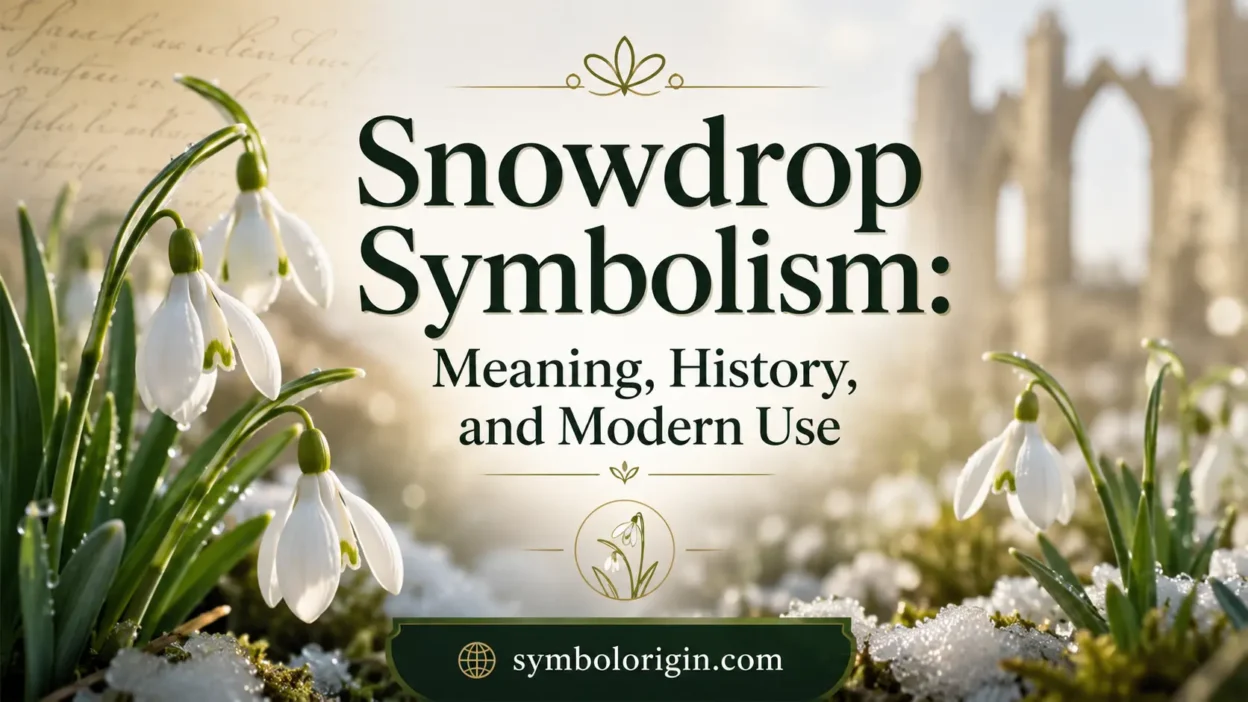
Snowdrops are small white flowers that appear when winter has not quite released its grip. Snowdrop symbolism centers on hope, renewal, resilience, and the promise of better conditions ahead, largely because these flowers bloom earlier than most familiar spring plants.
In the United States, snowdrops are most often encountered in gardens, woodland-style landscapes, floral imagery, birth-flower designs, and seasonal art. They are not native to North America, but the common snowdrop has naturalized in parts of the eastern United States and is valued as an early sign that winter is ending.
Their meaning also carries older European layers. Religious associations with purity, 19th-century flower language, regional superstitions, and spring traditions have all shaped how the flower is understood today.
Quick Answer
Snowdrop symbolism commonly represents hope, renewal, resilience, and new beginnings in modern American culture because the flower appears near the end of winter. Historically, snowdrops have also been associated with purity, Candlemas, seasonal transition, and, in some regional folklore, mourning or bad luck.
TL;DR
- Snowdrops most commonly symbolize hope and approaching renewal.
- Their early flowering makes them natural symbols of resilience.
- White blossoms contribute associations with purity and simplicity.
- Nineteenth-century flower language explicitly connected snowdrops with hope.
- Some British folklore gives snowdrops darker associations with death.
- Modern Americans also know snowdrops as a January birth flower.
What Snowdrops Look Like and Why Their Timing Matters
Snowdrops belong to the genus Galanthus. The common snowdrop, Galanthus nivalis, is a small bulbous perennial with narrow green leaves and solitary, nodding white flowers. The flower has three larger outer segments surrounding three smaller inner segments, which are commonly marked with green.
Their appearance alone does not explain their symbolic importance. Timing does.
Snowdrops flower in late winter or very early spring, sometimes emerging while snow remains on the ground. In colder American gardens, this makes them one of the first obvious signs that seasonal change has begun. The plant may look delicate, but it appears at a time when many other flowers remain dormant.
That contrast — white blossoms against frozen or bare ground — is the foundation for much of their symbolism.
What Snowdrops Commonly Mean in the United States
For most Americans who attach symbolic meaning to snowdrops, the flower carries positive associations. Hope is the clearest, followed by renewal, perseverance, fresh starts, and quiet optimism.
These meanings overlap, but they are not identical.
| Context | Meaning in the USA | Common Associations | Notes |
|---|---|---|---|
| Early spring | Hope | Warmer days, change | The strongest traditional meaning |
| Personal change | New beginnings | Recovery, fresh starts | Often used during transitions |
| Difficult periods | Resilience | Endurance, persistence | Linked to blooming in cold weather |
| White floral imagery | Purity | Simplicity, sincerity | Influenced partly by older traditions |
| January symbolism | Birth and renewal | New year, January birthdays | Snowdrop is a January birth flower |
| Memorial use | Hope after loss | Remembrance, consolation | Context can shift the meaning toward grief |
The flower usually communicates optimism without the exuberance of a sunflower or the romantic intensity of a rose. A snowdrop suggests something quieter: improvement has started, even if circumstances are not yet easy.
Why the Snowdrop Became a Symbol of Hope
Hope is not simply a modern marketing interpretation of the flower. It has a documented place in older flower-language traditions.
By the mid-19th century, American flower-language publications were explicitly assigning the snowdrop the meaning “hope.” The explanation was closely connected to the flower appearing during an otherwise bleak season and announcing the approach of spring.
That association remains intuitive today. A snowdrop does not wait for spring to be fully established. It appears while winter conditions may still be visible.
For that reason, the flower works particularly well as a symbol of hope that is based on evidence rather than certainty. Symbolically, the difficult season has not completely disappeared, but the first indication of change is already present.
This is why snowdrops may feel appropriate during recovery, periods of uncertainty, major life transitions, or the first stage of rebuilding after disappointment.
Renewal, Rebirth, and New Beginnings
Renewal is closely related to hope but emphasizes a different idea.
Hope looks forward. Renewal describes life beginning again.
Snowdrops emerge from perennial bulbs and return after a period of winter dormancy. Their reappearance naturally fits the annual cycle in which dormant landscapes begin producing visible growth again.
In personal symbolism, this can represent starting over after a difficult period, returning to something meaningful, recovering confidence, beginning a new stage of life, or accepting change after an ending.
Because they bloom around the transition from winter toward spring, snowdrops can also fit New Year imagery. Their connection with January strengthens this interpretation in American birth-flower traditions. Current U.S. gardening and almanac traditions commonly recognize the snowdrop alongside the carnation as a January birth flower.
Resilience and Strength Without Aggression
Snowdrops look fragile. Their stems are slender, their flowers hang downward, and their coloring is understated.
Yet they appear during cold conditions that seem inhospitable to flowering plants.
That visual contradiction makes them useful symbols of resilience.
Snowdrop resilience is different from the symbolism of an oak tree, lion, or other image associated with obvious physical power. It represents survival without displaying force. The message is closer to persistence, adaptability, and the ability to continue despite difficult surroundings.
For people choosing the flower after illness, grief, personal disruption, or another demanding experience, this distinction can matter. The snowdrop does not imply that hardship never happened. It suggests that growth can occur while traces of hardship remain.
Purity, Innocence, and Simplicity
The snowdrop’s white coloring has contributed to its association with purity.
White flowers have carried many different meanings across Western traditions, including innocence, peace, chastity, sacredness, mourning, and simplicity. A flower’s color therefore cannot determine its meaning by itself.
For snowdrops, the purity association became especially important through Christian traditions surrounding the Virgin Mary and Candlemas. Their plain white appearance also encouraged later interpretations involving modesty and innocence.
In modern American design, however, purity does not necessarily carry a religious meaning. A snowdrop illustration on wedding stationery, minimalist jewelry, or home decor may simply communicate freshness, sincerity, simplicity, or a clean beginning.
The downward-facing flower can also appear visually modest rather than showy, which reinforces the idea of quietness and humility.
Candlemas and Christian Snowdrop Symbolism
One of the flower’s most significant historical religious associations developed around Candlemas, traditionally observed on February 2.
Snowdrops became known in parts of Europe by names such as “Candlemas bells,” reflecting the fact that their flowering season coincided with the Christian feast associated with the Presentation of Jesus and the Purification of Mary. Their white flowers consequently became linked with Marian purity.
This background helps explain why purity became attached to the snowdrop alongside hope.
Christian interpretations may also extend the flower’s seasonal pattern into broader ideas of light following darkness, spiritual renewal, and life continuing after hardship. Those interpretations can be meaningful within Christian settings, but they should not be presented as the flower’s only meaning.
In contemporary American culture, someone can use a snowdrop as a symbol of hope without any religious intention.
Snowdrops in Nineteenth-Century Flower Language
Floriography — the practice of assigning messages to particular flowers — became especially fashionable during the 19th century.
The system was never completely standardized. Different flower dictionaries could assign different meanings to the same plant. Still, some associations became unusually persistent, and the snowdrop’s connection with hope is one of them.
An 1851 flower-language work published in Philadelphia placed the snowdrop under hope, explaining its meaning through the flower’s appearance before spring had fully arrived.
That is particularly relevant to American symbolism because it shows that the hope association was already circulating in the United States during the 1800s rather than being imported only through recent online flower guides.
Modern interpretations such as resilience and fresh beginnings expand that older idea rather than replacing it.
Snowdrop Symbolism in American Gardens
In the United States, snowdrops are primarily garden plants rather than major national or ceremonial symbols.
The common snowdrop originated outside North America, but it has escaped cultivation and naturalized in parts of the eastern continent. In suitable colder regions, gardeners value it because it flowers very early and can gradually form colonies.
This garden behavior strengthens its symbolic role.
A patch of snowdrops returning year after year under deciduous trees can become a personal seasonal marker. For a household, garden, or family, their first flowers may represent the practical end of the darkest part of winter.
Unlike many floral symbols whose meanings come primarily from mythology or ceremonial custom, much of the snowdrop’s modern appeal remains tied to something observable: it really does flower unusually early.
The January Birth Flower Meaning
Snowdrops are widely recognized in contemporary American birth-flower lists as one of the flowers associated with January, usually alongside carnations.
That pairing gives snowdrops an additional set of personal meanings.
For a January birthday, a snowdrop can represent optimism, perseverance, individuality, or the beginning of another chapter. It can also reference the new calendar year without relying on obvious New Year’s imagery.
This makes snowdrops suitable for birth-flower necklaces, prints, tattoos, cards, and personalized gifts.
A January snowdrop design does not have to carry every historical association of the flower. Sometimes its meaning is simply personal: it marks someone’s birth month.
Snowdrops in European Spring Traditions
Although the American interpretation is usually centered on hope and early spring, European traditions add useful context.
In Romania and Moldova, snowdrops are closely associated with the arrival of spring and can appear around early-March customs connected with Mărțișor. Some regional legends describe Spring protecting or uncovering a snowdrop during a struggle with Winter, turning the small flower into an emblem of the seasonal transition.
Such stories reinforce meanings of renewal and perseverance, but they belong to particular cultural traditions. They should not be blended indiscriminately with British, American, Christian, or classical symbolism.
That distinction matters because floral meanings rarely come from one universal source. The same flower can accumulate different interpretations as it moves between regions, religions, literary traditions, and gardening cultures.
Emotional and Psychological Meaning
Emotionally, snowdrops communicate a restrained form of optimism.
They are especially fitting when someone wants to acknowledge that circumstances have been difficult without making an unrealistically cheerful statement. The flower’s seasonal position allows it to symbolize progress that is still incomplete.
That can make snowdrop imagery relevant to recovery after a setback, adjusting after major change, rebuilding confidence, remembering someone while continuing forward, leaving an unhealthy situation, or beginning again later in life.
The symbolic emphasis is less on dramatic transformation and more on the first visible sign that movement is occurring.
This is also why a single snowdrop and a large group of snowdrops can feel different. One flower may suggest individual perseverance, while a naturalized group can suggest renewal spreading or life returning to an entire landscape.
Snowdrops in Tattoos, Jewelry, Gifts, and Decor
Modern use has expanded snowdrop imagery beyond gardens.
A snowdrop tattoo commonly works as a personal emblem of hope, survival, renewal, or a January birth month. Someone may choose a single flower for simplicity or combine it with dates, names, other birth flowers, or seasonal imagery.
In jewelry, snowdrops can communicate similar ideas more subtly. Pendants and engraved botanical designs allow people to carry a personal symbol without making its meaning obvious to everyone else.
Snowdrops can also appear in memorial cards or remembrance art. In that setting, hope becomes more reflective: grief exists, but so does the possibility of continuing forward.
For weddings and new-home gifts, the flower can shift toward fresh beginnings. In winter and early-spring decor, it may function primarily as a seasonal botanical motif rather than carrying a specific coded message.
Context determines which interpretation becomes most important.
Why Snowdrops Can Also Symbolize Mourning or Bad Luck
Not every traditional snowdrop meaning is positive.
Regional folklore recorded in Britain includes beliefs that bringing snowdrops indoors could bring bad luck, illness, or even predict a death. In some accounts, a single snowdrop carried a particularly ominous meaning. These beliefs have been reported across several generations and areas rather than representing one universally accepted rule.
One suggested explanation is the flower’s association with churchyards and the resemblance of its hanging white bloom to a shroud. Older religious connections with purity and white ceremonial imagery may also have helped create conflicting interpretations.
For a modern American audience, however, death is not the snowdrop’s dominant meaning.
The darker interpretation is best understood as regional folklore. It can be relevant when studying British plant traditions or historical superstition, but it should not override the much better established modern association with hope and spring renewal.
Common Misunderstandings About Snowdrop Symbolism
The biggest mistake is treating every snowdrop story as though it belongs to one continuous ancient tradition. It does not.
Its modern symbolism comes from several layers: the plant’s actual flowering behavior, European religious customs, 19th-century flower language, local folklore, garden culture, birth-flower traditions, and newer personal uses.
Another mistake is assuming that white automatically means innocence. White can also represent mourning, sacredness, winter, peace, or simplicity depending on culture and setting.
Likewise, resilience should not be interpreted as an ancient coded meaning. It is largely a modern extension of something people can easily observe — the small plant flowering during the coldest part of the growing season.
Online retellings sometimes assign a single legendary “origin” to the snowdrop. Such stories are better treated as folklore or later interpretation unless they can be placed within a specific historical tradition.
How the Meaning of the Snowdrop Has Evolved
Snowdrop symbolism has remained surprisingly consistent at its center while expanding around the edges.
The plant’s early flowering first made it an obvious seasonal marker. Religious custom added ideas of purity and sacred renewal. Nineteenth-century flower language strengthened the association with hope. Regional folklore introduced contrasting ideas of mourning and misfortune.
Modern culture has broadened the flower again.
Today, a snowdrop might represent a January birthday, recovery from adversity, a new relationship, remembrance of someone who died, a personal fresh start, or simply anticipation of spring.
What connects most of these meanings is transition.
The snowdrop stands at a boundary: winter and spring, dormancy and growth, difficulty and improvement, an ending and what follows it.
Frequently Asked Questions
What does a snowdrop symbolize most commonly?
The most established modern meaning is hope, specifically the kind that shows up during difficult circumstances rather than after they’ve ended. Renewal, resilience, and new beginnings all follow naturally from that same root idea, since snowdrops flower precisely at the moment winter is losing its grip but hasn’t fully released it.
Is snowdrop symbolism positive or negative?
Overwhelmingly positive in modern American use — hope, perseverance, and renewal dominate how the flower is read today. Older British folklore connecting snowdrops with bad luck or death does exist, but it’s a regional superstition rather than a competing universal meaning, and it carries far less weight in contemporary American symbolism.
What does a snowdrop tattoo mean?
A snowdrop tattoo commonly represents survival, hope after hardship, a quiet kind of resilience, or a personal fresh start. It also works well as a January birth-flower tattoo, which gives the design a more specific, personal anchor — a birthday or a family connection — rather than relying solely on the flower’s broader symbolic history.
What do snowdrops mean in Christianity?
Historically, snowdrops became tied to Candlemas and the purity of the Virgin Mary, largely because their white blooms and early-February flowering lined up with that feast day — hence names like “Candlemas bells.” Modern Christian interpretations sometimes extend this into broader themes of light following darkness or renewal after hardship, though that reading is an extension rather than the flower’s only meaning.
Are snowdrops a symbol of death?
In certain regional British folklore, yes — some traditions warned against bringing snowdrops indoors, associating them with bad luck or an approaching death, possibly linked to their resemblance to a shroud and their presence in churchyards. In contemporary American symbolism, though, this reading is a minority folklore tradition, not the dominant meaning, which remains firmly tied to hope and renewal.
Is the snowdrop a January birth flower?
Yes — contemporary American birth-flower traditions list the snowdrop alongside the carnation as January’s flower. Its early blooming season makes it a fitting match for the month, reinforcing themes of new beginnings, quiet optimism, and perseverance right at the start of the calendar year.
What does giving someone snowdrops mean?
It typically communicates encouragement, hope, or support during a period of change or difficulty, making it a thoughtful gift for someone going through a transition or recovery. Actual cut snowdrops are less common in American florist arrangements than snowdrop-themed plants, prints, or botanical gifts, since the flower’s real cultural weight lives more in its symbolism than in the cut-flower trade.
Why does the snowdrop’s timing matter more than its appearance for its symbolism?
Because the flower itself is genuinely delicate and unremarkable-looking — its real symbolic power comes entirely from when it chooses to bloom, not from any dramatic visual feature. A flower that looked identical but bloomed in June would carry none of the same weight; it’s specifically the contrast between a fragile white bloom and still-frozen ground that makes the hope symbolism feel earned rather than arbitrary.
How is the snowdrop’s meaning different from a flower like the sunflower or rose?
Snowdrop symbolism is deliberately quieter and more provisional — it represents hope that’s just beginning to show itself, not hope already confirmed or a fully arrived celebration. A sunflower suggests established brightness and a rose suggests declared passion, while a snowdrop suggests something more tentative and honest: the first real evidence that things are starting to improve, even while difficulty is still visibly present.
Do all snowdrop traditions around the world share the same meaning?
No — traditions in Romania and Moldova, for instance, tie snowdrops to specific early-spring customs like Mărțișor and regional legends about Spring overcoming Winter, which are culturally distinct from British, American, or Christian interpretations. These traditions can reinforce similar themes of renewal, but they shouldn’t be blended together as if they were one continuous global belief system; each developed independently within its own cultural context.
Conclusion
The snowdrop earns its symbolism through timing alone, which is rarer than it sounds. Most flowers carry meaning because of what they look like, what they’re used for, or what story got attached to them generations ago. The snowdrop’s whole reputation rests on a single observable fact: it blooms before it’s supposed to, pushing up through cold ground while almost everything else is still waiting. That’s not folklore. That’s just what the plant does every year, and the symbolism simply followed the evidence.
That honesty is what separates hope, as the snowdrop represents it, from simple optimism. The flower doesn’t appear after winter ends — it appears while winter is still technically in charge, which is exactly why it resonates with people in the middle of something difficult rather than people already past it. Candlemas tradition, Victorian flower dictionaries, and modern birth-flower culture all found slightly different words for the same underlying observation: something small and unlikely showed up early, and that counts for something.
That’s the version of hope worth taking from the snowdrop — not the confident kind that arrives once things are already fine, but the more fragile, more honest kind that shows up while the ground is still frozen, simply because it’s true that spring is coming.