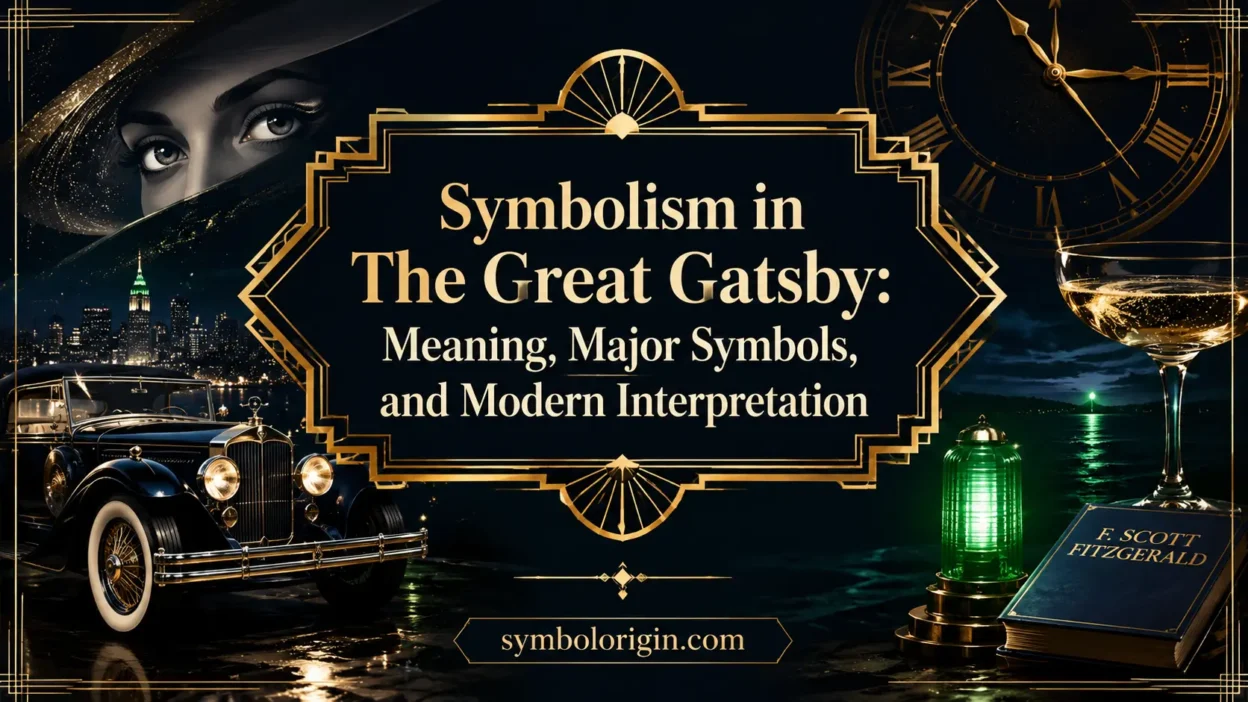
F. Scott Fitzgerald builds The Great Gatsby around objects, places, colors, and repeated images that carry meaning beyond the plot. Symbolism in The Great Gatsby helps explain why a story about one man’s obsession with Daisy Buchanan also became a broader examination of wealth, class, ambition, memory, and the American Dream.
Published in 1925 and set mainly during the summer of 1922, the novel places glittering mansions, expensive cars, crowded parties, and fashionable clothing beside industrial waste, loneliness, violence, and death. That contrast is central to Fitzgerald’s method. The attractive surface often hides something damaged underneath.
The symbols are also connected. The green light represents a desired future, the clock points toward an unrecoverable past, and the water between Gatsby and Daisy turns emotional distance into physical space. Taken together, these images show how badly Gatsby wants reality to conform to the dream he has created.
Quick Answer
Symbolism in The Great Gatsby most commonly represents the conflict between ambition and reality, especially through wealth, social class, love, and the American Dream. The green light, valley of ashes, Eckleburg billboard, colors, cars, parties, and repeated images of time show how hope can become distorted when people try to purchase status or recreate the past.
TL;DR
- The green light represents Gatsby’s desired future and unreachable dream.
- The valley of ashes exposes the human cost of wealth.
- Eckleburg’s eyes suggest judgment in a morally uncertain society.
- East and West Egg represent different forms of American wealth.
- Cars connect status, carelessness, mobility, and destructive privilege.
- Clocks and water emphasize Gatsby’s struggle against time and distance.
How Symbolism Works in The Great Gatsby
Fitzgerald rarely gives a symbol one fixed definition. Instead, an image changes meaning as the story develops.
The green light begins as an actual dock light across Long Island Sound. Because Gatsby repeatedly looks toward it and associates that direction with Daisy, it gradually becomes connected with longing. By the final pages, Nick expands it beyond Gatsby’s romance and links it with the human tendency to pursue a future that continually moves farther away.
This method appears throughout the novel. A car can represent glamorous modern life in one scene and lethal irresponsibility in another. White can suggest elegance while also surrounding characters who are far from innocent. Wealth can look beautiful while protecting people from the consequences of their actions.
That flexibility is why the novel rewards close reading. Its symbols are not simply codes in which one object always equals one idea.
The Green Light: Hope, Daisy, and the Future
The green light at the end of Daisy’s dock is the novel’s most famous symbol.
When Nick first sees Gatsby outside his mansion, Gatsby reaches toward the dark water. Nick can make out only a distant green light. Gatsby’s gesture immediately connects the light with desire, distance, and something he cannot yet possess.
At first, the light is closely tied to Daisy. Gatsby has built his life around returning to her after years apart. Yet Daisy represents more than romantic love to him. She belongs to the wealthy social world he once entered as an outsider, so winning her also seems to promise acceptance, status, and completion.
Once Gatsby reunites with Daisy, the light loses some of its previous significance. The object has not changed, but Gatsby’s relationship to it has. The dream seemed perfect while it remained distant.
By the ending, the light becomes broader still. Nick connects Gatsby’s pursuit with the urge to believe that fulfillment waits somewhere ahead, even when experience repeatedly proves otherwise.
The green light therefore represents hope, but Fitzgerald makes that hope complicated. It can motivate people to transform their lives, yet it can also keep them chasing an imagined future that reality cannot deliver.
Daisy Buchanan as a Symbol of Wealth and Idealized Desire
Daisy is a character with her own fears, limitations, and choices, so reducing her entirely to a symbol oversimplifies the novel. Still, Gatsby turns her into something larger than the actual woman.
He remembers a younger Daisy and builds an ideal around her. Over time, his desire becomes connected with her social position, expensive surroundings, beauty, and the security of inherited wealth.
The connection becomes especially clear when Gatsby observes that Daisy’s voice is “full of money.” Nick immediately understands the association: her attraction is inseparable from the privileged world that formed her.
This distinction matters. Gatsby does not simply want Daisy as she exists in 1922. He wants Daisy, his younger self, his lost opportunity, and the social future he imagined years earlier.
His tragedy comes partly from confusing a human being with an ideal.
The Valley of Ashes: Inequality Behind the Glamour
Between the wealthy communities of Long Island and Manhattan lies the valley of ashes, a bleak industrial landscape covered in dust and waste.
Fitzgerald describes ash-covered houses, chimneys, cars, workers, and heaps of industrial residue. George and Myrtle Wilson live there, physically positioned between the luxurious worlds through which richer characters move.
The setting creates a sharp contrast with Gatsby’s mansion and the Buchanans’ home. Those places display the rewards of wealth. The valley suggests what prosperity can leave behind.
Its importance is therefore social as well as visual. Gatsby, Tom, Daisy, and their friends can travel through this neglected landscape without belonging to it. George Wilson cannot.
For American readers, the valley is often understood as a criticism of the idea that economic prosperity benefits everyone equally. The dazzling consumer culture of the Jazz Age exists beside workers, pollution, exploitation, and people with little control over their circumstances. The historical 1920s were themselves marked by rapid technological change, consumer spectacle, celebrity culture, and significant economic inequality.
The Eyes of Doctor T. J. Eckleburg: Judgment Without Certainty
Above the valley of ashes stands an old advertisement featuring enormous blue eyes behind yellow spectacles.
The billboard once promoted an eye doctor. By the time Nick sees it, the advertisement has faded, yet the eyes continue looking over the wasteland.
Readers often interpret the eyes as representing moral observation or judgment. That reading becomes especially important when George Wilson, devastated by Myrtle’s death, associates the eyes with God’s awareness of human behavior.
But Fitzgerald includes an important complication: another character reminds Wilson that he is looking at an advertisement.
That tension makes the symbol more interesting. The eyes can suggest a desire for moral judgment in a world where reliable moral authority seems absent. They may appear godlike, but they belong to a decaying commercial sign.
The image therefore joins spirituality and advertising, two very different systems of meaning. In the materialistic world of the novel, even a symbol that looks like divine observation originates in commerce.
East Egg and West Egg: Two Kinds of Wealth
The geography of the novel separates wealth into different social categories.
East Egg is associated with families such as the Buchanans, whose money and status existed before the events of the novel. West Egg contains people such as Gatsby, who possess enormous wealth but do not automatically receive the same social legitimacy.
Nick immediately describes the fashionable homes across the bay as glittering white palaces. Gatsby, despite his mansion, remains socially vulnerable because money alone cannot give him the history and family connections that Tom assumes as his birthright.
This makes the two Eggs symbols of class division within wealth itself.
| Context | Symbolic Meaning | Main Association | Why It Matters |
|---|---|---|---|
| Green light | Desired future | Hope and longing | Gatsby cannot fully reach his imagined life |
| Valley of ashes | Social cost | Poverty and industrial waste | Wealth exists beside neglect |
| Eckleburg’s eyes | Uncertain judgment | Morality and surveillance | A commercial sign becomes almost religious |
| East Egg | Inherited status | Old money | Wealth is supported by established privilege |
| West Egg | New wealth | Self-invention | Money cannot guarantee acceptance |
| Gatsby’s car | Status and danger | Mobility and excess | Luxury becomes connected with destruction |
The distinction exposes a weakness in Gatsby’s version of self-invention: he can become rich enough to live across the bay from Daisy, but Tom can still dismiss him as socially inferior.
Gatsby’s Mansion and Parties: Spectacle Without Belonging
Gatsby’s estate seems at first to represent success. His house is enormous, his gardens glow with lights, orchestras play, alcohol flows, and crowds arrive from New York.
Yet Gatsby himself is strangely isolated from the celebration.
Guests come without knowing him. Rumors about his identity circulate freely. After the parties end, the host remains alone. Fitzgerald repeatedly contrasts the crowd surrounding Gatsby with Gatsby’s personal solitude.
The parties therefore symbolize the difference between attention and connection.
Gatsby can buy spectacle. He can attract hundreds of people. What he cannot purchase is the exact relationship, history, and social acceptance he wants.
That point becomes even clearer after his death, when most of the people who enjoyed his hospitality disappear.
Gatsby’s Shirts: Wealth Made Visible
One of the novel’s stranger emotional scenes occurs when Gatsby displays his expensive shirts to Daisy. He throws richly colored garments into a growing pile, and Daisy begins crying.
The shirts have several possible meanings.
They provide physical evidence of Gatsby’s transformation. The young man Daisy knew before the war lacked the wealth he now possesses. The shirts allow him to display success in a form that can be touched, seen, and admired.
They also reveal how strongly emotion and material goods overlap in Gatsby’s world. His romantic reunion quickly becomes a tour of possessions.
Daisy’s reaction does not have to mean that she literally cries because shirts are beautiful. The scene works because the clothes carry everything that has changed during their separation: money, lost years, altered possibilities, and Gatsby’s effort to prove that he has finally become worthy of her world.
Cars: Freedom, Status, and Carelessness
Automobiles were important markers of mobility and modernity in the 1920s, and Fitzgerald repeatedly uses them to connect wealth with danger.
Gatsby’s car is large, conspicuous, and expensive. It advertises his success wherever he travels.
Cars also allow characters to cross social boundaries quickly. Tom moves between East Egg, Manhattan, and the Wilsons’ garage. Gatsby travels between his invented identity and the social world he hopes to enter.
But the novel steadily turns automobile imagery darker.
An early party ends with a wrecked car outside Gatsby’s property. Later, Gatsby’s yellow car becomes the vehicle that kills Myrtle Wilson.
The automobile therefore becomes one of Fitzgerald’s clearest symbols of careless privilege: immense freedom without an equal willingness to accept responsibility.
Color Symbolism: Green, White, Yellow, Gold, Blue, and Gray
Color appears so frequently in the novel that no single chart can explain every use. Still, several patterns are especially important.
Green is most clearly connected with desire, possibility, and the future through the dock light.
Gray dominates the valley of ashes. It suggests exhaustion, lifelessness, industrial residue, and a world stripped of the brightness associated with wealthy spaces.
Yellow and gold often accompany money, display, artificial brightness, and luxury. Fitzgerald even describes music at Gatsby’s party through a yellow image, blending sound with the atmosphere of excess.
White surrounds Daisy and elite spaces, but it should not automatically be read as moral innocence. Daisy’s world may look polished and pure while concealing dishonesty, adultery, violence, and avoidance of responsibility.
Blue frequently appears around distance, atmosphere, gardens, cars, and the Eckleburg eyes. Depending on the scene, it can contribute to a dreamlike feeling or reinforce emotional separation.
Pink, especially Gatsby’s pink suit, highlights his conspicuous style. Tom even uses the suit to mock Gatsby’s claim to elite credentials, revealing how clothing becomes part of class judgment.
The Clock and Gatsby’s Fight Against Time
Few scenes state Gatsby’s problem as neatly as his reunion with Daisy at Nick’s house.
Nervous and uncomfortable, Gatsby leans against an old mantel clock and nearly knocks it over. He catches it before it falls. Moments later, the conversation establishes exactly how many years have passed since he and Daisy last knew each other.
The symbolism is difficult to miss, but it should not be reduced to “clock equals time.”
Gatsby is metaphorically trying to catch time before it falls away.
He believes that enough money, determination, and planning can restore an earlier emotional reality. When Nick warns him that the past cannot simply be repeated, Gatsby rejects the idea.
The clock exposes the impossible part of his dream: Gatsby does not merely want another chance with Daisy. He wants the intervening years to stop mattering.
Water and Distance: Why Daisy Remains Across the Bay
Long Island Sound separates Gatsby from Daisy’s home.
That physical distance matters because Gatsby’s central desire is repeatedly staged as something visible but separated from him. He can see the direction of Daisy’s world, yet he begins the novel unable to possess it.
Water traditionally creates boundaries, but Fitzgerald gives the image a specifically American dimension at the end of the novel. Nick looks beyond Gatsby’s personal story and imagines earlier European sailors encountering the American continent as something new and full of possibility.
Gatsby’s dream is then connected to a larger cycle of American desire: seeing something ahead, imagining what it could provide, and continuing toward it even as complete fulfillment remains unavailable.
The final image of boats struggling against a current brings the future and past together. People move forward while memory continually pulls backward.
Weather and Seasons Reflect Emotional Pressure
Fitzgerald also uses weather to reinforce changes in mood.
When Gatsby prepares to reunite with Daisy, rain accompanies his nervousness and uncertainty. As their meeting becomes warmer, the weather improves.
Later, extreme summer heat surrounds the confrontation at the Plaza Hotel. Characters become increasingly uncomfortable and irritable as Gatsby challenges Tom and demands that Daisy reject her marriage.
Weather does not control the characters, but it externalizes emotional conditions. Rain accompanies vulnerability. Heat intensifies pressure. Autumn approaches as Gatsby’s dream collapses.
This movement from summer abundance toward seasonal decline helps give the novel its sense that a brief period of possibility is ending.
The American Dream Behind the Novel’s Symbols
The symbols become most coherent when read together as a commentary on the American Dream.
Gatsby seems to embody self-creation. Born James Gatz, he rejects his origins, invents Jay Gatsby, acquires wealth, builds an extraordinary home, and attempts to enter a more prestigious social world.
His achievement is real, but it does not produce the outcome he expects.
Money gives him access without full acceptance. The mansion creates spectacle without secure belonging. The car provides mobility but becomes connected with death. Daisy appears to promise fulfillment but cannot match the ideal Gatsby has constructed around her.
For this reason, the novel is commonly read as a critique of an American Dream distorted by wealth, status, consumption, and class privilege. At the same time, Fitzgerald does not treat the desire to dream as entirely foolish. Gatsby’s hope and capacity for self-invention remain part of what makes him compelling.
The criticism is aimed less at aspiration itself than at the belief that wealth can make an imagined future perfect.
Carelessness Is the Moral Pattern Connecting the Symbols
A useful way to connect the novel’s symbols is through the idea of carelessness.
Beautiful objects repeatedly become associated with damaged lives. Cars become wrecks. Parties leave debris behind. Wealth permits escape from consequences. Myrtle dies on the road. Gatsby accepts responsibility for an accident he did not cause, while Daisy retreats into her protected life with Tom.
Near the ending, Nick describes Tom and Daisy as people who damage others and then withdraw behind money and privilege.
This is where the symbolism of the valley, automobile, mansion, and class geography comes together.
The novel’s wealthy world is not criticized merely for being extravagant. It is criticized because privilege allows certain characters to create consequences that other people must endure.
Why These Symbols Still Matter to American Readers
A century after the novel’s 1925 publication, its symbols remain familiar in American classrooms and popular culture. The green light in particular has become shorthand for unreachable ambition, while Gatsby’s parties continue to represent the seductive surface of Jazz Age excess. The novel remains prominent in American literary education and cultural discussion, including renewed attention surrounding its 2025 centennial and continuing national reading programs.
Its symbolism also survives because the questions behind the images remain recognizable.
Can people reinvent themselves completely? Does wealth erase class barriers? When does ambition become self-deception? Can success compensate for lost time? Why do societies celebrate glamour while overlooking the people who bear its costs?
Fitzgerald gives those questions physical forms: a green light, a dusty wasteland, an old clock, an expensive automobile, and two wealthy communities facing each other across the water.
Common Misunderstandings About Gatsby Symbolism
One common mistake is treating every color or object as if Fitzgerald assigned it a single permanent definition.
He did not.
Green can be associated with Gatsby’s future, but context still matters. White may appear around elegance without proving innocence. Yellow can suggest luxury in one passage and become attached to danger through Gatsby’s car.
Another oversimplification is saying that the green light represents only Daisy. Daisy is its immediate focus, but the ending deliberately broadens the image into something larger than Gatsby’s romance.
The Eckleburg billboard is similarly open. George Wilson interprets the eyes religiously, yet the text reminds readers that they belong to an advertisement. The ambiguity is part of the symbol rather than a problem that needs one definitive answer.
Strong interpretation therefore begins with what the image does in a particular scene before assigning a larger meaning.
Frequently Asked Questions
What does the green light symbolize in The Great Gatsby? The green light initially represents Gatsby’s desire for Daisy and the future he imagines building with her. By the novel’s final page, though, Nick deliberately widens it into something larger — a symbol for the human habit of reaching toward a fulfillment that keeps retreating just out of grasp, no matter how close it seems.
What does the valley of ashes symbolize? It represents the neglected, unglamorous underside of the era’s prosperity — industrial waste, poverty, and the people who never get to enjoy the wealth passing above and around them. Its placement directly between Long Island’s mansions and Manhattan is deliberate, forcing wealthy characters to physically pass through the cost of their comfort without ever truly seeing it.
What do the eyes of Doctor T. J. Eckleburg symbolize? Most readers connect them to judgment, surveillance, or a search for moral authority in a world that otherwise seems to lack one — a reading George Wilson makes explicit when he treats the eyes as God’s. Fitzgerald complicates that reading deliberately, though, by reminding readers the eyes belong to a faded advertisement, letting the symbol hold both religious weight and commercial emptiness at once.
What does Gatsby’s car symbolize? Early on, it represents wealth, modern mobility, and personal freedom — a rolling advertisement for his success. That meaning curdles as the plot progresses: after it kills Myrtle Wilson, the same car comes to represent the reckless, consequence-free way privilege lets certain people move through the world.
Why are colors so important in The Great Gatsby? Fitzgerald uses color constantly to link scenes with underlying ideas — money, status, desire, decay — but deliberately without a fixed, one-to-one code. White drapes over elegant spaces without guaranteeing innocence, yellow signals luxury in one scene and danger in another (via Gatsby’s car), and green shifts from literal dock light to a symbol for ambition itself. The patterns matter more than any single color’s “meaning.”
Is The Great Gatsby mainly criticizing the American Dream? Largely, yes, but with real nuance — the novel pushes hard against the idea that money and reinvention can manufacture belonging or restore the past. It’s not a simple takedown, though: Fitzgerald treats Gatsby’s capacity for hope with genuine sympathy, reserving his sharpest judgment for the careless privilege of Tom and Daisy rather than for ambition itself.
Why does Fitzgerald give the green light more than one meaning over the course of the novel? Because Gatsby’s relationship to his own dream changes, and the light tracks that change rather than staying fixed. While Daisy remains unreachable, the light represents pure longing; once Gatsby actually reunites with her, Nick notes that some of its enchantment vanishes — proof that the object was never really about Daisy alone, but about the distance itself.
What is the significance of East Egg versus West Egg beyond just “old money” and “new money”? The distinction exposes that wealth alone was never going to solve Gatsby’s real problem. He can out-spend anyone in the novel, but Tom can still dismiss him socially because West Egg money lacks the inherited history, family name, and unspoken credentials that East Egg treats as a birthright — showing that class in the novel runs deeper than a bank balance.
Why does Fitzgerald connect Gatsby’s shirts to Daisy’s tears instead of a more conventional romantic gesture? Because the scene captures exactly how thoroughly emotion and material wealth have merged in Gatsby’s world — his reunion with Daisy naturally becomes a tour of possessions rather than staying purely personal. Daisy’s tears aren’t really about the shirts themselves; they register everything the shirts represent: the years apart, the money that has changed him, and the effort behind proving himself worthy of her world.
How does the ending’s imagery of boats against the current tie all the novel’s symbols together? It fuses the green light’s forward-reaching hope with the clock’s backward-pulling memory into one final image — people pushing toward a future they can see while the past keeps dragging them back. Nick expands that image beyond Gatsby specifically, connecting it to a broader American pattern of chasing possibility that, Fitzgerald suggests, may never fully arrive no matter how close it appears.
Conclusion
What makes symbolism in The Great Gatsby endure isn’t that Fitzgerald hid one secret meaning in each object for readers to decode. It’s that he refused to let any single image sit still. The green light isn’t just hope; it’s hope that changes shape depending on how close Gatsby gets to it. The Eckleburg billboard isn’t just judgment; it’s judgment that turns out to be advertising. Even white, the color that should be safest, drapes over some of the novel’s most careless people. Fitzgerald built a book where beauty and damage are never fully separable — which is exactly the point.
That refusal to simplify is what lets the symbols work together instead of just piling up. The green light shows what Gatsby is reaching for. The clock shows what he can’t get back. The valley of ashes shows who pays for the reaching. The car shows what happens when reaching turns careless. None of these images explain the American Dream by themselves — but stacked together, they trace its entire arc: aspiration, self-invention, collision with reality, and the wreckage left for someone else to clean up.
That’s why the novel still lands a century later. Gatsby’s specific dream was Daisy and 1922 and a green light across the water. The shape of that dream — reaching for something that recedes exactly as fast as you approach it — never went out of date at all.