
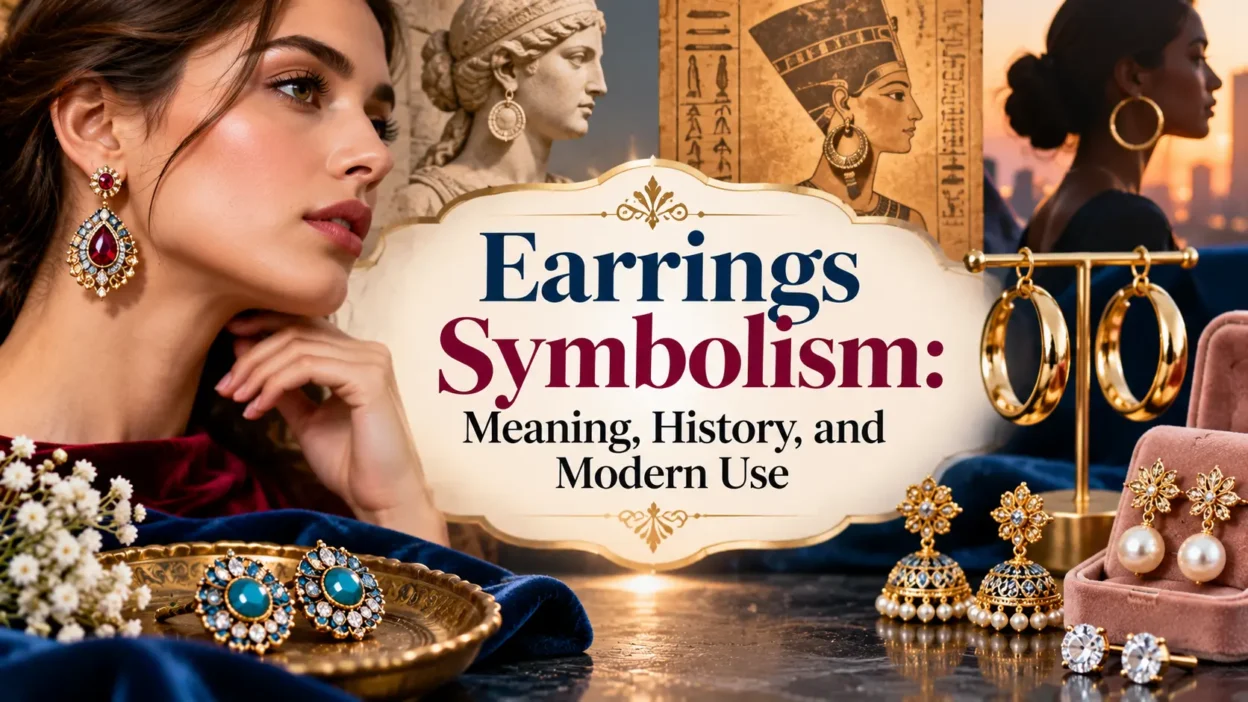
Earrings are more than decorative accessories. Across different societies, they have marked identity, social position, wealth, gender, belonging, remembrance, and personal taste. Today, earrings symbolism is often connected with self-expression, beauty, individuality, relationships, and cultural identity.
The meaning of an earring depends heavily on its design, material, wearer, and setting. A simple gold hoop can suggest confidence or personal style, while a pearl earring may evoke elegance, marriage, remembrance, or family tradition. A pair worn for a religious ceremony can carry a very different meaning from the same style worn as everyday fashion.
In the United States, earrings have become widely accessible forms of personal adornment. People use them to communicate aspects of personality and identity without necessarily following one fixed symbolic system.
Quick Answer
Earrings commonly symbolize personal style, identity, beauty, status, and self-expression in modern American culture. Historically, they have also represented wealth, social position, cultural belonging, religious devotion, protection, marriage, and remembrance.
TL;DR
- Earrings often express identity, beauty, confidence, and personal taste.
- Ancient earrings could indicate wealth, rank, religion, or cultural belonging.
- American mourning jewelry sometimes used earrings to express grief and remembrance.
- Gold, pearls, hoops, and gemstones can carry different associations.
- Modern earrings are increasingly connected with individuality rather than fixed social rules.
- Cultural context matters because the same earring can carry different meanings.
What Earrings Symbolize in Modern American Culture
In contemporary American culture, earrings most commonly function as a form of personal expression.
Someone may choose small studs for a subtle appearance, large hoops for a bold style, pearls for a formal setting, or unusual handmade earrings to show creativity. The symbolism comes partly from the design and partly from the wearer’s intention.
Earrings can communicate:
- Individuality
- Confidence
- Beauty
- Elegance
- Cultural identity
- Social belonging
- Professional style
- Romance
- Celebration
- Personal memories
Unlike many historical societies, modern Americans generally do not follow one universal symbolic code for earrings. Their meaning is flexible.
For example, a person wearing inherited earrings may value family history more than fashion. Another person may wear the same type of earrings simply because they complement an outfit.
Ancient Roots of Earring Symbolism
Earrings have an exceptionally long history. Archaeological evidence places earrings among the oldest forms of personal adornment, with examples associated with ancient Mesopotamia, Egypt, the Aegean world, India, and other regions.
Early earrings were not necessarily worn only for decoration. Their materials and craftsmanship could reveal social position.
Gold, precious stones, and elaborate designs required resources and skilled labor. Wearing them could therefore communicate wealth or rank. In some societies, jewelry also helped identify people belonging to particular communities or social groups.
Ancient earrings took many forms, including hoops, pendants, discs, and elaborate gemstone designs. Their meanings changed according to location and period.
This history is important because it shows that earrings have never had one universal meaning. They have always reflected the society in which they were worn.
Earrings as Symbols of Wealth and Status
One of the oldest recurring meanings associated with earrings is status.
Expensive materials such as gold, pearls, gemstones, and finely worked metal made jewelry visible evidence of access to wealth. Large or elaborate earrings could therefore communicate social standing.
Royal and elite jewelry provides some of the clearest historical examples. An elaborate earring could be part of a larger system of dress that distinguished rulers, aristocrats, wealthy families, or religious figures from others.
Even today, material can influence how earrings are perceived.
| Earring Type or Context | Common U.S. Association | Common Symbolic Idea | Important Note |
|---|---|---|---|
| Gold earrings | Luxury and confidence | Wealth or sophistication | Meaning depends on design and setting |
| Pearl earrings | Elegance and formality | Grace, tradition, refinement | Often associated with weddings and formal events |
| Hoop earrings | Personal style | Confidence and individuality | Strong cultural associations can vary |
| Memorial earrings | Remembrance | Love, grief, memory | Usually carries personal meaning |
| Handmade or cultural earrings | Creativity and identity | Heritage or self-expression | Cultural context should be respected |
Modern earrings rarely indicate social rank as formally as jewelry once did, but luxury materials can still communicate economic status or taste.
Religious and Spiritual Associations
Earrings appear in religious and sacred contexts, although their meanings differ significantly between traditions.
The Hebrew Bible, for example, includes references to earrings as valuable personal possessions. In the story of the golden calf, earrings are among the jewelry brought forward for the creation of the idol. This shows that earrings existed as recognizable forms of personal wealth and adornment in the ancient Near Eastern world.
In South Asian traditions, ear ornamentation has also had cultural and religious significance. Ear-piercing ceremonies in Hindu communities can be connected with family tradition, ritual life, and stages of childhood.
Buddhist imagery provides another interesting contrast. Statues of the Buddha often depict elongated earlobes without earrings. These elongated ears are commonly interpreted in relation to his former life of privilege and heavy jewelry, followed by renunciation of material luxury.
These examples demonstrate why it is risky to assign a single “spiritual meaning” to earrings. Religious symbolism depends on the specific tradition.
Earrings and Cultural Identity
Jewelry can communicate cultural belonging, and earrings are sometimes part of that visual language.
Traditional earrings may incorporate particular metals, beads, shells, stones, patterns, or motifs associated with a community. In such cases, wearing the jewelry can express ancestry, heritage, family history, or connection to a cultural tradition.
In the United States, this can be particularly visible in communities whose jewelry traditions have been preserved across generations.
Native artists, for example, use earrings and other jewelry to communicate cultural knowledge, artistic traditions, and connections to heritage. Such pieces should not be reduced to generic fashion accessories because their designs can carry meanings specific to particular peoples and artistic traditions.
The same principle applies to jewelry connected with South Asian, African, Latin American, Middle Eastern, East Asian, and other cultural traditions.
What Earrings Can Represent Emotionally
Because earrings are worn close to the face, they can become strongly connected with appearance and self-image.
People often choose jewelry according to how they want to feel or how they want others to perceive them. Earrings may therefore symbolize:
Confidence: Large hoops, geometric designs, or bright gemstones can become part of a bold personal presentation.
Elegance: Pearls, diamonds, and restrained metal designs are often associated with polished or formal appearance.
Individuality: Unusual shapes, handmade pieces, and mismatched earrings can communicate creativity.
Romance: Heart-shaped designs, gemstones, or gifted earrings can become reminders of affection.
Memory: Inherited or memorial earrings may represent a person, relationship, or important moment.
The emotional meaning is often more personal than historical. A pair of earrings given by a parent may have little connection to ancient symbolism but enormous significance to the wearer.
Earrings, Love, Marriage, and Celebration
Earrings frequently appear in celebrations, particularly weddings, anniversaries, birthdays, and other milestones.
At weddings, earrings may complement bridal clothing and can sometimes become family heirlooms. Pearls, diamonds, gold, and other precious materials are frequently associated with formal elegance.
Gifted earrings can also symbolize affection and commitment. Their meaning comes partly from the relationship between giver and recipient.
In some families, earrings are passed from one generation to another. When this happens, the jewelry can represent continuity: a grandmother’s earrings may become a daughter’s or granddaughter’s reminder of family history.
Unlike an engagement ring, earrings generally do not have one standardized relationship meaning in American culture. Their significance is determined by the people involved.
Earrings and Mourning or Remembrance
Earrings can also symbolize grief and remembrance.
During the eighteenth and nineteenth centuries, mourning jewelry became an important part of Western mourning customs. American mourning traditions included jewelry made with black materials such as jet and onyx, along with pieces incorporating hair or memorial imagery.
Black earrings could therefore form part of a larger visual language of mourning.
Today, formal mourning jewelry is much less standardized. A person may wear earrings belonging to a deceased relative, choose a piece incorporating a memorial stone, or simply wear a loved one’s jewelry as a private reminder.
This shift illustrates an important change in symbolism. Earlier mourning jewelry often followed recognizable social conventions. Modern memorial jewelry is more likely to express individual grief and personal memory.
Why Earrings Became Connected With Gender and Identity
The association between earrings and gender has changed considerably over time.
In some ancient societies, both men and women wore earrings. In other periods, earrings became strongly associated with women. Western attitudes toward men’s earrings also changed across different centuries.
By the nineteenth and early twentieth centuries, earrings in many Western settings were strongly feminized. Later, changing fashion, music, youth culture, and popular entertainment helped broaden acceptance of earrings among men.
In contemporary America, earrings are much less restricted by traditional gender expectations. Men, women, and nonbinary people may wear studs, hoops, cuffs, gauges, and elaborate jewelry according to personal preference.
As a result, earrings can now symbolize freedom of personal presentation as much as conventional femininity or masculinity.
Earrings as Symbols of Independence and Self-Expression
Ear piercing itself can sometimes become a personal milestone.
For a teenager, getting a first pair of earrings may represent growing independence. For an adult, a new piercing can mark a change in style or identity.
The symbolism is not universal, but the experience can be meaningful because the decision involves the body itself.
This is particularly relevant in modern American culture, where personal appearance is often treated as a form of individual expression. Earrings provide a relatively visible but adaptable way to change one’s appearance.
A person can switch between understated studs and dramatic statement pieces without changing their permanent identity. That flexibility makes earrings particularly suited to modern self-expression.
The Symbolism of Common Earring Styles
Different designs create different associations.
Hoop Earrings
Hoops are often associated with confidence, boldness, individuality, and fashion. Their circular shape can also suggest continuity or wholeness, although these interpretations are not universal.
Stud Earrings
Studs tend to communicate simplicity, restraint, neatness, and practicality. Because they are small and versatile, they are common in professional and everyday settings.
Drop and Dangle Earrings
These styles attract attention through movement. They can suggest elegance, celebration, femininity, drama, or artistic expression depending on their design.
Pearl Earrings
Pearls are frequently associated with refinement, tradition, weddings, maturity, and formal occasions. Their meaning can also be strongly connected with family jewelry.
Gemstone Earrings
Gemstones may carry meanings based on color, cultural tradition, birthstone customs, or personal associations. A red stone might suggest passion, while blue stones are often associated with calmness or loyalty, but these interpretations vary.
Earrings in American Fashion and Popular Culture
Fashion has transformed earrings from occasional luxury objects into everyday accessories.
American popular culture has repeatedly influenced earring styles. Musicians, actors, athletes, designers, and other public figures have helped normalize different shapes, materials, piercings, and styling choices.
Hoops, studs, statement earrings, ear cuffs, multiple piercings, and asymmetrical combinations can all appear in contemporary fashion.
Social media has accelerated this process by allowing people to display and exchange styling ideas quickly. Earrings can become part of an online visual identity, especially in fashion, beauty, lifestyle, and creative communities.
The symbolic emphasis has therefore shifted toward choice and individuality.
Common Misunderstandings About Earring Symbolism
A frequent mistake is assuming that every earring has a fixed hidden meaning.
There is no universal rule saying that a particular earring style always represents one emotion, personality trait, relationship status, or spiritual condition.
For example, a hoop does not automatically indicate confidence, rebellion, or a particular social identity. A pearl does not automatically indicate marriage. A black earring does not necessarily represent grief.
Meaning depends on context.
The material, shape, cultural background, occasion, wearer, and personal history can all affect interpretation. A symbolic reading is most useful when it acknowledges these differences rather than presenting one interpretation as a universal fact.
How Earrings Have Changed Meaning Over Time
The history of earrings shows a movement from strongly defined social meanings toward more flexible personal meanings.
In ancient societies, earrings could visibly communicate wealth, rank, religious affiliation, or community identity. In later Western societies, they became more strongly associated with gender and fashion.
Mourning traditions gave certain materials and colors specific meanings, particularly during the nineteenth century. Later, mass production and changing fashion made earrings accessible to much wider populations.
Today, an earring can be simultaneously fashionable, emotional, cultural, and personal.
A simple gold hoop may be inexpensive fashion for one person, an heirloom for another, and an expression of cultural identity for someone else.
That flexibility is one of the defining features of modern jewelry symbolism.
Modern Symbolism of Earrings in the United States
In the United States today, earrings most often symbolize choice, identity, style, and self-expression.
Their meaning may become more specific in particular situations:
- At a wedding, earrings can represent elegance and celebration.
- As an inherited object, they can represent family continuity.
- As memorial jewelry, they can represent remembrance.
- In cultural jewelry, they can represent heritage and belonging.
- In fashion, they can represent creativity and confidence.
- As a first piercing, they can represent independence.
- In professional settings, they can contribute to a polished personal image.
This range makes earrings different from symbols with one highly standardized interpretation. Their meaning is created through the interaction between object and wearer.
FAQ
What do earrings symbolize spiritually?
There is no single spiritual meaning for earrings. Depending on the tradition, they may be associated with devotion, cultural identity, protection, ritual, wealth, or personal adornment.
What do earrings symbolize in American culture?
In modern American culture, earrings commonly symbolize personal style, individuality, beauty, and self-expression. Their meaning can become more personal when they are inherited, gifted, or connected with a cultural tradition.
What do hoop earrings symbolize?
Hoop earrings are often associated with confidence, fashion, individuality, and bold personal style. Their meaning varies considerably according to cultural context and the person wearing them.
What do pearl earrings symbolize?
Pearl earrings are commonly associated with elegance, refinement, tradition, weddings, and formal occasions. They can also carry family significance when passed between generations.
Can earrings symbolize remembrance?
Yes. Earrings can represent remembrance when they belonged to someone who died, were specifically purchased as memorial jewelry, or contain a meaningful material or design. The symbolism is usually personal rather than universal.
Do earrings have different meanings in different cultures?
Yes. Earrings have been used in different societies to express status, heritage, religion, wealth, gender, age, and social belonging. A design that has one association in one culture may have a completely different meaning elsewhere.
Does getting your ears pierced symbolize independence?
It can. For some people, especially when piercing marks a personal milestone, getting earrings can represent growing independence or control over personal appearance. This is a personal interpretation rather than a universal symbolic rule.
Conclusion
Earrings have carried many meanings across time, including wealth, status, cultural identity, religious association, remembrance, beauty, and personal expression. Their symbolism has never been completely fixed; it changes according to culture, historical period, design, and the person wearing them.
In contemporary American culture, earrings symbolism is primarily connected with individual identity and self-expression, while inherited jewelry, cultural designs, wedding pieces, and memorial earrings can add more specific meanings.
The most accurate way to understand an earring is to consider both its history and its context. Sometimes the meaning comes from tradition; sometimes it comes from the person who wears it.