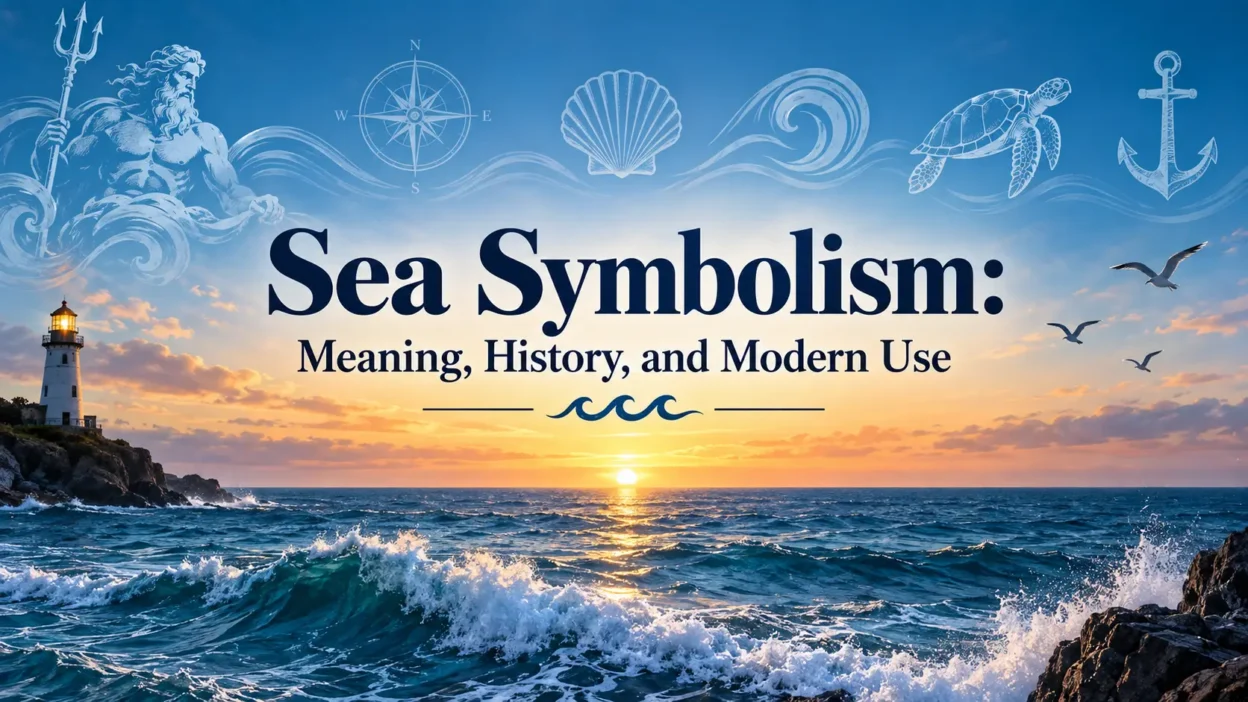
The sea has long represented freedom, change, emotional depth, adventure, and the unknown. In the United States, its meaning also connects to beaches, travel, maritime history, literature, family memories, environmental awareness, and the feeling of standing at the edge of something larger than yourself.
People encounter the sea as both a real landscape and a cultural image. A calm ocean can suggest peace and renewal, while rough waves can represent danger, uncertainty, or emotional struggle. Because the water is constantly moving, the sea naturally lends itself to ideas about change and the passage of time.
Its meaning is not always positive, however. For sailors and coastal communities, the ocean has also represented risk, loss, isolation, and forces that humans cannot control. American art and literature repeatedly use the sea to explore these contrasts.
Quick Answer
Sea symbolism commonly represents freedom, change, emotional depth, exploration, and the unknown in modern American culture, especially in art, tattoos, travel, and coastal design. Historically, the sea has also been associated with creation, danger, gods, spiritual transformation, and the boundary between the familiar world and the unknown.
TL;DR
- The sea commonly represents freedom, change, and emotional depth.
- Ancient cultures connected oceans with creation, gods, danger, and mystery.
- Americans often associate the coast with leisure, travel, and renewal.
- Stormy water can symbolize struggle, uncertainty, or uncontrollable forces.
- Sea imagery frequently appears in tattoos, art, jewelry, and home decor.
- Modern meanings also include environmental awareness and ocean conservation.
What Does the Sea Represent?
The sea has several overlapping meanings rather than one fixed definition.
The most common modern interpretation is freedom. An open horizon gives the impression of unlimited space and movement. A person looking across the water may associate it with leaving familiar surroundings, beginning a journey, or choosing a less restricted life.
The sea can also represent change because it never remains completely still. Tides rise and fall, waves form and disappear, and weather can transform calm water into a dangerous surface within minutes.
Another common meaning is emotional depth. Water often provides a useful image for feelings because its surface can appear calm while much remains hidden underneath. In writing and art, deep water can therefore suggest thoughts, memories, fears, or emotions that are difficult to express directly.
The sea can also stand for possibility. A distant horizon creates a visual boundary without showing what lies beyond it. That makes ocean imagery especially useful when an artist wants to suggest a future that has not yet been defined.
The Sea as a Symbol of Freedom and Exploration
For many Americans, the ocean is closely connected with movement and independence.
The country’s geography has made the sea important to commerce, fishing, travel, defense, migration, and recreation. The United States has an extensive coastline and a long maritime tradition, so ocean imagery can carry both personal and national associations.
A sailboat moving toward the horizon can symbolize independence. A lighthouse can suggest guidance during uncertainty. A ship leaving shore can represent a new beginning.
This interpretation also appears in American literature. Maritime stories often turn the voyage itself into a metaphor for discovery. Herman Melville’s Moby-Dick, for example, uses a sea voyage to explore obsession, fate, human limits, and the struggle between people and nature. American maritime writing has repeatedly treated the ocean as a setting where ordinary boundaries become less certain.
For this reason, a sea tattoo or ocean-themed artwork may communicate more than a love of beaches. It can represent independence, adventure, resilience, or a willingness to move into unfamiliar territory.
Ancient Roots and Early Symbolism
The sea gained symbolic importance long before modern beach culture.
Ancient societies depended on water for food, transportation, trade, and survival. At the same time, the ocean could be unpredictable and dangerous. These practical realities helped produce stories in which seas were associated with gods, monsters, creation, storms, and supernatural forces.
In Greek mythology, the sea was connected with Poseidon, a major deity associated with the ocean, earthquakes, and horses. Roman traditions later connected similar themes with Neptune. Sea creatures and maritime beings also appeared throughout classical mythology.
The ocean could therefore represent both life and danger. It provided food and routes for travel, yet storms and shipwrecks could destroy people without warning.
Ancient Mesoamerican traditions provide another example. Museum collections show that Maya cultures connected shells with water, the primordial sea, creation, moisture, sound, and ceremonial practices. This illustrates how marine objects could carry meanings beyond their physical use.
These older traditions help explain why ocean imagery still carries such a wide range of associations today.
Why the Sea Represents the Unknown
One of the clearest symbolic qualities of the sea is that people cannot easily see what lies beneath it.
Even when the surface is bright and calm, the depths remain largely hidden from ordinary view. This creates a natural metaphor for the unknown.
In stories, a person entering the ocean can therefore represent someone entering unfamiliar territory. A ship disappearing beyond the horizon may suggest separation, exploration, or uncertainty about what comes next.
The shoreline adds another layer. It is a physical boundary between land and water, and symbolic boundaries often appear at moments of change. The beach can represent the point between safety and uncertainty, home and travel, the known and the unfamiliar.
Historically, Western cultures did not always view the beach as a relaxing vacation destination. Earlier attitudes often connected the coast with shipwrecks, storms, dangerous wilderness, and the unknown. Modern American beach culture developed much later, changing the emotional meaning of the seaside considerably.
Sea Symbolism in American Culture
In the United States, ocean imagery has gradually developed meanings that extend beyond danger and exploration.
For many Americans, the beach represents rest, recreation, family time, and escape from routine. Summer trips to coastal communities have become part of American leisure culture, making the sea strongly associated with relaxation.
The ocean also appears in American art as a setting for work, conflict, beauty, and mortality. Artists such as Winslow Homer repeatedly portrayed fishermen, storms, rescue scenes, and coastal landscapes. His paintings show that the sea can symbolize both leisure and human vulnerability.
The sea also has a social history. Access to beaches and coastal spaces has not always been equal. American marine art can therefore reflect questions about race, labor, class, migration, commerce, and access to public spaces. Winslow Homer’s The Gulf Stream, for example, connects the ocean with human struggle while also engaging with the history of slavery and American expansion.
Today, the same ocean may mean vacation to one person, livelihood to another, and environmental responsibility to someone else.
Common Meanings of the Sea in the United States
| Context | Meaning in the USA | Common Associations | Notes |
|---|---|---|---|
| Calm ocean | Peace and renewal | Rest, balance, relaxation | Common in home decor and photography |
| Open horizon | Freedom and possibility | Travel, independence, new beginnings | Often used in motivational imagery |
| Stormy sea | Struggle and uncertainty | Fear, resilience, difficult change | Common in literature and tattoos |
| Waves | Change and movement | Growth, adaptation, life’s cycles | Often chosen for personal symbolism |
| Deep water | Emotional depth | Memory, introspection, hidden feelings | Frequently used in poetry and art |
| Lighthouse and sea | Guidance | Hope, safety, direction | Strong maritime and coastal association |
What Calm and Stormy Seas Symbolize
The condition of the water can completely change its symbolic message.
A calm sea often suggests peace, emotional balance, patience, and restoration. Photographs of still water are frequently used in bedrooms, spas, offices, and wellness spaces because the visual scene communicates quiet and openness.
A stormy sea, by contrast, can represent conflict, uncertainty, fear, or a difficult period in life.
Yet storm imagery does not necessarily mean something negative. A person may choose waves crashing against rocks to represent resilience. The message can be that difficulty exists, but the individual continues to endure it.
This distinction matters when interpreting tattoos or artwork. The same ocean can symbolize peace for one person and survival for another. Personal experience often determines the final meaning.
The Emotional and Psychological Meaning of Water
People often respond emotionally to natural water environments, although symbolism should not be treated as a universal psychological rule.
Research discussed by the American Psychological Association describes potential benefits associated with spending time near “blue spaces,” including lakes and oceans. Visual and sensory qualities of natural environments may contribute to positive experiences.
This helps explain why ocean imagery is often used to communicate calmness.
Blue also contributes to the familiar emotional language surrounding the sea. In American English, expressions such as “feeling blue” connect blue with sadness, while blue ocean imagery can simultaneously suggest calmness and openness. Color associations vary across people and cultures, so blue should not be treated as having one universal emotional meaning.
The emotional meaning of the sea is therefore best understood as a combination of visual experience, cultural association, memory, and personal interpretation.
Religious and Spiritual Associations
Water has important roles in many religious traditions, although the meaning differs considerably between them.
In Christianity, water can represent cleansing, baptism, renewal, and spiritual transformation. Biblical stories also portray seas as places of danger, divine power, travel, and deliverance.
Other religious and cultural traditions similarly use water in rituals, creation stories, purification practices, or ideas about transformation.
It is important not to claim that every ocean image has a religious meaning. A seashell on a necklace may simply represent a vacation or a personal connection to the coast. A wave tattoo may symbolize surfing rather than spirituality.
The context determines the interpretation.
What Sea Tattoos Commonly Mean
Sea and ocean tattoos are popular because they allow people to combine a recognizable image with a personal story.
A wave tattoo can symbolize change, resilience, movement, or a connection to surfing and coastal life.
An anchor with waves can suggest stability during difficult periods.
A lighthouse can represent guidance, hope, safety, or finding a way home.
A ship may symbolize adventure, independence, travel, or a major life journey.
A compass and ocean combination often communicates direction and exploration.
A whale, dolphin, shark, or sea turtle introduces additional symbolism because the animal brings its own cultural associations.
For someone who has lost a loved one connected to the sea, ocean imagery may also become a memorial. In that case, the meaning comes primarily from personal memory rather than a universal symbolic dictionary.
Sea Imagery in Art, Literature, and Popular Culture
Artists have long used the ocean because it provides an unusually flexible visual language.
A peaceful coastline can create a feeling of solitude. A huge wave can dwarf a human figure and emphasize nature’s scale. A ship disappearing into fog can create uncertainty without requiring an explanation.
American artists have used these contrasts repeatedly. The Smithsonian notes that American marine art has represented maritime voyages, changing landscapes, epic journeys, and different attitudes toward the sea.
Literature uses the sea in similarly varied ways. It can become the setting for adventure, isolation, obsession, discovery, escape, or confrontation with mortality.
This flexibility explains why ocean imagery continues to appear in novels, films, photography, music, advertising, and visual art.
Sea Symbols in Jewelry, Decor, and Fashion
In modern American design, ocean-related objects often carry simple lifestyle meanings.
Seashells can suggest the beach, travel, summer, or nostalgia. Anchors commonly suggest stability. Rope details can create a nautical feeling. Blue-and-white patterns may evoke coastal homes.
Ocean imagery is also common in jewelry. A wave pendant can represent movement or a favorite place. A shell necklace may recall a childhood vacation. A compass can communicate direction or independence.
These objects do not have fixed meanings. Their interpretation depends on how the wearer or designer presents them.
This is especially important with seashell symbolism. Historical cultures sometimes gave shells religious, social, economic, or ceremonial importance, while modern Americans may simply view a shell as a beautiful reminder of the coast. The object can therefore carry several layers of meaning at once.
Maritime Folklore, Luck, and Superstition
The sea has also produced a large body of folklore.
Maritime workers historically developed beliefs about luck, weather, words, objects, people, and actions aboard ships. The Library of Congress documents numerous North American maritime beliefs, including practices intended to avoid bad luck or interpret uncertain conditions.
These traditions developed partly because life at sea involved genuine hazards and limited control over weather and natural conditions.
Some beliefs have survived as folklore even after their original practical context disappeared. Sailors’ sayings, sea songs, ship traditions, and superstitions remain part of American maritime heritage.
The Library of Congress has also documented sea songs and shanties from Atlantic and Pacific coastal communities and inland waterways, showing how music became another way maritime communities preserved shared experience.
Positive and Negative Meanings
Sea symbolism is not automatically positive.
Positive meanings can include:
- Freedom
- Adventure
- Renewal
- Peace
- Exploration
- Emotional openness
- Resilience
- Possibility
- Connection with nature
Negative or difficult meanings can include:
- Isolation
- Loss
- Fear
- Uncertainty
- Danger
- Emotional overwhelm
- Separation
- Lack of control
The contrast is one reason ocean imagery works so well in storytelling. The same environment can offer beauty and danger at the same time.
A calm ocean may represent peace today and uncertainty tomorrow. A storm may represent hardship, but it can also become an image of endurance.
How Sea Meaning Has Changed Over Time
The symbolic meaning of the coast has changed significantly.
Earlier Western attitudes often emphasized danger. Storms, shipwrecks, pirates, monsters, disease, and unfamiliar territories made the shoreline a place of anxiety rather than leisure.
During the 18th and 19th centuries, attitudes toward seaside environments gradually changed in Europe and North America. Coastal travel and recreation became more common, helping transform the beach into a place associated with health, leisure, tourism, and social life.
American art reflects this shift. Coastal scenes could show labor and danger, but they could also show recreation, family life, beauty, and escape from crowded cities.
In the 21st century, another layer has become increasingly important: environmental responsibility. Ocean imagery can now represent conservation, marine wildlife, climate concerns, pollution awareness, and protection of coastal ecosystems. U.S. marine sanctuaries, for example, preserve both natural habitats and maritime cultural resources.
Common Misunderstandings About Sea Symbolism
One common mistake is assuming that the sea has one universal meaning.
It does not.
A wave can mean freedom, grief, surfing, survival, spiritual renewal, or simply a favorite vacation spot. A seashell may represent childhood memories for one person and cultural heritage for another.
Another mistake is treating spiritual interpretations as historical facts. Some modern websites assign highly specific meanings to every type of wave, shell, color, or marine animal. Such interpretations may be meaningful to individuals, but they should not automatically be presented as ancient or universal traditions.
Historical symbolism is also different from personal symbolism. A person does not need an ancient cultural reason to choose an ocean tattoo. Personal experience can create a legitimate meaning of its own.
Why the Sea Still Matters in Modern Culture
The sea remains culturally important because it combines several ideas that people continue to experience: freedom and limitation, beauty and danger, movement and stability, distance and belonging.
For Americans, the ocean also connects personal life with national history. Coastal communities depend on fishing, tourism, shipping, recreation, conservation, and other maritime activities. Marine environments are not simply decorative backgrounds; they are part of economic, environmental, and cultural life.
Modern ocean imagery therefore works on several levels. It can decorate a home, mark a personal milestone, memorialize someone, express environmental values, or simply communicate a love of the coast.
That flexibility is what keeps the symbol relevant.
Frequently Asked Questions
What does the sea symbolize spiritually?
Spiritually, the sea can represent renewal, transformation, cleansing, mystery, and the boundary between the known and unknown. Specific meanings depend on the religious or cultural tradition rather than one universal interpretation.
What does a sea tattoo symbolize?
A sea tattoo commonly represents freedom, change, adventure, resilience, or a personal connection to the coast. Its meaning becomes more specific when combined with symbols such as anchors, ships, lighthouses, compasses, or marine animals.
Does the sea symbolize freedom?
Yes. The open horizon and uninterrupted movement of water make the sea a common image of freedom and possibility. In American culture, this association is especially visible in travel, maritime stories, beach culture, and personal artwork.
What does a stormy sea symbolize?
A stormy sea can symbolize struggle, uncertainty, emotional conflict, danger, or a difficult period of life. It can also represent resilience when the image focuses on surviving or moving through the storm.
Is the sea a positive or negative symbol?
It can be either. Calm water often suggests peace and renewal, while dangerous water may represent fear or uncertainty; the surrounding context determines the meaning.
What does the ocean symbolize in American culture?
In the United States, ocean imagery commonly connects with freedom, recreation, travel, exploration, maritime heritage, and nature. It can also represent work, environmental responsibility, loss, and the country’s long relationship with coastal communities.
Why is the sea associated with emotions?
The sea changes constantly while also appearing calm or turbulent, making it a useful metaphor for changing emotional states. Its hidden depths also provide a natural image for feelings, memories, and thoughts that are not immediately visible.
Conclusion
The sea represents much more than water. In modern American culture, it can symbolize freedom, change, exploration, emotional depth, renewal, resilience, and the unknown, while its historical meanings also include danger, divine power, creation, and human vulnerability.
Sea symbolism remains flexible because people encounter the ocean in very different ways. A sailor may see a workplace, a traveler may see adventure, an artist may see a metaphor, and someone remembering a loved one may see a connection to the past.
Its meaning ultimately depends on context, culture, and personal experience. The sea continues to offer one of the clearest images for the tension between what we can see, what we cannot control, and what may lie beyond the horizon.