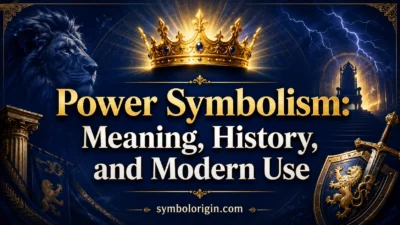
Crown symbolism centers on authority, achievement, dignity, and elevated status. Although crowns began as ceremonial headwear associated with rulers, religious leaders, and honored victors, their meaning now reaches far beyond monarchy.
Americans encounter crowns on national monuments, pageant stages, jewelry, tattoos, clothing, logos, album artwork, birthday decorations, and social media profiles. Depending on the setting, the image may communicate leadership, confidence, spiritual reward, personal sovereignty, or an exaggerated sense of superiority.
Its meaning is not automatically positive. A crown can represent responsible leadership, but it can also suggest inherited privilege, colonial power, vanity, or entitlement. Understanding the surrounding design and cultural context is therefore essential.
Quick Answer
Crown symbolism commonly represents authority, success, leadership, and personal worth in modern American culture. Historically, crowns also marked royal legitimacy, military victory, religious office, divine favor, and an individual’s position within a social hierarchy.
TL;DR
- Crowns most often represent authority, honor, and achievement.
- Their elevated position suggests importance and higher status.
- Ancient wreaths connected crowns with victory and public recognition.
- Religious crowns may signify sacrifice, holiness, or heavenly reward.
- Americans often use crowns for confidence and personal identity.
- Crowns can also suggest privilege, domination, or entitlement.
What a Crown Looks Like and Why Its Shape Matters
A crown is usually a circular head ornament made from metal, fabric, leaves, feathers, beads, or other valuable materials. Royal versions often include raised points, arches, crosses, gemstones, or symbolic figures. Simpler versions may resemble a narrow headband, wreath, coronet, or diadem.
Its placement is central to its meaning. Because the crown sits on the highest part of the body, it visually raises the wearer above others. Height becomes a metaphor for rank: the crowned person is presented as the leader, winner, protector, or central figure.
The circular band can also suggest continuity. A circle has no visible beginning or end, making it suitable for institutions that claim permanence, hereditary succession, or an enduring sacred order. Jewels and precious metals add ideas of wealth, rarity, durability, and public importance.
Not every decorated headpiece is technically a crown. Tiaras, diadems, coronets, ceremonial caps, wreaths, and feathered headdresses have different histories. In modern visual culture, however, people often group them together whenever they signal prestige or elevated identity.
Core Meanings at a Glance
| Context | Common Meaning in the USA | Typical Associations | Important Note |
|---|---|---|---|
| Royal imagery | Authority and sovereignty | Kings, queens, dynasties, government | May also suggest inherited privilege |
| Awards and contests | Victory and recognition | Pageants, champions, top performers | The crown marks a temporary title |
| Religious art | Sacred authority or spiritual reward | Heaven, martyrdom, Christ, saints | Meaning depends on the crown’s form |
| Tattoos and jewelry | Confidence and self-rule | Independence, ambition, resilience | Initials or dates personalize it |
| Art and fashion | Status, identity, or rebellion | Street art, music, luxury, self-expression | It may challenge traditional hierarchy |
| Satirical imagery | Ego or entitlement | Arrogance, vanity, dominance | A tilted or oversized crown may be critical |
Ancient Roots: Wreaths, Diadems, and Divine Rule
There was no single moment when every culture adopted the crown. Different societies developed distinctive head ornaments to identify rulers, priests, warriors, deities, and members of elite families.
In ancient Egypt, crowns could identify territorial authority and divine responsibility. The white and red crowns represented Upper and Lower Egypt, while combined forms communicated the ideal of a unified kingdom. Cobras, feathers, animal imagery, and solar elements could connect a ruler or deity with protection and cosmic order.
Royal and elite diadems also appeared across the ancient Near East and Mediterranean world. Their function was not merely decorative. A specific headpiece could distinguish a king from officials, identify a dynasty, or communicate the ruler’s connection to a deity.
The English word “crown” ultimately traces back through French to the Latin corona, referring to a wreath or garland worn as an emblem of honor or majesty. This linguistic history preserves the connection between royal crowns and the plant wreaths once presented to victors.
How the Crown Became a Sign of Sovereignty
A crown does more than identify a ruler. In a coronation, placing it on someone’s head publicly transforms that person into the recognized holder of an office. The object represents powers and duties that continue beyond the life of any individual monarch.
European coronation traditions strengthened this idea by combining political authority with religious ceremony. Crowns, scepters, orbs, robes, rings, swords, and sacred anointing presented rulership as an ordered institution rather than a private claim to power.
Individual pieces of regalia could represent different responsibilities. A scepter might indicate temporal power and good governance, while an orb topped by a cross could present the sovereign’s rule within a Christian understanding of the world.
This explains why “the Crown” can mean more than a jeweled object. In countries shaped by British constitutional traditions, the phrase can refer to the monarchy, the state, or governmental authority. Americans usually encounter that broader meaning in historical writing, legal dramas, royal news, and popular entertainment.
Victory, Honor, and the Highest Achievement
Before the jeweled royal crown became the dominant Western image, wreaths were awarded for military, athletic, civic, and artistic distinction. Greek and Roman imagery frequently connected wreaths with victory, public honor, and an individual’s service to the community.
Roman leaders used laurel and other ceremonial wreaths to present themselves as successful commanders. Coins helped circulate these images, allowing the ruler’s crowned portrait to communicate authority across a large territory. Ancient coin imagery still influences modern medals, trophies, seals, and official emblems.
That older meaning survives in everyday expressions. A person may speak of a “crowning achievement,” meaning the finest result of a career or effort. To “crown” a champion is to recognize someone as the best performer, even when no literal crown is presented.
The crown therefore represents not only power received through birth. It can also signify status earned through discipline, competition, talent, or service.
Crown Meaning in Christianity
Christian imagery gives the crown several distinct meanings. A jeweled crown can represent Christ’s kingship, the authority of God, the queenship of the Virgin Mary, or the spiritual honor granted to saints.
The crown of thorns carries almost the opposite visual message. According to the Gospel narratives, it was placed on Jesus in mockery before the Crucifixion. In Christian art, it came to represent suffering, humiliation, sacrifice, and the contrast between worldly ridicule and spiritual kingship.
Biblical phrases such as the “crown of life” and “crown of righteousness” use the object as a metaphor for spiritual reward. In these settings, the crown is not mainly about material wealth. It represents faithfulness, perseverance, moral victory, or eternal life.
A crown topped by a cross usually communicates authority under God rather than unrestricted personal power. By contrast, a halo-like crown of light may emphasize holiness, revelation, or divine presence.
Crowns Across World Cultures
Crowns and ceremonial head ornaments appear in many traditions, but they should not be treated as interchangeable. Their materials and shapes often communicate meanings specific to the society that produced them.
Ancient Egyptian crowns could represent territorial rule, divine protection, and the ruler’s duty to maintain order. Elsewhere in Africa, possession of particular royal regalia could help establish a leader’s legitimate succession and connection to a ruling lineage.
In Buddhist art, a crowned Buddha may depict the Buddha as a universal monarch or show him in a celestial, glorified form rather than in the plain clothing of a monk. The crown does not simply turn the Buddha into an ordinary political king; it visualizes spiritual supremacy and an ideal form of enlightened rulership.
Gold crowns from Korea’s Silla period include tree-like, antler-shaped, and winglike forms. Scholars have connected these features with rulership, sacred trees, birds, and traditions involving movement between earthly and spiritual realms, although individual interpretations remain debated.
These examples show why cultural context matters. A European jeweled crown, an Egyptian double crown, and a Korean gold crown may all indicate high rank, yet each belongs to a different political and spiritual system.
What the Crown Commonly Means in the United States
The United States has no monarch, so Americans usually treat the crown as a flexible cultural image rather than a symbol of national government. Its most common meanings are excellence, confidence, luxury, leadership, and being “number one.”
Children wear paper crowns at birthdays. Schools crown homecoming royalty. Businesses use crowns to imply premium quality. Sports language applies royal terms to dominant athletes, while entertainment media refer to a leading performer as the king or queen of a genre.
The symbol can also support self-affirmation. Phrases such as “know your worth,” “fix your crown,” and “queen behavior” use royal language to encourage confidence, boundaries, and self-respect. In such contexts, the crown is metaphorical: it tells the wearer to value themselves rather than wait for outside approval.
However, Americans may also read crown imagery ironically. An oversized crown can mock a person’s ego, while a broken or falling crown can represent failure, lost influence, or the collapse of an inflated public image.
Liberty and the Radiant Crown
One of the most recognizable crowns in the United States belongs to the Statue of Liberty. Her headpiece is a diadem with seven rays, designed as a radiant halo rather than a conventional royal crown.
The rays communicate light and enlightenment, reinforcing the statue’s official identity as Liberty Enlightening the World. The design connects the figure with Libertas, the Roman personification of liberty, while the broken chains near her feet strengthen the message of release from tyranny and servitude.
This is an important exception to the crown’s usual association with monarchy. On the Statue of Liberty, the headpiece does not announce inherited royal control. Instead, it elevates liberty itself as an ideal worthy of honor.
For generations of immigrants arriving through New York Harbor, the radiant figure became a visible image of freedom and opportunity. As a result, Americans may associate a spiked or sunlike crown with enlightenment, inclusion, democracy, and hope rather than kingship.
Crowns in Pageants, Ceremonies, and Public Recognition
Beauty pageants transformed the crown into a familiar American award. The winning contestant receives a visible title, but the crown also carries expectations involving public appearances, representation, service, and personal conduct.
The Miss America tradition, which developed over more than a century, helped establish the jeweled pageant crown as an American symbol of achievement, public femininity, and competitive recognition. The organization now emphasizes areas such as service, scholarship, and professional opportunity alongside its ceremonial traditions.
Similar crowning ceremonies appear at homecoming events, county fairs, cultural festivals, drag pageants, school celebrations, and community competitions. In each case, the crown turns an abstract judgment into a visible social role.
Yet pageant imagery can carry mixed feelings. Some people see the crown as recognition for talent and effort. Others connect it with narrow beauty standards, gender expectations, or popularity-based hierarchies. Both interpretations arise from the same function: the crown separates one selected person from the rest of the group.
Why Crowns Appear in Tattoos, Jewelry, Fashion, and Decor
A crown tattoo often represents self-control, ambition, dignity, or the decision to direct one’s own life. Rather than claiming literal royalty, the wearer may be declaring, “I am responsible for my choices,” or “I will not allow others to define my worth.”
Design details change the message. A crown above a name may honor a parent, partner, child, or deceased loved one. Paired king-and-queen crowns can represent commitment, although they may also express traditional relationship roles. A crown with a lion emphasizes courage or command, while a crown with wings can suggest spiritual elevation or remembrance.
A broken crown may symbolize betrayal, grief, lost status, or recovery after personal collapse. Thorns introduce sacrifice and suffering. Skulls can turn the image into a reminder that status and power eventually end.
In jewelry and fashion, crowns commonly convey glamour, confidence, and luxury. In home decor, they may create a fairy-tale, royal, or theatrical atmosphere. Because the image is immediately recognizable, even a small crown can make an ordinary object appear ceremonial or exclusive.
Crowns in American Art, Music, and Digital Culture
Modern artists have used crowns to question who receives recognition and who is excluded from traditional definitions of greatness. Jean-Michel Basquiat’s repeated crown motif is a prominent American example. In his work, crowns could elevate Black figures, identify admired subjects, mark authorship, and challenge established cultural hierarchies.
Music and streetwear also use royal language to claim mastery. Artists may call themselves kings or queens to announce authority within a genre, neighborhood, movement, or creative tradition. This symbolic self-coronation can be boastful, playful, defensive, or politically meaningful.
Online, the crown emoji can indicate excellence, beauty, loyalty, confidence, or support for someone seen as a leader. It may appear after a username, beside a compliment, or in posts celebrating an accomplishment.
Digital crown imagery is often exaggerated and temporary. Someone may be “queen for the day” after solving a problem or “king of the group chat” after making a joke. Such uses preserve the crown’s connection with distinction while removing most of its formal political meaning.
Emotional and Psychological Meaning
The emotional appeal of a crown comes from recognition. It makes a person visible and tells an audience that this individual matters. That message can satisfy a basic desire to be respected, chosen, protected, or acknowledged.
For someone rebuilding confidence, the image may represent self-possession. It can serve as a reminder to establish boundaries, act with dignity, or stop minimizing personal accomplishments.
A crown can also represent responsibility. A worthy ruler is expected to protect others, make difficult decisions, and accept the consequences of leadership. In that reading, the crown is not merely a reward. It is a burden that must be carried with judgment.
Negative emotions emerge when the crown becomes a sign of pressure. The wearer may feel expected to remain perfect, successful, attractive, or emotionally controlled. A heavy, cracked, or slipping crown can therefore express exhaustion, insecurity, or fear of losing status.
Positive and Negative Interpretations
The crown’s positive meanings include leadership, victory, confidence, excellence, dignity, protection, and earned recognition. It may honor someone who has survived hardship or taken control of a difficult situation.
Its negative meanings include arrogance, domination, vanity, elitism, and entitlement. A person who imagines themselves wearing a crown may believe they deserve special treatment without accepting the duties associated with leadership.
Context usually reveals which interpretation applies. A crown held above someone’s head suggests approaching success. One placed firmly on the head indicates recognized authority. A crown lying on the floor can show defeat, while one that is too large may imply immaturity or pretension.
The wearer’s expression matters as well. A calm figure with a plain crown can communicate disciplined leadership. A figure surrounded by wealth and kneeling followers may instead suggest control, inequality, or self-worship.
Colonialism, Privilege, and Misuse
Royal crowns cannot be separated completely from conquest, inherited hierarchy, and empire. Many historic regalia collections contain gemstones, metals, and objects connected with colonial expansion, warfare, political coercion, or disputed ownership.
The history of the Koh-i-Noor diamond is one well-known example. The stone passed through several South Asian powers before entering British royal possession during the colonial period, and demands for its return have kept debates about ownership and empire active.
For this reason, crown imagery may feel celebratory to one audience and oppressive to another. It can represent cultural continuity and national history while also recalling systems in which power was concentrated among a small hereditary class.
Modern misuse usually occurs when the symbol is treated as automatic proof of superiority. Calling oneself a king or queen can be harmless self-expression, but using royal identity to belittle others changes the crown from a sign of dignity into a sign of domination.
Cultural sensitivity is especially important with ceremonial headwear. A sacred or traditional crown should not be reduced to a generic costume without understanding who wears it, during which ceremonies, and what responsibilities it represents.
How the Meaning Has Changed Over Time
Early crowns and wreaths identified specific offices, victories, religious roles, or ruling families. Their meaning depended on public systems of authority: a person was crowned because a community, priesthood, dynasty, army, or institution recognized the title.
Over time, the symbol moved beyond literal rulership. Christianity used crowns to describe spiritual victory and sacred kingship. Civic and athletic traditions preserved the connection with achievement. Pageants and festivals turned crowning into a form of temporary public recognition.
Modern individualism changed the image again. Today, a person can symbolically crown themselves. The crown may express confidence, creative authority, independence, or resistance to a society that has denied them recognition.
This shift explains the crown’s continuing appeal. It still carries the visual authority of ancient rulers, but people can now use it to honor personal survival, artistic identity, community leadership, or ordinary moments of success.
FAQs
What does a crown symbolize spiritually?
Spiritually, a crown can represent divine authority, moral victory, enlightenment, or a reward for faithfulness, though the exact meaning shifts dramatically with its form. A jeweled royal crown, a halo-like crown of light, and the crown of thorns are almost opposites — one communicates glory, another suffering, and the difference matters more than the shared word “crown.”
Is a crown a positive symbol?
Usually, but not automatically. It reads as positive when it represents dignity, responsible leadership, earned achievement, or self-respect — the kind of authority paired with duty. It tips negative when it implies arrogance, inherited superiority, or a demand for special treatment without any of the responsibility that traditionally came with wearing one.
What does a crown tattoo mean?
A crown tattoo commonly represents confidence, ambition, independence, or taking control of one’s own life rather than claiming literal royalty. The surrounding details do most of the work in refining that message — a name underneath often honors someone specific, while a lion, a cross, or broken points each pull the meaning toward courage, faith, or survival respectively.
What does a crown with a cross symbolize?
A crown topped with a cross generally represents authority understood as subject to God rather than unrestricted personal power — kingship exercised under something greater than the ruler. In royal regalia this connects political rule to religious duty; in a personal tattoo or piece of jewelry, it more often expresses faith, spiritual victory, or devotion.
What does a broken crown symbolize?
A broken crown can represent lost authority, humiliation, grief, or the end of an important relationship — the visible collapse of something that once stood for status. It can also carry a more hopeful reading, marking survival after failure or freedom from an exhausting need to maintain appearances and status.
Why does the Statue of Liberty wear a crown?
She wears a radiant diadem with seven rays, designed as a halo of light rather than a conventional royal crown — the difference is deliberate. Rather than marking her as a monarch, the design elevates liberty and enlightenment themselves as ideals, which is part of why the image resonated so strongly with generations of immigrants arriving through New York Harbor.
What does a king-and-queen crown represent?
Paired crowns most often symbolize partnership, loyalty, and two people who see each other as equals within a relationship. That said, the imagery can also lean into fixed, traditional gender roles depending on how it’s styled, so the specific design and the couple’s own intent shape which reading fits best.
Why do crowns appear so often in Black American art and hip-hop culture?
Artists like Jean-Michel Basquiat used the crown motif deliberately to elevate Black subjects and challenge who traditional art history considered worthy of that kind of recognition. That same self-coronation shows up throughout music and streetwear today, where calling oneself a king or queen can be a way of claiming authority and greatness the mainstream has historically withheld.
Is it disrespectful to wear crown imagery from a culture that isn’t yours?
It can be, particularly with sacred or ceremonial crowns tied to specific religious or royal traditions — reducing one of those to a generic costume ignores who is meant to wear it and under what circumstances. Generic, non-specific crown imagery used for confidence or celebration is a different matter, but any crown tied to a real cultural or spiritual practice deserves that context before it’s borrowed.
Why is crown symbolism sometimes controversial?
Because real crowns are historically inseparable from conquest, colonialism, and inherited hierarchy — objects like the Koh-i-Noor diamond carry ongoing disputes over ownership precisely because of that history. The same image can feel like a celebration of heritage to one audience and a reminder of empire and unequal power to another, which is why context always shapes how a crown lands
Conclusion
A crown has never really been about the object sitting on someone’s head — it’s always been about the agreement everyone around that person has made to look up. Strip away the gold and the gemstones and what’s left is a simple, almost universal piece of visual logic: height signals importance, and a circle signals something meant to last.
That logic is exactly why the symbol has survived every century and every culture willing to use it, from Egyptian double crowns to Roman laurel wreaths to a paper cone at a child’s birthday party. The specific claim changes constantly — divine right, military victory, spiritual reward, pageant title, personal self-worth — but the underlying gesture never does: someone, or something, is being told they now stand apart from the rest.
That’s also exactly why the symbol demands care. The same raised position that can honor genuine achievement can just as easily excuse real harm, which is why the most honest way to read any crown is to ask what it’s actually resting on — talent and responsibility, or only the assumption that someone deserves to be looked up to.