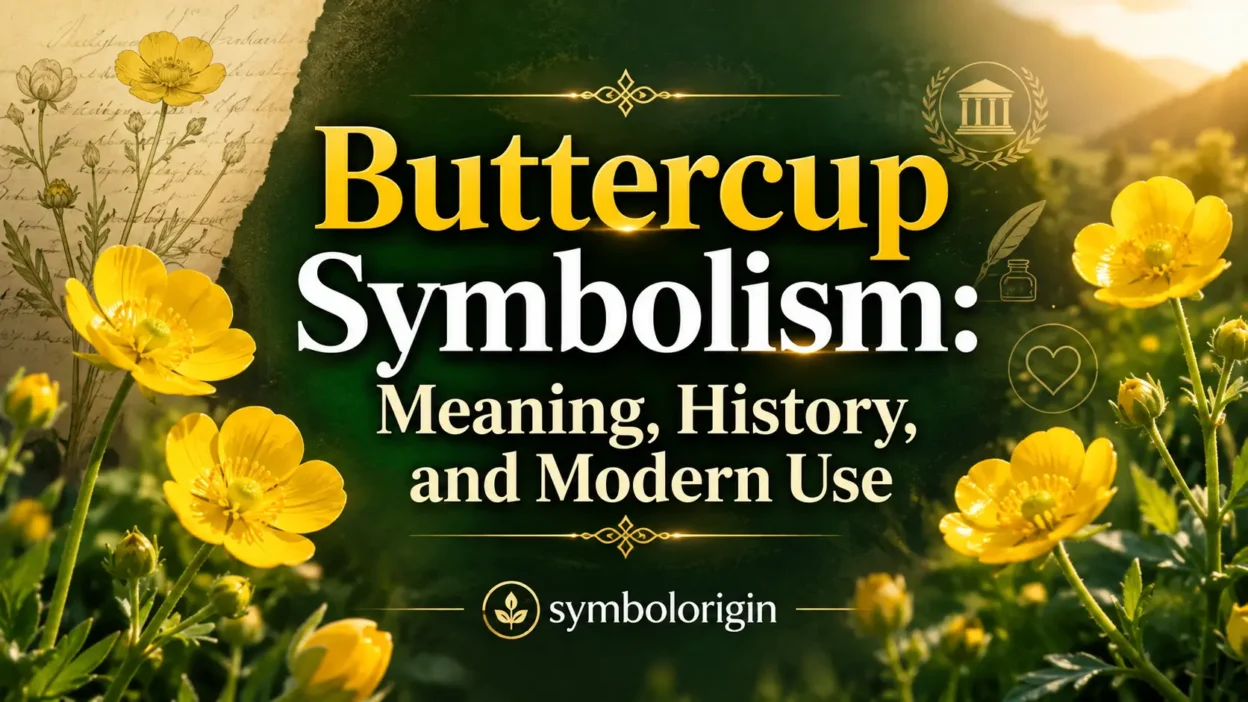
Buttercup symbolism is most closely associated with happiness, childhood innocence, playfulness, and appreciation for life’s ordinary pleasures. The flower’s glossy yellow petals, familiar meadow setting, and connection with children’s games have made it a cheerful emblem rather than a formal symbol used in ceremonies or public institutions.
For many Americans, buttercups evoke memories of spring lawns, country fields, childhood walks, and the game of holding a flower beneath someone’s chin. Because the plant often grows without cultivation, it can also represent natural beauty, simplicity, and joy that appears unexpectedly.
However, its meaning is not entirely straightforward. Nineteenth-century flower dictionaries sometimes connected the buttercup with childishness, while cultivated ranunculus flowers developed separate associations with charm, attraction, and radiant beauty. Understanding which flower and tradition a person means helps prevent confusion.
Quick Answer
Buttercup symbolism commonly represents happiness, childhood innocence, playfulness, and simple pleasures in modern American culture. Historically, buttercups were connected with children’s folklore and Victorian ideas of childishness, while ornamental ranunculus flowers came to express charm and attraction.
TL;DR
- Buttercups commonly represent joy, innocence, and youthful playfulness.
- Their yellow color creates associations with sunshine and optimism.
- Children’s games strengthened their connection with carefree childhood.
- Victorian flower dictionaries sometimes assigned them “childishness.”
- Wild buttercups symbolize simplicity more than luxury or formal romance.
- Modern designs use them for hope, memory, and everyday happiness.
What a Buttercup Looks Like
The name buttercup applies to numerous plants in the genus Ranunculus. The wildflower most people picture has five glossy yellow petals surrounding a small central cluster of reproductive parts. It frequently appears in lawns, meadows, pastures, roadsides, and other grassy areas.
Its petals look unusually shiny because their structure reflects light from more than one surface. Yellow pigment absorbs much of the blue-green portion of visible light, while smooth cell layers and a thin air space increase the petal’s reflective quality. This structure produces the golden glow seen when someone holds the flower under a chin.
Not every flower sold as ranunculus resembles the small wild buttercup. Florist ranunculus varieties often have dozens of thin, layered petals and come in white, pink, red, orange, yellow, and purple. They belong to the same botanical genus but carry somewhat different cultural meanings.
That distinction matters. A tiny yellow meadow buttercup usually suggests childhood, sunshine, and simplicity. A layered ranunculus bouquet is more likely to communicate admiration, romantic charm, or refined beauty.
Buttercup Meanings at a Glance
No flower has one meaning that applies everywhere. Symbolism changes according to the plant’s form, color, setting, and purpose.
| Context | Common Meaning in the USA | Main Association | Important Note |
|---|---|---|---|
| Wild yellow buttercup | Happiness and innocence | Sunshine, childhood, spring | The most familiar modern interpretation |
| Childhood game | Playfulness and curiosity | Holding petals beneath the chin | A folk game, not a serious test |
| Victorian flower language | Childishness | Youthful or immature behavior | Could sound affectionate or critical |
| Florist ranunculus | Charm and admiration | Attraction, beauty, celebration | Usually refers to layered garden varieties |
| Tattoo or jewelry | Personal joy and optimism | Memory, resilience, simplicity | Meaning depends on the wearer |
| Meadow or garden imagery | Natural beauty | Humility, freedom, rural life | Often nostalgic rather than ceremonial |
These meanings overlap, but they are not interchangeable. A person choosing a buttercup tattoo may emphasize joy and resilience, while someone giving ranunculus flowers may intend admiration.
Why Yellow Shapes the Flower’s Meaning
Color is one of the main reasons buttercups are interpreted positively. In American design and popular culture, bright yellow commonly suggests sunlight, warmth, energy, cheerfulness, and alertness. A buttercup’s clear golden color makes those associations immediate.
The flower also appears close to the ground, often scattered across green grass. That contrast creates the impression of small lights appearing across a field. As a result, buttercups can represent moments of happiness that are modest but noticeable.
Yellow is not positive in every situation. It can also suggest caution, nervousness, or jealousy. However, those meanings are less common with buttercups because the flower is strongly connected with spring landscapes and childhood play rather than warning signs.
Its reflective petals strengthen the association with brightness. The flower does not merely look yellow; it appears to shine when light reaches it at the right angle.
Childhood Games, Innocence, and Playfulness
The best-known buttercup tradition involves holding the flower beneath another person’s chin. According to the game, a yellow reflection means the person likes butter. The result actually comes from the petal’s optical structure, but the playful explanation has survived as children’s folklore.
The game helps explain why the flower represents innocence. It turns an ordinary plant into a small social ritual involving curiosity, teasing, and imagination. Children do not need a formal ceremony or special object; they simply use a flower found in the grass.
Because the activity is passed informally from one child or family member to another, the buttercup also carries nostalgia. Adults may associate it with schoolyards, grandparents’ gardens, family walks, or summers spent outdoors.
In this context, innocence does not mean ignorance. It refers to openness, uncomplicated delight, and the ability to find entertainment in something simple.
The Victorian Meaning of Childishness
Flower symbolism became especially fashionable during the nineteenth century. Illustrated dictionaries assigned emotions and messages to individual plants, allowing flowers and bouquets to function like coded communications. Interest in these systems spread through Britain, France, and North America, although different books did not always agree.
One meaning repeatedly associated with the common buttercup was childishness. That word could describe lighthearted youthfulness, but it could also criticize someone as immature, thoughtless, or overly playful.
Context therefore mattered. A buttercup exchanged between friends might affectionately acknowledge a playful personality. In a more formal Victorian interpretation, the same flower could suggest that the recipient was behaving foolishly.
Flower dictionaries were never a perfectly standardized language. Numerous guides circulated, and their definitions sometimes conflicted. Even people living during the height of floriography could misunderstand a message unless both sender and recipient followed the same guide.
Modern interpretations usually soften “childishness” into childlike joy, innocence, or youthful energy.
The Difference Between Buttercup and Ranunculus Meanings
Confusion often arises because buttercup and ranunculus can refer to plants in the same genus. Symbolically, however, wild buttercups and cultivated florist ranunculus occupy different cultural spaces.
The wild yellow buttercup is small, familiar, and commonly encountered outdoors. Its meanings grow from meadows, childhood games, yellow color, and its status as an unplanned part of the landscape.
Florist ranunculus flowers are cultivated for their densely layered petals. In modern floral arrangements, they appear at weddings, anniversaries, formal dinners, and romantic celebrations. Their traditional floral message is closer to charm, admiration, and being dazzled by someone’s attractiveness.
A bouquet of layered pink or white ranunculus should not automatically be interpreted as a statement about childishness. Similarly, a wild buttercup illustration usually does not carry the polished romantic meaning associated with luxury floral arrangements.
What Buttercups Mean in the United States
In the United States, the buttercup does not have an official national meaning. Americans generally understand it through ordinary experience rather than a single religious, political, or ceremonial tradition.
Its strongest associations include:
- Spring and early summer
- Rural landscapes
- Childhood freedom
- Cheerful personalities
- Small, unexpected pleasures
- Natural beauty outside formal gardens
The word buttercup may also be used as an affectionate form of address. Depending on tone, calling someone “buttercup” can sound tender, humorous, old-fashioned, or mildly teasing. Informal expressions such as “What’s up, buttercup?” reinforce the flower’s playful cultural personality.
Popular entertainment has also turned Buttercup into a recognizable character name. Such uses do not establish a fixed symbolic meaning, but they preserve the word’s associations with femininity, youth, affection, and memorable personality.
European Folklore and Cross-Cultural Associations
Many widely repeated buttercup customs come from European rural traditions. The chin-reflection game is especially connected with British childhood culture, although versions of it are known more broadly.
The flower’s common name has sometimes been explained through the mistaken belief that buttercups gave butter its yellow color. In reality, fresh buttercups contain irritating compounds, and grazing animals commonly avoid them when other food is available. The botanical name Ranunculus comes from a Latin word meaning “little frog,” probably referring to the damp environments favored by many species.
European floral traditions also linked buttercups with pastoral life. Fields covered in yellow flowers suggested summer abundance, grazing land, and the return of seasonal warmth. These interpretations eventually entered American imagery through literature, gardening culture, art, and family customs.
Claims that buttercups have one universal Celtic, Christian, Greek, or Indigenous meaning should be treated cautiously. Local stories may exist, but they belong to particular communities and should not be presented as beliefs shared by an entire culture.
Emotional and Psychological Meaning
Emotionally, the buttercup communicates approachable happiness. It is less formal than a rose and less ceremonial than a lily. Its message feels spontaneous, friendly, and unforced.
Someone drawn to buttercup imagery may value:
- A cheerful outlook
- Connection with childhood memories
- Simplicity over display
- Time spent outdoors
- Emotional warmth
- Recovery of curiosity and play
The flower can also represent permission to enjoy ordinary experiences. Its symbolism does not require dramatic success or major transformation. Instead, it recognizes pleasure found in sunlight, open space, familiar people, and small moments of relief.
For a person who has endured a difficult period, the buttercup may become a reminder that happiness can return gradually. A field does not become yellow because of one enormous flower; it changes through many small blooms appearing together.
Simplicity, Humility, and Everyday Beauty
Buttercups often grow where they were not deliberately planted. Depending on the species and location, gardeners or farmers may even consider them weeds. This ordinary status contributes to their symbolic connection with humility.
A buttercup does not traditionally represent social rank, expensive taste, or exclusivity. Its appeal comes from being widely recognizable and easily encountered. That makes it an appropriate emblem for people who value authenticity, modest pleasures, or beauty that does not need to be purchased.
However, humility should not be confused with weakness. Creeping buttercup, for example, can spread through lawns by horizontal stems and become difficult to remove. In a symbolic interpretation, that persistence may suggest quiet determination or the ability to flourish without ideal conditions.
This resilient meaning is modern rather than a universally documented historical code. It develops logically from the plant’s growth habits and the way contemporary people use botanical images to express identity.
Love, Friendship, and Flower Giving
A wild buttercup is not one of the standard flowers used for formal romantic declarations in the United States. Roses, tulips, peonies, and cultivated ranunculus are more common in commercial bouquets.
Still, buttercups can express affection in an informal setting. A hand-picked bunch may communicate warmth, familiarity, and shared memories. The gesture often feels personal because the flowers were noticed and gathered rather than purchased as part of a conventional arrangement.
For friendship, buttercups can suggest:
- Appreciation for a cheerful companion
- Memories of growing up together
- Support during a fresh start
- Encouragement to remain hopeful
- Affection without romantic pressure
Cultivated ranunculus flowers are better suited to weddings and romantic gifts. Their layered appearance gives them a more elegant tone, and their established floral association with charm makes them appropriate for admiration and attraction.
Buttercups in Tattoos and Jewelry
Buttercup tattoos are often chosen for personal reasons rather than strict historical tradition. A small yellow flower can represent optimism, a happy childhood, a loved one’s nickname, or the decision to notice joy after hardship.
Design choices can alter the meaning:
- A single buttercup may represent one treasured memory.
- A group of flowers can suggest family, community, or accumulating happiness.
- A buttercup with a name or date often serves as a memorial.
- A flower growing through a crack may symbolize persistence.
- A buttercup with a bee can represent cooperation and life in motion.
- A black-ink outline emphasizes simplicity rather than color symbolism.
Buttercup jewelry carries similar meanings. Necklaces, rings, and earrings shaped like the flower can serve as reminders of youth, warmth, or a cheerful person. Because the design is less predictable than a rose or daisy, it may also express individuality.
The intended meaning should come from the wearer’s experience. A tattoo does not have to reproduce a Victorian dictionary definition to be legitimate.
Buttercups in Weddings, Decor, and Digital Culture
Wild buttercups can add a relaxed meadow feeling to spring celebrations, but they are not always practical as commercial cut flowers. Florists are more likely to use cultivated ranunculus, which offers layered blooms and a wide range of colors.
In wedding design, yellow buttercup imagery can suggest happiness, warmth, and an informal country atmosphere. White or blush ranunculus arrangements usually communicate romance, refinement, and new beginnings rather than childhood.
Home decor often uses buttercups in cottage-style prints, botanical illustrations, ceramics, wallpaper, and seasonal wreaths. These designs create a sense of sunny outdoor space and may appeal to people who want a room to feel welcoming rather than formal.
On social media, buttercup photographs frequently accompany messages about spring, gratitude, mental refreshment, and time in nature. Digital use has simplified the flower’s meaning: the older Victorian possibility of criticism is usually replaced by optimism and nostalgia.
Common Misunderstandings and Safety Concerns
The most common misunderstanding is the belief that every ranunculus flower has the same meaning. Wild yellow buttercups and elaborate florist ranunculus share a genus, but their modern symbolism differs because people encounter and use them in different settings.
Another mistake is presenting flower meanings as universal facts. Floral symbolism is created by communities, books, art, commerce, and personal experience. Definitions change, and even nineteenth-century dictionaries did not always agree.
Buttercups should also not be treated as harmless edible flowers. Fresh plants contain compounds that can irritate the skin and digestive system, and several species are considered toxic to livestock. Animals often avoid fresh buttercups because of their unpleasant taste, but exposure remains a concern in heavily infested pastures.
The childhood chin game depends on reflected light, not sap. Even so, flowers should be handled gently, kept away from the mouth, and washed off the skin if irritation occurs.
How the Meaning Has Changed
The buttercup’s meaning began with visible characteristics and everyday contact. Its yellow color suggested warmth, while its presence in fields connected it with seasonal life and rural landscapes.
Children’s customs then turned the flower into a symbol of play and mock fortune-telling. During the nineteenth century, floriography formalized one aspect of this connection by assigning the buttercup “childishness.” Meanwhile, the broader ranunculus family gained a more romantic association with charm and attractive appearance.
In modern American culture, the negative side of childishness has largely faded. The flower now more often represents childlike happiness, emotional openness, simplicity, and optimism.
Personal symbolism has expanded its meaning further. Tattoos, memorial jewelry, wedding designs, and online images allow individuals to connect buttercups with specific people, places, and experiences. What was once a playful meadow flower can now serve as a private reminder to remain hopeful or preserve a valued memory.
FAQs
Is buttercup symbolism positive or negative?
It’s overwhelmingly positive in modern use, representing happiness, innocence, playfulness, and simple pleasures. The one mildly negative note comes from Victorian flower dictionaries, where “childishness” could carry a critical edge — but that reading has largely faded from how people use the flower today.
What does a buttercup tattoo mean?
A buttercup tattoo commonly represents optimism, childhood memories, resilience, or affection for someone connected with the flower. The finer details shape the specific meaning — a flower growing through a crack often suggests persistence, while a name or date alongside it usually signals a memorial piece.
What does a yellow buttercup symbolize?
A yellow buttercup commonly symbolizes sunshine, cheerfulness, warmth, and youthful happiness, with its glossy, light-reflecting petals reinforcing that sense of brightness. The color does most of the symbolic work here — yellow is one of the more universally upbeat colors in American design and popular culture.
Is a buttercup a symbol of love?
Not in the formal, romantic sense — a wild buttercup is more suited to expressing informal affection, warmth, or shared memory than passionate romance. If romance is the goal, layered florist ranunculus is the better choice, since it’s the variety with an established floral association with charm and attraction.
What did buttercups mean in Victorian flower language?
Many Victorian-era flower guides associated the common buttercup with childishness, a word that could swing between affectionate and critical depending on context and the specific dictionary being used. Since floriography was never fully standardized, the exact tone of that message depended heavily on which guide the sender and recipient both knew.
Do buttercups have a religious meaning?
No single religious meaning is widely recognized for buttercups in the United States. Some people incorporate the flower into personal spiritual art as a symbol of light, gratitude, or renewal, but these are individual interpretations rather than part of any established doctrine.
Can buttercups symbolize remembrance?
Yes, even though remembrance isn’t part of the flower’s historical definition. People often choose buttercups for memorial tattoos or jewelry specifically because the flower is tied to informal, personal memories — a childhood, a rural home, a loved one’s nickname — rather than a public or ceremonial event.
What’s the difference between buttercup and ranunculus symbolism?
The two share a genus but occupy very different symbolic territory. Wild yellow buttercups draw their meaning from meadows, childhood games, and everyday spring landscapes, while cultivated florist ranunculus — with its dozens of layered petals — is associated with charm, admiration, and romantic celebration in weddings and formal bouquets.
Why do buttercups turn your chin yellow?
It’s an optical effect rather than a chemical stain — the petal’s smooth surface and internal structure reflect light unusually well, especially the yellow wavelengths, creating a golden glow when held close to skin. The folk explanation (“it means you like butter”) is playful rather than literal, but the science behind the reflection is real.
Are buttercups safe to touch or pick?
Handling an occasional buttercup outdoors is generally fine, but the fresh plant contains compounds that can irritate skin and the digestive system, and it’s considered toxic to livestock in some species. It’s best kept away from the mouth, washed off skin if any irritation appears, and not treated as an edible or medicinal plant despite its harmless-looking appearance.
Conclusion
Buttercups earn their symbolism the way childhood memories do — not through anything grand, but through repetition, familiarity, and being noticed at just the right moment. A flower that grows uninvited in the grass and turns a chin gold in the sunlight was never going to carry royal or ceremonial weight. Its meaning had to come from somewhere smaller and closer to daily life, and it did.
That smallness is the whole point. Where more formal flowers like roses or lilies carry meanings built for weddings, funerals, and public ceremony, the buttercup built its reputation almost entirely out of backyard games and passing spring light. Even its one brush with a harsher meaning — Victorian “childishness” — has softened over time into something closer to a compliment: the ability to still find delight in something this ordinary.
That’s ultimately what a buttercup offers as a symbol: permission. Permission to enjoy a plain, unpurchased kind of beauty, to hold onto a piece of childhood without embarrassment, and to trust that happiness doesn’t need to arrive as one big bloom — sometimes it just shows up, yellow and glossy, scattered across an entire field at once.