Cyclamen symbolism combines seemingly opposite ideas: affectionate attachment and graceful separation. The flower’s heart-shaped leaves invite associations with love, while its bowed stems, swept-back petals, winter flowering, and seasonal dormancy suggest humility, departure, endurance, and return.
In the United States, cyclamen is most familiar as a colorful winter houseplant. Pink, white, red, lavender, and magenta flowers rise above patterned leaves when many outdoor gardens are quiet. Because it appears during the colder months, people often give it as a holiday plant, a thoughtful home gift, or an encouraging reminder that life continues beneath the surface.
Its older meanings are less cheerful. Nineteenth-century flower-language traditions connected cyclamen with resignation, diffidence, and goodbye. Those meanings have not disappeared, but modern interpretation tends to soften them into peaceful closure, sincere affection, remembrance, and the courage to accept change.
Quick Answer
Cyclamen symbolism commonly represents graceful farewell, sincere affection, modesty, and resilience in modern American use. Historically, flower-language traditions also associated it with resignation, diffidence, and saying goodbye.
TL;DR
- Cyclamen commonly represents affection, farewell, modesty, and emotional acceptance.
- Victorian flower guides linked it with resignation and diffidence.
- Heart-shaped leaves support its association with sincere love.
- Winter blooms suggest endurance, renewal, and hope during hardship.
- Colors add modern meanings but follow no universal code.
- Cyclamen is meaningful for gifts, memorials, tattoos, and home decor.
What the Cyclamen Looks Like
Cyclamen is a genus of tuber-growing perennials in the primrose family. Its native range extends across parts of Europe, North Africa, western Asia, Iran, and northeastern Somalia, although different species occupy different parts of that broad region. The florist’s cyclamen commonly sold in American stores is generally descended from Cyclamen persicum.
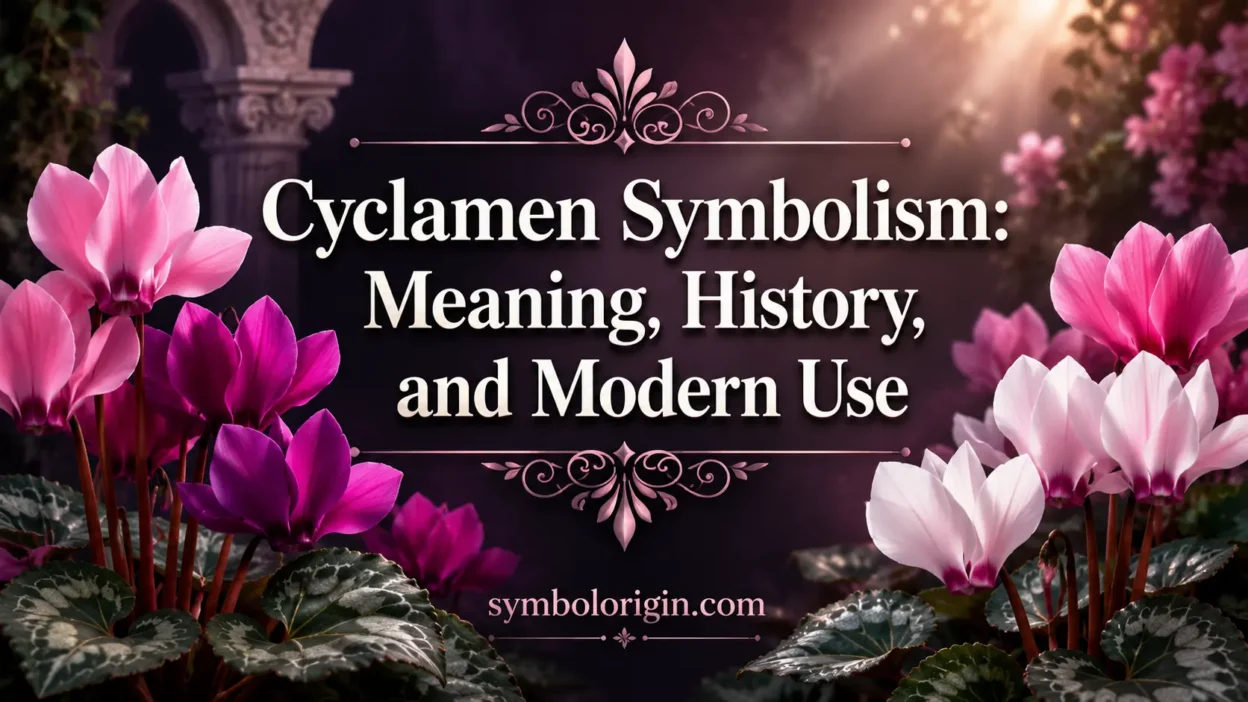
The plant’s appearance contributes strongly to its symbolic appeal. Its rounded or heart-shaped leaves are often dark green with silver marbling. Above them, slender stems carry solitary flowers with five petals that bend sharply backward. Some people compare the blooms to butterflies, flames, birds in flight, or tiny figures bowing their heads.
Cyclamen usually grows during the cooler part of the year. Many species produce leaves in fall, flower during fall, winter, or early spring, and become dormant as summer turns hot and dry. That cycle makes the plant appear to vanish and later return, giving it a natural connection with rest, patience, and renewal.
Cyclamen Meanings at a Glance
| Context | Meaning in the USA | Common Associations | Notes |
|---|---|---|---|
| Farewell gift | Peaceful separation | Retirement, moving, life transitions | Draws from older flower-language traditions |
| Romantic gift | Sincere affection | Devotion, tenderness, quiet love | Heart-shaped leaves reinforce this meaning |
| Winter display | Resilience and hope | Endurance, patience, renewal | Based on its cool-season flowering cycle |
| Memorial use | Acceptance and remembrance | Closure, dignity, continuing love | Less common than lilies or roses |
| Personal design | Emotional complexity | Love, loss, humility, recovery | Meaning depends on the wearer or artist |
These interpretations are best understood as flexible cultural associations rather than fixed definitions. Flower meanings have always varied between books, regions, periods, and personal circumstances. Even Victorian guides sometimes assigned different messages to the same flower.
Farewell, Resignation, and Graceful Release
The most firmly documented historical meaning of cyclamen is resignation or goodbye. American horticultural references that preserve traditional flower-language lists still identify the flower with “resignation and good-bye.” A surviving American trade card from 1892 labels cyclamen as “diffidence,” showing that reserved or hesitant emotion was also part of its nineteenth-century symbolism.
“Resignation” can sound defeated to a modern reader, but its older sense was not necessarily hopeless. It could mean accepting an unavoidable situation with composure. In that context, cyclamen does not simply communicate abandonment. It can express the recognition that a relationship, season, job, or stage of life has reached its natural end.
This is why the flower can suit a retirement, relocation, graduation, or respectful parting. Its message is closer to “I care about you as we go separate ways” than “I no longer care.” The combination of affection and separation distinguishes cyclamen from flowers associated only with grief or rejection.
Its backward-sweeping petals also visually support the idea of departure. They appear to be moving away from the flower’s center while remaining attached to it. That form can suggest distance without complete emotional severance — a useful image for friendships and family bonds that continue after someone leaves.
Modesty, Diffidence, and Reserved Emotion
Diffidence means shyness or a lack of confidence in expressing oneself. In older floral imagery, cyclamen’s lowered flower head could resemble a modest bow, while the petals curl upward rather than opening directly toward the viewer. These features encouraged associations with reserve, humility, and feelings held back.
This meaning remains relevant even though Americans rarely use the word “diffidence” in everyday conversation. A cyclamen can represent someone who loves quietly, avoids public displays, or communicates care through consistent action rather than dramatic statements.
Psychologically, the plant may appeal to people who identify with emotional privacy. Its blooms are colorful and noticeable, yet their faces point downward. Symbolically, that creates a contrast between visible beauty and guarded inwardness.
Modesty should not be confused with shame or weakness. In a positive interpretation, cyclamen represents self-control, thoughtfulness, and the ability to feel strongly without needing constant attention. It can therefore serve as a fitting personal symbol for introversion, quiet dignity, or understated confidence.
Love, Affection, and Devotion
Cyclamen’s associations with farewell do not erase its connection with love. The plant’s heart-shaped leaves make affection an immediate modern interpretation, especially when it is given in pink or red. Its long flowering period also suggests care that continues rather than disappearing after a brief display.
The flower is especially suited to sincere, gentle affection. A cyclamen plant does not communicate the theatrical passion usually attached to a dozen red roses. It feels more domestic and lasting: something placed on a windowsill, watered over time, and noticed during ordinary days.
That quality allows it to symbolize devotion between partners, but it can also represent love between relatives, close friends, caregivers, or people separated by distance. In such cases, cyclamen acknowledges both attachment and vulnerability.
Historical folklore also linked the plant with romantic attraction. Accounts of its cultural history describe old beliefs that cyclamen preparations could inspire love or act as charms. These claims belong to folklore rather than safe modern practice, but they show that the flower’s connection with affection developed long before contemporary floral gifting.
Winter Blooming, Renewal, and Resilience
Cyclamen is frequently interpreted as a symbol of resilience because it flowers when many plants are dormant. Florist’s cyclamen is traditionally sold during winter, while hardy species may bloom in fall, winter, or early spring. The contrast between vivid flowers and a cold landscape naturally suggests persistence during difficult periods.
Its resilience is not aggressive. Cyclamen does not overcome summer heat by remaining constantly active. Instead, it survives through dormancy. The leaves fade, growth pauses, and the tuber stores what the plant needs until favorable conditions return.
That pattern offers a more realistic image of endurance than nonstop productivity. Symbolically, rest is part of survival. Retreat, recovery, and reduced activity do not necessarily mean failure; they may prepare the way for renewed growth.
For someone experiencing burnout, bereavement, illness in the family, or a demanding transition, cyclamen can represent patient recovery. It does not promise that hardship will disappear immediately. It suggests that a quiet period can still contain the conditions for a future return.
The plant’s recurring cycle also gives it a connection with hope. A dormant cyclamen may look finished to an inexperienced owner, but properly cared-for plants can grow again when their active season begins.
Mediterranean Origins and Ancient Folklore
Cyclamen is not originally an American plant. Species occur naturally across a wide region centered on the Mediterranean and extending into parts of Europe, western Asia, North Africa, Iran, and northeastern Somalia. Its long presence in these landscapes placed it within ancient medicinal practice, household folklore, and later European gardening traditions.
The name is connected to an ancient Greek word associated with a circle. Explanations usually point either to the plant’s rounded underground tuber or to the way some species coil their flower stalks as seeds develop. The circular form may have encouraged later associations with cycles, continuity, and return, although those ideas are modern interpretations rather than a single documented ancient code.
Older traditions attributed unusual powers to the plant. It was connected with love charms, protection, fertility, childbirth, and medicinal preparations. Some historical writers treated it as beneficial, while others warned pregnant women to avoid it because of beliefs about its effects on labor. Such accounts reveal how people once combined observation, superstition, and medicine, but they should not be treated as reliable health guidance.
These contradictory beliefs also help explain the flower’s emotional complexity. It could signify attraction and danger, fertility and loss, protection and caution. Modern interpretations are gentler, but the older layers prevent cyclamen from becoming a simple symbol of cheerful romance.
Victorian Flower Language and the Evolution of Meaning
Flower language, often called floriography, became highly fashionable in Europe and the United States during the nineteenth century. Illustrated dictionaries assigned sentiments to flowers, allowing bouquets, cards, household objects, and printed images to carry emotional messages. The practice was especially popular during the Victorian era, though meanings varied substantially between guides.
Cyclamen appeared in this system with meanings such as resignation, goodbye, and diffidence. The surviving 1892 American trade card connecting it with diffidence confirms that the symbolism circulated beyond private flower dictionaries and entered commercial popular culture.
The flower’s symbolism changed as formal knowledge of floriography declined. Most Americans today choose cyclamen for its color, seasonal availability, or decorative form rather than to send a coded message. As a result, negative-sounding ideas such as resignation have softened into acceptance, transition, or respectful closure.
Modern meanings such as resilience and renewal draw more directly from the plant’s growth pattern than from Victorian dictionaries. Its heart-shaped foliage has also strengthened its connection with love. The current symbolism is therefore a blend of historical convention, botanical behavior, visual form, and personal interpretation.
What Cyclamen Commonly Means in the United States
In contemporary American culture, cyclamen does not carry one universally recognized message. It is first understood as an ornamental winter plant, particularly a potted indoor flower. Its symbolic meaning usually becomes important only when a giver, artist, writer, or recipient deliberately considers it.
The most natural American interpretations are:
- affection expressed without extravagance
- encouragement during a difficult season
- acceptance of a necessary change
- remembrance after separation
- patience during recovery
- quiet or private love
Cyclamen may appear among holiday plants because of its winter flowering and red, white, or pink color range. However, it does not have the same fixed Christmas identity as the poinsettia. It can remain on display after the holidays without feeling tied to one celebration.
It also works as a housewarming or hostess gift. In that setting, the meaning usually centers on warmth, thoughtfulness, and beauty during winter rather than goodbye. Context therefore matters more than any historical dictionary definition.
Americans using cyclamen in personal art often select the meaning that matches their own experience. Someone might see it as a farewell flower after moving away from home, while another person may see it as a sign of recovery after an emotionally dormant period.
What Different Cyclamen Colors Can Represent
Cyclamen color meanings are not governed by a consistent historical system. The following interpretations combine common American color associations with the flower’s broader themes rather than claiming an official floral code.
Pink cyclamen. Pink suggests tenderness, gratitude, compassion, and gentle affection. It is a suitable choice for a friend, parent, caregiver, romantic partner, or anyone who has offered steady emotional support.
Red cyclamen. Red emphasizes devotion, romantic feeling, and emotional courage. Because the plant also carries farewell associations, red cyclamen can express love that continues despite distance or change.
White cyclamen. White commonly represents peace, sincerity, remembrance, and calm acceptance. It can suit memorial settings, sympathy gifts, reflective spaces, or a transition approached without resentment.
Purple or lavender cyclamen. Purple and lavender suggest dignity, introspection, individuality, and restrained emotion. They work well when the intended meaning is personal growth, creativity, or quiet strength.
Multicolored cyclamen. Bicolored, fringed, or patterned varieties can represent emotional complexity. They are appropriate when a situation contains mixed feelings — such as pride and sadness at a graduation, retirement, or move.
Color should support the intended message rather than replace it. A short written note is the clearest way to prevent a thoughtful gift from being misread.
Cyclamen in Gifts, Memorials, Tattoos, and Decor
As a gift, cyclamen works best when the recipient enjoys living plants and can provide cool, bright conditions. It may be given for a winter birthday, a new home, a retirement, an extended recovery, or a departure. Because historical meanings include goodbye, a note can clarify whether the plant represents encouragement, affection, remembrance, or peaceful transition.
In memorial settings, cyclamen is less conventional than lilies, chrysanthemums, or roses. That can make it feel more personal. Its dormancy and return offer a subtle image of continuing memory, while white flowers can create a calm and restrained atmosphere.
A cyclamen tattoo may represent a farewell that changed the wearer, love maintained across distance, introversion, emotional recovery, or the acceptance of an ending. The flower’s curved petals create a sense of movement, while the heart-shaped leaf can add an explicit connection with affection.
In jewelry and botanical illustration, cyclamen often communicates elegance and individuality rather than a specific historical message. Its unusual silhouette is recognizable without being as common as a rose, lotus, or daisy.
In home decor, the plant’s meaning depends strongly on placement. A bright cyclamen in an entryway feels welcoming. One beside a photograph may suggest remembrance. A group of winter-blooming plants can represent color, hospitality, and life continuing through the darker part of the year.
Cross-Cultural, Religious, and Misunderstood Meanings
Cyclamen has cultural importance in parts of its native range. Cyclamen cyprium, for example, is the national plant of Cyprus, where it carries ecological and national significance beyond the private emotional meanings assigned by flower dictionaries.
Some Christian devotional interpretations connect the bowed flower with humility, reverence, or Mary. These associations can be meaningful in religious art or personal reflection, but cyclamen does not have one universal biblical definition. It is better described as a later devotional symbol than as a flower assigned a specific meaning in scripture.
The flower is also sometimes presented online as a universal symbol of maternal love, sacred romance, protection, or spiritual awakening. These interpretations may be personally useful, but they should not be confused with historically consistent meanings across all cultures.
Cyclamen is not inherently a death symbol. Its association with farewell can make it suitable for mourning, but it more often represents separation, acceptance, or transition than death itself.
It is also inaccurate to assume that its heart-shaped leaves make it an exclusively romantic flower. Cyclamen can express friendship, family affection, gratitude, remembrance, or self-respect.
Finally, historical medicinal or magical uses should not encourage experimentation. Cyclamen contains compounds that can cause illness if ingested, with the roots and tubers posing particular risks to cats, dogs, horses, and people. It should be placed away from curious pets and children.
Frequently Asked Questions
Is cyclamen a positive or negative symbol?
It can carry either tone, and that duality is really the point of the flower. Its historical meanings of resignation and goodbye can sound somber on their own, but modern interpretation tends to pair them with affection, resilience, and peaceful closure — making cyclamen less a sad symbol than a bittersweet one.
What does a cyclamen tattoo mean?
A cyclamen tattoo can represent quiet love, separation, emotional recovery, humility, or acceptance of change, and the specific framing usually comes from added details. A heart-shaped leaf leans the design toward affection, while a particular color, a date, or a wilting versus blooming stage can sharpen the meaning toward something more personal.
Does cyclamen symbolize goodbye?
Yes — goodbye is one of its best-documented flower-language meanings, historically paired with resignation and diffidence in Victorian floral dictionaries. Modern use tends to soften that into a caring farewell rather than cold rejection, closer to “I care about you as we go separate ways” than a message of abandonment.
Is cyclamen associated with love?
Yes, particularly sincere or devoted love rather than dramatic passion — its heart-shaped foliage makes that connection almost immediate, especially in pink or red varieties. What makes cyclamen distinct from more overtly romantic flowers is that its farewell associations let it also represent love that continues through distance, separation, or change.
What does white cyclamen symbolize?
White cyclamen commonly suggests peace, sincerity, remembrance, and calm acceptance, making it a fitting choice for memorial settings or a transition approached without resentment. Like most cyclamen color meanings, this is a modern association built from general color psychology rather than a fixed historical rule.
What is the spiritual meaning of cyclamen?
Spiritually, cyclamen is often read as a symbol of humility, patient renewal, rest before growth, and acceptance of life’s changing seasons. There’s no single established religious tradition behind these interpretations, so the meaning tends to depend heavily on the individual’s own beliefs and what the plant’s growth cycle evokes for them personally.
Is cyclamen appropriate as a sympathy gift?
It can be a thoughtful, less conventional choice, particularly for someone who appreciates living plants over cut flowers. White or pale pink varieties tend to communicate remembrance and quiet support well, but because cyclamen’s meaning isn’t widely known the way lilies or roses are, a short note explaining the sentiment goes a long way.
Why does cyclamen carry such contradictory meanings — love and goodbye at the same time?
The contradiction traces back through the flower’s whole history rather than being a modern accident. Its heart-shaped leaves invite associations with affection, while its backward-curling petals and older folklore around resignation and diffidence pull toward separation — the plant essentially holds attachment and release in the same form, which is part of what makes it feel emotionally honest rather than simply cheerful.
Is it safe to keep cyclamen around pets or children?
Not without caution — the plant contains compounds that can cause illness if ingested, and the roots and tubers carry particular risk for cats, dogs, horses, and people. Its historical use in folk medicine and love charms shouldn’t be mistaken for safety; it’s best displayed somewhere curious pets and small children can’t easily reach.
What’s the difference between cyclamen’s meaning as a gift versus in Victorian flower language?
The core sentiment has softened rather than changed entirely. Victorian floriography emphasized resignation, diffidence, and goodbye somewhat starkly, while modern gift-giving tends to draw out the gentler layer already present in those meanings — acceptance, quiet affection, and encouragement — making cyclamen feel more like a hopeful, caring gesture than the more somber message it once carried.
Conclusion
Cyclamen resists becoming a simple symbol because it was never built from simple materials. A flower with heart-shaped leaves and backward-curling petals is, quite literally, shaped like two opposite gestures at once — reaching toward and pulling away — and its symbolism has just followed that lead honestly instead of forcing the plant into one tidy meaning.
That honesty is what gives cyclamen its staying power across such different contexts. Mediterranean folklore saw both a love charm and a caution in the same tuber. Victorian flower dictionaries filed it under resignation and goodbye. Modern gift-givers reach for it to say something gentler — affection that persists through change, or hope that survives a dormant season. None of those readings are wrong; they’re what happens when a plant’s actual shape and growth cycle keep giving people permission to project real, complicated feelings onto it.
That’s ultimately the most useful way to give or wear cyclamen: not as a flower that resolves the tension between holding on and letting go, but as one that’s honest enough to hold both at the same time — which, most of the time, is exactly what a real goodbye actually feels like.