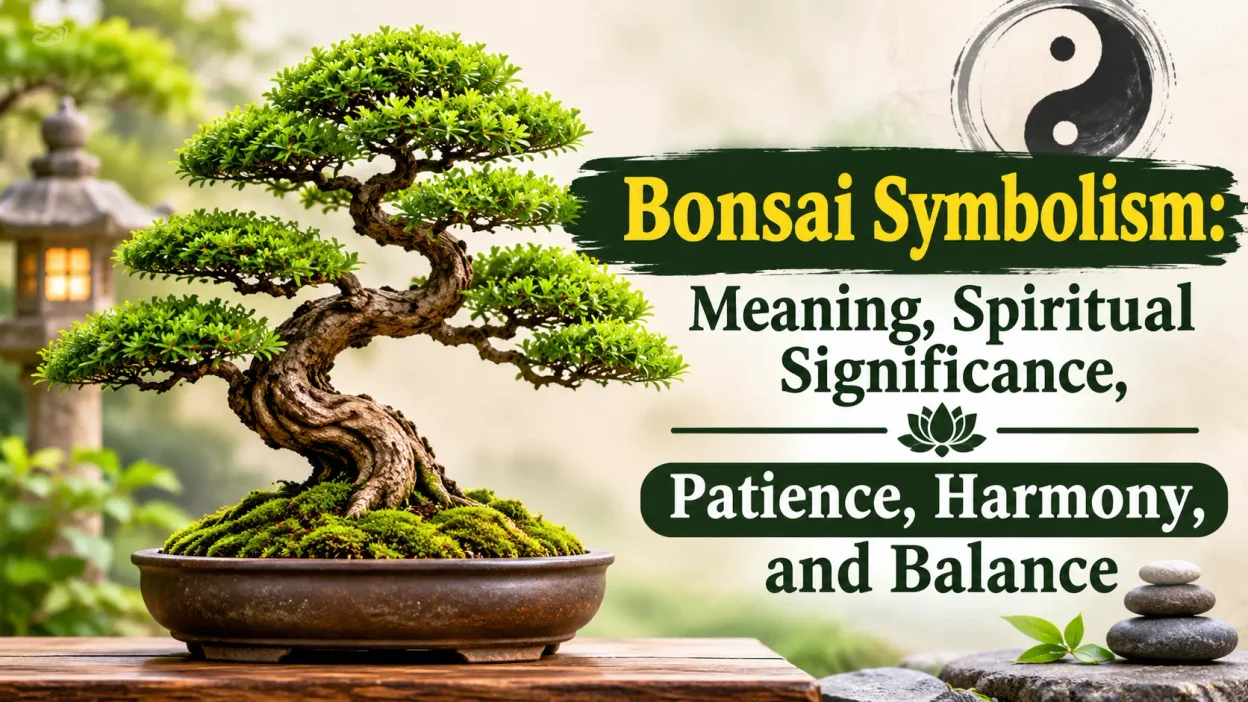
Bonsai trees are admired around the world for their beauty, delicate appearance, and artistic presentation. Although they are small in size, they represent something much greater than miniature trees. Bonsai symbolism is deeply connected with patience, balance, harmony, wisdom, resilience, and the beauty of nature.
The art of bonsai involves carefully cultivating and shaping trees in containers while maintaining their natural character. This process requires time, attention, and a deep understanding of the plant’s growth. As a result, bonsai trees have become powerful symbols of discipline, mindfulness, and the relationship between humans and nature.
Bonsai is especially associated with Japanese culture, although its historical roots are connected to the older Chinese art of penjing. Across modern interpretations, bonsai trees can represent peace, prosperity, longevity, and personal development.
But what does a bonsai tree symbolize spiritually? Does it represent good luck, strength, or balance? Let’s explore its meanings, cultural history, spiritual significance, different types, and symbolism in everyday life.
What Does a Bonsai Tree Symbolize?
A bonsai tree commonly symbolizes patience, harmony, balance, wisdom, resilience, and personal growth. Its carefully cultivated appearance represents the relationship between nature, time, and human creativity.
Here are some of the most common symbolic meanings of bonsai trees:
- Patience: Growing and maintaining a bonsai requires consistent care and a long-term commitment.
- Harmony: Its balanced shape represents the relationship between natural growth and human creativity.
- Peace: Its graceful appearance can symbolize tranquility, mindfulness, and inner calm.
- Wisdom: Its connection with traditional cultivation represents experience, learning, and thoughtful decisions.
- Resilience: A carefully maintained bonsai can symbolize endurance and the ability to adapt.
- Balance: Its branches, trunk, roots, and container create a visual representation of proportion and harmony.
- Longevity: Some bonsai trees can live for generations with appropriate care, making them symbols of continuity.
- Personal growth: Its gradual development represents self-improvement and the importance of nurturing potential.
The exact meaning of a bonsai tree depends on its cultural background, species, design, and the personal interpretation of the person who owns it.
Spiritual Meaning of Bonsai Trees
Spiritually, bonsai trees are often interpreted as symbols of mindfulness, patience, balance, and connection with nature. Their slow development encourages people to appreciate the present moment and understand that meaningful growth takes time.
1. Patience and Discipline
One of the strongest meanings associated with bonsai is patience.
Unlike decorative objects that can be completed immediately, a bonsai tree develops gradually. Its shape is maintained through careful pruning, watering, wiring, and regular attention.
This process symbolizes the importance of patience in personal development.
A bonsai can remind you that meaningful achievements rarely happen overnight. Consistency, discipline, and thoughtful effort are often more valuable than rushing toward immediate results.
2. Harmony Between Humans and Nature
Bonsai represents a relationship between human creativity and natural growth.
The caretaker guides the tree’s development but must also respect its natural characteristics and biological needs.
Spiritually, this relationship can symbolize cooperation rather than control.
It encourages people to work with nature, recognize their limitations, and find harmony between personal ambitions and the world around them.
3. Inner Peace and Mindfulness
Caring for a bonsai can involve quiet observation and focused attention.
Watching its growth, removing unwanted branches, and maintaining its health can become a mindful activity.
In modern spiritual interpretations, bonsai symbolizes the value of slowing down and appreciating small moments.
Its presence can also represent a peaceful environment and a thoughtful approach to everyday life.
4. Balance and Stability
A well-maintained bonsai often has carefully balanced proportions between its roots, trunk, branches, and foliage.
This visual harmony makes it a symbol of balance and stability.
Spiritually, it may represent the importance of balancing work, relationships, personal responsibilities, and emotional well-being.
5. Wisdom and Personal Growth
Bonsai trees develop through time, experience, and continuous care.
Their gradual transformation can represent the process of gaining wisdom and becoming more mature.
A bonsai may symbolize the idea that growth is not always about becoming bigger. Sometimes, true development involves becoming more thoughtful, balanced, and aware.
6. Resilience and Endurance
Many tree species used for bonsai can survive for decades or even centuries under suitable conditions.
Their ability to continue growing despite careful shaping and environmental changes makes them symbols of resilience.
In spiritual interpretations, bonsai represents the strength to adapt without losing your essential character.
Bonsai Symbolism in Japanese Culture
Bonsai is strongly associated with Japanese culture and is widely recognized as a traditional art of cultivating miniature trees.
However, the practice did not originate entirely in Japan. It developed from older Chinese traditions and was later adapted into a distinctive Japanese art form.
The Japanese word bonsai is commonly translated as “planted in a tray” or “tray planting.”
Harmony and Simplicity
Japanese bonsai aesthetics often emphasize simplicity, natural beauty, proportion, and harmony.
The goal is not simply to create a small tree but to present a convincing artistic representation of a mature tree in nature.
This approach can connect with broader Japanese aesthetic ideas such as:
- Wabi-sabi: Appreciation of imperfection, simplicity, and the passage of time.
- Shizen: Naturalness or a quality of being natural.
- Ma: The importance of space, pauses, and meaningful intervals in composition.
These concepts are broader aesthetic ideas, not exclusive meanings of bonsai.
Respect for Nature
Bonsai cultivation requires close attention to the natural growth patterns of a tree.
A bonsai artist must understand the species, its needs, and how it responds to pruning and shaping.
This practice can symbolize respect for nature and the importance of working with natural processes.
Patience and Dedication
Traditional bonsai cultivation requires ongoing attention over many years.
This makes it a meaningful representation of dedication, responsibility, and long-term commitment.
The process reminds people that beauty and maturity develop through time rather than through shortcuts.
Bonsai Symbolism in Chinese Culture
The historical roots of bonsai are closely connected to the Chinese art of penjing.
Penjing is an artistic practice that creates miniature landscapes using trees, rocks, water, and other natural elements.
It existed in China before bonsai developed into its distinctive Japanese form.
Penjing and the Natural World
Penjing aims to represent the beauty and atmosphere of natural landscapes on a smaller scale.
Depending on the composition, it may symbolize mountains, forests, rivers, and the relationship between different elements of nature.
This artistic approach reflects an appreciation for balance, natural harmony, and the interconnectedness of the environment.
Longevity and Prosperity
In some Chinese cultural interpretations, trees can symbolize longevity, vitality, and prosperity.
Bonsai and penjing compositions may carry these associations depending on the species and artistic context.
However, not every bonsai has the same traditional meaning, and specific interpretations vary.
Bonsai Symbolism in Zen and Meditation
Bonsai is sometimes associated with Zen Buddhism and mindfulness because its cultivation encourages concentration, patience, and careful observation.
However, bonsai is not itself a religious practice, and not every bonsai tradition is directly connected with Zen.
Mindful Attention
Caring for a bonsai requires observing small changes in the tree’s health and appearance.
This attention can encourage a mindful approach to everyday activities.
Acceptance of Imperfection
A bonsai may develop natural irregularities, scars, or uneven branches that become part of its character.
Modern interpretations often connect this with the broader aesthetic appreciation of imperfection.
Living in the Present
Because bonsai trees develop gradually, they encourage their caretakers to appreciate the current stage of growth rather than focusing only on the final appearance.
This can serve as a reminder to value the present moment.
Bonsai Tree Symbolism by Shape and Style
Bonsai trees are cultivated in different styles, each with distinctive visual characteristics.
Their shapes can also inspire different symbolic interpretations.
| Bonsai styleAppearancePossible symbolic meaning | ||
|---|---|---|
| Formal upright | Straight trunk with balanced branches | Stability, discipline, and strength |
| Informal upright | Curved but upright trunk | Flexibility and resilience |
| Slanting | Trunk grows at an angle | Adaptability and determination |
| Cascade | Branches extend downward below the container | Perseverance and overcoming challenges |
| Semi-cascade | Branches extend outward and downward | Balance and flexibility |
| Broom style | Branches spread upward in a rounded shape | Unity, harmony, and community |
| Windswept | Branches appear shaped by strong winds | Endurance and resistance |
| Literati | Tall, slender trunk with sparse branches | Simplicity, elegance, and freedom |
These meanings are interpretive associations inspired by each style’s appearance, not fixed traditional definitions.
Bonsai Tree Symbolism by Species
Different tree species are used for bonsai cultivation. Their individual characteristics and cultural associations can influence their symbolic meanings.
1. Juniper Bonsai Symbolism
<escape>Juniper</escape> bonsai is popular because of its distinctive foliage and ability to be shaped into different styles.
It is commonly associated with:
- Strength and endurance.
- Resilience and adaptability.
- Protection in some cultural and folk interpretations.
- Longevity and persistence.
Its rugged appearance makes it a particularly recognizable symbol of survival and determination.
2. Ficus Bonsai Symbolism
Ficus bonsai trees are popular among beginners because some species adapt well to indoor growing conditions.
They may symbolize:
- Growth and vitality.
- Adaptability.
- Stability.
- Abundance and prosperity in some modern interpretations.
Their ability to develop aerial roots in certain species can also create symbolic associations with connection and grounding.
3. Japanese Maple Bonsai Symbolism
Japanese maple bonsai is admired for its delicate leaves and changing seasonal colors.
It can symbolize:
- Transformation.
- Beauty and elegance.
- The passage of time.
- Acceptance of change.
- Seasonal renewal.
Its changing foliage makes it an especially meaningful representation of life’s natural cycles.
4. Pine Bonsai Symbolism
Pine bonsai trees are strongly associated with longevity, strength, endurance, and resilience in East Asian artistic and cultural traditions.
Their evergreen foliage represents continuity through changing seasons.
In Japanese New Year traditions, pine is also associated with longevity and auspiciousness.
5. Cherry Blossom Bonsai Symbolism
Cherry blossom bonsai represents beauty, renewal, and the temporary nature of life.
Cherry blossoms are strongly associated with sakura traditions in Japan.
Their short blooming period is often interpreted as a reminder to appreciate beauty and recognize that life is constantly changing.
6. Chinese Elm Bonsai Symbolism
Chinese elm bonsai is valued for its graceful branching and adaptability.
In modern symbolic interpretations, it can represent:
- Flexibility.
- Wisdom.
- Stability.
- Balance.
- Long-term growth.
These associations are interpretive rather than universal traditional meanings.
Bonsai Symbolism in Dreams
Dreaming about a bonsai tree can have different interpretations depending on its appearance, condition, and the emotions you experience.
Dream interpretations are subjective and should not be treated as scientifically established predictions.
Dreaming of a Healthy Bonsai Tree
A healthy bonsai may symbolize patience, stability, personal development, and emotional balance.
It could reflect satisfaction with gradual progress in your life.
Dreaming of a Small Bonsai Tree
A small bonsai may represent potential, simplicity, and the importance of nurturing something meaningful.
It could also reflect your desire to focus on personal development rather than external achievements.
Dreaming of a Flowering Bonsai
A flowering bonsai may symbolize happiness, creativity, renewal, and the results of consistent effort.
It could represent a positive stage of personal or professional development.
Dreaming of a Dying Bonsai
A dying bonsai may represent neglect, exhaustion, disappointment, or an area of life that needs attention.
It may encourage you to consider whether you have been giving enough time and care to your goals or relationships.
Dreaming of Pruning a Bonsai
Pruning a bonsai may symbolize letting go of unnecessary habits, distractions, or responsibilities.
It can represent the process of making thoughtful decisions to create room for healthier growth.
Dreaming of Planting a Bonsai
Planting a bonsai may represent new plans, patience, and long-term commitment.
It can reflect the beginning of a project or personal journey that requires consistent effort.
Bonsai Symbolism in Love and Relationships
In relationships, bonsai trees can represent patience, commitment, harmony, and the importance of nurturing emotional connections.
Their slow growth makes them meaningful symbols of relationships that develop through consistent care.
Patience and Understanding
A healthy relationship requires patience, communication, and the willingness to understand another person’s needs.
Bonsai symbolism reflects the importance of giving relationships time to develop naturally.
Long-Term Commitment
Some bonsai trees can live for generations when properly maintained.
This makes them symbols of continuity and long-term commitment.
Giving someone a bonsai may express the wish for a lasting relationship, although the meaning depends on the individuals involved.
Balance and Mutual Respect
A carefully maintained bonsai represents harmony between different elements.
In relationships, this can symbolize balancing individual needs with shared responsibilities.
Growth Together
A bonsai changes gradually over time.
Similarly, relationships develop through shared experiences, challenges, and mutual support.
Bonsai Symbolism as a Gift
A bonsai tree can be a thoughtful gift because it represents patience, care, growth, and lasting appreciation.
People often give bonsai trees for meaningful occasions.
| Occasion | Possible symbolic message |
|---|---|
| Birthday | Personal growth and new experiences |
| Wedding | Harmony, commitment, and a lasting relationship |
| Housewarming | Peace, prosperity, and a welcoming home |
| Business opening | Patience, success, and long-term growth |
| Retirement | Wisdom, reflection, and a new chapter |
| Graduation | Achievement, discipline, and future opportunities |
| Anniversary | Lasting affection and shared growth |
A bonsai is also a living gift that requires ongoing attention. It is best suited to someone who enjoys plants or is willing to learn how to care for one.
Is a Bonsai Tree Good Luck?
Many people consider bonsai trees symbols of good fortune, prosperity, and positive energy.
This association is especially common in modern home décor and feng shui-inspired interpretations.
However, bonsai is not automatically a good-luck object in every traditional belief system.
Its symbolic associations with prosperity and positive energy depend on cultural context, species, placement, and personal beliefs.
In modern interpretations, a healthy bonsai may represent:
- Financial growth.
- Stability and security.
- New opportunities.
- Long-term success.
- Positive personal development.
A bonsai can serve as a meaningful reminder of these qualities, but owning one does not guarantee wealth or good fortune.
Bonsai Tree Symbolism in Feng Shui
In feng shui-inspired interpretations, plants are often associated with growth, vitality, and the energy of living things.
Bonsai trees may be used as decorative symbols of balance, patience, and connection with nature.
However, opinions about bonsai in feng shui are not uniform. Some interpretations appreciate their beauty and living energy, while others prefer plants with unrestricted natural growth.
Placement and Meaning
People who incorporate bonsai into their homes may choose locations based on personal preference and traditional feng shui interpretations.
- Living room: May symbolize harmony and a welcoming atmosphere.
- Study or office: Can represent patience, focus, and professional development.
- Entryway: May symbolize growth and a positive welcome.
- Meditation space: Can encourage calmness and reflection.
Practical plant requirements should always come first. A bonsai needs suitable light, airflow, watering, and care depending on its species.
What Can We Learn from Bonsai Symbolism?
Bonsai trees offer several meaningful lessons that can be applied to everyday life.
Practice patience: Meaningful growth takes time, and progress does not always happen immediately.
Find balance: A fulfilling life requires attention to different responsibilities and relationships.
Respect natural growth: Personal development should happen through thoughtful effort rather than unnecessary pressure.
Stay resilient: Difficult circumstances can shape strength and encourage adaptability.
Appreciate simplicity: A meaningful life does not always require more possessions or greater achievements.
Remain mindful: Paying attention to small details can improve your understanding of yourself and your surroundings.
Nurture what matters: Relationships, goals, and personal well-being all require consistent care.
Frequently Asked Questions About Bonsai Symbolism
1. What does a bonsai tree symbolize?
A bonsai tree commonly symbolizes patience, harmony, balance, wisdom, resilience, longevity, and personal growth. Its gradual development represents the importance of time and consistent care.
2. What is the spiritual meaning of a bonsai tree?
Spiritually, a bonsai tree is often associated with mindfulness, inner peace, patience, and harmony with nature. It can represent the importance of remaining grounded while continuing to grow.
3. Is a bonsai tree a symbol of good luck?
Bonsai trees are often associated with good fortune, prosperity, and positive energy in modern interpretations. However, these associations are not universal and do not guarantee good luck.
4. What does a bonsai tree symbolize in Japanese culture?
In Japanese culture, bonsai is an art form that emphasizes harmony, natural beauty, proportion, simplicity, and patience. It represents the careful cultivation of a miniature tree while respecting its natural characteristics.
5. What is the difference between bonsai and penjing?
Bonsai is the Japanese art of cultivating miniature trees in containers. Penjing is an older Chinese art that can include miniature trees, rocks, water, and complete landscape compositions.
6. What does a bonsai tree symbolize in love?
In relationships, bonsai trees can represent patience, lasting commitment, harmony, and mutual growth. They can be meaningful gifts for people who value long-term connections.
7. What does a bonsai tree symbolize in dreams?
A bonsai tree in a dream may represent personal growth, patience, stability, and the desire for balance. Its condition and the dreamer’s emotions can influence its personal interpretation.
8. What does a dying bonsai tree symbolize?
A dying bonsai may symbolize neglect, exhaustion, disappointment, or a need to give more attention to something important. This is a subjective dream or personal interpretation, not a prediction.
9. Why is bonsai associated with patience?
Bonsai trees require regular attention and long-term care. Their gradual development makes them powerful symbols of patience, discipline, and the value of consistent effort.
10. What does a pine bonsai symbolize?
Pine bonsai is commonly associated with longevity, strength, endurance, and continuity. Its evergreen foliage makes it a particularly strong symbol of persistence through changing seasons.
11. Can a bonsai tree symbolize prosperity?
Yes. In some modern cultural and decorative interpretations, bonsai trees symbolize prosperity, abundance, and long-term success. The exact meaning depends on the species and cultural context.
12. Is bonsai connected to Zen Buddhism?
Bonsai is sometimes associated with Zen aesthetics and mindfulness because its cultivation encourages patience, concentration, and appreciation of nature. However, bonsai is not exclusively a Zen Buddhist practice.
Conclusion
Bonsai symbolism is deeply connected with patience, harmony, balance, wisdom, resilience, and personal growth. Although a bonsai tree is small in size, its meaning can be significant, representing the beauty of nature and the value of nurturing something over time.
In Japanese culture, bonsai is admired as an artistic expression of natural beauty and careful cultivation. Its historical connection with Chinese penjing adds another layer of meaning involving miniature landscapes and harmony with the natural world.
Whether viewed as a symbol of peace, a reminder of patience, or a gift representing lasting commitment, the bonsai tree offers an important lesson: meaningful growth takes time, attention, and care.