
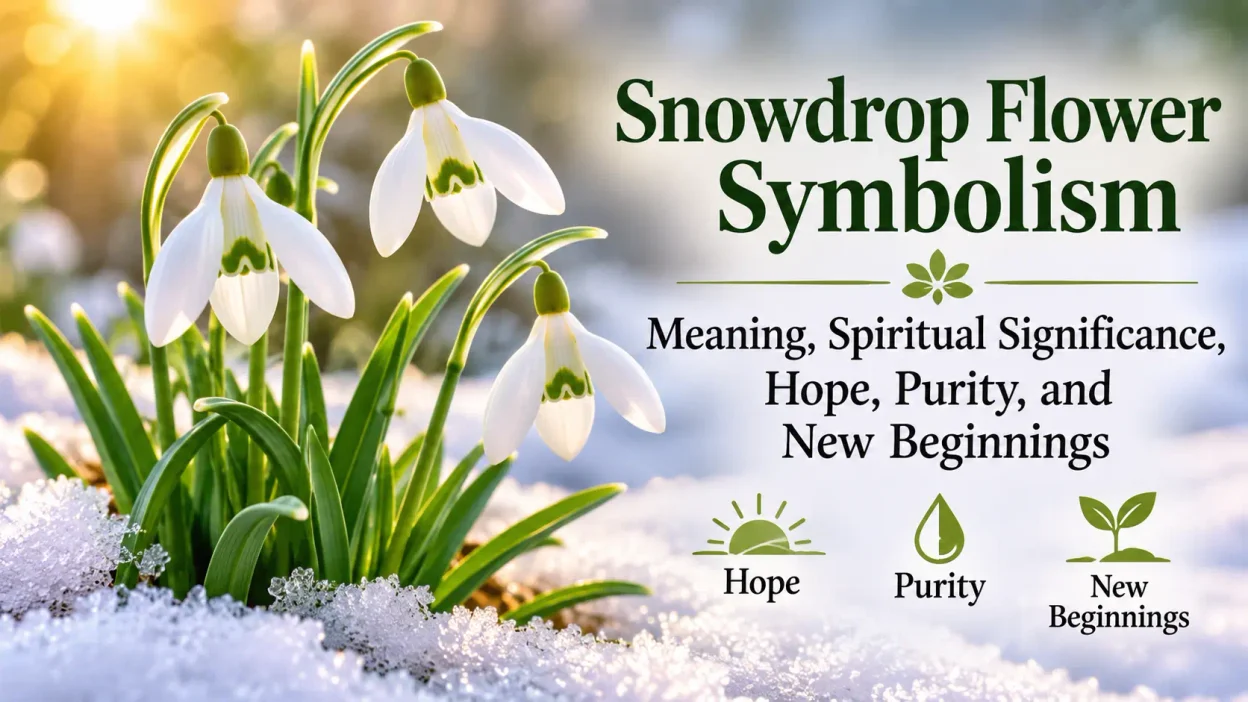
The snowdrop is a delicate white flower that often appears when winter has not yet completely disappeared. Emerging through cold soil and sometimes even snow, this small blossom has become a powerful symbol of hope, renewal, purity, and new beginnings. Its ability to bloom during the coldest part of the year makes it a meaningful reminder that brighter days can arrive even after difficult seasons.
Snowdrop flower symbolism is closely connected to the transition from winter to spring. Its white petals suggest innocence and peace, while its early flowering represents resilience, patience, and the promise of fresh opportunities. In different traditions, snowdrops have also been associated with consolation, sympathy, remembrance, and the return of life.
Whether you encounter snowdrops in a garden, receive them as a gift, or simply admire their appearance, these flowers carry a gentle message: even the smallest signs of hope can make a difference.
What Does the Snowdrop Flower Symbolize?
The snowdrop (Galanthus) commonly symbolizes hope, purity, renewal, resilience, and the arrival of spring. Its appearance during winter gives it a special connection with overcoming challenges and finding beauty in difficult circumstances.
Here are its most common symbolic meanings:
| Symbolic Meaning | Significance |
|---|---|
| Hope | The promise of better days after hardship |
| Purity | Innocence, sincerity, and spiritual cleanliness |
| New beginnings | Fresh opportunities and a new chapter |
| Renewal | The return of life after a dormant season |
| Resilience | Strength and perseverance during difficult times |
| Peace | Calmness, simplicity, and emotional comfort |
| Sympathy | Compassion and support during loss |
| Rebirth | Transformation and the beginning of a new cycle |
These meanings are largely drawn from the flower’s seasonal behavior, appearance, and cultural associations. Their interpretation can vary depending on personal beliefs and traditions.
1. Snowdrop Symbolism of Hope
One of the strongest meanings associated with snowdrops is hope. These flowers often bloom in late winter, when the landscape still looks cold and lifeless. Their appearance suggests that winter will eventually end and warmer days are approaching.
Because they emerge when many other plants remain dormant, snowdrops represent optimism during challenging periods. They remind people that difficult circumstances do not last forever and that positive change can begin quietly.
Snowdrops can symbolize:
- Hope after disappointment
- Encouragement during difficult times
- Faith in a better future
- Emotional strength during uncertainty
- The possibility of happiness after hardship
A snowdrop can be a thoughtful gift for someone facing a difficult period because it communicates encouragement without requiring many words.
2. Snowdrop Symbolism of Purity and Innocence
The snowdrop’s delicate white petals make it a natural symbol of purity and innocence. White flowers are often associated with sincerity, simplicity, peace, and spiritual cleanliness.
Unlike large or brightly colored blossoms, snowdrops have a modest appearance. Their understated beauty suggests that purity does not need to be displayed dramatically.
In symbolic interpretations, snowdrops may represent:
- A sincere heart
- Honest intentions
- Innocent love
- Inner peace
- A fresh and uncomplicated beginning
Their white color can also suggest emotional clarity and the desire to move forward without carrying unnecessary negativity.
3. Snowdrop Symbolism of New Beginnings
Snowdrops are among the flowers associated with the transition from winter to spring. Their early appearance makes them a symbol of fresh starts and new possibilities.
Spring is commonly understood as a season of growth, activity, and renewed life. Snowdrops appear before the full transformation of the landscape, making them especially meaningful symbols of the first steps toward change.
They may represent:
- Starting a new relationship
- Beginning a different career
- Recovering after a setback
- Moving into a new home
- Developing a new personal goal
- Leaving an old chapter behind
Snowdrops are particularly meaningful when someone is entering a new stage of life but has not yet seen the full results of their efforts.
4. Snowdrop Symbolism of Resilience and Strength
Although snowdrops look fragile, they are adapted to flower during cold weather. Their ability to emerge while winter conditions remain makes them powerful symbols of resilience.
They demonstrate that strength does not always look dramatic. Sometimes it appears as quiet persistence, patience, and the ability to continue growing despite unfavorable circumstances.
Snowdrops can symbolize:
- Inner strength
- Perseverance through hardship
- Courage during uncertainty
- Patience and endurance
- The ability to recover after difficulties
Their symbolism is especially meaningful for people who have experienced personal challenges, emotional struggles, or major life changes.
5. Snowdrop Symbolism of Renewal and Rebirth
Snowdrops are closely associated with renewal because they signal the gradual return of life after winter.
Their appearance represents the natural cycle of dormancy, growth, and regeneration. This makes them meaningful symbols of personal transformation and emotional renewal.
In spiritual interpretations, snowdrops may represent releasing the past, restoring inner balance, and welcoming a more hopeful future.
They can symbolize:
- Emotional healing
- Personal growth
- Spiritual renewal
- Releasing old habits
- Rebuilding confidence
- Beginning again after a difficult experience
Snowdrops remind us that renewal does not always happen suddenly. Sometimes it begins with a small change that gradually develops into something meaningful.
6. Snowdrop Symbolism of Peace and Tranquility
The snowdrop’s soft white petals and simple shape give it a peaceful appearance. It is often interpreted as a symbol of calmness, gentleness, and emotional comfort.
Unlike flowers associated with dramatic passion or celebration, snowdrops communicate a quieter kind of beauty.
They may represent:
- Inner calm
- Emotional balance
- Reconciliation
- Gentle affection
- Freedom from unnecessary conflict
- A peaceful environment
Because of these associations, snowdrops can be meaningful gifts for someone who needs comfort, encouragement, or a reminder to slow down.
7. Snowdrop Symbolism of Sympathy and Remembrance
Snowdrops are sometimes associated with sympathy, remembrance, and consolation. Their white flowers can express respect, while their appearance at the end of winter can suggest that hope remains even during periods of grief.
In this context, snowdrops may represent:
- Remembering someone who has passed away
- Offering comfort after a loss
- Expressing compassion
- Honoring meaningful memories
- Finding hope during grief
However, flower meanings are not universal. Snowdrops are not an established symbol of mourning in every culture, so their suitability for funerals or memorials depends on local customs and personal preferences.
Snowdrop Spiritual Meaning
The spiritual meaning of snowdrops is often connected with hope, purification, transformation, and the return of light after darkness.
Their early flowering can serve as a metaphor for spiritual growth. Just as snowdrops appear before spring fully arrives, personal development can begin before someone sees significant changes in their life.
In modern spiritual interpretations, snowdrops may encourage people to remain patient, trust the process of growth, and recognize the value of small beginnings.
Snowdrop as a Symbol of Spiritual Awakening
Snowdrops can represent the beginning of a deeper understanding of oneself. Their appearance after winter may symbolize becoming more aware, letting go of old beliefs, and welcoming a fresh perspective.
Snowdrop as a Symbol of Hope and Faith
Their ability to bloom in cold conditions makes snowdrops meaningful symbols of maintaining hope when life feels uncertain.
Snowdrop as a Symbol of Inner Purity
Their white petals can represent sincerity, honest intentions, and the desire to develop a peaceful inner life.
These spiritual meanings are interpretive rather than universal religious teachings.
Snowdrop Flower Meaning in Different Cultures
Snowdrops have developed different associations in European folklore, gardening traditions, and modern flower symbolism.
1. Snowdrop Meaning in European Traditions
Snowdrops are strongly associated with the end of winter and the beginning of spring in many parts of Europe.
Their early flowering has made them familiar signs of seasonal change. In British and European gardens, they are often celebrated as some of the first flowers to appear after winter.
They commonly represent:
- The arrival of spring
- Hope after a difficult season
- Renewal and fresh beginnings
- The return of warmth and light
2. Snowdrops in Victorian Flower Language
During the Victorian era, flowers were sometimes used to communicate feelings and messages that people might not express directly.
Snowdrops have been associated in later flower-language interpretations with consolation, hope, and purity. However, Victorian floriography was not a single standardized system, and flower meanings differed between dictionaries and traditions.
Their delicate appearance and early blooming helped strengthen their associations with innocence and the promise of spring.
3. Snowdrops in Folklore
European folklore includes several stories about snowdrops and their relationship with winter, purity, and the arrival of spring.
One well-known legend says that snowdrops appeared when an angel comforted Eve after she was expelled from the Garden of Eden. In this story, snowflakes were transformed into flowers to give her hope that winter would eventually end.
This is a folk legend, not a biblical account. The Bible does not specifically mention snowdrops.
Snowdrop Flower Meaning by Color
Snowdrops are best known for their white flowers, although some species and varieties may display differences in markings and floral details.
| Color or Appearance | Symbolic Meaning |
|---|---|
| White snowdrops | Purity, innocence, peace, and hope |
| Green markings | Renewal, growth, and connection with nature |
| Delicate white petals with green details | Balance, simplicity, and fresh beginnings |
The green markings commonly found on snowdrop flowers are part of their natural appearance. Their symbolic interpretation is generally modern and personal rather than based on a universal historical color system.
Snowdrop Symbolism in Love and Relationships
Snowdrops can represent gentle affection, sincere love, loyalty, and the possibility of a fresh beginning in a relationship.
Their delicate appearance suggests a quiet and thoughtful form of love rather than intense passion. They can also symbolize patience and the willingness to allow a relationship to develop naturally.
In relationships, snowdrops may represent:
- Pure and sincere affection
- Hope after a disagreement
- Reconciliation and forgiveness
- Loyalty during difficult periods
- A fresh start after separation
- Gentle and lasting emotional connection
Giving someone snowdrops can be a thoughtful way to express encouragement, appreciation, or the hope of a brighter future together.
Snowdrop Symbolism in Dreams
Dreaming about snowdrops can be interpreted in different ways depending on the dreamer’s emotions, experiences, and circumstances.
Because these flowers are commonly associated with hope and renewal, they may represent a desire for positive change or a new beginning.
Here are some possible interpretations:
| Snowdrop Dream | Possible Meaning |
|---|---|
| Seeing a single snowdrop | A small sign of hope or a new possibility |
| Seeing a field of snowdrops | Renewal, optimism, and emotional growth |
| Snowdrops growing through snow | Resilience during difficult circumstances |
| Receiving snowdrops as a gift | Affection, encouragement, or support |
| Picking snowdrops | Desire to embrace a new opportunity |
| Seeing withered snowdrops | Disappointment, fading hope, or the end of a phase |
| Planting snowdrop bulbs | Patience and investment in future growth |
Dream interpretations are subjective. A snowdrop dream does not predict a particular event or guarantee that something will happen.
Snowdrop Symbolism in Literature and Art
Snowdrops have a natural place in literature and visual art because they represent the transition between darkness and light.
Artists and writers may use them to communicate hope, innocence, renewal, or the beauty of small beginnings.
In paintings, snowdrops can suggest the first signs of spring or the contrast between a cold landscape and emerging life. In poetry, they may represent endurance, quiet beauty, and the promise of change.
Their symbolism is particularly effective when a story explores:
- Recovery after loss
- The passage of time
- Hope during hardship
- The beginning of personal transformation
- The contrast between winter and spring
Snowdrop Flower Meaning as a Gift
Snowdrops can make thoughtful gifts because their symbolism communicates encouragement, sincerity, and hope.
They are especially suitable for occasions involving change, recovery, or new beginnings.
| Occasion | Why Snowdrops Are Meaningful |
|---|---|
| New beginnings | They symbolize fresh opportunities and renewal. |
| Difficult times | They communicate hope and encouragement. |
| Friendship | They express gentle affection and support. |
| Apology | They can represent reconciliation and a fresh start. |
| Memorial occasions | They may communicate remembrance and consolation. |
| Spring celebrations | They represent the arrival of a new season. |
Snowdrops are also associated with early spring birthdays in some modern birth-flower lists, although birth-flower traditions vary by source.
Are Snowdrops Good Luck?
Snowdrops are sometimes considered symbols of good fortune because they appear as winter begins to give way to spring.
Their association with hope and renewal can make them feel like positive signs. However, beliefs about their luck vary.
There is also a traditional superstition in parts of Britain that bringing snowdrops indoors could bring bad luck or even suggest a death in the household. Such beliefs are folklore, not evidence that the flowers cause misfortune.
Therefore, snowdrops can represent hope and positive change in modern symbolism, but they do not guarantee good luck or predict future events.
Snowdrop Flower Symbolism in Christianity
Snowdrops are not specifically mentioned in the Bible, so they do not have an established biblical meaning.
However, their white flowers and early appearance have inspired Christian interpretations connected with purity, hope, renewal, and the promise of new life.
Some people connect their seasonal symbolism with themes found in Christian teachings, such as:
- Renewal: Romans 12:2 discusses transformation through the renewal of the mind.
- Hope: Romans 15:13 speaks about hope, joy, and peace through faith.
- New life: 2 Corinthians 5:17 describes becoming a new creation in Christ.
- Light: John 1:5 describes light shining in darkness.
These verses do not refer to snowdrops directly. Rather, they provide themes that people may use when interpreting the flower from a Christian perspective.
Snowdrop Botanical Facts and Natural Symbolism
Understanding the snowdrop’s natural characteristics helps explain why it carries such powerful symbolic meanings.
| Botanical Feature | Description |
|---|---|
| Botanical genus | Galanthus |
| Plant family | Amaryllidaceae |
| Flower color | Usually white |
| Blooming season | Late winter to early spring, depending on species and climate |
| Growth habit | Grows from bulbs |
| Flower shape | Small, drooping, bell-shaped blossoms |
| Natural habitat | Woodlands, meadows, and other suitable habitats |
| Common symbolic associations | Hope, purity, resilience, and renewal |
Snowdrops are perennial bulbous plants. Their flowers typically have six petal-like structures called tepals, with three outer segments and three smaller inner segments that often display green markings.
The genus Galanthus contains multiple species. One of the best-known is the common snowdrop, Galanthus nivalis.
Their natural growth cycle is especially important to their symbolism. They can emerge during cold weather and flower before many other plants begin their spring growth.
Important safety note: Snowdrops contain naturally occurring compounds and are considered poisonous if eaten. They should not be used as food or home remedies, and bulbs should be kept away from children and pets.
Snowdrop vs. Other Spring Flowers: Symbolic Differences
Snowdrops are often compared with other early-season flowers because they share associations with spring and renewal. However, each flower has its own symbolic character.
| Flower | Common Symbolic Meaning |
|---|---|
| Snowdrop | Hope, purity, resilience, and new beginnings |
| Crocus | Joy, youthfulness, and the arrival of spring |
| Daffodil | Renewal, optimism, and new opportunities |
| Tulip | Love, affection, and elegance |
| Primrose | Youth, renewal, and early spring |
| Lily of the valley | Humility, sweetness, and the return of happiness |
Snowdrops stand out because their symbolism emphasizes hope during difficult conditions. While many spring flowers represent happiness and growth, snowdrops particularly suggest that positive change can begin before circumstances become comfortable.
Frequently Asked Questions (FAQs)
1. What does the snowdrop flower symbolize?
The snowdrop commonly symbolizes hope, purity, renewal, resilience, and new beginnings. Its early appearance during winter makes it a powerful reminder that brighter days are approaching.
2. What is the spiritual meaning of snowdrops?
In modern spiritual interpretations, snowdrops represent spiritual renewal, inner purity, patience, and hope. They can symbolize the beginning of personal growth after a difficult period.
3. Why are snowdrops associated with hope?
Snowdrops often bloom while winter is still present. Their ability to emerge in cold conditions makes them symbols of optimism, perseverance, and the promise of spring.
4. Do snowdrops symbolize new beginnings?
Yes. Snowdrops are associated with new beginnings because they appear near the transition from winter to spring. They can represent fresh opportunities, personal transformation, and a new chapter in life.
5. What does a white snowdrop symbolize?
A white snowdrop commonly represents purity, innocence, peace, sincerity, and hope. Its simple white petals contribute to these symbolic associations.
6. Are snowdrops a symbol of love?
Snowdrops can symbolize sincere affection, gentle love, loyalty, and reconciliation. They are more closely associated with quiet devotion and hope than intense romantic passion.
7. What does it mean to dream about snowdrops?
Dreaming about snowdrops may symbolize hope, emotional renewal, or a desire for positive change. The meaning depends on the dream’s context and the dreamer’s personal experiences.
8. Are snowdrops mentioned in the Bible?
No. Snowdrops are not specifically mentioned in the Bible. Their associations with purity and renewal are later symbolic interpretations rather than direct biblical teachings.
9. Are snowdrops good luck?
Some people associate snowdrops with good fortune, hope, and the arrival of spring. However, certain European folk beliefs also connect bringing them indoors with bad luck. These are cultural superstitions, not established facts.
10. What do snowdrops symbolize after a loss?
Snowdrops can symbolize sympathy, remembrance, consolation, and hope after loss. Their appearance may serve as a gentle reminder that healing and renewal are possible.
11. Why are snowdrops called snowdrops?
The common name refers to their white, drooping flowers, which resemble small drops of snow. Their ability to bloom during cold weather also contributes to the name.
12. Are snowdrops poisonous?
Yes. Snowdrops contain naturally occurring toxic compounds and should not be eaten. Keep the flowers and bulbs away from children and pets.
Conclusion
Snowdrop flower symbolism is deeply connected with hope, purity, resilience, renewal, and new beginnings. These delicate white flowers appear when winter is still present, reminding us that even the smallest signs of change can bring encouragement.
Their symbolism extends to love, peace, sympathy, remembrance, and spiritual growth. Although cultural interpretations differ, the snowdrop’s central message remains consistent: difficult seasons do not last forever, and new possibilities can emerge even in the coldest circumstances.
Whether growing in a garden or given as a thoughtful gift, the snowdrop is a beautiful reminder of quiet strength, sincere affection, and the promise of brighter days.