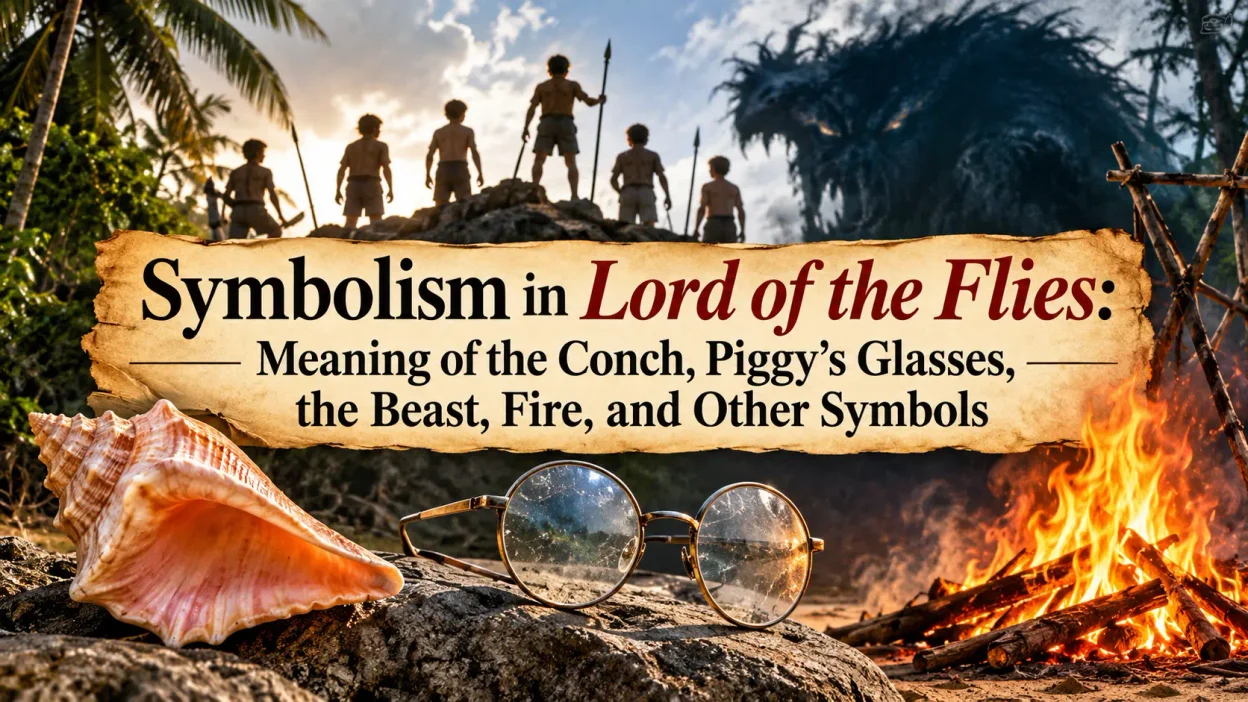
William Golding’s Lord of the Flies is a powerful novel that explores human nature, civilization, fear, violence, and the struggle between order and savagery. Published in 1954, the story follows a group of British schoolboys stranded on a remote island after a plane crash. Without adult supervision, the boys attempt to establish their own society, but their efforts gradually collapse as fear, rivalry, and violence take control.
One of the most important features of the novel is its use of symbolism. Golding uses ordinary objects, characters, animals, and natural elements to communicate deeper ideas about human behavior and society.
The conch shell represents order and democratic authority, Piggy’s glasses symbolize intelligence and scientific knowledge, and the beast represents humanity’s inner capacity for evil. Other important symbols, including the signal fire, the Lord of the Flies, the island, and the naval officer, help develop the novel’s central themes.
In this guide, we explore the major symbols in Lord of the Flies, their meanings, and how William Golding uses them to reveal the darker sides of human nature.
What Is the Main Symbolism in Lord of the Flies?
The central symbolism in Lord of the Flies concerns the conflict between civilization and savagery. Golding uses the island and its objects to show how quickly social order can collapse when people lose their sense of responsibility and moral restraint.
The most important symbols include:
- The conch shell: Democracy, authority, communication, and civilization.
- Piggy’s glasses: Intelligence, reason, science, and technological progress.
- The beast: Fear, evil, and the darkness within human nature.
- The Lord of the Flies: Savagery, corruption, and humanity’s capacity for evil.
- The signal fire: Hope, rescue, civilization, and survival.
- The island: A miniature representation of human society.
- The pig’s head: The physical manifestation of evil and the boys’ inner darkness.
- The face paint: Loss of identity, freedom from social rules, and savagery.
- The parachutist: The destructive influence of adult warfare and the reality of human conflict.
- The naval officer: The contradictions of civilization and the persistence of violence.
Together, these symbols reveal Golding’s argument that evil is not simply an outside threat. It can also emerge from within human beings.
1. The Conch Shell Symbolism: Democracy, Order, and Civilization
<AsyncImage query=”Lord of the Flies conch shell on tropical beach literary symbolism” aspectRatio=”16:9″ width=”100%”/>
The conch shell is one of the most important symbols in Lord of the Flies. Ralph and Piggy discover it near the beginning of the novel, and they use it to gather the boys together.
The conch becomes a symbol of democratic authority, civilized behavior, and organized communication.
The Conch as a Symbol of Democracy
After discovering the conch, Ralph uses it to call the other boys to an assembly. During meetings, the person holding the conch has the right to speak without interruption.
This system creates an organized way for the boys to share opinions and make decisions.
The conch therefore represents:
- Democratic participation.
- Equality and fairness.
- Respect for rules.
- Organized communication.
- Collective responsibility.
Ralph uses the conch to establish a system based on cooperation rather than individual power.
The Decline of the Conch
As Jack becomes increasingly powerful, the boys begin to ignore the rules associated with the conch.
The shell gradually loses its authority because the boys no longer respect the democratic system it represents.
Its destruction near the end of the novel is especially significant. When Roger releases the boulder that kills Piggy, the conch is shattered at the same moment.
This event symbolizes the complete collapse of the boys’ civilized society.
The destruction of the conch suggests that democracy and order cannot survive when people abandon the principles that support them.
2. Piggy’s Glasses Symbolism: Intelligence, Science, and Reason
<AsyncImage query=”round eyeglasses on tropical island sand Lord of the Flies symbolism” aspectRatio=”16:9″ width=”100%”/>
Piggy’s glasses symbolize intelligence, rational thinking, scientific knowledge, and technological progress.
Although Piggy is physically vulnerable and frequently mocked by the other boys, he is one of the most logical and practical characters in the novel.
His glasses allow the boys to create fire by focusing sunlight.
The Glasses as a Symbol of Knowledge
Piggy’s glasses represent the power of human intelligence to understand and control the environment.
They help the boys accomplish something important for survival: making fire without matches.
This ability demonstrates how knowledge and practical thinking can benefit society.
The Loss of Piggy’s Glasses
As Jack’s group becomes more violent, the glasses are increasingly treated as an object of power.
Jack’s hunters steal them so they can make fire for their own purposes.
This shift is important because the glasses move from being a tool associated with shared survival to an instrument controlled by those seeking power.
Piggy’s glasses symbolize several important ideas:
- Intelligence and rational thought.
- Science and technological development.
- Dependence on knowledge.
- The misuse of technology.
- The conflict between reason and violence.
Their destruction and loss of control reflect the decline of rational society.
3. The Beast Symbolism: Fear, Evil, and Human Nature
<AsyncImage query=”Lord of the Flies dark jungle island ominous forest silhouette beast symbolism” aspectRatio=”16:9″ width=”100%”/>
The beast is one of the most significant symbols in the novel. The younger boys become frightened by the possibility that a dangerous creature lives on the island.
At first, the beast seems like an external threat. However, as the story develops, Golding reveals that the real danger comes from the boys themselves.
The Beast as a Symbol of Fear
The beast represents the fear that grows when people do not understand something.
The younger boys become increasingly frightened because they imagine a mysterious creature hiding in the forest.
Jack uses this fear to strengthen his authority and persuade the others to follow him.
The Beast as a Symbol of Inner Evil
During Simon’s hallucination, the pig’s head tells him that the beast is part of the boys themselves.
This moment reveals one of the novel’s central ideas: evil does not necessarily come from an external monster.
Instead, the capacity for violence, cruelty, and destruction already exists within human nature.
The Dead Parachutist and the Beast
The boys eventually mistake a dead parachutist caught in the trees for the beast.
The parachutist is actually a reminder of the adult world’s war and violence.
This discovery strengthens the connection between the imaginary monster and the real destructive behavior of human beings.
The beast symbolizes:
- Fear of the unknown.
- Psychological insecurity.
- Inner evil.
- Violence and savagery.
- The destructive power of collective fear.
4. The Lord of the Flies Symbolism: Evil and Corruption
<AsyncImage query=”pig head on stick flies dark jungle symbolic still life Lord of the Flies” aspectRatio=”16:9″ width=”100%”/>
The Lord of the Flies is the severed pig’s head that Jack’s hunters place on a sharpened stick as an offering to the beast.
The name is a translation of Beelzebub, a name associated with the devil in Christian tradition.
The pig’s head becomes one of the novel’s most disturbing symbols.
The Lord of the Flies as a Symbol of Evil
The pig’s head represents the evil and savagery developing within the boys.
It is surrounded by flies and becomes a disturbing object that reflects the violence of the island.
During Simon’s encounter with it, the head appears to speak and tells him that the beast cannot be hunted or defeated because it exists within the boys themselves.
This moment communicates Golding’s central message about humanity’s capacity for evil.
The Connection Between the Lord of the Flies and Simon
Simon is the only boy who understands that the beast is not a physical monster.
However, when he returns to the group to share the truth, the boys mistake him for the beast and kill him during a violent frenzy.
His death demonstrates how fear and collective aggression can destroy truth and understanding.
The Lord of the Flies symbolizes:
- Inner evil.
- Corruption.
- Violence.
- Moral decay.
- Humanity’s darker instincts.
5. The Signal Fire Symbolism: Hope, Rescue, and Civilization
<AsyncImage query=”small campfire on remote tropical island beach smoke rising ocean Lord of the Flies” aspectRatio=”16:9″ width=”100%”/>
The signal fire represents hope, rescue, civilization, and the boys’ connection with the outside world.
Ralph understands that keeping the fire burning is essential because passing ships may notice the smoke and rescue them.
The Fire as a Symbol of Hope
At the beginning of the novel, the fire represents the boys’ desire to return to civilization.
It requires organization, cooperation, and responsibility.
The boys must work together to maintain it, making it a symbol of collective effort.
The Fire as a Symbol of Destruction
The fire also has a darker meaning.
The boys’ first major fire spreads out of control and may contribute to the disappearance of one of the younger children.
Later, Jack’s hunters use fire to create destruction and eventually drive Ralph into the open.
Ironically, the final destructive fire attracts the attention of a naval ship, leading to the boys’ rescue.
This creates an important contrast: fire can represent both civilization and savagery.
Its symbolism depends on how people use it.
6. The Island Symbolism: Human Society and Civilization
<AsyncImage query=”remote tropical island aerial view white sandy beach dense green jungle Lord of the Flies setting” aspectRatio=”16:9″ width=”100%”/>
The island is the main setting of the novel, but it also represents a miniature version of human society.
At first, the island seems like a beautiful paradise. It has beaches, fruit, fresh water, and natural resources.
However, the boys gradually transform this peaceful environment into a place of fear, violence, and destruction.
The Island as a Social Experiment
The island removes the boys from ordinary adult authority and allows them to create their own social structure.
Their behavior reveals how different systems of leadership can influence a community.
Ralph represents cooperation and democratic organization, while Jack represents authoritarian control and violence.
The island therefore becomes a setting where Golding explores the foundations of human civilization.
The Island as a Symbol of Human Nature
Although the island initially appears peaceful, the boys bring their fears, rivalries, and destructive instincts with them.
This suggests that evil is not necessarily created by the environment.
Instead, the island exposes characteristics that already exist within human beings.
7. Face Paint Symbolism: Loss of Identity and Savagery
<AsyncImage query=”tribal style red white face paint mask theatrical close up wild hunter” aspectRatio=”16:9″ width=”100%”/>
Face paint becomes an important part of Jack’s transformation from a schoolboy into a violent hunter.
Initially, Jack is concerned with rules, appearance, and social expectations. However, after painting his face, he begins to feel less restricted by his former identity.
Face Paint as a Mask
The paint allows Jack and the other hunters to hide their familiar appearances.
This creates a psychological separation between their civilized identities and their increasingly violent behavior.
With their faces covered, the boys feel more comfortable participating in hunting and cruelty.
Face Paint as a Symbol of Anonymity
The masks reduce the sense of personal responsibility.
The boys begin to act as members of a group rather than as individuals who must answer for their actions.
Face paint therefore represents:
- Loss of individual identity.
- Freedom from social expectations.
- Anonymity.
- Group mentality.
- The development of savagery.
8. The Parachutist Symbolism: Adult Violence and the Reality of War
<AsyncImage query=”military parachute caught in trees remote tropical forest dramatic scene” aspectRatio=”16:9″ width=”100%”/>
The dead parachutist is a significant symbol because he connects the boys’ experiences on the island with the wider world of adult conflict.
The boys mistake the parachutist’s body for the beast because it moves in the wind and appears frightening in the darkness.
The Parachutist as a Symbol of War
The parachutist represents the violence taking place in the adult world.
The boys have been evacuated because of a war, yet the society they create on the island eventually develops similar patterns of violence.
This creates a powerful contrast between the supposedly civilized adult world and the increasingly savage behavior of the children.
The Parachutist as a Symbol of Misunderstood Fear
The boys’ inability to identify the parachutist correctly shows how fear can distort perception.
Instead of understanding the source of their anxiety, they create an imaginary monster.
The parachutist symbolizes:
- Adult warfare.
- Destruction and conflict.
- The failure of civilization.
- Fear and misunderstanding.
- The connection between adult and childhood violence.
9. The Pig Symbolism: Violence, Hunting, and Savagery
<AsyncImage query=”wild pig boar in dense tropical forest natural wildlife” aspectRatio=”16:9″ width=”100%”/>
Pigs play an important role in the novel because hunting them becomes a central activity for Jack and his followers.
Initially, hunting is presented as a way to obtain food. However, it gradually becomes an obsession and a source of excitement and power.
The Pig as a Symbol of Human Instincts
The boys’ increasing interest in hunting reflects their growing attraction to violence.
Jack becomes more concerned with killing animals than maintaining the signal fire or following the rules.
The hunt changes from a practical activity into a demonstration of dominance.
The Pig’s Head as an Offering
The hunters place a pig’s head on a sharpened stick as an offering to the beast.
This object eventually becomes the Lord of the Flies, connecting the animal with evil, fear, and corruption.
The pig symbolism therefore reflects the boys’ movement from organized survival toward uncontrolled savagery.
10. The Naval Officer Symbolism: Civilization and Irony
<AsyncImage query=”British naval officer white uniform naval cap standing on tropical beach ocean horizon illustration” aspectRatio=”16:9″ width=”100%”/>
The naval officer appears at the end of the novel when the boys are finally rescued.
His arrival initially seems to represent the return of civilization, discipline, and adult authority.
However, his presence also creates one of the novel’s strongest ironies.
The Officer as a Symbol of Civilization
The officer represents the organized adult world that the boys have been trying to reach.
His arrival ends their immediate struggle for survival on the island.
Ralph and the other boys are once again connected with a larger social structure.
The Irony of Adult Civilization
The officer is part of a naval force involved in the wider war.
This creates an uncomfortable contrast: the adult world that supposedly represents order and civilization is also engaged in organized violence.
The officer symbolizes the contradiction between civilized appearances and humanity’s continued capacity for destruction.
His presence suggests that the problems seen on the island are not limited to children.
Summary of Major Symbols in Lord of the Flies
The following table provides a quick overview of the most important symbols and their meanings.
| Symbol | Main Meaning | Deeper Significance |
|---|---|---|
| Conch shell | Democracy and order | Collapse of civilized society |
| Piggy’s glasses | Intelligence and reason | Knowledge and technological power |
| The beast | Fear and evil | Darkness within human nature |
| Lord of the Flies | Corruption and savagery | Humanity’s inner evil |
| Signal fire | Hope and rescue | Conflict between civilization and destruction |
| Island | Human society | A miniature world revealing human nature |
| Face paint | Anonymity | Loss of identity and moral restraint |
| Parachutist | War and destruction | Adult violence and misunderstood fear |
| Pig | Hunting and violence | Growing savagery |
| Naval officer | Adult civilization | Irony of civilized violence |
How Symbolism Connects to the Major Themes of Lord of the Flies
Golding’s symbols are closely connected with the novel’s central themes. Understanding these relationships makes it easier to interpret the deeper meaning of the story.
1. Civilization vs. Savagery
The conch and signal fire represent civilized society, while face paint, hunting, and the Lord of the Flies represent the growth of savagery.
As the novel progresses, the symbols of civilization lose their influence.
This reflects the collapse of the boys’ social structure.
2. Good vs. Evil
The beast and the Lord of the Flies reveal the darker side of human nature.
Simon recognizes that the real danger is not an external monster but the potential for evil within people.
3. Fear and Its Influence
The beast represents how fear can control a community.
Jack uses the boys’ fear to gain power, showing how leaders can manipulate uncertainty to influence others.
4. Power and Leadership
Ralph and Jack represent different approaches to leadership.
Ralph values rules, cooperation, and shared responsibility. Jack increasingly relies on force, hunting, and fear.
The conch and face paint help symbolize these opposing leadership styles.
5. Loss of Innocence
The boys begin the novel as schoolchildren who expect to survive and return home.
By the end, they have experienced violence, death, and moral destruction.
The broken conch, Piggy’s death, and Simon’s murder demonstrate the loss of innocence and the collapse of their earlier expectations.
Why Is Symbolism Important in Lord of the Flies?
Symbolism is essential to Lord of the Flies because it allows William Golding to explore complicated ideas through recognizable objects and events.
Instead of simply telling readers that civilization is fragile or that people can become violent, Golding demonstrates these ideas through the destruction of the conch, the misuse of Piggy’s glasses, and the boys’ fear of the beast.
The symbols also create connections between the island and the wider world.
The boys’ behavior reflects the violence of adult society, suggesting that the potential for destruction exists across different stages of human life.
By following the changing meanings of these symbols, readers can understand how the novel develops its central argument about human nature.
Conclusion
Symbolism in Lord of the Flies plays a central role in revealing William Golding’s ideas about civilization, savagery, fear, power, and human nature.
The conch represents democracy and order, Piggy’s glasses symbolize intelligence and reason, and the beast reveals the darkness within humanity. The signal fire represents both hope and destruction, while the Lord of the Flies becomes a disturbing representation of evil and corruption.
Other symbols, including the island, face paint, parachutist, pigs, and naval officer, strengthen the novel’s exploration of social order and violence.
Ultimately, Golding suggests that civilization is fragile and that human beings must actively maintain the values that prevent society from falling into chaos. The novel’s symbols make this message powerful, memorable, and relevant beyond the fictional island.
Frequently Asked Questions (FAQs)
1. What is the main symbolism in Lord of the Flies?
The main symbolism in Lord of the Flies explores the conflict between civilization and savagery. The conch represents order, the beast represents inner evil and fear, and Piggy’s glasses symbolize intelligence and reason.
2. What does the conch symbolize in Lord of the Flies?
The conch symbolizes democracy, authority, communication, and civilized society. Its destruction represents the collapse of the boys’ organized social system.
3. What do Piggy’s glasses symbolize?
Piggy’s glasses symbolize intelligence, rational thinking, science, and technological progress. They also represent the power of knowledge and how technology can be controlled or misused.
4. What does the beast symbolize in Lord of the Flies?
The beast symbolizes fear and the potential for evil within human nature. Although the boys believe an external monster threatens them, Simon realizes that the real beast is connected to their own inner darkness.
5. What does the Lord of the Flies symbolize?
The Lord of the Flies symbolizes evil, savagery, corruption, and humanity’s destructive instincts. It represents the darkness that exists within the boys rather than an external monster.
6. What does the signal fire symbolize?
The signal fire symbolizes hope, rescue, civilization, and survival. However, it also represents destruction when the boys use fire irresponsibly or violently.
7. What does the island symbolize?
The island represents a miniature version of human society. It provides a setting in which Golding explores leadership, social order, fear, and the conflict between civilization and savagery.
8. What does face paint symbolize in Lord of the Flies?
Face paint symbolizes anonymity, loss of identity, and freedom from social restrictions. It allows the hunters to behave more violently without feeling connected to their previous civilized identities.
9. What does the parachutist symbolize?
The dead parachutist symbolizes adult warfare, destruction, and the failure of civilization. His presence connects the boys’ violent behavior with the larger conflict taking place in the adult world.
10. What does the naval officer symbolize?
The naval officer symbolizes adult authority and the return of civilization. However, his connection to the ongoing war creates irony because the supposedly civilized adult world is also involved in violence.
11. What does the pig’s head symbolize?
The pig’s head, known as the Lord of the Flies, symbolizes evil, corruption, and savagery. It becomes a physical representation of the boys’ inner darkness and fear.
12. How does symbolism develop the theme of civilization vs. savagery?
Golding uses symbols such as the conch and signal fire to represent civilization, while the beast, face paint, and Lord of the Flies represent savagery. Their changing roles demonstrate how the boys gradually abandon social order.
13. Why is the title Lord of the Flies symbolic?
The title refers to the pig’s head covered in flies, which Simon encounters in the forest. The name is associated with Beelzebub, a name linked to the devil, and represents evil and corruption within human nature.
14. What is the most important symbol in Lord of the Flies?
The conch and the beast are two of the most important symbols. The conch represents civilization and democratic order, while the beast represents fear and the potential for evil within humanity. Together, they capture the novel’s central conflict.
15. What is William Golding’s message about human nature?
Golding suggests that human beings have the capacity for both cooperation and violence. Civilization depends on rules, responsibility, and moral restraint, but these values can collapse when fear, power, and destructive instincts take control.