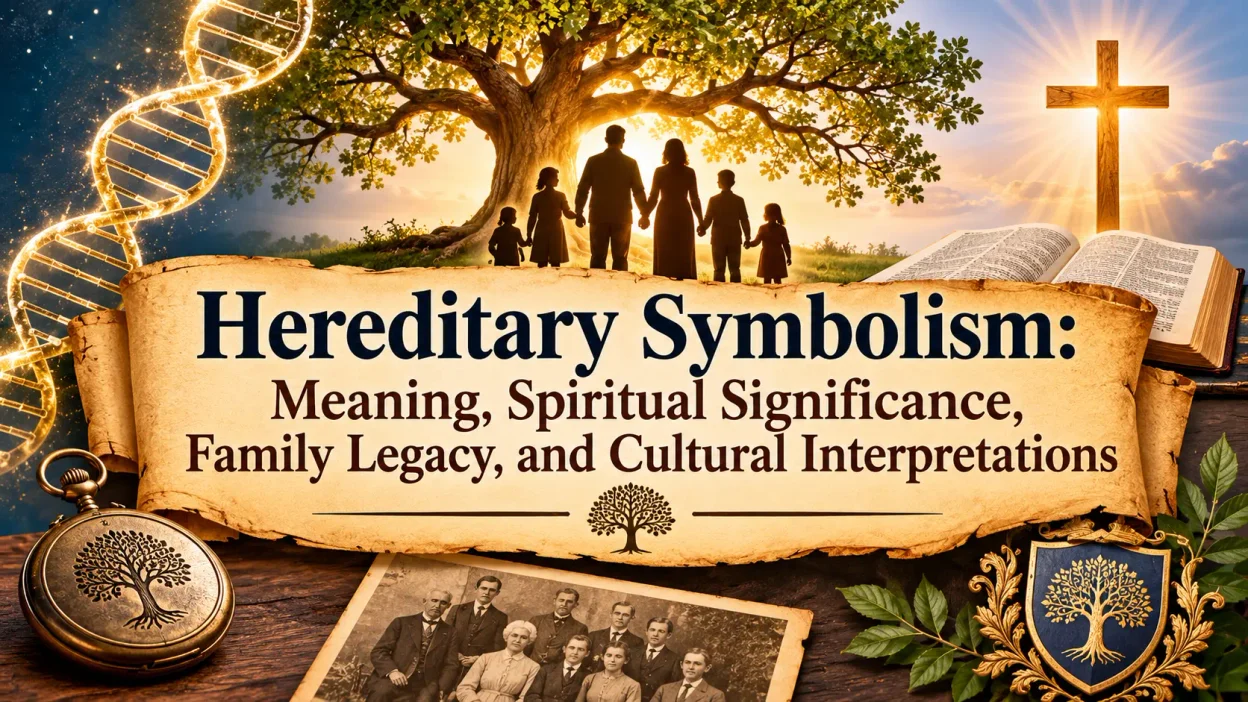
Hereditary symbolism explores the meanings associated with inheritance, ancestry, family identity, and the connections between generations. The word hereditary generally describes characteristics, traditions, or qualities passed from parents to children. Symbolically, it can represent the lasting influence of family history, inherited values, cultural identity, and the legacy people receive from those who came before them.
Hereditary symbolism appears in family crests, coats of arms, heirlooms, inherited jewelry, surnames, genetic imagery, and cultural traditions. These symbols often communicate a sense of belonging, continuity, responsibility, and connection to one’s roots.
In spiritual and personal interpretations, hereditary symbolism may also represent generational wisdom, inherited strengths, family responsibilities, and the desire to understand one’s place within a larger family story.
However, hereditary symbolism is not one universally defined ancient symbol. It is a broader concept expressed through different objects, images, traditions, and beliefs.
In this article, we explore hereditary symbolism, its meanings, spiritual significance, cultural interpretations, and the ways inherited symbols connect people with their past and future.
What Does Hereditary Symbolism Mean?
Hereditary symbolism refers to the symbolic meaning of things passed from one generation to another. These may include physical characteristics, family names, cultural practices, beliefs, possessions, stories, and traditions.
At its core, hereditary symbolism represents continuity between the past, present, and future.
Common symbolic meanings include:
- Ancestry: Connection with parents, grandparents, and earlier generations.
- Family identity: A sense of belonging to a particular family or lineage.
- Inheritance: Receiving something meaningful from previous generations.
- Legacy: Preserving the values, achievements, and memories of ancestors.
- Continuity: Maintaining connections across generations.
- Tradition: Passing cultural practices and beliefs from one generation to another.
- Responsibility: Caring for and preserving what has been inherited.
- Identity: Understanding how family history contributes to personal identity.
Hereditary symbolism can involve both biological inheritance and cultural inheritance. A person may inherit physical characteristics through genetics while also receiving language, traditions, stories, and values through family life.
1. Ancestry and Connection to Family Roots
One of the strongest meanings of hereditary symbolism is ancestry.
Ancestry represents the generations of people who came before an individual. Family history can provide information about where people originated, how they lived, what they believed, and how their experiences influenced later generations.
Symbols associated with ancestry often create a connection between individuals and their family roots.
Examples include:
- Family trees.
- Ancestral portraits.
- Family names and surnames.
- Historical family documents.
- Traditional jewelry.
- Family photographs.
- Memorial objects.
A family tree is particularly meaningful because its branches visually represent generations connected through a shared foundation.
Symbolic lesson: Understanding your ancestry can help you appreciate the experiences, sacrifices, and traditions that shaped your family.
2. Family Identity and Belonging
Hereditary symbolism can also represent family identity.
People often develop a sense of belonging through shared names, traditions, stories, languages, and cultural practices. These connections can become important parts of how individuals understand themselves.
Family symbols may communicate this identity through recognizable images, colors, patterns, or objects.
For example, a family crest can represent a particular lineage, while a traditional piece of jewelry may remind someone of their parents or grandparents.
Family identity does not mean that every family member must have the same personality, beliefs, or ambitions. Instead, it represents a shared history that connects people despite their individual differences.
Symbolic lesson: Family history can provide a sense of belonging while still allowing each generation to create its own identity.
3. Inheritance and Passing Down Values
Inheritance is another central meaning of hereditary symbolism.
Inheritance is commonly associated with money, property, and possessions, but it can also include values, knowledge, skills, and responsibilities.
For example, a child may inherit a family home, an antique watch, a collection of books, or a meaningful piece of jewelry. These objects may represent much more than their financial value because they carry memories and family stories.
Inherited values can be equally important.
Examples include:
- Honesty and integrity.
- Respect for elders.
- Religious or spiritual traditions.
- Family recipes and cultural practices.
- Professional skills and knowledge.
- Commitment to helping others.
Symbolic lesson: What people inherit is not always something they can hold. Values, knowledge, and memories can become lasting family treasures.
4. Legacy and Generational Influence
Hereditary symbolism is closely connected with legacy.
A legacy is what someone leaves behind for others. It may involve achievements, family traditions, personal values, creative work, or contributions to society.
A person can influence future generations through the example they set and the lessons they share.
For instance, a grandparent who teaches children the importance of kindness, education, or perseverance creates a legacy that may continue long after their lifetime.
Symbols of legacy include:
- Family heirlooms.
- Memorial monuments.
- Ancestral homes.
- Written family histories.
- Generational photographs.
- Traditional crafts.
- Family mottos.
Symbolic lesson: A meaningful legacy is not measured only by wealth or possessions. The values and positive influence passed to others can be equally important.
5. Continuity Between Generations
Another important meaning of hereditary symbolism is continuity.
Each generation receives something from the generations before it and may pass something forward to those who follow.
This creates a connection between past, present, and future.
The family tree is a common visual representation of this idea. Its roots suggest origins, its trunk represents the present family structure, and its branches represent future generations.
Continuity can also appear through repeated family traditions, such as celebrating holidays, preparing traditional meals, or gathering for important occasions.
Symbolic lesson: Every generation contributes to a larger family story, even when its members make different choices from those who came before them.
6. Responsibility and Preserving Family Traditions
Hereditary symbolism is not only about receiving something from the past. It can also represent the responsibility of protecting and preserving meaningful traditions.
Some families maintain customs because they connect younger generations with their history.
These practices may include:
- Celebrating cultural festivals.
- Preserving family photographs.
- Teaching traditional languages.
- Maintaining religious customs.
- Passing down recipes.
- Sharing stories about ancestors.
- Protecting historically meaningful objects.
However, preserving family traditions does not mean that every inherited practice must remain unchanged. Each generation can decide which traditions are meaningful and how they should be adapted.
Symbolic lesson: Respecting family heritage can involve preserving valuable traditions while allowing room for growth and change.
7. Identity, Genetics, and Biological Inheritance
Hereditary symbolism also has a scientific connection through genetics.
Biological inheritance refers to the transmission of genetic information from parents to their children. DNA carries instructions that influence many inherited characteristics.
This scientific process has inspired modern symbolic associations involving identity, ancestry, connection, and continuity.
The double helix is one of the most recognizable images associated with hereditary inheritance.
It can symbolize:
- Genetic connections between generations.
- Biological ancestry.
- Family resemblance.
- The continuity of life.
- Individual identity.
- The relationship between parents and children.
It is important to remember that genetics does not determine every aspect of a person’s identity. Environment, experiences, culture, education, and personal choices also influence how individuals develop.
Symbolic lesson: Biological inheritance is one part of a person’s story, but it does not define everything they can become.
Hereditary Symbolism in Different Objects
Certain objects are commonly used to represent family heritage, ancestry, and generational connections.
1. Family Tree
<text color=”secondary” size=”sm”>Ancestry, roots, and generations</text>
A family tree is one of the clearest symbols of hereditary connections. Its roots represent ancestors, while its branches represent descendants and future generations.
It illustrates how different family members are connected through shared ancestry.
2. Family Crest
<text color=”secondary” size=”sm”>Lineage, identity, and heritage</text>
A family crest or coat of arms can represent a particular family or lineage. Historically, heraldic designs used symbols, colors, and patterns to identify individuals and families.
Not every family has an officially documented coat of arms, and a heraldic design should not automatically be assumed to belong to everyone sharing a surname.
3. Heirloom Jewelry
<text color=”secondary” size=”sm”>Memory, love, and inheritance</text>
Rings, necklaces, watches, and other inherited jewelry can carry emotional meaning across generations.
An object may become valuable because it connects its owner with a parent, grandparent, or another family member.
4. Ancestral Home
<text color=”secondary” size=”sm”>Stability, history, and belonging</text>
A home passed down through generations can represent family continuity, shared memories, and a connection to one’s roots.
It may also preserve stories about how earlier generations lived.
5. Family Photographs
<text color=”secondary” size=”sm”>Memory and generational connection</text>
Photographs help preserve the appearance and memories of previous generations. They can make family history more personal and meaningful.
6. DNA Double Helix
<text color=”secondary” size=”sm”>Genetic inheritance and biological identity</text>
The double helix represents DNA and is widely recognized as a symbol of genetics, heredity, and the transmission of biological information.
Hereditary Symbolism in Different Cultures
Ideas about ancestry and inheritance appear in cultures around the world. However, each society has its own traditions and ways of expressing family identity.
1. Chinese Cultural Traditions
Family ancestry has traditionally held an important place in many Chinese cultural practices.
Ancestral tablets, family genealogies, and ancestor-honoring ceremonies can express respect for earlier generations and the continuity of family relationships.
These practices may symbolize respect, gratitude, remembrance, and the importance of family history.
2. African Cultural Traditions
Many African communities have rich traditions involving oral history, family lineages, and ancestral remembrance.
Stories about ancestors can preserve cultural knowledge, explain family origins, and connect younger generations with community history.
However, African cultures are diverse, and ancestral traditions differ significantly across regions and communities.
3. Celtic Heritage
Celtic-inspired artwork often includes knotwork and interwoven patterns. In modern interpretations, these designs are sometimes associated with continuity, family connection, and the interconnectedness of generations.
It is important to distinguish contemporary symbolic interpretations from the specific historical meanings of individual designs.
4. Indigenous Cultural Traditions
Many Indigenous communities place importance on relationships with ancestors, family history, land, and cultural knowledge.
Stories, ceremonies, names, and traditional practices can help maintain connections between generations.
There is no single universal Indigenous interpretation of hereditary symbolism. Traditions vary among individual nations and communities.
5. European Family Heraldry
In medieval and later European societies, heraldic symbols were used to identify individuals, families, and institutions.
Coats of arms could communicate lineage, status, achievements, and family associations.
These symbols developed through specific historical and legal traditions rather than following one universal system.
Hereditary Symbolism in Spirituality
In modern spiritual interpretations, hereditary symbolism may represent the connection between personal identity, family history, and generational experience.
Some people use the concept to reflect on the values, beliefs, and emotional patterns they receive from their families.
Common spiritual interpretations include:
1. Ancestral Connection
Hereditary symbols can remind people of their relationship with previous generations and the importance of remembering family history.
2. Generational Wisdom
Family stories and experiences may provide lessons that help younger generations make thoughtful decisions.
3. Family Healing
Some modern spiritual approaches use ancestry as a starting point for reflecting on difficult family experiences and choosing healthier patterns.
4. Gratitude and Remembrance
Inherited objects and family traditions can encourage appreciation for the people who helped shape a person’s life.
5. Personal Freedom
Understanding family history can help individuals recognize inherited expectations and decide which values they want to continue.
These are personal and contemporary spiritual interpretations, not universal religious teachings or scientifically established claims about inherited spiritual energy.
Positive and Challenging Meanings of Hereditary Symbolism
Hereditary symbolism can carry both positive and difficult meanings.
| Positive meanings | Challenging meanings |
|---|---|
| Family connection | Family conflict |
| Belonging | Pressure to conform |
| Wisdom | Outdated expectations |
| Cultural continuity | Resistance to change |
| Legacy | Burden of responsibility |
| Inherited knowledge | Repeated harmful patterns |
| Identity | Feeling restricted by family history |
This contrast shows that inheritance is not always simple. People may receive valuable traditions and supportive relationships while also facing expectations or difficulties connected with their family background.
A healthy understanding of heritage allows people to appreciate their roots without feeling that their future must be controlled by their past.
What Does Hereditary Symbolism Mean in Dreams?
There is no universally established dream meaning for hereditary symbolism. However, dreams involving family heirlooms, ancestral homes, family trees, or inherited possessions may encourage reflection on identity, memory, and family relationships.
Some possible personal interpretations include:
| Dream symbol | Possible interpretation |
|---|---|
| Seeing a family tree | Exploring ancestry and personal identity |
| Receiving an heirloom | Thinking about family memories or responsibilities |
| Visiting an ancestral home | Reflecting on roots and belonging |
| Finding old family photographs | Reconnecting with the past |
| Meeting an ancestor | Remembering family history or seeking guidance |
| Losing an inherited object | Concern about preserving memories or traditions |
| Discovering a family crest | Exploring family identity and heritage |
These interpretations are possibilities rather than predictions. The meaning of a dream depends on the dreamer’s experiences, emotions, and personal circumstances.
How Hereditary Symbols Influence Modern Life
Hereditary symbolism continues to influence modern society in several ways.
Family history research: People investigate genealogical records to understand their ancestors and family origins.
DNA testing: Genetic ancestry services have made biological heritage a common subject of personal exploration.
Family traditions: Celebrations, recipes, languages, and customs continue to connect generations.
Jewelry and keepsakes: People preserve inherited objects as reminders of loved ones and family history.
Art and tattoos: Family trees, names, dates, and DNA designs are used to express identity and generational connection.
Historical preservation: Family documents, photographs, and ancestral homes help protect memories and cultural heritage.
These examples demonstrate that hereditary symbolism is not limited to the past. It continues to shape how people understand identity, relationships, and belonging today.
Frequently Asked Questions About Hereditary Symbolism
1. What does hereditary symbolism mean?
Hereditary symbolism represents the meanings associated with inheritance, ancestry, family identity, generational connections, and the passing down of traditions, values, and characteristics.
2. What is the main symbol of heredity?
The DNA double helix is one of the most recognizable symbols of biological heredity. A family tree is another common symbol, representing ancestry and connections between generations.
3. What does hereditary symbolism represent spiritually?
In modern spiritual interpretations, it may represent ancestral connection, generational wisdom, family remembrance, personal identity, and reflection on inherited patterns.
4. What does a family tree symbolize?
A family tree symbolizes ancestry, family relationships, roots, continuity, and the connection between past, present, and future generations.
5. What does inherited jewelry symbolize?
Inherited jewelry can represent family love, remembrance, heritage, continuity, and emotional connections with previous generations.
6. How is heredity connected to identity?
Heredity contributes to identity through biological characteristics passed down from parents. Family traditions, language, values, and cultural experiences also influence how people understand themselves.
7. What does a family crest symbolize?
A family crest or coat of arms can represent a particular lineage, family identity, historical associations, and sometimes achievements or status. Its meaning depends on the documented history of the specific design.
8. Can hereditary symbolism have negative meanings?
Yes. It can also represent inherited expectations, family conflicts, pressure to follow traditions, or harmful patterns passed between generations. Understanding these meanings can encourage people to make thoughtful choices about what they continue.
9. What is the difference between hereditary and cultural inheritance?
Hereditary inheritance usually refers to biological characteristics transmitted through genes. Cultural inheritance involves traditions, beliefs, language, knowledge, and practices passed from one generation to another through learning and social experience.
10. Why is hereditary symbolism important?
Hereditary symbolism helps people understand their family connections, appreciate their ancestors, preserve meaningful traditions, and reflect on how the past influences the present and future.
Conclusion
Hereditary symbolism represents the connections that link generations through ancestry, inheritance, family identity, and shared traditions. It reminds us that every individual is part of a larger story shaped by the experiences, choices, and values of those who came before.
From family trees and heirloom jewelry to coats of arms and DNA imagery, hereditary symbols express continuity, belonging, wisdom, and legacy. They can also encourage people to reflect on the responsibilities and challenges that come with inherited traditions.
Ultimately, hereditary symbolism is not simply about where someone comes from. It is also about deciding what to preserve, what to learn from, and what to pass on to future generations.