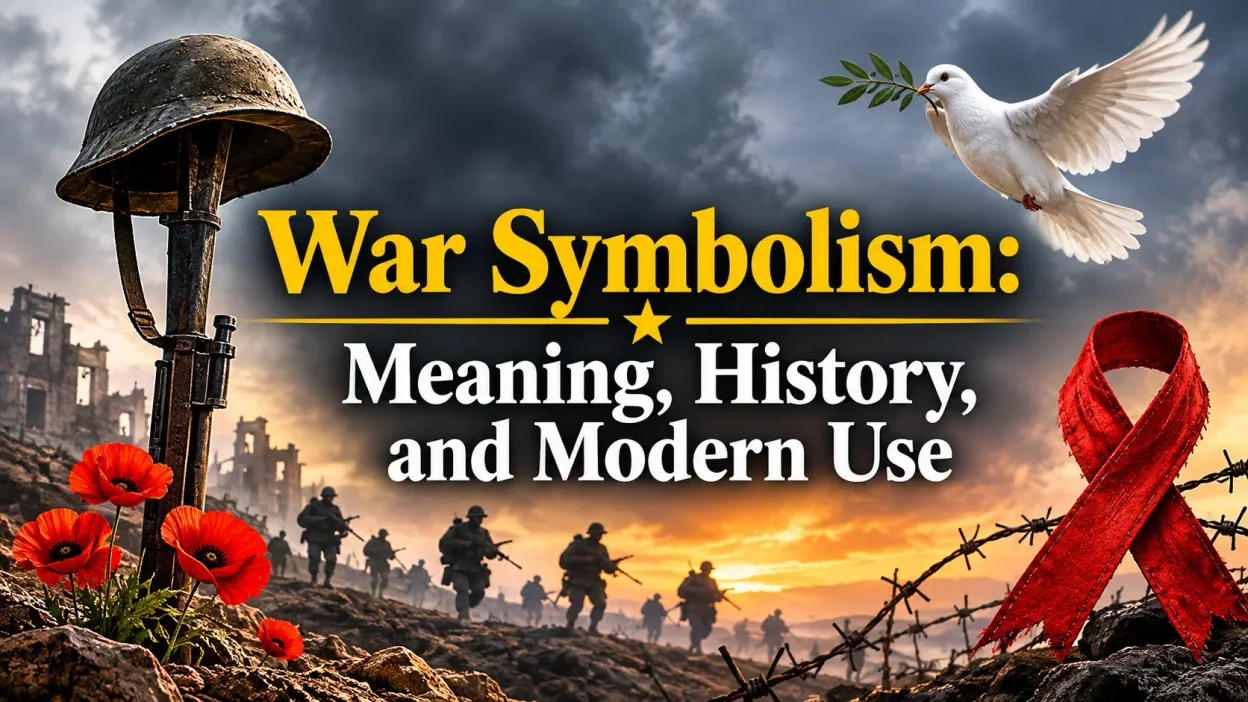
War symbolism explores how societies represent conflict, courage, sacrifice, destruction, victory, and the human cost of violence. From ancient swords and military banners to modern memorials and red poppies, symbols of war communicate ideas that words alone cannot always express.
In American culture, war symbols appear in military ceremonies, monuments, films, literature, public holidays, and remembrance traditions. Some represent national pride and the bravery of service members, while others remind people of grief, loss, and the lasting consequences of armed conflict.
Understanding war symbolism means looking beyond weapons and battle imagery. A broken sword may represent the end of violence, an olive branch can communicate peace, and a poppy can honor those who died in war. Each symbol reflects a different way people understand conflict and its consequences.
Quick Answer: What Does War Symbolize?
War commonly symbolizes conflict, sacrifice, courage, destruction, power, and the struggle for survival. Historically, swords, shields, eagles, and military banners represented strength and victory, while modern memorials, broken weapons, and red poppies often communicate mourning, remembrance, and the hope for peace.
TL;DR
- Swords symbolize combat, authority, justice, and military power.
- Shields represent protection, defense, and the duty to safeguard others.
- Eagles often symbolize national identity, freedom, and military strength.
- Red poppies commemorate military deaths and the human cost of war.
- Ravens can represent death, loss, and the aftermath of battle.
- Olive branches and broken weapons symbolize peace and the desire to end conflict.
What War Symbolism Really Means
War symbolism gives visible form to experiences that are difficult to describe, including fear, bravery, loyalty, grief, destruction, and the desire to protect a community. A single symbol may communicate different ideas depending on who uses it and the historical circumstances surrounding it.
For a soldier, a shield may represent protection and responsibility. For a historian, a damaged shield might reveal the violence of a particular battle. For someone who has lost a loved one, an empty battlefield or a memorial flame may represent absence and remembrance.
War symbols commonly express several themes:
- Conflict: The struggle between opposing forces, nations, or beliefs.
- Courage: The willingness to face danger despite fear.
- Sacrifice: The personal costs paid during armed conflict.
- Power: Military authority, conquest, or control.
- Loss: The deaths, destruction, and displacement caused by war.
- Remembrance: The effort to honor those affected by conflict.
- Peace: The hope that violence will end and communities will recover.
These meanings are not always positive or negative in isolation. A sword may represent courage in one setting and aggression in another. Understanding its symbolism requires attention to the story, culture, and circumstances in which it appears.
1. Sword Symbolism: Conflict, Courage, and Power

The sword is one of the most recognizable symbols of war. Historically, it represented a weapon used in close combat, but its symbolic meaning extended to authority, military status, justice, and the ability to defend or conquer.
In ancient and medieval societies, swords were sometimes associated with rulers, warriors, and military leaders. Ceremonial swords could communicate rank and responsibility, while swords appearing in heraldry often represented bravery, readiness, or martial authority.
In modern American culture, sword imagery remains common in military-themed artwork, historical films, fantasy literature, and commemorative designs. Its meaning depends on how it is presented.
A raised sword can suggest resistance or a willingness to fight. A sheathed sword may communicate restraint, discipline, or the decision not to use force. A broken sword can symbolize the end of fighting or the rejection of violence.
The sword therefore represents more than combat. It can express the difficult relationship between the use of power and the responsibility to control it.
2. Shield Symbolism: Protection and Defense

A shield symbolizes protection, defense, security, and the responsibility to safeguard others.
Unlike a sword, which is primarily associated with striking, a shield is designed to absorb or deflect attacks. This practical difference explains why shield imagery often communicates endurance and protection rather than conquest.
In ancient warfare, shields could also identify a group or community through their colors, patterns, and emblems. In heraldic traditions, shield-shaped designs became associated with family identity, social status, and institutional representation.
Today, shields appear in military insignia, police emblems, organizational logos, and fictional stories about defenders. Their meaning often extends beyond physical protection to include loyalty, duty, and standing up for vulnerable people.
A damaged shield can represent the cost of defending others, while a shield placed beside a weapon may suggest that strength includes the ability to protect rather than simply attack.
For this reason, the shield is especially suitable for representing the defensive side of war and the human desire for safety during conflict.
3. Eagle Symbolism: Military Strength and National Identity

The eagle commonly symbolizes strength, freedom, authority, and national identity. Its impressive appearance and ability to fly high have made it an enduring image of power in many cultural traditions.
In the United States, the bald eagle has a particularly important national meaning. It appears on the Great Seal of the United States, where it holds an olive branch and a bundle of arrows. The combination communicates both the aspiration for peace and the capacity to defend the nation.
The arrows are associated with readiness for defense, while the olive branch represents peace. Together, these elements express the idea that national strength and the pursuit of peace can exist side by side.
Eagles also appear in military insignia, official emblems, monuments, and patriotic artwork. In these contexts, they may communicate duty, service, courage, or national unity.
However, an eagle does not always symbolize war. It can also represent independence, vision, and freedom in settings unrelated to military power. Its precise meaning depends on the accompanying imagery and historical context.
4. Red Poppy Symbolism: Remembrance and Sacrifice

The red poppy is one of the best-known symbols of remembrance for people who died in war.
Its association with military remembrance grew after World War I, when poppies became linked with the battle-scarred landscapes of the Western Front. The flowers appeared in disturbed soil across areas affected by fighting, making them an enduring image of life emerging from destruction.
The poem In Flanders Fields, written by Canadian physician and soldier John McCrae during World War I, helped establish the poppy’s association with remembrance.
In the United States, red poppies are used in Memorial Day traditions, particularly through programs associated with veterans’ organizations. People may wear a poppy or display it in a memorial setting to honor fallen service members.
The flower carries a striking contrast. Its bright color suggests life and vitality, while its historical association reminds viewers of death, grief, and the enormous cost of conflict.
Unlike weapons or military emblems, the red poppy focuses attention on the people who experienced war rather than the power used to fight it.
5. Raven Symbolism: Death, Loss, and the Battlefield

Ravens have often been associated with death, battlefields, prophecy, and the uncertain boundary between life and death.
These associations partly arise from the scavenging behavior of corvids, including ravens and crows, which may feed on animal remains. In historical storytelling, the presence of such birds around battlefields helped connect them with mortality and the aftermath of violence.
In Norse mythology, ravens are associated with Odin, who is accompanied by Huginn and Muninn. These birds are linked with thought and memory rather than serving simply as symbols of death. Their presence demonstrates how raven symbolism can combine knowledge, observation, and warfare.
In literature and visual art, a raven overlooking a battlefield may suggest the inevitability of death, the suffering left behind after fighting, or the persistence of memory.
Ravens also appear in contemporary fantasy and war stories as signs of foreboding or reminders of the cost of conflict. These are artistic associations, not universal interpretations of the bird.
The raven is particularly effective as a symbol of war’s aftermath because it draws attention to what remains when the fighting has stopped.
6. Crossed Swords: Battle, Readiness, and Military Honor

Crossed swords are a common emblem of combat, military readiness, and armed confrontation.
When two swords intersect, the design creates a direct visual representation of opposing forces meeting. This makes the symbol useful in military insignia, historical illustrations, fictional battle scenes, and depictions of duels.
In some institutional settings, crossed swords can signify military service, training, or a particular branch or role. Their exact meaning depends on the organization and emblem in which they appear.
In popular culture, crossed swords often communicate rivalry or a decisive confrontation between two characters. They may also symbolize the struggle between competing principles, such as duty and personal loyalty.
The symbol does not necessarily mean that violence is being celebrated. In a historical account, crossed swords may simply identify the presence of battle, while in a memorial design they may acknowledge the military experiences of those being remembered.
7. Olive Branch Symbolism: Peace After War

The olive branch is an established symbol of peace, reconciliation, and the desire to end conflict.
In ancient Greek traditions, the olive tree had associations with Athena and civic life, while olive branches and wreaths appeared in contexts connected with honor and achievement. Across later Western traditions, the branch became widely recognizable as an emblem of peace.
Its use alongside arrows in the Great Seal of the United States provides a particularly clear example of its relationship to war. The eagle carries both symbols, expressing the coexistence of peaceful intentions and defensive strength.
In modern art and public communication, an olive branch may represent a ceasefire, negotiations, reconciliation, or an effort to rebuild relationships after violence.
Unlike a weapon, the olive branch does not emphasize the ability to defeat an opponent. It emphasizes the possibility of reaching an agreement and ending the destruction.
As a symbol of war, it is especially meaningful because it represents what people hope to achieve after the conflict itself.
8. Broken Weapons: The End of Violence

A broken weapon often symbolizes the end of fighting, the loss of military power, or the rejection of violence.
The meaning depends on the object and setting. A shattered sword may represent defeat, while a deliberately broken weapon in a peace memorial may communicate disarmament or the determination to prevent further bloodshed.
Broken weapons are particularly effective in visual storytelling because their original function has been interrupted. An object designed to cause harm is no longer capable of performing its intended role.
This transformation can suggest that conflict has ended or that a society is choosing a different approach to resolving disputes.
In contemporary artwork and antiwar imagery, broken weapons can express grief, exhaustion, or hope for a future in which military force is no longer necessary.
The symbol is not always optimistic. A broken weapon may also represent a defeated army or the collapse of a defensive system. Its meaning depends on whether the surrounding context emphasizes liberation, loss, or peace.
9. War Symbolism in American Culture
In the United States, war symbols appear in public monuments, military ceremonies, national emblems, historical museums, films, and remembrance holidays.
Their meanings are shaped by the country’s military history and the different experiences of service members, families, veterans, and civilians.
- Memorials: Names, wreaths, poppies, and eternal flames honor people who died in service.
- Military insignia: Eagles, shields, stars, and other emblems communicate institutional identity, rank, or service.
- National emblems: Flags and official seals express national identity, unity, and responsibility.
- Memorial Day: Poppies, flowers, flags, and visits to gravesites help honor fallen service members.
- Veterans Day: Ceremonies and service-related symbols recognize the contributions of military veterans.
- Antiwar art: Empty helmets, damaged landscapes, and broken weapons may emphasize suffering and the desire to prevent future conflicts.
These uses should not be treated as interchangeable. Memorial Day specifically honors those who died in military service, while Veterans Day recognizes military veterans more broadly.
War symbolism can also be contested. A military emblem may represent courage and service to one viewer while reminding another of a painful historical experience. A thoughtful interpretation recognizes that public symbols can carry multiple meanings.
10. War Symbols Across Cultures and History
War symbolism is not limited to Western military traditions. Different societies have used animals, weapons, colors, banners, and religious imagery to express the meaning of conflict.
| Symbol | Common association | Important context |
|---|---|---|
| Sword | Combat, authority, and courage | May also represent justice or restraint |
| Shield | Protection and defense | Can communicate duty and collective identity |
| Eagle | Power and national identity | Meaning varies across countries and traditions |
| Red poppy | Remembrance and sacrifice | Particularly associated with World War I remembrance |
| Raven | Death, memory, or foreboding | Meanings differ across mythology and literature |
| Olive branch | Peace and reconciliation | Often appears in diplomacy and peace imagery |
In ancient Roman culture, military standards played an important role in identifying units and expressing collective loyalty. Their loss could be understood as a serious military and symbolic defeat.
In Japanese history, the samurai sword developed meanings connected not only with combat but also with social status and warrior identity. Modern interpretations of samurai imagery, however, may differ substantially from its historical context.
In ancient Greek mythology, Athena was associated with strategic warfare and wisdom, illustrating a distinction between uncontrolled violence and the planning and judgment associated with military action.
These examples demonstrate that war symbols communicate the values and concerns of the societies that use them. A weapon may represent honor in one context, political authority in another, and the tragic consequences of conflict in a third.
11. Psychological and Emotional Meaning of War Symbols
War symbols can evoke intense emotions because they connect abstract ideas with experiences of danger, loss, belonging, and survival.
A flag may remind someone of family members who served in the military. A memorial wreath may bring grief and respect to the foreground. A damaged helmet may communicate vulnerability more directly than a written description of a battle.
These responses can serve different purposes:
- Identity: Military emblems can connect individuals with a unit, institution, or shared experience.
- Remembrance: Memorial symbols help communities honor those who died.
- Courage: Images of shields and defenders can express the willingness to protect others.
- Mourning: Empty boots, helmets, or chairs may represent lives lost and absences left behind.
- Reconciliation: Olive branches and broken weapons can express the desire to end violence.
- Warning: Ruined buildings and devastated landscapes can remind viewers of war’s human cost.
Symbolic meaning also depends on personal experience. A veteran may interpret a military object differently from someone who has never experienced military service. Someone affected by displacement or conflict may respond to war imagery with fear or grief rather than patriotism.
For this reason, war symbols are best understood with attention to the people who encounter them and the histories they recall.
12. War Symbolism in Literature, Film, and Art
Artists and writers frequently use war symbols to explore themes that extend beyond the battlefield.
In literature, weapons may represent power, revenge, or the burden of responsibility. A damaged flag may communicate a nation’s suffering, while a battlefield covered in flowers may create a contrast between natural beauty and human destruction.
Films often use helmets, uniforms, medals, and military vehicles to establish a setting or reveal a character’s relationship with war. A medal may represent courage and sacrifice, but it may also remind a character of traumatic memories or people who did not return.
Antiwar art frequently focuses on objects left behind. An abandoned boot, an empty uniform, or a ruined home can make the absence of people more visible than a direct depiction of combat.
In American cultural memory, works about wars such as the Civil War, World War I, World War II, and the Vietnam War have used symbols to examine national identity, loss, duty, and the moral consequences of violence.
The same object may have different meanings in different works. A flag can represent unity, mourning, resistance, or political disagreement depending on the narrative surrounding it.
13. Modern Uses of War Symbolism
War symbols continue to appear in contemporary life, often in settings far removed from actual combat.
Tattoos: Soldiers, veterans, and civilians may choose poppies, memorial dates, dog tags, or other designs to commemorate service, loss, or personal experiences.
Jewelry: Military pendants and remembrance pins can express family connections, respect for service members, or participation in commemorative traditions.
Memorials: Wreaths, engraved names, eternal flames, and symbolic figures provide public spaces for reflection and remembrance.
Films and games: Swords, shields, banners, and military insignia help establish conflict, allegiance, and historical or fictional settings.
Political imagery: Flags, doves, broken weapons, and military emblems can communicate arguments about national defense, conflict, and peace.
Museums and education: Uniforms, medals, letters, and battlefield artifacts help explain historical events and the experiences of people who lived through them.
When using war imagery, it is worth considering whether the intended message is remembrance, celebration, criticism, or reconciliation. These purposes can require very different visual approaches.
14. Common Misunderstandings About War Symbolism
War symbolism can become misleading when its historical context is ignored.
War symbols do not always glorify violence. A sword may represent military power, but a broken sword can represent the rejection of fighting. The same object can communicate opposing ideas.
Military symbols do not have universal meanings. An eagle, flag, or banner may have a specific national or institutional association that differs from its general symbolic interpretation.
Courage does not eliminate fear. Images of heroic warriors may suggest fearlessness, but courage can also involve recognizing danger and acting responsibly despite uncertainty.
Remembrance is different from celebration. A poppy or memorial wreath honors those who died; it does not necessarily express support for the war in which they served.
Peace symbols do not erase historical suffering. An olive branch can express hope for reconciliation while leaving room to acknowledge injustice, grief, and accountability.
Recognizing these distinctions helps people interpret war symbols without reducing complex historical experiences to simple stories of victory or defeat.
Frequently Asked Questions
What is the most common symbol of war?
The sword is one of the most recognizable symbols of war because it represents combat, military power, and courage. Flags, shields, and military emblems are also widely used to represent armed conflict and national defense.
What animal symbolizes war?
Eagles, ravens, and lions can be associated with war, depending on the cultural tradition. Eagles often represent power or national identity, ravens may suggest death and the aftermath of battle, and lions can symbolize courage and martial strength.
What flower symbolizes war remembrance?
The red poppy is strongly associated with remembrance for people who died in war, especially those connected with World War I. In the United States, poppies are also used in Memorial Day remembrance traditions.
What does a broken sword symbolize?
A broken sword can represent the end of fighting, defeat, disarmament, or the rejection of violence. Its meaning depends on whether the surrounding context emphasizes surrender, loss, liberation, or peace.
What does an olive branch mean in relation to war?
An olive branch symbolizes peace, reconciliation, and the desire to end conflict. It is often used in contrast with weapons to communicate the possibility of resolving disputes without continued violence.
What does a raven symbolize on a battlefield?
A raven may represent death, mourning, memory, or the consequences of battle. In mythology and literature, its meaning can also involve wisdom, prophecy, or observation, so it should not automatically be interpreted as a sign of death.
What is a symbol of peace after war?
The olive branch is one of the most recognizable symbols of peace after war. White doves, broken weapons, and hands joining together can also represent reconciliation, disarmament, and the hope of rebuilding relationships.
Conclusion
War symbolism reflects the many dimensions of armed conflict, including courage, power, sacrifice, loss, remembrance, and the desire for peace. Swords and shields represent the realities of combat and defense, while eagles can express national identity, poppies honor the fallen, and olive branches communicate reconciliation.
These symbols do not have one fixed meaning. Their significance depends on historical circumstances, cultural traditions, and the experiences of the people who encounter them.
Understanding war symbolism means recognizing both the ideals associated with military service and the human costs of conflict. Ultimately, the most meaningful interpretations acknowledge not only the struggle itself but also the people affected by it and the possibility of building a more peaceful future.


