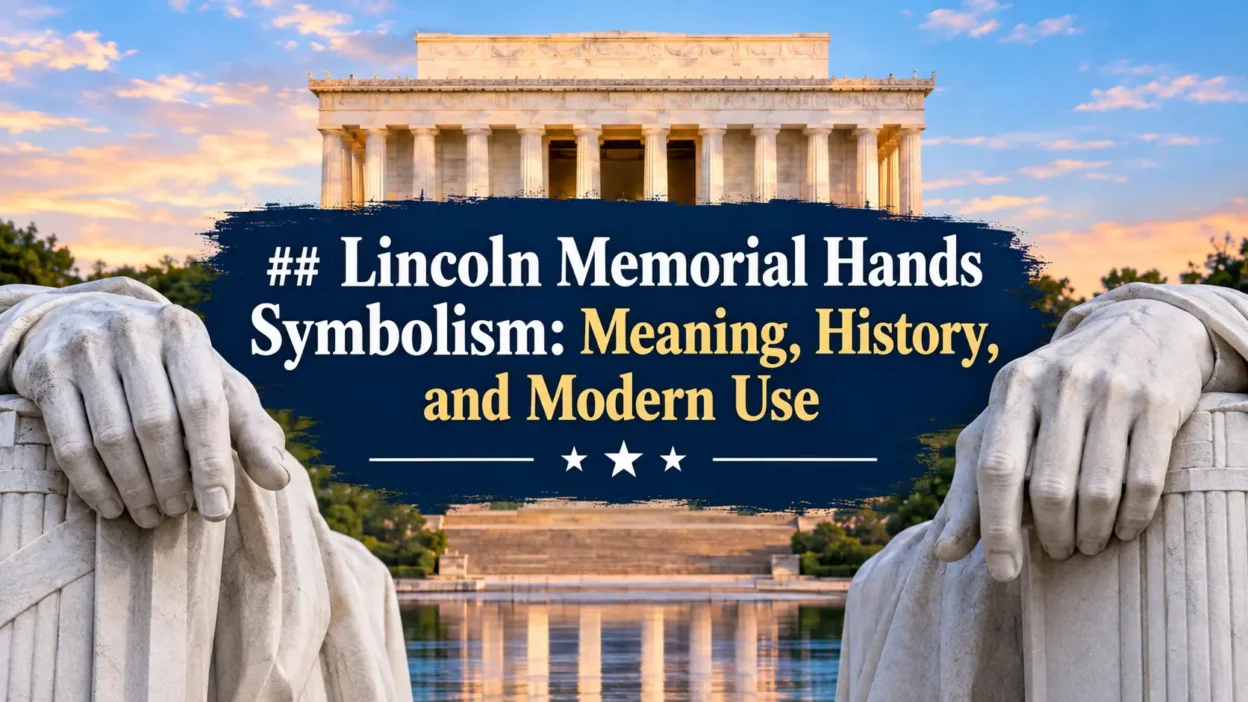
The Lincoln Memorial hands symbolism comes from the contrast between Abraham Lincoln’s clenched left hand and his more relaxed right hand. In the Washington, D.C., memorial, the two hands are commonly interpreted as expressing Lincoln’s determination during the Civil War alongside his compassion and willingness to pursue peace. The National Park Service notes that sculptor Daniel Chester French studied casts of Lincoln’s actual hands when creating the statue. National Park Service
The detail is easy to overlook because the enormous seated figure, marble architecture, inscriptions, and surrounding National Mall dominate the visitor’s attention. Yet the hands provide one of the clearest visual contrasts in the sculpture.
Their meaning also matters because several popular stories have grown around them. One widely repeated claim says the hands spell Lincoln’s initials in American Sign Language. That interpretation is not supported by the National Park Service, which explains that French used hand casts and intentionally relaxed one hand rather than creating coded initials. National Park Service
Quick Answer
The Lincoln Memorial hands symbolism commonly represents strength and determination in the clenched hand, balanced by compassion and peace in the relaxed hand. Historically, the contrast reflects how Daniel Chester French portrayed Lincoln as a leader who defended the Union while also seeking reconciliation after the Civil War.
TL;DR
- The clenched hand suggests determination, strength, and resolve.
- The relaxed hand is associated with compassion, peace, and reconciliation.
- Daniel Chester French studied casts of Lincoln’s actual hands.
- The hands are not confirmed American Sign Language initials.
- Their contrast reflects major themes of Lincoln’s presidency.
- Today, they remain part of America’s visual memory of Lincoln.
What the Lincoln Memorial Hands Look Like
Inside the central chamber of the Lincoln Memorial, visitors see Abraham Lincoln seated in a monumental marble chair. His left hand is clenched, while his right hand is more relaxed, with the index finger slightly extended around the armrest. The sculpture is about 19 feet tall and was carved from 28 pieces of Georgia marble. National Park Service
The difference between the hands is intentional. They prevent the figure from appearing completely symmetrical or static. Instead, Lincoln seems to be caught in a moment of thought and controlled tension.
The hands also connect visually with other elements of the memorial. Beneath them are bundles of rods called fasces, an ancient symbol associated with authority and strength through unity. Within the memorial, these motifs support the larger theme of national union. National Park Service
What the Clenched Left Hand Symbolizes
The clenched left hand is generally understood as a symbol of strength, determination, and resolve.
This interpretation fits the historical situation represented by the memorial. Lincoln’s presidency was dominated by the Civil War, when the survival of the United States as one nation was at stake. French wanted the sculpture to communicate a leader under enormous pressure rather than a relaxed historical figure simply posing for a portrait.
The National Park Service describes the closed hand as possibly representing Lincoln’s determination to see the war through to its conclusion. Other elements of the memorial reinforce this reading through imagery connected with strength, including the fasces and oak leaves. National Park Service
The fist therefore does not simply mean physical power. It can be read as controlled resolve: the ability to remain committed to a difficult responsibility.
That distinction is important. The hand does not celebrate violence itself. Instead, its symbolic context relates to Lincoln’s determination to preserve the Union during an exceptionally destructive national conflict.
What the Relaxed Right Hand Symbolizes
Lincoln’s right hand creates the other half of the sculpture’s message.
Its relaxed position is commonly interpreted as representing compassion, peace, charity, and reconciliation. The National Park Service connects the hand with the memorial’s broader themes of compassion and peace. National Park Service
This interpretation becomes especially relevant when considered alongside Lincoln’s Second Inaugural Address, which is carved into the memorial’s north wall. The address reflected on the Civil War and ended with a call for reconciliation rather than revenge.
The relaxed hand can therefore be understood as a visual counterweight to the fist. Lincoln is shown as capable of firmness without being reduced to aggression.
In symbolic terms, the two hands work together:
Resolve without cruelty. Strength without abandoning compassion. Leadership alongside reconciliation.
That balance is one reason the hands have remained such an effective detail of the statue.
Why Daniel Chester French Designed the Hands This Way
Daniel Chester French did not invent the hands without reference to Lincoln’s appearance. He spent considerable time researching Lincoln, studying photographs, eyewitness descriptions, and casts of Lincoln’s hands made in 1860. National Park Service
French’s goal was to create more than a literal portrait. He wanted the sculpture to communicate qualities he associated with Lincoln.
The resulting pose combines physical realism with symbolic composition. One hand remains closed while the other is relaxed, creating visual tension without making Lincoln appear physically aggressive.
The sculpture was then carved by the Piccirilli brothers under French’s supervision. The finished statue became the centerpiece of the memorial when it was dedicated in 1922. National Park Service
This background helps explain why the hands matter. Their meaning comes not from a secret code but from the artist’s deliberate use of posture, gesture, and contrast.
The Hands and Lincoln’s Leadership During the Civil War
The hands can also be understood as a compact representation of two demands placed on Lincoln as president.
One demand was preservation of the Union. Lincoln remained committed to keeping the United States together during the Civil War. The memorial repeatedly emphasizes this idea through its architecture and imagery.
The other demand was reconciliation. By the later stages of the war, Lincoln’s public language increasingly emphasized bringing the country back together rather than permanently punishing the defeated South.
The hands make these two ideas visible without words.
The fist suggests the resolve required to withstand the conflict. The open or relaxed hand suggests the possibility of peace afterward.
That contrast is consistent with the memorial’s larger message. The inscription above the statue refers to Lincoln as the president who “saved the Union,” while the speeches and surrounding imagery address freedom, justice, unity, charity, and reconciliation. National Park Service
The Hands Within the Larger Symbolism of the Memorial
The hands make more sense when viewed as part of the entire memorial rather than as an isolated detail.
The Lincoln Memorial contains several layers of symbolism. Its Greek-inspired architecture connects the memorial with classical democratic traditions. Its 36 exterior columns represent the states in the Union when Lincoln died. The interior contains Lincoln’s Gettysburg Address and Second Inaugural Address, while murals portray concepts including freedom, liberty, justice, unity, fraternity, and charity. National Park Service
The fasces beneath Lincoln’s arms are especially relevant. In their axe-less form within the memorial, they emphasize the idea of unity: individual rods become stronger when bound together. The motif appears elsewhere in the memorial and reinforces its concern with national union. National Park Service
The hands therefore participate in a larger visual argument. Lincoln’s personal qualities are presented alongside the survival and reunification of the nation.
Lincoln Memorial Hands and American Ideas of Leadership
In the United States, the hands can be read as a visual model of leadership based on both firmness and restraint.
American political monuments often present leaders through recognizable physical gestures. A raised hand may suggest authority, a pointing hand may indicate direction, and a relaxed posture may imply calm. French’s Lincoln combines different signals within the same figure.
The result is not a simple image of dominance.
The clenched hand communicates that leadership sometimes requires commitment under pressure. The relaxed hand introduces another expectation: authority should coexist with compassion.
This interpretation has remained relevant because Americans continue to debate what responsible leadership looks like. The statue does not provide a political program, but its visual language presents two qualities side by side.
The American Sign Language Initials Myth
One of the most persistent stories about the statue claims that Lincoln’s hands secretly form the American Sign Language letters A and L, representing his initials.
The story has an interesting background. French did create another Washington, D.C., sculpture that explicitly incorporated sign language: his statue of Thomas Hopkins Gallaudet and Alice Cogswell. In that work, sign language is intentionally part of the composition. National Park Service
That fact may help explain why visitors have connected French with the idea of coded hand signs.
However, the National Park Service states that the Lincoln statue’s hands were not intended to spell his initials. French worked from casts of Lincoln’s hands, which were already in a loose fist-like position, and relaxed one hand for the final composition. National Park Service
So the ASL explanation is best treated as a popular interpretation or myth, not established symbolism.
Strength and Compassion in One Image
The most useful way to understand the hands is not to choose between the two gestures but to see why they appear together.
A completely closed posture would make Lincoln appear rigid. Two relaxed hands could make the figure seem passive. French instead created contrast.
The fist introduces tension. The relaxed hand releases it.
That visual rhythm suits the historical figure being commemorated. Lincoln faced a national crisis requiring forceful decisions, but his public language also included appeals to charity, reconciliation, and healing.
The symbolism therefore works through balance rather than a single isolated meaning.
| Hand or Feature | Common U.S. Interpretation | Historical Association | Symbolic Function |
|---|---|---|---|
| Clenched left hand | Strength and determination | Civil War leadership | Shows resolve |
| Relaxed right hand | Compassion and peace | Reconciliation | Softens the image of authority |
| Fasces beneath hands | Unity and collective strength | Preservation of the Union | Connects Lincoln to national unity |
| American flag behind Lincoln | National identity and Union | Civil War and preservation of the nation | Places Lincoln within American history |
| Seated posture | Thoughtfulness and authority | Presidential leadership | Presents Lincoln as contemplative and commanding |
How Americans Interpret the Hands Today
Modern visitors often approach the Lincoln Memorial as both a historical monument and a national symbol.
The hands can therefore carry several related meanings depending on the visitor. A student may notice determination. Someone reflecting on the Civil War may see the tension between conflict and reconciliation. Another visitor may interpret the relaxed hand as an image of forgiveness.
The memorial itself has also become associated with later struggles over freedom and equality. In 1963, Martin Luther King Jr. delivered his “I Have a Dream” speech near the Lincoln Memorial during the March on Washington. The location helped connect Lincoln’s legacy with the continuing American struggle over civil rights. National Park Service
This later history does not change what French originally intended. Instead, it demonstrates how monuments can acquire additional meanings as generations encounter them.
Emotional and Psychological Meaning of the Two Hands
The hands also work at a basic emotional level because people instinctively recognize gestures.
A fist can communicate tension, readiness, determination, frustration, or controlled force. An open or relaxed hand can suggest calm, welcome, generosity, restraint, or peace.
Placed together, these gestures create emotional complexity.
Visitors do not need detailed knowledge of nineteenth-century American history to sense the difference. The sculpture communicates through body language before a person reads the inscriptions.
That makes the hands particularly effective as visual symbolism. They transform abstract ideas such as determination and compassion into recognizable physical gestures.
At the same time, the exact emotional response is personal. The National Park Service’s interpretation provides an important framework, but individual viewers may attach additional meanings based on their own experiences.
Why the Hands Are Often Misunderstood
The hands attract speculation partly because the Lincoln Memorial contains so many details that reward close observation.
Visitors have developed stories about hidden faces, coded initials, meaningful numbers of steps, and other supposed secrets. The National Park Service has specifically addressed these claims because they can distract from the memorial’s documented symbolism. National Park Service
The ASL-initials story is a good example.
It is visually plausible enough to encourage curiosity, especially for visitors familiar with French’s Gallaudet sculpture. But plausibility is not the same as historical evidence.
The more reliable interpretation comes from the artist’s documented research and the National Park Service’s explanation: French used casts of Lincoln’s hands and intentionally varied their positions to convey contrasting qualities.
How the Meaning Has Evolved Since 1922
When the Lincoln Memorial was dedicated in 1922, its symbolism was strongly connected to Lincoln’s role in preserving the Union.
The memorial’s architecture, inscriptions, fasces, columns, murals, and statue all reinforce that historical context. The phrase above the statue explicitly commemorates Lincoln as the person who “saved the Union.” National Park Service
Over the decades, however, Americans have encountered the memorial in new historical circumstances.
The civil rights movement gave the site another layer of meaning. Later visitors may see Lincoln not only as the president who preserved the Union but also as a figure associated with emancipation, constitutional change, equality, and the continuing effort to define American freedom.
The hands remain useful within this evolving interpretation because their basic contrast is broad enough to invite reflection without requiring one fixed modern meaning.
The Hands in American Public Memory
The Lincoln Memorial is more than a statue of an individual president. It is part of the visual vocabulary of American public memory.
Photographs of Lincoln’s seated figure appear in textbooks, documentaries, historical programs, political commentary, tourist materials, and educational content. The hands often receive attention precisely because they provide a small human detail within an enormous monument.
They remind viewers that the memorial’s subject was not represented simply as a heroic warrior. French portrayed a person who appears thoughtful, physically imposing, tense, and restrained at the same time.
That combination has helped the sculpture remain recognizable across generations.
What the Hands Do Not Symbolize
It is equally important to establish what should not be claimed.
The hands do not have a documented secret message spelling Lincoln’s initials in American Sign Language. The National Park Service explicitly rejects that interpretation. National Park Service
They also should not be interpreted as a universal symbol of aggression versus kindness without considering the memorial’s historical context.
The clenched hand is connected to determination and strength, while the relaxed hand has been associated with compassion and peace. These meanings emerge from the composition of the statue and its surrounding symbolism.
Keeping those distinctions clear prevents popular legends from replacing the better-supported historical interpretation.
Why the Lincoln Memorial Hands Still Matter
The hands remain memorable because they communicate an idea that is easy to understand without reducing Lincoln to a single trait.
One hand holds tension. The other releases it.
Together, they can represent the difficult balance between defending a principle and seeking peace afterward. In the context of the Lincoln Memorial, that balance is closely connected to the preservation of the Union and the hope of reconciliation after the Civil War.
For modern Americans, the hands can also prompt broader questions about leadership, responsibility, conflict, forgiveness, and national unity.
Frequently Asked Questions
What do Lincoln’s hands symbolize at the Lincoln Memorial?
The clenched left hand is commonly interpreted as representing strength and determination, while the relaxed right hand suggests compassion and peace. The contrast reflects the way Daniel Chester French presented different aspects of Lincoln’s character.
Do Lincoln’s hands spell A and L in sign language?
No. The National Park Service says the hands were not intended to form Lincoln’s initials in American Sign Language. French used casts of Lincoln’s hands and altered one hand’s position for the final sculpture. National Park Service
Why is one of Lincoln’s hands closed?
The closed hand is generally associated with Lincoln’s determination and resolve during the Civil War. It creates a visual impression of controlled strength rather than simply depicting a relaxed seated figure.
Why is Lincoln’s other hand relaxed?
The relaxed hand is commonly associated with compassion, peace, charity, and reconciliation. It provides a deliberate contrast with the clenched hand and contributes to the statue’s balanced portrayal of Lincoln.
Are the hands connected to the Civil War?
Yes, their interpretation is closely connected to Lincoln’s leadership during the Civil War. The clenched hand can suggest determination to preserve the Union, while the relaxed hand fits the memorial’s themes of reconciliation and peace.
Are Lincoln’s hands the most important symbol in the memorial?
They are important, but they are only part of a much larger symbolic design. The memorial also uses the fasces, inscriptions, murals, columns, architecture, and flag imagery to communicate ideas about Union, freedom, justice, and national memory. National Park Service
Why do people think the hands contain a secret message?
The unusual contrast between the hands invites close observation, and French’s separate use of sign language in another sculpture helped encourage the initials story. Historical evidence, however, supports the interpretation of strength and compassion rather than a coded ASL message. National Park Service
Conclusion
The Lincoln Memorial hands symbolism is built around contrast. Lincoln’s clenched left hand suggests determination and strength, while his relaxed right hand is commonly associated with compassion, peace, and reconciliation. Together, they present a leader who could act firmly while still allowing room for restraint and healing.
The hands are also a useful reminder that the Lincoln Memorial communicates through many details at once. Its inscriptions, fasces, architecture, murals, flag imagery, and statue all contribute to a larger story about the Union and Lincoln’s place in American history.
Rather than being a secret code, the hands work because their message is visible: leadership can require both resolve and compassion.