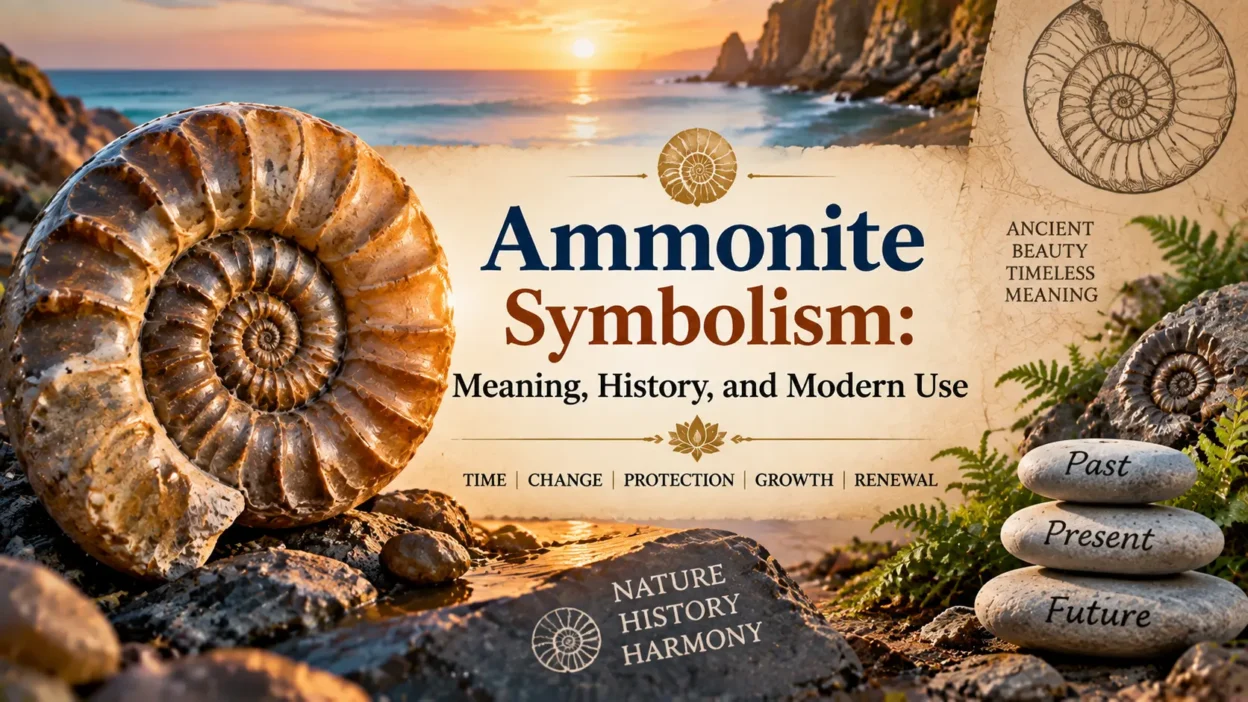
Ammonite symbolism connects an ancient ocean fossil with ideas of growth, transformation, cycles, protection, and connection to Earth’s history. These spiral-shaped fossils appear in jewelry, home decor, museums, and spiritual communities because their natural form invites people to think about time, change, and renewal.
Ammonites were marine creatures that lived millions of years ago before becoming extinct. Today, their fossilized shells are admired not only for their scientific value but also for the meanings people attach to their spiral shape and long journey through geological time.
Quick Answer
Ammonite symbolism commonly represents growth, transformation, and life cycles in modern American culture, especially in jewelry, art, and nature-inspired design. Historically, ammonite fossils have been associated with creation, protection, and spiritual ideas because of their spiral form and ancient connection to the Earth.
TL;DR
- Ammonites symbolize growth, cycles, and transformation.
- Their spiral shape represents movement and renewal.
- Ancient cultures connected ammonites with protection.
- Americans often use ammonites in jewelry and decor.
- Fossils represent Earth’s long history and change.
What Is an Ammonite and Why Does It Carry Symbolic Meaning?
Ammonites were extinct marine animals related to modern squid and octopuses. They lived in oceans from roughly 400 million years ago until their extinction about 66 million years ago. Their curled shells are among the most recognizable fossils because they form a natural spiral pattern.
The spiral shape is one reason people find ammonites meaningful. Spirals appear throughout nature, including galaxies, shells, plants, and weather patterns. Because of this repeated pattern, many people connect spirals with movement, development, and the ongoing cycles of life.
In modern American culture, ammonites are often appreciated as symbols that combine science, nature, and personal reflection. Unlike many traditional symbols created by humans, ammonites gained meaning from their actual existence as ancient life preserved in stone.
What Ammonite Symbolism Means in Modern American Culture
In the United States, ammonites are most commonly associated with change, endurance, and natural history. Many people see the fossil as a reminder that life continues through different stages and that transformation is part of existence.
Common modern interpretations include:
| Context | Meaning in the USA | Common Associations | Notes |
|---|---|---|---|
| Jewelry | Personal growth and change | Renewal, identity, reflection | Often worn as a meaningful accessory |
| Home decor | Connection with nature | Earth, history, curiosity | Used in natural and coastal designs |
| Fossil collecting | Appreciation of time | Science, discovery, learning | Popular among collectors |
| Spiritual practices | Cycles and transformation | Balance, personal journeys | Meanings vary by belief system |
| Art and design | Natural beauty | Patterns, creativity, movement | Inspired by the spiral form |
Many Americans encounter ammonites through museums, science education, rock shops, and decorative objects. Their meaning often depends on personal experience rather than a single traditional definition.
The Spiral Shape and Its Symbolic Importance
The ammonite’s spiral is the central feature behind much of its symbolism. A spiral suggests movement rather than a fixed point. It can represent development, progress, and the idea that experiences shape a person over time.
Some people interpret the spiral as a visual reminder of personal growth. Life rarely moves in a straight line, and the spiral can represent returning to familiar lessons while moving forward.
The spiral also appears in many natural forms. Shells, plants, storms, and cosmic structures all contain spiral patterns. Because of this, ammonites are sometimes connected with broader ideas of harmony between humans and the natural world.
Ancient Roots and Early Symbolic Connections
Although ammonites are modern fossils, their symbolic history began after humans discovered and interpreted these unusual stones. Before people understood fossils scientifically, many cultures created stories to explain their strange shapes.
In parts of Europe, ammonite fossils were sometimes called “snakestones” because their curled shape resembled a coiled snake. Some legends connected them with folklore figures, saints, or protective objects.
During earlier periods, people often viewed unusual natural objects as signs with special meaning. Fossils, crystals, shells, and unusual stones were collected because they seemed to connect the visible world with hidden forces or ancient events.
Scientific understanding later changed how people viewed ammonites. Instead of mysterious objects, they became evidence of ancient oceans and extinct life. However, symbolic interpretations continued because the fossils still inspire ideas about time, survival, and transformation.
Ammonites in Folklore and Cultural Traditions
Ammonites appear in several folklore traditions, especially in regions where fossils were commonly found.
In parts of England, ammonites were historically known as “snakestones.” Some local stories connected them with legends about saints turning snakes into stone. These stories reflected attempts to explain fossils before modern geology existed.
In other traditions, spiral fossils were valued as protective objects. Their circular form was sometimes interpreted as a symbol that could represent wholeness or defense.
These meanings were shaped by local beliefs rather than by a universal interpretation. Today, many people appreciate these stories as examples of how humans have always searched for meaning in natural objects.
Ammonite Symbolism in Jewelry and Personal Style
Ammonite jewelry has become popular among people who enjoy fossils, natural materials, and symbolic accessories. Pendants, rings, and earrings often highlight the fossil’s spiral because it creates a distinctive design.
For many wearers, an ammonite piece represents:
- Personal transformation
- A connection with nature
- Respect for ancient life
- A reminder of resilience
Unlike mass-produced symbols, fossil jewelry carries a sense of individuality because each ammonite has its own shape, pattern, and history.
In American fashion, nature-inspired jewelry often appeals to people who want accessories that communicate personal values rather than only appearance.
Ammonites in Spiritual and Personal Growth Practices
Some spiritual communities associate ammonites with energy, balance, and personal development. These interpretations often focus on the spiral as a symbol of movement and inner change.
People may use ammonite fossils during meditation, reflection, or personal rituals. Some believe the fossil represents grounding because it comes from the Earth and contains a record of ancient life.
However, these spiritual meanings are personal interpretations rather than scientific conclusions. The fossil itself provides evidence about ancient organisms and Earth’s history, while symbolic meanings depend on individual beliefs.
Emotional and Psychological Meaning of Ammonites
Ammonites can represent several emotional ideas because of their connection to time and survival.
The fossil may remind people that change is natural. A creature that lived millions of years ago can still exist today as a preserved record, creating a sense of continuity between the past and present.
Some people connect ammonites with patience because fossil formation requires enormous amounts of time. The object becomes a reminder that growth often happens gradually rather than instantly.
For others, ammonites represent curiosity. Their unusual appearance encourages exploration and learning about the natural world.
Ammonites in American Homes, Art, and Design
In the United States, ammonite fossils are commonly used in natural interior design. Their spiral patterns fit well with coastal themes, museum-inspired spaces, and collections focused on geology.
Decorative ammonites may appear in:
- Shelves and display cases
- Office spaces
- Nature-themed rooms
- Educational collections
- Artwork inspired by fossils
Their appeal comes from combining visual beauty with a story. A fossil decoration is not only an object; it represents a moment in Earth’s history.
Artists also use ammonite patterns because the spiral creates balance and movement. The shape can inspire paintings, sculptures, and digital designs.
Ammonite Symbolism in Tattoos and Identity
Ammonite tattoos are chosen by people who connect with themes of change, nature, and personal evolution.
Common interpretations include:
- A new chapter after a major life event
- Respect for ancient wisdom
- Acceptance of life’s cycles
- A connection with the natural world
Because fossils are linked with survival across immense periods of time, some people view ammonite tattoos as reminders of endurance.
The meaning is highly personal. One person may choose an ammonite tattoo because of scientific interest, while another may choose it for symbolic reasons.
Scientific Meaning Versus Symbolic Interpretation
Ammonites have a clear scientific meaning. They are fossils that provide information about ancient marine ecosystems, evolution, and geological history.
Their symbolic meanings are different. They come from human interpretation of the fossil’s appearance, age, and emotional impact.
Understanding this difference helps maintain respect for both science and cultural traditions. An ammonite can be appreciated as a scientific discovery while also serving as a meaningful personal symbol.
| Perspective | Meaning |
|---|---|
| Scientific | Evidence of extinct marine life and Earth’s history |
| Cultural | A natural object connected with stories and traditions |
| Personal | A reminder of growth, change, or connection |
| Artistic | Inspiration from spiral patterns and ancient forms |
Common Misunderstandings About Ammonite Symbolism
One common misunderstanding is that ammonites have one fixed meaning shared by every culture. In reality, interpretations differ depending on location, belief, and personal experience.
Another misconception is that symbolic meanings are scientifically proven. Ideas such as protection or emotional healing belong to cultural or personal traditions, not fossil science.
Some sellers also attach exaggerated claims to fossils. While ammonites have fascinating histories, claims about guaranteed spiritual effects are matters of belief rather than established evidence.
How Ammonite Meaning Has Changed Over Time
The meaning of ammonites has changed alongside human understanding of the natural world.
Early communities often explained fossils through mythology and folklore. Later, geology revealed that ammonites were remains of ancient sea creatures.
Today, ammonites hold multiple meanings at once. They are scientific objects, collectible fossils, artistic inspirations, and symbols of transformation for many people.
This combination of science and symbolism explains why ammonites remain interesting in modern culture.
Frequently Asked Questions About Ammonite Symbolism
What does ammonite symbolism represent?
Ammonite symbolism often represents transformation, growth, natural cycles, and connection with Earth’s history. Modern interpretations usually focus on personal change and appreciation for nature.
What does an ammonite tattoo symbolize?
An ammonite tattoo may symbolize personal growth, resilience, transformation, or a connection with ancient life. The meaning depends on the person wearing it.
Are ammonites considered spiritual symbols?
Some people view ammonites as spiritual symbols connected with balance, cycles, and reflection. These meanings come from personal beliefs rather than scientific evidence.
What did ammonites symbolize in ancient cultures?
In some European folklore traditions, ammonites were connected with stories about snakes and protection. These interpretations developed before fossils were scientifically understood.
Why are ammonites associated with spirals?
Ammonites have naturally coiled shells, and spirals are often associated with growth, movement, and repeating cycles in nature.
Are ammonites lucky symbols?
Some people consider ammonites lucky or protective because of traditional folklore associations. However, ideas about luck vary between cultures and individuals.
What is the difference between an ammonite fossil and its symbolism?
An ammonite fossil is a preserved remains of an ancient marine animal. Its symbolism comes from the meanings people attach to its shape, age, and connection to nature.
Conclusion
Ammonite symbolism reflects humanity’s fascination with ancient life, natural patterns, and personal transformation. In modern American culture, these fossils often represent growth, change, curiosity, and a connection to the Earth’s long story.
Whether displayed as decor, worn as jewelry, studied as a fossil, or used in personal artwork, an ammonite carries both scientific importance and symbolic meaning. The value of the symbol comes from the way it connects the distant past with the experiences people have today.