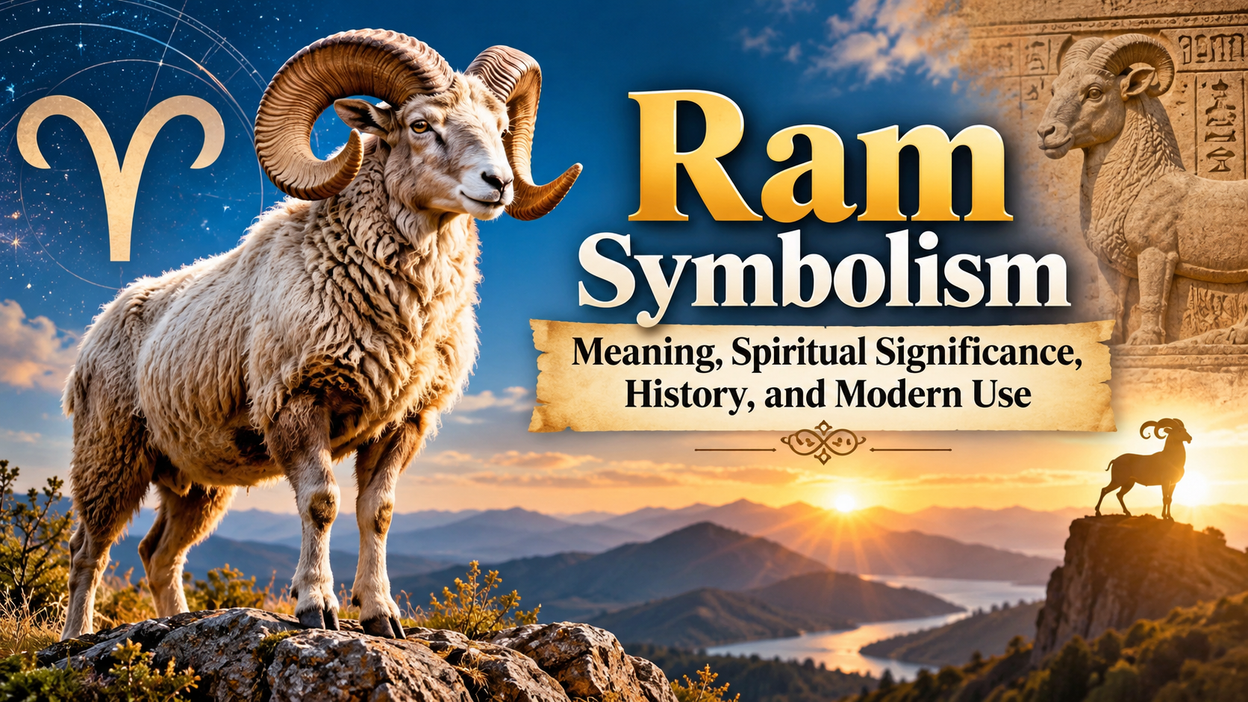
The symbolism of a ram is closely associated with strength, courage, determination, leadership, and fertility. Known for its powerful build and distinctive curved horns, the ram has appeared in ancient religious traditions, mythology, art, and cultural symbolism for thousands of years.
A ram can represent the willingness to face challenges, the confidence to stand one’s ground, and the determination to protect what matters. Its horns are often interpreted as symbols of power and defense, while its association with livestock and reproduction connects it to abundance, prosperity, and renewal.
However, the ram’s meaning changes depending on the culture and context. In ancient Egypt, the animal was associated with important deities, including Amun and Khnum. In Greek mythology, the ram appears in stories of courage, protection, and heroic journeys. In modern symbolism, it can represent ambition, resilience, independence, and the desire to overcome obstacles.
Getty
+2
Understanding ram symbolism requires looking beyond its physical strength. The animal also raises questions about leadership, sacrifice, instinct, and the balance between confidence and aggression.
Quick Answer: What Does a Ram Symbolize?
A ram most commonly symbolizes strength, courage, determination, leadership, fertility, and protection. Its powerful horns represent defense and assertiveness, while its historical association with sacred animals connects it to spiritual power and sacrifice in several ancient traditions.
TL;DR
- Strength and courage: Facing challenges with confidence.
- Leadership: Taking initiative and standing firm in difficult situations.
- Determination: Continuing toward a goal despite obstacles.
- Fertility and abundance: Representing reproduction, prosperity, and growth.
- Spiritual significance: Associated with sacred power and protection in certain ancient cultures.
- Sacrifice: Appearing in religious stories as a symbol connected with devotion and offering.
- Modern meaning: Representing ambition, resilience, independence, and the willingness to act.
1. The Core Symbolism of a Ram

The ram’s symbolism begins with its physical characteristics. Its muscular body, sturdy stance, and impressive horns make it a natural image of power and resistance.
Across different symbolic traditions, these qualities have been used to express several related ideas.
Strength and Power
A ram symbolizes physical strength and the ability to withstand pressure. Its solid build and forceful movements make it an emblem of resilience and confidence.
In personal symbolism, the ram may represent someone who refuses to give up when circumstances become difficult.
Courage and Boldness
Rams are known for using their horns in contests with other animals. Symbolically, this behavior can represent bravery, assertiveness, and the willingness to confront opposition.
Courage, however, does not always mean fighting. A more balanced interpretation is the ability to face challenges without allowing fear to determine every decision.
Determination and Persistence
The ram is often used as a symbol of persistence because it is associated with directness and force. It represents a willingness to keep moving toward a goal, even when progress requires effort.
This interpretation makes the ram especially relevant to stories about ambition, personal growth, and overcoming obstacles.
Protection and Defense
The ram’s horns serve as natural defensive tools. In symbolic imagery, they can represent boundaries, self-protection, and the defense of family or community.
Ancient Egyptian art also connected ram imagery with divine protection and power, giving the animal significance beyond its physical abilities.
Getty
+1
2. Spiritual Meaning of a Ram
In spiritual symbolism, a ram is often associated with inner strength, determination, vitality, and the courage to move forward.
Its meaning depends on the belief system involved. In some contemporary spiritual interpretations, the ram represents confidence and the ability to overcome obstacles. In historical religious traditions, it can be associated with divine power, sacred offerings, or protection.
The ram’s horns are particularly important. Their curved shape can suggest strength that is both defensive and assertive, while the animal’s upright posture can evoke confidence and readiness.
A spiritual interpretation of the ram may encourage a person to:
- Trust their ability to face difficult situations.
- Defend important values without becoming needlessly aggressive.
- Take responsibility for their choices.
- Develop patience alongside determination.
- Recognize when courage requires action and when it requires restraint.
These are symbolic lessons rather than universal spiritual rules. Seeing a ram does not establish that a supernatural message has been sent, but the animal can serve as a meaningful personal reminder.
3. Ram Horns: Symbolism of Power and Authority

The ram’s horns are among its most recognizable features and carry much of its symbolic meaning.
Because horns can be used for defense and competition, they have often been associated with authority, strength, dominance, and protection.
In ancient visual traditions, the ram’s head could also represent the power of a deity. The Ashmolean Museum, for example, identifies its Ram of Amun-Re as an image of the powerful Egyptian god associated with the sun and air.
Ashmolean Museum
+1
The horns may symbolize several ideas:
- Authority: The confidence to lead or make decisions.
- Defense: Protecting personal boundaries and loved ones.
- Resilience: Remaining strong under pressure.
- Assertiveness: Expressing needs and beliefs clearly.
- Vitality: The energy associated with life and reproduction in some historical traditions.
The shape and condition of a ram’s horns can influence an artwork’s visual impact, but there is no single universal meaning for every horn design.
In modern jewelry, tattoos, logos, and decorative art, ram horns can communicate toughness, individuality, confidence, or a connection with nature.
4. Ram Symbolism in Ancient Egyptian Culture

The ram held significant religious importance in ancient Egypt. It was associated with several deities, including Amun, Khnum, Heryshaf, and Banebdjedet.
These associations were not identical. Different gods and regional traditions emphasized different aspects of the animal’s significance.
Amun-Re: Divine Power and Kingship
Amun became one of ancient Egypt’s major deities and was later associated with the sun god Re. Ram imagery was used in representations of Amun and Amun-Re.
The Ashmolean Museum explains that rulers used imagery associated with Amun-Re to evoke power and strength. Ram imagery could also serve a protective role in sacred settings.
Ashmolean Museum
+1
Khnum: Creation and Life
Khnum was a ram-headed Egyptian god associated with creation. According to the Global Egyptian Museum, he was connected with the Nile’s life-giving waters and was depicted as a creator who formed human beings on a potter’s wheel.
Khnum
+1
Through this association, the ram became connected with creation, fertility, and the continuation of life.
Fertility and Vitality
The ram’s reproductive strength also contributed to its ancient symbolism. Egyptian religious art sometimes emphasized the animal’s virility, associating it with fertility and generative power.
Egypt Museum
+1
Overall, the ram in ancient Egyptian culture could symbolize divine authority, protection, creation, and fertility. Its meaning depended on the particular deity, region, and religious setting.
5. Ram Symbolism in Greek Mythology
In Greek mythology, the ram appears in important stories involving rescue, sacrifice, courage, and heroic journeys.
One of the best-known examples is the Golden Ram associated with Phrixus and Helle. In the myth, a miraculous ram with a golden fleece carries Phrixus away from danger. The fleece later becomes the object of the quest undertaken by Jason and the Argonauts.
The story gives the ram a role that goes beyond physical strength. It becomes an instrument of rescue and the source of a legendary object connected with adventure and kingship.
The Getty Museum’s discussion of ram imagery in ancient art connects the animal with heroic narratives, courage, protection, and sacrifice.
Getty
The ram in Greek mythology can therefore represent:
- Rescue: Deliverance from danger.
- Courage: The strength to face threatening circumstances.
- Adventure: The beginning of a difficult journey.
- Sacrifice: The cost associated with fulfilling a mission.
- Achievement: The Golden Fleece as the object of a demanding quest.
The Golden Ram also demonstrates that the same symbol can carry several meanings at once. It offers protection, but its story is also tied to sacrifice and the pursuit of something valuable.
6. Biblical Meaning of a Ram
In biblical traditions, the ram is associated with sacrifice, worship, and devotion.
One of the most significant passages is the story in Genesis 22, in which Abraham is prepared to sacrifice Isaac but ultimately offers a ram caught in a thicket instead. The ram becomes associated with the substitutionary offering provided in place of Isaac.
This story gives the ram a meaning that differs from the more familiar symbolism of aggression or dominance.
Sacrifice and Devotion
The ram in the story represents the animal offered in a moment of profound religious testing. Its role is connected with obedience, provision, and the seriousness of devotion.
Provision and Deliverance
Because the ram appears at the critical moment when Isaac is spared, readers may interpret the story as an image of provision and deliverance.
Worship and Religious Offering
Rams also appear in the sacrificial practices described in the Hebrew Bible. Their meaning depends on the specific ritual and passage rather than one universal symbolic definition.
It is important to distinguish the biblical ram from the lamb, which has its own symbolism in Christian traditions. The two animals are related but are not interchangeable in every religious context.
For this reason, the biblical symbolism of the ram is best understood through the particular stories and rituals in which it appears.
7. Ram Symbolism in Astrology: Aries

The ram is the traditional symbol of Aries, the first sign of the Western zodiac. In astrology, Aries is commonly associated with initiative, confidence, independence, and action.
The ram fits this symbolism because it evokes boldness and the willingness to move forward. Its horns also suggest the determination to confront obstacles rather than wait for circumstances to change.
Within astrological interpretation, the ram can represent:
- New beginnings: Taking the first step toward a goal.
- Independence: Making decisions and taking initiative.
- Leadership: Being willing to act rather than remain passive.
- Passion: Pursuing interests with energy and enthusiasm.
- Impulsiveness: Acting too quickly without considering consequences.
Aries symbolism also has a cautionary side. Confidence can become stubbornness, and initiative can turn into impatience when there is little room for reflection.
Astrology is a belief-based interpretive system, not a scientifically established way to determine personality or predict events. The ram’s association with Aries is nevertheless an influential example of how an animal can become a widely recognized cultural symbol.
8. Ram Symbolism in Different Cultures
The ram has held different meanings across societies, especially in communities where sheep raising played an important economic, social, or religious role.
Its significance often reflects local beliefs about animals, fertility, sacrifice, protection, and the relationship between humans and the natural world.
| Cultural context | Ram symbolism |
|---|---|
| Ancient Egypt | Divine power, protection, creation, and fertility |
| Ancient Greek traditions | Courage, heroic journeys, rescue, and sacrifice |
| Biblical traditions | Sacrifice, devotion, and provision |
| Kazakh and other Turkic traditions | Sacred significance, protection, and fertility-related imagery |
| Western astrology | Initiative, confidence, and the symbolism of Aries |
Archaeological and ethnographic research on traditional Kazakh culture describes ram imagery in tombstones, figurines, and ornaments. The ram-horn motif known as qoshqarmuyiz is associated with wealth and fertility, while the ram also held significance in traditional beliefs about protection and the soul.
Belleten
+1
These examples show that the ram’s meaning cannot be reduced to strength alone. In some settings, it is a sacred animal; in others, it represents prosperity, protection, or the courage required to undertake a difficult task.
Cultural interpretations can also change over time, so it is best to avoid assuming that every community shares the same beliefs about the ram.
9. Ram Symbolism in Dreams
Dream interpretations involving rams vary across spiritual traditions and popular dream symbolism. There is no scientifically established meaning that applies to every dream.
Still, people may use the ram as a symbol to reflect on experiences involving conflict, confidence, ambition, or personal boundaries.
Dreaming of a Strong Ram
A strong or healthy ram might be interpreted as an image of confidence, determination, or the desire to become more independent.
Dreaming of a Charging Ram
A charging ram may bring to mind confrontation, pressure, anger, or the need to address a conflict. It could also reflect feelings of being challenged or pushed into a difficult situation.
Dreaming of a Peaceful Ram
A calm ram might symbolize controlled strength, patience, or confidence without aggression.
Dreaming of Ram Horns
Horns may evoke defense, authority, or personal boundaries. The meaning depends on whether the dream feels threatening, reassuring, or neutral.
When interpreting such dreams, consider your emotions and circumstances rather than treating a particular image as a prediction. A dream about a ram does not establish that a conflict, success, or major life change is about to occur.
10. Ram Symbolism in Love and Relationships
In modern symbolic interpretation, the ram can represent loyalty, protection, determination, and a strong sense of commitment.
Its association with strength can suggest a willingness to stand up for a partner or protect a relationship during difficult periods. The animal may also represent the confidence to communicate needs and establish healthy boundaries.
However, the ram has a more challenging side in relationship symbolism.
Its association with force and head-on confrontation can also suggest stubbornness, competitiveness, or a tendency to insist on being right.
| Positive relationship meaning | Possible challenge |
|---|---|
| Loyalty | Possessiveness |
| Protection | Overprotectiveness |
| Confidence | Dominating behavior |
| Determination | Refusal to compromise |
| Direct communication | Unnecessary confrontation |
A balanced interpretation of the ram emphasizes strength combined with empathy. Healthy relationships require both the courage to speak honestly and the patience to listen.
These meanings are symbolic rather than universal rules about personality or romantic compatibility.
11. Ram Symbolism in Career, Ambition, and Success
The ram’s determination makes it a useful symbol for career goals, leadership, entrepreneurship, and personal achievement.
Its image can represent the willingness to take initiative, accept responsibility, and persist through demanding situations.
In a professional context, the ram may symbolize:
- Leadership: Taking responsibility when a decision is needed.
- Ambition: Setting meaningful goals and working toward them.
- Resilience: Recovering from setbacks and continuing to learn.
- Confidence: Presenting ideas and defending sound decisions.
- Persistence: Following through when progress takes time.
For example, a person starting a business might use the ram as a symbol of courage and determination. A team might use it as a mascot to communicate strength and competitive spirit.
However, the ram’s symbolism also provides a useful warning: moving forward is not always the same as making progress. Effective leadership requires knowing when to persist, when to change direction, and when to collaborate.
The most constructive meaning of the ram in professional life is therefore not aggression, but purposeful action guided by good judgment.
12. The Negative or Shadow Symbolism of a Ram
Although the ram is often viewed positively, its symbolism can include stubbornness, aggression, impulsiveness, and excessive pride.
These interpretations arise from the animal’s association with forceful contests and its ability to confront rivals directly.
The ram’s shadow symbolism can serve as a reminder that a strength may become a weakness when it is used without restraint.
- Stubbornness: Refusing to reconsider an approach that no longer works.
- Aggression: Treating every disagreement as a battle.
- Impulsiveness: Acting before understanding the consequences.
- Pride: Prioritizing victory over cooperation.
- Excessive independence: Rejecting help even when collaboration would be beneficial.
This dual meaning makes the ram a particularly useful symbol in stories and artwork. It can represent a hero’s courage while also warning against the dangers of unchecked ambition.
A balanced ram symbolizes strength with restraint, confidence with humility, and determination with the ability to adapt.
13. Ram Symbolism in Tattoos, Art, and Modern Design

The ram remains a popular visual motif in tattoos, illustrations, jewelry, logos, and decorative art.
Its recognizable horns and strong silhouette make it visually distinctive, while its varied cultural associations allow artists to communicate different ideas.
Ram Tattoos
A ram tattoo may represent courage, independence, determination, protection, or a connection to Aries. Some people choose the image to commemorate a personal challenge or express their commitment to a goal.
Others may be drawn to its appearance rather than any specific symbolic meaning.
Ram Images in Art
Artists may use the ram to convey physical strength, sacred power, fertility, sacrifice, or the tension between aggression and control.
In historical art, the ram’s head could identify a connection with a deity or religious tradition. In modern artwork, the same image may be used more broadly as an emblem of authority or resilience.
Ram Symbols in Logos and Branding
Businesses and sports organizations may use ram imagery to communicate toughness, confidence, competitiveness, or persistence.
The symbol works well in branding because its horns and sturdy form create a strong visual identity. However, a ram logo does not automatically have a religious or spiritual meaning; its significance depends on the organization using it.
14. What the Ram Symbolizes in Modern Life
In modern life, the ram can serve as a reminder to act with courage, remain committed to important goals, and protect personal values.
Its traditional symbolism can be applied to everyday situations without requiring a spiritual interpretation.
For example:
- During a difficult period: The ram can represent the determination to keep going.
- When starting something new: It can symbolize initiative and confidence.
- When setting boundaries: It can represent the courage to protect personal needs.
- When leading others: It can remind a person to combine strength with responsibility.
- When facing conflict: It can encourage directness while warning against unnecessary aggression.
The ram can also prompt reflection on the difference between bravery and recklessness. Courage is not simply the willingness to confront every obstacle; it includes the judgment to decide which challenges deserve a response.
In this sense, the ram’s modern meaning is most useful when its strength is paired with patience, awareness, and respect for others.
Frequently Asked Questions
1. What does a ram symbolize spiritually?
A ram is commonly associated with strength, courage, determination, protection, and vitality. In particular religious traditions, it can also represent sacred power, sacrifice, or divine provision. Its exact meaning depends on the spiritual or cultural context.
2. What does a ram symbolize in the Bible?
In biblical traditions, the ram is associated with sacrifice and devotion. In Genesis 22, a ram is offered in place of Isaac, connecting the animal with provision and deliverance. Other biblical references to rams occur in the context of religious offerings.
3. What does a ram symbolize in ancient Egypt?
In ancient Egypt, the ram was associated with deities including Amun-Re and Khnum. Its symbolism included divine power, protection, fertility, and creation. The precise meaning depended on the deity and the religious setting.
4. What do ram horns symbolize?
Ram horns commonly symbolize strength, defense, authority, assertiveness, and resilience. In some historical religious art, the ram’s head and horns also represented divine power and protection.
5. What does a ram symbolize in dreams?
In popular dream interpretation, a ram may represent courage, ambition, conflict, or personal boundaries. A charging ram might evoke confrontation, while a calm ram may suggest controlled strength. These are possible interpretations, not scientifically established meanings or predictions.
6. What does a ram symbolize in astrology?
The ram is the symbol of Aries in Western astrology. It is associated with initiative, independence, confidence, passion, and bold action. Astrology is a belief-based system rather than a scientifically established method of personality assessment.
7. What does a ram tattoo mean?
A ram tattoo may symbolize courage, resilience, determination, independence, protection, or an association with Aries. Its meaning depends on the person’s intentions, the design, and any cultural or spiritual references included.
8. Is a ram a symbol of good luck?
In some cultural and spiritual interpretations, the ram is associated with protection, fertility, prosperity, or success. However, it is not universally regarded as a good-luck symbol, and its meaning differs across traditions.
Conclusion
The symbolism of a ram combines strength, courage, determination, protection, fertility, and spiritual significance. Its powerful horns and sturdy appearance make it a natural emblem of confidence and resistance, while its role in ancient religious traditions gives it deeper associations with creation, sacrifice, and divine power.
From ancient Egyptian deities and Greek mythology to biblical stories, astrology, tattoos, and modern branding, the ram has taken on many different meanings. These interpretations share certain themes, but they should not be treated as universal beliefs.
The ram also represents a balance between strength and restraint. Its determination can inspire persistence, while its more aggressive associations remind us that confidence can become stubbornness when it lacks wisdom.
Ultimately, the ram symbolizes the courage to stand firm, the determination to move forward, and the wisdom to use strength responsibly.