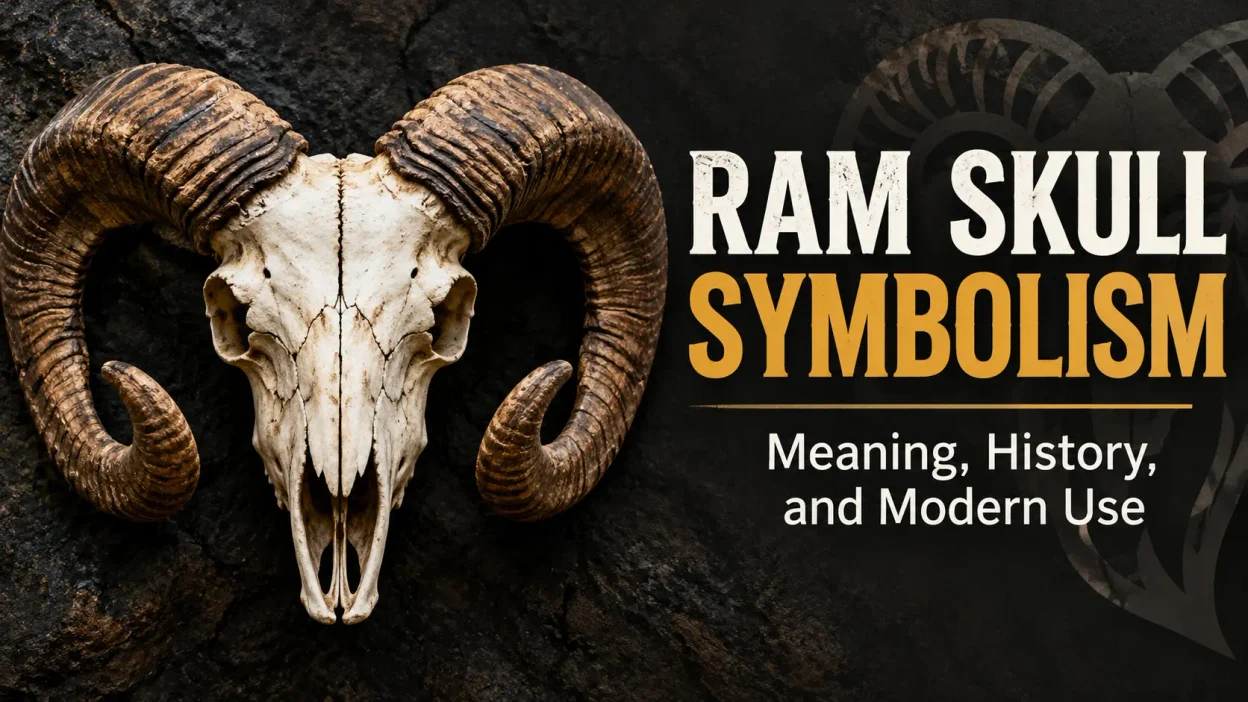
Ram skull symbolism often centers on strength, determination, sacrifice, and the realities of death. A ram skull, with its sturdy bone structure and curved horns, can represent the instinct to confront obstacles, protect personal boundaries, or stand firm under pressure. Its meaning depends on where it appears, how it is designed, and the beliefs of the person interpreting it.
In the United States, ram skulls appear in tattoo art, alternative fashion, gothic decoration, outdoor-inspired design, and some spiritual or symbolic artwork. For one person, the image may communicate courage and independence. For another, it may suggest mortality, rebellion, or a connection to the natural world.
The symbol also has a history beyond modern aesthetics. Rams have appeared in ancient religious imagery, royal emblems, mythology, and agricultural societies where livestock played an important role in daily life. Understanding these different contexts helps separate documented historical associations from modern interpretations that are personal, artistic, or spiritual.
Quick Answer
Ram skull symbolism commonly represents strength, resilience, independence, and mortality in modern American culture, especially in tattoos, artwork, and alternative design. Historically, rams were associated with fertility, leadership, sacrifice, and divine or royal power in several ancient cultures, while the skull adds themes of death, remembrance, and the cycle of life.
TL;DR
- Ram skulls can represent determination, courage, and resistance.
- The skull introduces mortality, remembrance, and the cycle of life.
- Ancient ram imagery appeared in religious, royal, and agricultural settings.
- Modern Americans often use the design to express individuality or toughness.
- Spiritual meanings depend on personal beliefs and cultural context.
- The image is not automatically satanic, threatening, or associated with one religion.
What a Ram Skull Represents as a Symbol
A ram skull combines two visual elements with different associations: the animal’s horns and the remains of its head. The horns often suggest defense, force, competition, and persistence. The skull introduces death, memory, and the physical limits shared by living beings.
Together, these elements can communicate strength that survives hardship or a reminder that even powerful creatures are mortal. A person might choose a ram skull image to represent overcoming a difficult period, maintaining independence, or accepting that life includes both struggle and change.
The symbol does not have one universal definition. A realistic skull displayed in a natural-history setting has a different purpose from a stylized skull on a leather jacket or a tattoo surrounded by flowers. Context determines whether the image feels scientific, solemn, rebellious, protective, or decorative.
Some interpretations also emphasize the ram’s tendency to meet challenges head-on. This association is easy to understand visually, but it is best treated as a modern symbolic reading rather than a meaning shared by every historical culture.
Strength, Courage, and Determination
Strength is one of the most recognizable modern interpretations of a ram skull. Rams are muscular animals, and many species have horns that make their heads visually distinctive. Their behavior, especially the head-to-head contests associated with some males, has helped establish the ram as an image of force and persistence.
In personal artwork, the skull can suggest courage that remains after a difficult experience. It may stand for someone who endured loss, resisted pressure, or learned to defend their boundaries. The image can also communicate a refusal to give up when progress becomes uncomfortable.
However, strength does not have to mean aggression. A ram skull can represent controlled determination: the ability to stand firm without seeking conflict. Its meaning may be especially personal when someone associates the image with recovery, independence, or a major life transition.
In American visual culture, bold animal imagery often communicates toughness quickly. The ram skull fits this tradition because its horns create a strong silhouette, even when the design contains few details.
Mortality, Remembrance, and the Cycle of Life
The skull is a long-standing reminder of mortality in art and human culture. It makes death visible without showing the circumstances that caused it. When paired with a ram’s horns, it can create a contrast between the animal’s former vitality and its present remains.
Some people use this contrast to reflect on the shortness of life. Rather than treating the image as a threat, they see it as a prompt to value time, relationships, and meaningful experiences. In this interpretation, mortality encourages awareness rather than fear.
A ram skull may also serve as a memorial symbol. Someone who values the animal, grew up around livestock, or associates rams with a family member’s work may use the image to preserve a personal connection. The meaning comes from memory and experience, not from a fixed symbolic rule.
In art, the skull can also represent transformation. The animal is no longer alive, but its bones remain as evidence of a life once lived. This makes the image suitable for themes of endings, survival, inheritance, and change.
Ancient Roots of Ram Imagery
Ram imagery is much older than modern skull designs. In ancient societies, sheep and rams had practical value as sources of meat, wool, and breeding stock. Their importance in farming helped make them familiar subjects in religious objects, sculpture, and decorative art.
In parts of the ancient Near East and Egypt, ram imagery was connected with particular deities and ideas of authority, fertility, or creative power. These associations differed by place and period. The ram was not a single, universally understood emblem across all ancient societies.
Rams could also appear in royal and ceremonial settings. Their imposing horns made them useful visual signs of vitality and status, while their role in animal husbandry connected them with prosperity and reproduction. In some religious contexts, ram imagery expressed divine attributes rather than the personality of the animal itself.
A necessary distinction is that historical ram symbolism does not automatically establish an ancient meaning for a ram skull specifically. Surviving images of living rams, horned deities, or sacrificial animals are evidence of ram-related symbolism, but a modern skull design may combine those older associations with newer ideas about death and identity.
Rams in Egyptian Religion and Art
Ancient Egyptian religion offers a notable example of ram imagery. Certain gods, including Amun in some representations and Khnum, were associated with ram features. Their roles and visual forms varied across historical periods and religious traditions.
Khnum was commonly represented with a ram’s head and was associated with creation, including traditions describing the formation of human beings on a potter’s wheel. Amun could also appear in ram-headed form, connecting the animal with aspects of divine authority and kingship in particular contexts.
These images should not be reduced to a general claim that every ram represented the same god or idea. Egyptian religious symbols often carried meanings tied to specific deities, temples, local traditions, and periods.
For modern viewers, this history can add layers of creation, vitality, and sacred authority to ram imagery. Yet a ram skull tattoo or decoration does not necessarily express Egyptian religious beliefs. Unless the design includes recognizable historical references, the connection may be a personal interpretation rather than a direct continuation of ancient practice.
Greek Mythology, the Golden Fleece, and the Ram
Greek mythology includes several important ram-related stories. The myth of the Golden Fleece, for example, concerns a remarkable fleece connected with a ram that carries Phrixus and Helle away from danger. The fleece later becomes the object of Jason and the Argonauts’ quest.
The story connects the ram with rescue, royal inheritance, danger, and the pursuit of a valuable goal. In later interpretations, the Golden Fleece can also suggest ambition, achievement, and the difficult journey required to obtain something important.
The myth is about a living ram and its fleece, not a ram skull. A skull design inspired by Greek mythology might borrow the broader themes of sacrifice, loss, or the aftermath of heroic struggle, but those are interpretive extensions rather than the story’s only established meanings.
This distinction matters because modern symbolic artwork often blends elements from different traditions. A ram skull with Greek-style ornamentation may evoke mythology without representing one specific ancient object or belief.
Sacrifice, Fertility, and Agricultural Life
In societies where livestock supported household survival, rams were more than decorative or religious figures. They contributed to breeding, food production, wealth, and the continuation of herds. Their symbolic importance could therefore reflect fertility, abundance, and material security.
Rams also appeared in sacrificial practices in some ancient religious traditions. In those contexts, an animal could represent an offering, a ritual obligation, or a relationship between worshippers and a deity. The meaning depended on the particular practice and belief system.
A skull may evoke sacrifice because it represents what remains after an animal’s life has ended. Still, it would be inaccurate to assume that every ram skull refers to a religious offering. In contemporary art, sacrifice may instead mean giving something up to achieve a goal, accepting consequences, or honoring a difficult choice.
The agricultural connection can also be personal. People raised around farms, ranches, or livestock may see a ram skull as a reminder of work, family heritage, animal husbandry, or the practical relationship between people and the land.
Ram Skull Symbolism in Modern American Culture
In the United States, ram skulls are often encountered through tattoo culture, graphic design, alternative fashion, metal music aesthetics, and rustic or Southwestern-inspired decor. Their meanings are not uniform, but several themes recur: toughness, independence, mortality, and a willingness to challenge expectations.
Some designs emphasize the skull’s natural structure, making the image feel connected to wildlife, ranch life, or natural history. Others exaggerate the horns, add sharp lines, or use dark contrast to create an aggressive or rebellious appearance. The style influences how viewers interpret the same basic subject.
The ram also has a recognizable place in American sports and team imagery, where it can suggest force, competitive spirit, and collective identity. However, a sports mascot featuring a living ram should not automatically be interpreted as a death symbol simply because a separate artwork depicts a ram skull.
In contemporary culture, meaning often comes from the combination of image, setting, and audience. A ram skull on a ranch wall may reflect rural identity, while the same image on a musician’s album artwork may emphasize intensity, danger, or resistance.
What Ram Skull Tattoos Commonly Mean
<AsyncImage query=”blackwork ram skull tattoo design with curved horns on forearm” aspectRatio=”5:4″ width=”100%” />
Ram skull tattoos can express a personal commitment to resilience, independence, or self-protection. The design may appeal to someone who wants an image that feels bold without relying on words. Its strong outline also makes it adaptable to realistic, minimalist, geometric, and illustrative tattoo styles.
Additional elements can change the message:
- Flowers: May soften the skull’s severity or contrast beauty with mortality.
- Moon or stars: Can add personal associations with cycles, night, or the cosmos.
- Flames: Often create a sense of intensity, destruction, or renewal.
- Geometric lines: May emphasize balance, structure, symmetry, or contemporary design.
- Names or dates: Can turn the image into a memorial or marker of a life event.
These meanings are possibilities, not a universal tattoo code. A person may simply appreciate the shape of the horns or the visual contrast between bone and skin. It is better to ask the wearer what the tattoo means than to assume it reveals their character, religion, or beliefs.
Positive and Negative Interpretations
Ram skull symbolism can feel positive or unsettling depending on the viewer’s experiences and the way the image is presented. Some people associate the ram with courage, leadership, and the ability to withstand adversity. Others focus on the skull and see death, danger, or aggression.
| Context | Possible positive meaning | Possible negative meaning |
|---|---|---|
| Tattoo or personal art | Resilience, individuality, remembrance | Defiance, intimidation, emotional hardness |
| Rural or natural-history decor | Connection to livestock, land, and nature | A stark reminder of animal death |
| Myth-inspired artwork | Sacrifice, achievement, transformation | Violence or loss |
| Dark fashion and music | Nonconformity, intensity, independence | Threatening or confrontational appearance |
| Spiritual artwork | Personal reflection on life and mortality | Fear or assumptions about occult beliefs |
Neither interpretation is automatically correct. A skull is visually associated with death, but death-related imagery can honor life, commemorate someone, or encourage reflection. Likewise, a bold design does not prove that its owner is hostile or aggressive.
The surrounding details matter. A skull paired with a memorial inscription may feel solemn, while one surrounded by flames and weapons may appear confrontational. Even then, visual style alone cannot reveal the creator’s full intention.
Psychological and Emotional Meaning
People often choose symbols that help express experiences that are difficult to describe directly. A ram skull can give visible form to feelings of endurance, grief, self-reliance, or the desire to establish boundaries. It can also represent a personal identity built around persistence.
The image’s two main elements create a useful emotional contrast. The horns suggest the capacity to act, defend, and confront challenges. The skull reminds viewers that strength exists within the limits of a mortal life. For some, this combination feels empowering; for others, it feels solemn or unsettling.
Personal associations may matter more than historical ones. Someone who has worked with livestock may connect the skull with practical knowledge and familiar landscapes. Another person may associate it with a difficult period they survived. A third may see only an interesting natural form.
There is no reliable psychological rule that says choosing a ram skull indicates a particular personality or emotional state. Symbolic preferences are shaped by taste, culture, memories, and context. The image can invite questions about identity, but it cannot diagnose the person who uses it.
Cross-Cultural Interpretations and Religious Context
Ram imagery appears in several cultural and religious traditions, but the meanings differ. In some ancient Egyptian settings, ram-headed deities were connected with creation or divine authority. In Greek myth, the ram associated with the Golden Fleece appears in a story involving rescue and a dangerous quest. Other societies valued rams for their role in farming, breeding, and ritual life.
In Abrahamic religious traditions, sheep and rams appear in stories involving sacrifice, obedience, provision, and covenant. A ram is associated with the substitutionary sacrifice in the biblical story of Abraham and Isaac. This episode can give ram imagery a connection with divine provision and a life spared, although interpretations vary among Jewish, Christian, and Islamic traditions.
A skull adds a separate visual layer. It may prompt reflection on death, but it does not automatically mean sacrifice, sin, or spiritual danger. A contemporary artist may combine religious and animal imagery for reasons that differ from the beliefs of the historical communities involved.
Cultural care means identifying the specific tradition being referenced rather than treating all ram imagery as interchangeable. A ram skull inspired by Egyptian temple art, a biblical story, or Greek mythology may require different explanations.
Is a Ram Skull a Satanic or Occult Symbol?
A ram skull is not inherently satanic. The ram and its horns have appeared in agricultural, mythological, royal, and religious contexts long before many modern occult images developed. The skull itself is also common in natural history, memorial art, gothic design, and general depictions of mortality.
Some contemporary occult or alternative artworks use horned skulls because the shape can suggest power, mystery, defiance, or a connection with death. Certain designs may intentionally reference specific religious or occult imagery, but that interpretation depends on recognizable details and the creator’s stated intent.
The shape of the horns alone is not enough to establish a religious affiliation. Horns occur naturally in many animals and have served a wide range of artistic purposes. A viewer who labels every horned skull as satanic may be confusing one modern association with a much broader history.
When a design includes identifiable symbols from a particular movement or belief system, those details deserve separate consideration. Without that context, it is more accurate to describe the image as a ram skull and leave room for multiple interpretations.
Ram Skull Imagery in Fashion, Decor, and Digital Art
<AsyncImage query=”ram skull with large curved horns rustic interior wall decor natural bone aesthetic” aspectRatio=”5:4″ width=”100%” />
Ram skull imagery appears in several modern design settings. In rustic interiors, it may be used alongside wood, leather, stone, or other natural materials. In gothic and alternative fashion, the skull can create a stark, dramatic focal point. In digital art, its symmetrical shape and curved horns make it useful for logos, album covers, posters, and fantasy-inspired illustrations.
The design’s mood changes with color and material. A natural bone-colored image may suggest a museum specimen or a connection with the outdoors. A black silhouette can feel minimalist and graphic. Metallic finishes or elaborate ornamentation may shift the image toward luxury, fantasy, or ceremonial design.
On social media, ram skull images can function as visual shorthand for an aesthetic rather than a declaration of belief. Someone may post the image because it fits a dark, Western, metal, or nature-focused style. The post alone does not establish a spiritual practice or political identity.
For physical decor, it is also worth distinguishing between genuine animal remains, replicas, and artistic representations. Those are different objects with different ethical, legal, and practical considerations. A printed illustration or sculpted replica can communicate the same visual theme without using an actual skull.
Common Misunderstandings About Ram Skull Symbolism
One common misunderstanding is that the image has a single ancient meaning. Historical ram imagery appeared in multiple settings, including religion, farming, mythology, and art. A modern ram skull combines those possible associations with the broader symbolism of bones and death.
Another misconception is that the skull must represent evil. Skulls can appear in memorials, scientific collections, artistic studies, and cultural traditions that use death imagery to encourage reflection. Their meaning depends on context, not simply on their appearance.
It is also easy to confuse the symbolism of a ram with the symbolism of a ram skull. A living ram may suggest fertility, vitality, leadership, or competitive strength. A skull may add mortality, loss, or remembrance. The combined image can hold both sets of associations, but not every design intentionally uses them all.
Finally, no image can reliably reveal a person’s beliefs or character on its own. A tattoo or decorative object may have a private meaning that is not obvious to an observer. The most responsible interpretation starts with visible context and remains open to the owner’s explanation.
How to Interpret a Ram Skull in Art or Everyday Life
To interpret a ram skull, begin by looking at the design rather than assigning a meaning immediately. Notice whether the skull is realistic or stylized, whether the horns are intact or broken, and whether the image appears alone or alongside other symbols.
Next, consider its setting. A ram skull in a natural-history display may be presented as an animal specimen. In a memorial piece, it may symbolize loss or remembrance. In a tattoo, it may express independence, endurance, or an aesthetic preference.
The creator’s intent is another useful clue. If an artist explains that the image represents survival, that statement provides stronger evidence than a viewer’s assumption based on the horns. When the meaning is not stated, describe interpretations as possibilities rather than facts.
A few practical questions can help:
- Does the image emphasize strength, death, nature, or spiritual themes?
- Are there additional symbols that point toward a particular story or tradition?
- Is the setting personal, religious, decorative, artistic, or commercial?
- Has the owner or artist explained what the image means to them?
These questions allow a careful reading without forcing a single definition onto every ram skull image.
Frequently Asked Questions
What does a ram skull symbolize?
A ram skull commonly symbolizes strength, determination, independence, and mortality. Depending on its context, it can also suggest sacrifice, remembrance, resilience, or a connection to nature.
Is a ram skull a symbol of protection?
Some people interpret the ram’s horns as signs of defense, courage, and strong personal boundaries. This is a modern symbolic reading rather than a universal belief shared by all cultures.
What does a ram skull tattoo mean?
A ram skull tattoo may represent resilience, individuality, remembrance, or an interest in gothic, Western, or myth-inspired art. Its exact meaning depends on the wearer and the other elements in the design.
Does a ram skull have biblical meaning?
The Bible includes a ram in the story of Abraham and Isaac, where the animal becomes associated with provision and sacrifice. A ram skull is not a standard biblical symbol with one fixed interpretation, so its meaning depends on the specific artwork or religious context.
Is a ram skull considered satanic?
No, not by itself. Ram skulls appear in many secular, artistic, historical, and religious settings, although some modern occult designs may use horned skull imagery intentionally.
What is the difference between ram symbolism and ram skull symbolism?
A living ram often suggests vitality, fertility, leadership, or competitive strength. A ram skull adds themes of mortality, loss, and remembrance, allowing the combined image to express both endurance and life’s limits.
Can a ram skull symbolize transformation?
Yes, in a personal or artistic interpretation, it can represent change after hardship, the closing of one life chapter, or the lasting impact of an experience. This meaning comes from combining the ram’s associations with persistence and the skull’s connection to endings.
Conclusion
Ram skull symbolism brings together the ram’s associations with strength and persistence and the skull’s reminder of mortality. Depending on the setting, it may communicate courage, independence, sacrifice, remembrance, or a personal connection with nature. Historical ram imagery adds further associations with religious traditions, agriculture, mythology, and authority, but those meanings should not be applied indiscriminately to every modern design.
In the United States today, the ram skull is often a personal or artistic statement rather than a fixed religious sign. Its meaning becomes clearer when the design, cultural references, and creator’s intention are considered together. Ultimately, the image can represent both the determination to face life’s challenges and the awareness that every life has limits.
Ram Skull Symbolism: Meaning, History, and Modern Use
Meta Description: Discover ram skull symbolism, its links to strength, sacrifice, and mortality, its historical roots, and how people interpret it in modern American culture.
Introduction
Ram skull symbolism often centers on strength, determination, independence, and mortality. With its heavy bone structure and distinctive curved horns, a ram skull can suggest the ability to face challenges, defend personal boundaries, and remain firm under pressure. Yet the skull also reminds us that even strong creatures are subject to death and change.
In the United States, ram skulls appear in tattoos, alternative fashion, rustic interiors, music artwork, and nature-inspired designs. Some people choose the image to express resilience or individuality, while others appreciate its dramatic appearance or connection to wildlife. Its meaning depends on the person, the setting, and the details surrounding the design.
The image also draws on older traditions in which living rams represented fertility, authority, sacrifice, and divine power. These historical associations provide useful context, but they do not give every modern ram skull a single established meaning. To understand the symbol accurately, it helps to distinguish the history of the ram from the newer interpretations associated with its skull.
Quick Answer
Ram skull symbolism commonly represents strength, resilience, independence, and mortality in modern American culture, especially in tattoos, artwork, and alternative design. Historically, rams were associated with fertility, leadership, sacrifice, and divine authority in several ancient cultures, while the skull adds themes of death, remembrance, and life’s changing cycles.
TL;DR
- Ram skulls often represent strength, courage, and personal independence.
- The skull adds themes of mortality, remembrance, and transformation.
- Ancient ram imagery appeared in religious, royal, and agricultural settings.
- Modern Americans use ram skull designs to express identity and individuality.
- Religious and spiritual meanings depend on the specific tradition and context.
- A ram skull is not automatically satanic or threatening.
What a Ram Skull Represents as a Symbol
A ram skull combines two visual elements with different associations. The horns can suggest defense, competition, determination, and physical strength. The skull introduces mortality, memory, and the remains of a life once lived.
Together, these features can represent strength in the face of hardship or the recognition that even powerful beings have limits. Someone who chooses a ram skull for personal artwork might associate it with overcoming adversity, protecting their independence, or moving forward after a difficult experience.
The image can also communicate a connection to nature. Animal skulls reveal details of anatomy that are often hidden by skin and fur, making them subjects of scientific study, natural-history displays, and artistic observation. In this setting, a ram skull may reflect curiosity about wildlife rather than a spiritual or emotional message.
Context matters. A skull displayed in a museum has a different purpose from one used in a tattoo, a memorial piece, or a decorative logo. The same shape can communicate scientific interest, remembrance, rebellion, or personal resilience depending on how and why it is presented.
Strength, Courage, and Determination
Strength is one of the most recognizable modern interpretations of a ram. Rams are muscular animals, and their horns give them a distinctive appearance. Some species and breeds are known for head-to-head contests, behavior that has helped establish the ram as a visual shorthand for force and persistence.
When represented as a skull, the image can suggest that strength remains part of someone’s identity even after hardship. A person might use it to mark recovery, independence, or the decision to stand firm when facing pressure. The skull can make this message feel more serious by connecting endurance with the cost of struggle.
Courage does not always mean aggression. A ram skull can represent the ability to hold a boundary, make a difficult choice, or continue working toward a goal without giving in to fear. In this interpretation, the horns suggest readiness to face a challenge, not a desire to attack others.
The symbol’s bold outline also helps explain its appeal in American visual culture. Animal imagery is frequently used in sports, branding, and personal design to communicate qualities quickly. A ram skull can convey toughness and resolve without requiring a written explanation.
Mortality, Remembrance, and the Cycle of Life
The skull is a familiar symbol of mortality because it makes death visible. Unlike a living animal, a skull shows the structure that remains after life has ended. Paired with the ram’s imposing horns, it creates a contrast between former vitality and present stillness.
Some people interpret this contrast as a reminder to value time and relationships. The image may encourage reflection on aging, change, or the importance of making meaningful choices while life continues. In this sense, the skull is not necessarily a negative sign. It can represent awareness of life’s limits.
Ram skulls can also serve as personal memorials. Someone who worked with livestock, grew up on a ranch, or associates rams with a loved one may choose the image to preserve a connection to a person, place, or way of life. Its significance comes from lived experience rather than a universal symbolic rule.
The image may suggest transformation as well. A skull represents an ending, but it also remains as evidence of what once existed. Artists may use that contrast to explore loss, inheritance, recovery, and the way experiences continue to shape people after a chapter of life has closed.
Ancient Roots of Ram Imagery
Ram imagery developed in societies where sheep and rams played important practical, economic, and religious roles. Livestock provided food, wool, breeding stock, and material wealth. Because rams were valuable animals, they became recognizable subjects in religious objects, sculpture, decorative art, and ceremonial imagery.
In ancient Egypt, different ram forms were associated with particular deities, including Khnum and Amun. These associations could involve creation, fertility, authority, and protection. The details varied by deity, location, and historical period, so it would be inaccurate to treat every ancient ram image as a symbol of the same idea.
Rams also appeared in mythology and religious practices beyond Egypt. In some traditions, the animal was connected with sacrifice, provision, or the continuation of life. In farming communities, it could also represent the practical importance of a healthy herd.
An important distinction remains: evidence for ancient ram symbolism is not automatically evidence for an ancient meaning of the ram skull. A historical image of a ram-headed deity, for example, tells us about the religious significance of the animal, not necessarily about the symbolic use of its remains. Modern ram skull designs may combine these older associations with contemporary ideas about death, resilience, and identity.
Ram Symbolism in Ancient Egyptian Religion
Ancient Egyptian religion provides one of the clearest historical examples of ram imagery. Khnum was commonly depicted as a ram-headed man and associated with creation. Religious traditions connected him with the Nile’s life-giving waters and the formation of human beings, sometimes described through the image of a potter shaping figures on a wheel.
Amun was also represented in ram form or with a ram’s head in particular contexts. Over time, Amun became associated with royal authority and was combined with the sun god Ra as Amun-Ra. These representations carried specific religious meanings rather than simply portraying the ram as a sign of physical strength.
The ram’s association with fertility and creative force helped explain its importance in these traditions. Its presence in amulets, temple art, and ceremonial objects could connect the animal with divine protection, creation, or authority.
For a modern reader, this history can add associations with renewal, vitality, and sacred power to ram imagery. However, a contemporary ram skull tattoo does not necessarily express Egyptian religious beliefs. Unless the artwork deliberately references identifiable Egyptian forms or deities, such a connection remains an interpretation rather than an established fact.
Greek Mythology and the Golden Fleece
Greek mythology offers another important ram-related story through the Golden Fleece. In the myth, a ram carries Phrixus and Helle away from danger, although Helle falls during their journey. Phrixus reaches safety, and the ram’s fleece later becomes central to the quest undertaken by Jason and the Argonauts.
The story links the ram with rescue, danger, sacrifice, and the pursuit of a valuable goal. The Golden Fleece eventually becomes an object of ambition that requires a difficult journey to obtain. Later artistic interpretations may therefore connect ram imagery with achievement, perseverance, or the risks involved in seeking something important.
The original myth concerns a living ram and its fleece, not a ram skull. A modern artist who combines a skull with Greek-inspired elements may be drawing on themes of loss or sacrifice, but these are extensions of the story rather than the only meanings it supports.
This distinction is useful because contemporary art frequently combines historical references. A ram skull with classical ornament, a mythological background, or a fleece motif may evoke Greek mythology without reproducing a specific ancient symbol.
Sacrifice, Fertility, and Agricultural Life
In agricultural societies, rams were important for reasons beyond their appearance. They played a role in breeding and maintaining herds, which could support food production, household wealth, and community survival. Their associations with fertility and abundance grew partly from these practical realities.
Rams also appear in sacrificial traditions. In these settings, an animal might be offered as part of a religious ceremony, expressing devotion, obligation, gratitude, or a relationship with the divine. The meaning depended on the particular tradition and ritual.
The biblical account of Abraham and Isaac provides a well-known example. In Genesis, a ram caught by its horns is sacrificed in place of Isaac. Within Jewish and Christian interpretations, the episode is associated with themes that include divine provision and sacrifice, though the story’s meaning is understood in different ways across religious traditions.
The ram’s skull can evoke the aftermath of sacrifice, but it should not automatically be treated as a religious offering symbol. In modern artwork, sacrifice might mean giving something up for a goal, accepting a difficult responsibility, or remembering a personal loss.
For people with rural backgrounds, the image may have a more direct association with livestock, farm work, family heritage, or the realities of animal husbandry. These personal connections can be just as meaningful as the symbol’s older religious associations.
Ram Skull Symbolism in Modern American Culture
In the United States, ram skulls appear in tattoo art, alternative fashion, music graphics, rustic decoration, and fantasy-inspired illustration. Their meaning varies, but common modern interpretations include toughness, independence, mortality, and resistance to expectations.
A realistic design may emphasize the animal’s anatomy and suggest a connection with wildlife, ranch life, or natural history. A highly stylized skull with exaggerated horns may create a more confrontational or rebellious impression. Neither style has a fixed meaning, but each can influence how viewers respond.
The ram also appears in American sports imagery, where the living animal often represents competitive drive, physical strength, and team identity. This is related to the broader symbolism of the ram, but it is not the same as ram skull symbolism. A skull image introduces the separate visual association with death and remembrance.
Modern American culture often uses symbols as expressions of personal identity. Someone might choose a ram skull because it represents persistence, while another person may simply appreciate its dramatic shape. In both cases, the design’s meaning depends on the individual and the setting rather than a single national interpretation.
What Ram Skull Tattoos Commonly Mean
Ram skull tattoos can express resilience, independence, self-protection, remembrance, or an interest in nature and mythology. Their bold silhouette works across different tattoo styles, from small minimalist outlines to large, detailed pieces.
The surrounding imagery often shapes the message:
- Flowers: May contrast mortality with beauty, growth, or renewal.
- Moon and stars: Can introduce personal associations with night, cycles, or the cosmos.
- Flames: May suggest intensity, destruction, or a period of change.
- Geometric patterns: Can emphasize symmetry, order, and contemporary design.
- Names or dates: May turn the image into a memorial or reminder of a major life event.
- Mountains or desert scenery: Can connect the skull with wilderness, ranch culture, or a personal relationship with the land.
These are possible readings rather than a universal tattoo code. A person may choose the design because of its appearance, because it recalls a meaningful experience, or because it represents a quality they want to embody.
It is best not to assume that someone with a ram skull tattoo is aggressive, religious, or involved in an occult practice. If the meaning matters, the wearer’s explanation is more reliable than an outsider’s guess.
Positive and Negative Interpretations
Ram skull symbolism can seem inspiring or unsettling depending on the viewer’s experiences and the design’s presentation. Some people focus on the ram’s associations with courage and persistence. Others notice the skull first and interpret it through death, danger, or aggression.
| Context | Possible positive meaning | Possible negative meaning |
|---|---|---|
| Tattoo or personal artwork | Resilience, independence, remembrance | Defiance or intimidation |
| Rural or natural-history decor | Connection with land, livestock, and nature | A stark reminder of animal death |
| Myth-inspired artwork | Sacrifice, achievement, or survival | Violence, loss, or danger |
| Alternative fashion and music | Nonconformity and individuality | A confrontational appearance |
| Spiritual artwork | Reflection on mortality or renewal | Fear or assumptions about occult beliefs |
Neither side is automatically correct. Death-related imagery can honor a loved one, encourage reflection, or celebrate the natural world. Similarly, a bold image may express personal independence without indicating hostility toward others.
The details help establish tone. A ram skull paired with a memorial inscription may feel solemn, while one surrounded by weapons or flames may look more aggressive. Even then, visual appearance cannot reveal the full intention behind a design.
Psychological and Emotional Meaning
People often choose symbols to express feelings or experiences that are difficult to put into words. A ram skull can serve as a visual reminder of resilience, grief, self-reliance, or the need to maintain personal boundaries. For someone who has faced a major challenge, the image might represent a period of life they survived.
The horns and skull create an emotional contrast. The horns suggest action, defense, and the ability to confront obstacles. The skull represents the limits of life and the fact that strength does not make anyone invulnerable. This combination may feel empowering to one person and solemn to another.
Personal experience can be more influential than cultural history. Someone raised around livestock may connect the image with familiar landscapes and family traditions. Another person may associate it with a personal loss, while someone else may simply admire the animal’s anatomy.
There is no reliable psychological rule that says choosing a ram skull reveals a person’s personality or emotional condition. Symbolic preferences reflect many influences, including taste, memory, culture, and artistic style. The image can prompt reflection, but it cannot diagnose the person who uses it.
Cross-Cultural and Religious Interpretations
Ram imagery appears in several cultural and religious traditions, but its meanings are not interchangeable. In ancient Egypt, ram-headed deities were associated with particular aspects of creation, divine authority, and protection. In Greek mythology, the ram connected with the Golden Fleece appears in a story involving rescue, danger, and a difficult quest.
In Jewish and Christian traditions, the ram in the story of Abraham and Isaac is associated with the substitutionary sacrifice in the biblical narrative. Islamic traditions also include the story of Abraham’s willingness to sacrifice his son, although details and interpretations differ from those in the biblical account. The ram is connected with sacrifice in discussions of these traditions, but a ram skull itself is not a universal religious emblem.
Other cultural meanings may arise from livestock keeping, hunting, ceremonial practice, or local artistic traditions. The same animal can have different significance depending on how a community relates to it.
Cultural respect requires attention to the specific reference being used. A design based on Egyptian religious art should not be explained as though it carries the same meaning as a biblical image or a modern Western tattoo. The skull may add themes of death or remembrance, but those associations should not erase the original context.
Is a Ram Skull a Satanic or Occult Symbol?
A ram skull is not inherently satanic. Rams have appeared in agriculture, mythology, royal imagery, and religious traditions, while skulls are used in natural history, memorial art, gothic design, and depictions of mortality. No single religious interpretation applies to every ram skull.
Some modern occult or alternative artwork uses horned skulls to communicate mystery, defiance, power, or an interest in death-related themes. Particular designs may deliberately reference a religious or occult movement, but that interpretation depends on specific visual details and the creator’s intention.
The horns alone do not establish religious affiliation. They are a natural feature of the animal and have appeared in many unrelated artistic traditions. Assuming that every horned skull represents the same belief system confuses a modern association with a much broader history.
When a design includes recognizable symbols from a particular tradition, those details can help clarify its intended meaning. Without such context, it is more accurate to identify the image as a ram skull and allow for multiple interpretations.
Ram Skull Imagery in Fashion, Decor, and Digital Art
Ram skull imagery appears in rustic interiors, gothic decor, alternative fashion, album artwork, posters, and digital illustration. Its distinctive horns create a strong silhouette that can work in both detailed and minimalist designs.
Materials and colors change the mood. Natural bone tones may suggest a connection with wildlife or a museum specimen. Black silhouettes can create a stark, graphic appearance, while metallic finishes and elaborate ornamentation may shift the image toward fantasy or ceremonial design.
On social media, a ram skull may function as part of a visual aesthetic rather than a statement of belief. Someone might use it because it fits a Western, gothic, metal, or nature-focused style. A post featuring the image does not, by itself, establish the person’s spiritual views or character.
It is also useful to distinguish real animal remains from replicas, sculptures, and printed images. These objects differ in their origins and practical considerations, even when they share a similar appearance. An illustration or replica can communicate the same visual themes without using an actual skull.
Common Misunderstandings About Ram Skull Symbolism
One common misunderstanding is that the image has a single ancient meaning. Historical ram imagery appeared in several settings, including religion, farming, mythology, and royal art. A modern ram skull combines possible associations with the broader symbolism of death and bones, but it does not automatically inherit every meaning attached to living rams.
Another misconception is that the skull must represent evil. Skulls appear in scientific collections, memorials, artistic studies, and cultural traditions that use mortality as a subject for reflection. The image may feel unsettling, but that reaction does not establish its intended meaning.
It is also easy to confuse ram symbolism with ram skull symbolism. A living ram may suggest vitality, fertility, or leadership, while a skull adds mortality and remembrance. An artwork may draw on both sets of associations, but not every design is intended to communicate all of them.
Finally, an image cannot reliably reveal someone’s beliefs or personality on its own. A tattoo or decorative object may carry a private meaning that is not obvious to an observer. The most responsible interpretation considers the context and leaves room for the creator’s explanation.
How to Interpret a Ram Skull in Art or Everyday Life
Begin by examining the image itself. Is the skull realistic or stylized? Are the horns intact, broken, exaggerated, or decorated? Does the design include flowers, flames, religious imagery, geometric patterns, or a recognizable mythological reference?
Next, consider where the image appears. A natural-history display may focus on anatomy, while a memorial design may emphasize remembrance. In fashion or tattoo art, the skull may express identity, independence, or an aesthetic preference.
The creator’s stated intention is another useful clue. If an artist explains that a ram skull represents survival, that statement offers stronger evidence than a viewer’s assumption based on the horns. If the intention is unknown, describe possible meanings without presenting them as facts.
Ask yourself a few practical questions:
- Does the design emphasize strength, mortality, nature, or spiritual themes?
- Are other symbols present that point to a particular story or tradition?
- Is the setting personal, religious, decorative, artistic, or commercial?
- Has the owner or artist explained what the image means to them?
These questions make it easier to understand the symbol without forcing a single definition onto every ram skull.
Frequently Asked Questions
What does a ram skull symbolize?
A ram skull commonly represents strength, determination, independence, and mortality. Depending on its context, it may also suggest sacrifice, remembrance, resilience, or a connection with nature.
Is a ram skull a symbol of protection?
Some people interpret the ram’s horns as signs of defense, courage, and strong personal boundaries. This is a possible modern interpretation, not a universal belief shared by every culture.
What does a ram skull tattoo mean?
A ram skull tattoo may represent resilience, individuality, remembrance, or an interest in gothic, Western, or myth-inspired art. Its specific meaning depends on the wearer and the other elements in the design.
Does a ram skull have biblical meaning?
The Bible includes a ram in the story of Abraham and Isaac, where the animal becomes associated with sacrifice and provision. A ram skull itself is not a standard biblical symbol with one fixed interpretation.
Is a ram skull considered satanic?
No, not by itself. Ram skulls appear in secular, artistic, historical, and religious settings, although some modern occult designs may use horned skull imagery intentionally.
What is the difference between ram symbolism and ram skull symbolism?
A living ram often suggests vitality, fertility, leadership, or competitive strength. A ram skull adds themes of mortality, loss, and remembrance, allowing the combined image to express both endurance and life’s limits.
Can a ram skull symbolize transformation?
Yes. In personal artwork, it can represent the end of one chapter, recovery after hardship, or the lasting effects of a major experience. This interpretation combines the ram’s association with persistence and the skull’s connection to endings.
Conclusion
Ram skull symbolism combines the ram’s associations with strength and persistence with the skull’s reminder of mortality. Depending on its setting, the image may communicate courage, independence, sacrifice, remembrance, or a connection with nature. Historical ram imagery adds associations with religious traditions, agriculture, mythology, and authority, but those meanings should not be applied automatically to every modern design.
In the United States, a ram skull is often a personal or artistic statement rather than a fixed religious sign. Its meaning becomes clearer when the design, cultural references, and creator’s intention are considered together. Ultimately, the image can represent the determination to face life’s challenges while recognizing that every living thing has limits.