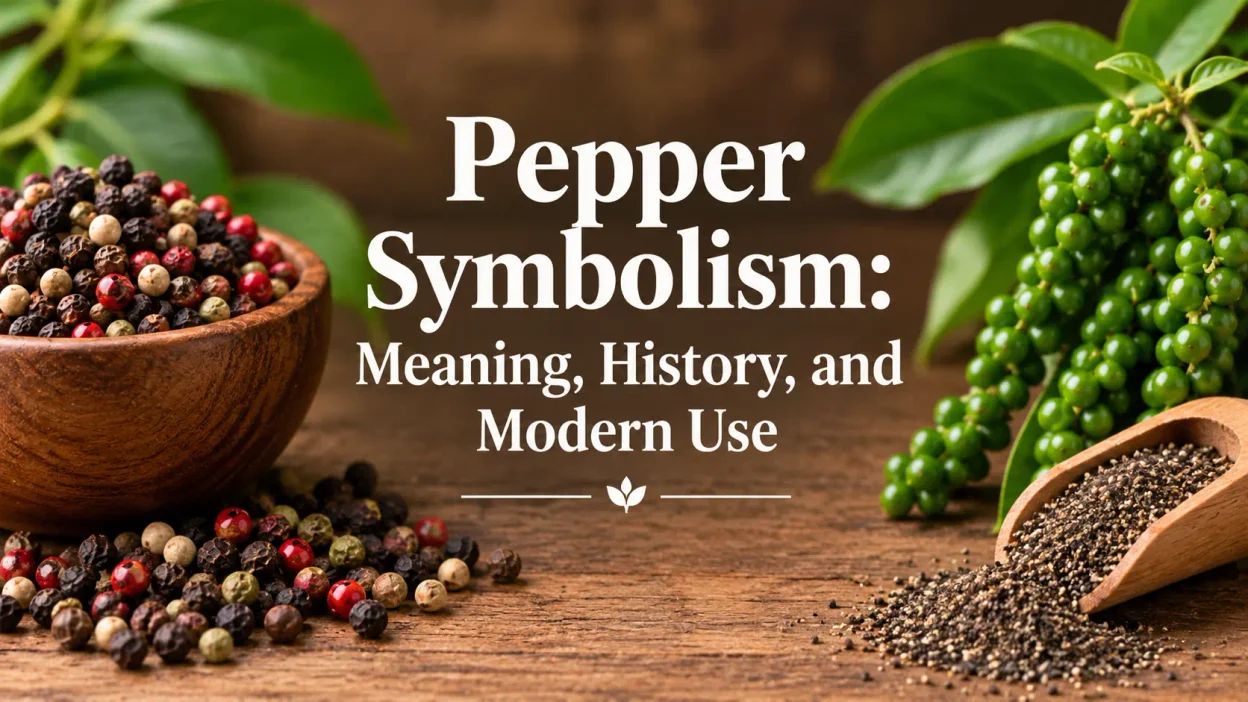
Pepper symbolism connects an ordinary kitchen ingredient with ideas of passion, protection, wealth, hospitality, and personal strength. In the United States, pepper appears most often in food and everyday routines, but certain peppers also carry cultural meanings that go beyond flavor. A red chili pepper, for example, can suggest heat, confidence, boldness, or a lively personality, while black pepper can bring to mind value, trade, and the importance of small things.
The word pepper covers several different plants and ingredients. Black pepper comes from the Piper nigrum vine, while familiar bell peppers, jalapeños, and cayenne peppers belong to the Capsicum group. Their appearances and histories differ, so their symbolic meanings should not automatically be treated as identical.
Understanding these distinctions helps explain why pepper can represent both comfort and intensity. It seasons a shared meal, adds heat to a dish, and recalls centuries of trade between distant regions. In some cultural traditions, a red pepper also serves as a protective charm. Its meaning depends on the type of pepper, the setting, and the beliefs of the people using it.
Quick Answer
Pepper symbolism commonly represents passion, vitality, boldness, and protection in modern American culture, especially when associated with hot red peppers and spicy food. Historically, black pepper also symbolized wealth, trade, and social status because it traveled long distances and once cost enough to be treated as a luxury.
TL;DR
- Hot peppers often symbolize passion, confidence, intensity, and a bold personality.
- Black pepper reflects the history of valuable spices and international trade.
- Red chili charms hold protective meanings in some Italian and Italian American traditions.
- Pepper in food can represent hospitality, flavor, and shared cultural identity.
- The meaning depends on the pepper species, color, setting, and cultural background.
- Modern designs use pepper imagery to express humor, heat, confidence, and heritage.
What Pepper Represents as a Symbol
Pepper’s symbolic meaning often begins with its physical qualities. A hot pepper can sting the tongue, produce warmth, and transform a mild dish into something intense. These sensations make it a natural image for passion, excitement, courage, and a strong personality.
Black pepper communicates something different. Its small, dark grains look modest, but a pinch can change the flavor of an entire meal. Historically, its high price also made it a sign of access to valuable goods. As a result, black pepper can suggest value, resourcefulness, refinement, or influence.
The shape and color of a pepper matter, too. A glossy red chili may suggest energy or attraction, while a green pepper can evoke freshness, growth, and the garden. These are common visual associations, not universal rules. A green jalapeño does not carry an established spiritual meaning simply because it is green.
Pepper is therefore a flexible symbol rather than one with a single fixed definition. Its meaning can be culinary, emotional, historical, cultural, or personal.
Passion, Heat, and Emotional Intensity
The most immediate symbolic association of hot peppers is heat. People use words such as fiery, spicy, and hot to describe strong feelings, energetic behavior, and romantic attraction. A chili pepper can therefore represent desire, enthusiasm, impatience, anger, or a willingness to take risks.
This association is especially familiar in American food culture. Restaurant menus describe dishes as mild, medium, hot, or extra hot, turning physical heat into a shorthand for intensity. Hot sauce brands also use pepper imagery to communicate bold flavor and an adventurous attitude.
The symbol can have a playful meaning. A red chili on a shirt, sticker, or kitchen sign may simply suggest that its owner enjoys spicy food. In a romantic context, it might imply flirtation or chemistry. In a discussion about someone’s temper, it could suggest a quick or fiery reaction.
Context determines which interpretation makes sense. A pepper graphic on a hot sauce bottle is primarily a product cue; the same image on a personal accessory may be a statement about taste, identity, or attitude.
Protection and the Red Pepper Charm
One of the more specific cultural associations of pepper appears in Italian and Italian American folk practice. In some families and communities, a small red chili-shaped charm, often called a cornicello or corno when it takes the traditional horn form, is associated with protection against the malocchio, or evil eye.
The evil eye is a folk belief that envy or a hostile gaze can bring misfortune. Protective objects are used in various Mediterranean and neighboring traditions, although their forms and meanings vary. In Italian popular culture, the red pepper and the horn-shaped charm may be associated with warding off ill fortune, envy, or harmful intentions.
A real chili pepper and a cornicello are not the same object. Their shapes can be related in popular jewelry and souvenir designs, but the horn charm has its own history and should not be described as simply a pepper in another form.
In some Italian American households, red pepper charms have appeared as pendants or decorations in cars. For people who use them, the object may express family heritage, cultural continuity, or a hope for good fortune. Others wear one mainly as jewelry or a reminder of their background.
These are cultural and personal beliefs, not scientifically established protective effects. The respectful way to understand the charm is to recognize what it means to its wearer without claiming that all Italians share the same belief.
Black Pepper, Wealth, and Historical Status
Black pepper’s association with wealth comes from its history as a valuable traded spice. Native to South Asia, black pepper moved through long-distance trade networks connecting the Indian subcontinent with the Middle East, North Africa, and the Mediterranean world. Its cost and limited availability in some markets made it a prized commodity.
In ancient Rome, pepper appeared in cooking and could be found in wealthy households. During the European Middle Ages, it remained an expensive import and a sign of access to goods from far away. Historical accounts also describe pepper being used in financial exchanges and, in certain circumstances, demanded as tribute or ransom. Such examples help explain why pepper became associated with money and prestige.
These associations should not be exaggerated into a claim that pepper functioned as ordinary currency everywhere. Its role varied by place and period. It was a commodity that could carry substantial economic value, not a universal replacement for coins.
Today, black pepper is inexpensive and familiar in most American kitchens. Its old association with luxury is less obvious in daily life, but it remains part of the spice’s historical story. Symbolically, it can remind us that the perceived value of an object changes as trade, supply, and access change.
Pepper and the History of Trade
Pepper’s symbolism also reflects the movement of goods, people, and ideas across borders. Long before it became a standard American table seasoning, black pepper connected producers in South Asia with merchants and consumers in distant regions.
The spice trade helped build commercial relationships across the Indian Ocean and into the Mediterranean. In later centuries, European powers competed to control access to pepper and other Asian spices. Portuguese, Dutch, and English trading interests became involved in commercial and colonial struggles over supply routes, ports, and profits.
Pepper’s history is therefore not only a story of culinary discovery. It also reveals unequal power, the ambitions of merchants and empires, and the labor of the communities that cultivated and traded valuable crops. The spice’s journey from a prized import to an everyday seasoning reflects major changes in global commerce.
In a modern interpretation, pepper may symbolize connection, exchange, ambition, or the hidden history behind ordinary goods. A pepper shaker on a dining table rarely prompts people to think about ocean voyages or colonial trade, but that history adds another layer to the object.
Pepper Symbolism in American Food and Hospitality
In the United States, pepper is most often understood through cooking. Black pepper sits beside salt in restaurants and home kitchens, while bell peppers and hot peppers appear in dishes shaped by many regional and immigrant food traditions.
Because seasoning helps make a meal satisfying, pepper can suggest hospitality and care. Preparing food for guests often involves adjusting flavors to suit the people at the table. A pepper grinder passed around a family dinner becomes part of a shared routine rather than a formal symbol.
Hot peppers add another layer. They can represent regional pride, culinary adventure, and personal preference. Chili peppers feature in many Mexican American, Southwestern, Cajun, Caribbean American, and other food traditions, though the varieties and meanings differ by community. Their presence should not be reduced to a single generic idea of American spice.
A pepper image in a restaurant logo may communicate freshness, heat, or a focus on bold flavors. In a home kitchen, a decorative chili can suggest warmth and an enthusiasm for cooking. These everyday uses are among the clearest ways pepper acquires meaning in American life.
Red, Green, and Black Pepper: How Color Changes the Meaning
Color can shape the impression a pepper creates, but it does not provide a universal symbolic code. Red, green, and black peppers differ in appearance, botanical identity, culinary use, and cultural associations.
A red chili often suggests heat because many varieties turn red as they ripen and are commonly used in spicy foods. Red also has familiar associations with energy, attraction, warning, and urgency in American visual culture. Those associations can reinforce the pepper’s fiery appearance.
Green peppers may suggest freshness, growth, or a garden harvest. A green bell pepper is usually mild compared with a jalapeño, so color alone cannot tell someone how hot a pepper will taste. Black peppercorns, meanwhile, are associated with seasoning and historical trade rather than the bright visual energy of red chilies.
| Pepper or color | Common symbolic association | Typical context | Important distinction |
|---|---|---|---|
| Red chili pepper | Passion, heat, boldness | Hot sauce, food branding, jewelry | Can also be a cultural charm |
| Green pepper | Freshness, growth, harvest | Gardening, cooking, produce design | Does not necessarily mean spicy |
| Black peppercorn | Value, refinement, trade | Culinary history, dining | Its historic luxury contrasts with modern affordability |
| Bell pepper | Nourishment, color, everyday abundance | Family meals, gardens, recipes | Usually less associated with heat |
| Dried chili | Intensity, preservation, culinary heritage | Cooking, decor, regional food traditions | Meaning varies by culture and use |
These associations are useful starting points, not fixed definitions. A designer may choose a green pepper for its color rather than for any symbolic message.
Ancient Roots of Black Pepper and Chili Peppers
Black pepper and chili peppers have different botanical origins and historical journeys. Black pepper originated in the Indian subcontinent, particularly the southwestern region of present-day India. Chili peppers, by contrast, originated in the Americas and were cultivated by Indigenous communities long before Europeans arrived.
Black pepper was already moving through ancient trade networks thousands of years ago. It became familiar in South Asian food and medical traditions before reaching Mediterranean markets in larger quantities. By the Roman period, it had become a sought-after ingredient in wealthy households.
Chili peppers followed a different path. Archaeological evidence shows that people in parts of Mesoamerica used them well before European contact. After the late 15th century, chili peppers spread to Europe, Africa, and Asia through expanding trade and colonial networks. Communities in these regions adopted them into local cuisines, developing new varieties and cooking traditions.
This history matters when interpreting pepper imagery. A black peppercorn may evoke ancient commerce and luxury, while a chili can point toward Indigenous American foodways, migration, and the exchange of cultural knowledge. Treating both as one historical symbol erases the distinct stories that shaped their meanings.
Pepper in Indigenous American Food Traditions
Chili peppers were important to Indigenous communities in the Americas long before they became familiar ingredients in European cooking. Their uses varied across regions and peoples, including seasoning food and forming part of established agricultural and culinary practices.
In some Mesoamerican communities, chili was more than an optional flavoring. It belonged to food systems built around locally cultivated crops, preparation methods, and shared knowledge. Research on Nahua communities in Mexico’s Huasteca region, for example, describes chili as a culturally significant part of life, with connections to physical, emotional, and spiritual experience.
It is important not to turn these findings into a claim that every Indigenous American society assigned chili the same spiritual meaning. The Americas contain many distinct cultures, languages, and histories. Specific interpretations should be connected to the communities that hold them.
For American readers today, pepper can serve as a reminder that familiar foods often have long Indigenous histories. Recognizing those histories adds cultural context to the ingredient without inventing beliefs or reducing diverse traditions to a single symbolic message.
Pepper as a Sign of Confidence and Personal Identity
Because hot peppers create an intense physical sensation, they often communicate a willingness to embrace challenge. Someone who enjoys very spicy food may describe themselves as adventurous, resilient, or eager to test their limits. A chili pepper design can convey the same attitude without requiring words.
This meaning is particularly visible in casual American culture. Pepper graphics appear on hot sauce labels, novelty gifts, aprons, kitchen signs, and clothing. Some designs are deliberately humorous, while others present spice as a mark of toughness or individuality.
The symbolism also has limits. Eating extremely hot food does not prove that a person is brave, and preferring mild food does not make someone timid. The connection between spice and confidence is a cultural metaphor, not a reliable judgment about personality.
When someone chooses pepper imagery for personal style, the intended message may be as simple as enthusiasm for cooking. It can also express a playful identity: someone who likes strong flavors, dislikes blandness, or enjoys being a little unconventional.
Pepper in Tattoos, Jewelry, and Home Decor
Pepper imagery offers a compact design with several possible meanings. A tattoo of a red chili might celebrate a favorite food, honor family traditions, or express a lively temperament. A small pepper charm can have cultural significance, especially when connected to Italian or Italian American protective traditions.
In jewelry, the shape matters. A traditional cornicello is a curved horn-like amulet often mistaken for a chili pepper by people unfamiliar with it. It is commonly associated with protection against the evil eye in Italian folk culture. A simple chili-shaped pendant, however, may be a fashion accessory with no spiritual intention at all.
Home decor tends to emphasize the culinary side of the symbol. Framed pepper illustrations, ceramic chili ornaments, and colorful kitchen textiles can make a room feel warm, informal, and connected to cooking. A string of dried peppers may suggest food preservation or regional culinary heritage.
Before assigning meaning to a pepper design, consider its setting and the owner’s explanation. The same shape can be a family heirloom, a protective charm, a joke, a food reference, or simply an attractive object.
Pepper Symbolism in Folklore and Popular Belief
Folklore gives everyday objects meanings that may not be obvious to outsiders. Pepper is a good example because its sharp taste, red color, and association with heat have made it suitable for different folk interpretations.
In some Italian American accounts, a red pepper is described as a protective object against the evil eye. In other cases, a horn-shaped amulet serves that role. Such objects may be kept in a car, worn as a necklace, or given as a gift. Their significance can combine family memory, inherited belief, and personal reassurance.
Pepper also appears in sayings and everyday metaphors. Calling someone “full of pepper” can suggest liveliness or spirited behavior in certain contexts, while describing a remark as “spicy” may imply sharp humor or provocative language. These expressions draw on the sensation of heat rather than a formal religious tradition.
Not every folk belief has a documented origin, and not every modern interpretation is ancient. Traditions can change as families migrate, objects become commercial products, and meanings pass between generations. It is more accurate to describe a belief as a tradition held by particular people than to label it a universal rule.
The Psychological Meaning of Pepper
Pepper can symbolize intensity because people experience its effects directly. Hot peppers stimulate the mouth and can create a sensation of heat, making them an immediate metaphor for excitement, challenge, and emotional force. Black pepper has a milder but still distinctive sharpness, linking it more closely with seasoning and refinement.
Food also carries memory. The smell of a familiar dish can remind someone of childhood meals, a relative’s kitchen, a holiday gathering, or a place they once lived. In these cases, pepper’s meaning comes less from a universal symbol and more from personal association.
For one person, a jar of chili flakes may represent a parent’s cooking. For another, a pepper charm may recall a grandparent’s jewelry or a family story about protection. A hot sauce label might remind someone of a trip, a shared joke, or a personal challenge.
These connections are meaningful without requiring supernatural explanations. A symbol can influence how people interpret an object because it links a visible thing to memory, identity, and emotion.
Common Misunderstandings About Pepper Symbolism
One common mistake is assuming that all peppers symbolize the same thing. Black pepper, bell peppers, and hot chili peppers differ in their origins and everyday uses, so their associations can differ as well.
Another mistake is treating protection as a universal meaning. Some red pepper charms are associated with warding off the evil eye in Italian and Italian American traditions, but this does not mean every pepper pendant is a protective amulet. The owner may have chosen it for fashion, humor, or culinary interest.
People also sometimes confuse folk belief with established fact. A charm may be meaningful to someone who believes it protects them, but there is no scientific evidence that a pepper-shaped object can prevent misfortune or harmful intentions.
Finally, modern meanings should not be projected backward without evidence. A chili pepper on a contemporary hot sauce bottle may communicate extreme heat or daring flavor, but that does not establish what chili meant in every ancient society. Historical context and modern design choices need to be considered separately.
How to Interpret Pepper in Art and Everyday Life
The easiest way to interpret pepper symbolism is to look at the object, its setting, and the person using it. Start by identifying whether the image represents black pepper, a bell pepper, a chili, or a horn-shaped charm. Then consider what the object is doing in that setting.
A black pepper grinder in a still-life painting might point toward domestic life, dining, or the historical value of imported spices. A red chili on a restaurant sign is more likely to advertise spicy food or bold flavor. A small pepper-shaped pendant worn by someone with Italian family roots may carry a cultural association, but the wearer’s own explanation is the most reliable guide.
Ask three questions:
- What is shown? Identify the type, color, shape, and material.
- Where does it appear? A kitchen, artwork, necklace, advertisement, and family keepsake can suggest different meanings.
- Who uses it, and why? Personal history and cultural tradition often explain more than the image alone.
This approach avoids forcing a symbolic meaning onto every pepper. Sometimes it is a deliberate sign of passion or protection. At other times, it is simply an ingredient or decoration.
Frequently Asked Questions
What does pepper symbolize spiritually?
Pepper may symbolize protection, vitality, or the ability to resist unwanted influences in particular folk traditions. These meanings are not universal spiritual teachings, so the specific cultural background and use of the pepper matter.
Does a red pepper symbolize protection?
In some Italian and Italian American folk practices, red pepper imagery is associated with protection against the evil eye. However, a red pepper can also represent heat, passion, cooking, or personal style, depending on the context.
What does a chili pepper tattoo mean?
A chili pepper tattoo may represent a love of spicy food, a bold personality, passion, humor, or cultural heritage. Its meaning depends on the person who chose it and any other images included in the design.
What does black pepper symbolize?
Black pepper can represent value, refinement, and trade because it was historically an expensive imported spice. In modern daily life, it is more often associated with cooking, flavor, and hospitality.
Is pepper considered a symbol of good luck?
Some pepper-shaped charms are used as protective or lucky objects in particular folk traditions, especially in Italian and Italian American contexts. There is no single meaning shared by all cultures, and luck is a matter of belief rather than a proven effect.
What is the difference between pepper and chili pepper symbolism?
Black pepper is often linked with historic trade, wealth, and culinary refinement, while chili peppers more readily suggest heat, passion, intensity, and bold flavor. These are broad associations rather than strict rules, and individual traditions may give either type a different meaning.
Why is pepper important in cultural history?
Pepper connects food with agriculture, migration, commerce, and cultural exchange. Black pepper helped shape long-distance trade between South Asia and other regions, while chili peppers spread from the Americas and became central to cuisines around the world.
Conclusion
Pepper symbolism brings together several meanings: passion and intensity from the heat of chilies, wealth and trade from the history of black pepper, and protection in certain folk traditions. In the United States, pepper most commonly appears as a culinary image, a sign of bold flavor, or a familiar part of home and family life.
Its meaning becomes clearer when the type of pepper, historical background, and personal context are considered together. A pepper can be a seasoning, a cultural keepsake, a playful design, or a symbol of protection. What it communicates depends on the story attached to it, not simply its shape or color.