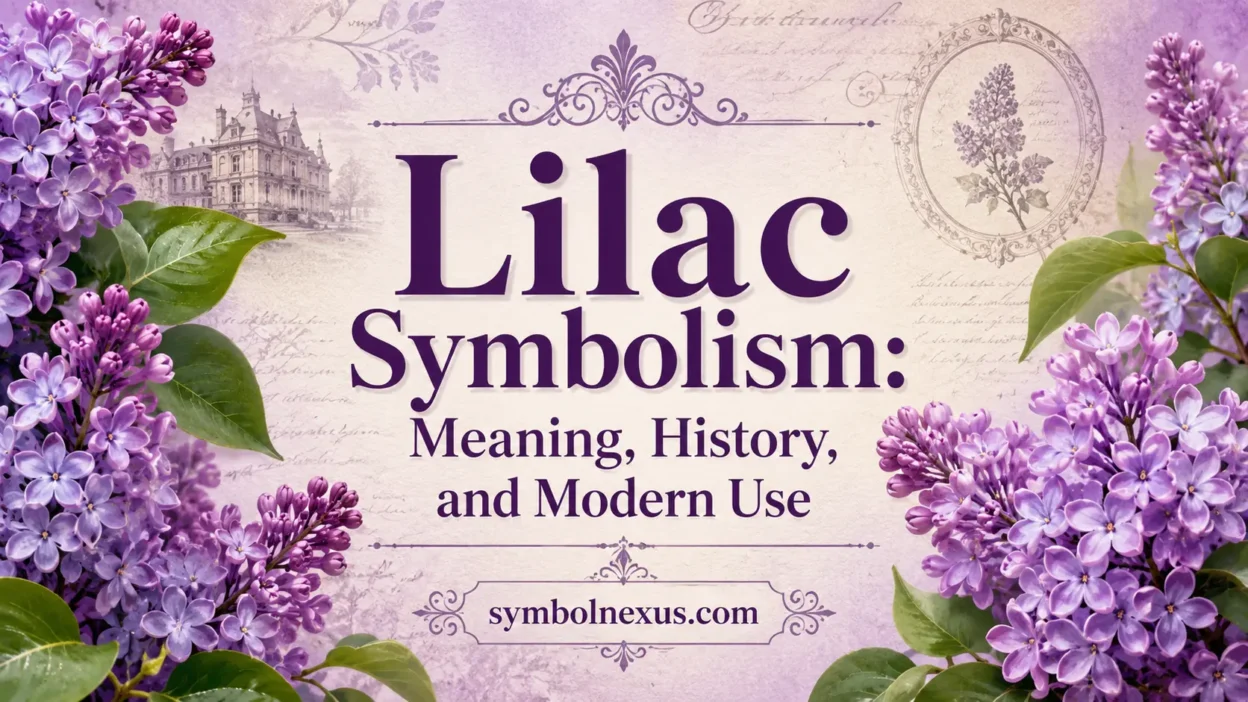
Lilacs are familiar spring flowers, but their meaning reaches beyond their soft purple color and recognizable fragrance. Lilac symbolism is most strongly associated today with first love, youthful affection, renewal, memory, and the return of spring. In American culture, those meanings come from a mix of older flower-language traditions, garden history, literature, seasonal associations, and personal memory.
The flower carries an unusual emotional range. A blooming lilac can suggest the excitement of a new relationship or the comfort of something beloved returning after winter. In American literature, however, lilacs have also become connected with grief, remembrance, and healing.
Understanding the symbol therefore requires separating documented historical meanings from modern interpretations. Lilacs have never had one universal definition; their significance changes with color, occasion, cultural setting, and the story attached to them.
Quick Answer
Lilac symbolism commonly represents first love, youthful affection, renewal, and cherished memories in modern American culture. Historically, purple lilacs were linked with the first emotions of love in Western flower-language traditions, while American literature also gave the flower an important association with mourning, remembrance, and healing.
TL;DR
- Lilacs most often represent first love, renewal, and affectionate memory.
- Purple lilacs traditionally expressed the first emotions of love.
- White lilacs were historically associated with youthful innocence.
- Spring blooming connects lilacs naturally with return and new beginnings.
- Walt Whitman gave lilacs a major American association with mourning.
- Modern meanings depend heavily on color, context, and personal intention.
What Lilacs Look Like and Why Their Season Matters
The common lilac, Syringa vulgaris, is a deciduous shrub known for dense clusters of small, fragrant flowers. Traditional blooms are lilac-purple, although cultivated varieties also appear in white, pink, lavender, magenta, cream, and other shades. Its leaves are typically opposite and heart-shaped, giving the plant a recognizable appearance even after flowering ends.
Lilacs usually flower in spring, especially in climates with sufficiently cold winters. Their bloom period is relatively brief, which helps explain why people often connect them emotionally with a particular season, childhood home, relationship, or annual event. In northern American gardens, their scent can function almost like a seasonal marker: lilacs blooming means winter has finally passed.
That natural cycle matters symbolically. Unlike an evergreen plant that looks similar year-round, a lilac disappears into ordinary foliage after a concentrated burst of flowers. Its return each spring makes renewal and recurrence understandable modern associations, even though those ideas should not be mistaken for a single ancient or universally fixed meaning.
What Lilacs Commonly Mean in the United States
In modern American use, lilacs most often suggest young love, affectionate memory, spring renewal, tenderness, and nostalgia.
These meanings overlap because Americans often encounter lilacs in deeply personal settings: an old shrub beside a family house, a grandmother’s garden, a spring wedding, a neighborhood hedge, or flowers brought indoors for their fragrance. Lilacs can therefore symbolize not only a person but also a remembered place or period of life.
Their emotional tone is generally softer than that of the red rose. A red rose conventionally makes an unmistakably romantic statement, while lilacs can express affection without implying mature passion. That distinction fits particularly well with their historical connection to the earliest feelings of love.
They also carry a distinctly seasonal message. Because established lilacs return and flower year after year, they can represent continuity: something familiar reappearing after absence.
How First Love Became the Traditional Lilac Meaning
The strongest documented historical association is with the beginning of romantic feeling.
Nineteenth-century flower-language books assigned meanings to individual flowers so bouquets could communicate emotions symbolically. In Kate Greenaway’s well-known Language of Flowers, purple lilac was assigned the meaning “first emotions of love,” while another nineteenth-century flower-language text similarly connected lilac with the earliest stages of romantic feeling.
This does not mean every Victorian person followed an identical floral code. Flower dictionaries differed, and floral meanings changed between books, places, and periods. Smithsonian educational material on the language of flowers likewise notes that meanings and traditions shift over time and culture.
Still, the association between purple lilacs and emerging love is historically grounded. That is why the flower works especially well today as a symbol of a first crush, young romance, early courtship, or affection remembered from youth.
Its message is less “eternal passion” than “the moment love begins.”
White Lilacs and Youthful Innocence
Color mattered in traditional flower language.
White lilacs were historically associated with youthful innocence, while purple lilacs represented the first emotions of love. That color distinction appears explicitly in nineteenth-century flower-language references rather than being purely a recent internet invention.
In modern settings, white lilacs can therefore work naturally in ceremonies centered on freshness, sincerity, youth, or new beginnings. Their appearance also reinforces that interpretation: white flowers in Western culture are frequently used in weddings and other ceremonies where simplicity and purity are emphasized.
However, “purity” should not automatically be treated as the historical meaning of every white lilac in every culture. A flower’s message depends on the arrangement, event, and intention of the person using it.
Why Lilacs Represent Spring, Renewal, and Return
Renewal is largely a meaning created by the plant’s behavior.
Lilacs are spring-flowering shrubs that require seasonal cycles, including cold dormancy for many types, before producing their familiar bloom. In colder parts of the United States, their flowers arrive during the visible transition from winter into warmer weather.
That timing makes the symbolism intuitive. Bare or quiet branches suddenly become covered in fragrant flowers. A familiar scent returns after many months. Gardens visibly change.
As a result, lilacs can represent:
| Context | Meaning in the USA | Common Association | Why It Fits |
|---|---|---|---|
| Early romance | First love | Young affection | Traditional flower-language meaning |
| Spring | Renewal | Fresh starts | Blooms return after winter |
| Family memory | Nostalgia | Home and childhood | Long-lived garden shrubs |
| Memorial use | Remembrance | Grief and healing | Strong American literary association |
| White flowers | Innocence | Youth and sincerity | Historical color-specific meaning |
“Renewal” is therefore best understood as a seasonal and modern symbolic interpretation rather than a rigid message inherited unchanged from one historical tradition.
Lilacs in American Gardens and Cultural Memory
Lilacs have been part of American garden culture since the colonial era, even though they are not native to North America.
The common lilac originated in eastern Europe, while other members of the genus come from Europe and Asia. By the eighteenth century, lilacs were established in North American gardens. Thomas Jefferson recorded planting methods for lilacs in 1767, and George Washington wrote in 1785 about transplanting lilacs in his garden. Lilacs believed to date to around 1750 survive at the former Governor Wentworth estate in Portsmouth, New Hampshire.
That long garden history helps explain the flower’s American connection with memory.
Lilac bushes can remain associated with one property or family for generations. An old shrub may outlive the people who planted it, creating a living connection between present-day residents and earlier households.
This gives lilacs a form of symbolism that does not depend on flower dictionaries. For many people, the meaning is autobiographical: the scent recalls a porch, a relative, a childhood yard, or a particular spring.
Walt Whitman, Abraham Lincoln, and Lilacs as Mourning
One of the most important American meanings of the lilac comes from literature.
After President Abraham Lincoln’s assassination in April 1865, Walt Whitman wrote When Lilacs Last in the Dooryard Bloom’d. The Library of Congress describes the poem as a major elegy concerned with death and national healing, built around recurring images including the lilac, a star, and a thrush.
Whitman’s connection between lilacs and Lincoln was partly personal and seasonal. He later recalled that lilacs were blooming around the time of the assassination and that their sight and scent became permanently linked in his memory with the tragedy. In the poem, the flower participates in a larger movement through grief toward remembrance, continuity, and renewal.
This literary history explains why lilacs can carry two meanings that initially seem contradictory.
They can represent spring and new life while also representing death and mourning.
The contradiction is exactly what makes the symbol effective. Spring continues even after loss. Flowers return, although the person being mourned does not.
In an American context, therefore, lilacs can appropriately symbolize remembrance shaped by renewal rather than grief alone.
New Hampshire and the Lilac as Civic Identity
Lilacs also have an official place in American state symbolism.
New Hampshire adopted the purple lilac, Syringa vulgaris, as its state flower in 1919. The choice reinforced a flower already closely associated with the state’s gardens and climate.
The connection is especially fitting because lilacs have a long history in New England horticulture. Their ability to thrive in cold climates and return reliably each spring helped make them familiar features around older homes and communities.
Here the flower moves beyond private emotion.
It becomes a public emblem of place, regional continuity, and local identity. For someone from New Hampshire, a lilac may therefore carry a civic association that another American would not automatically recognize.
What Different Lilac Colors Can Suggest
Color changes the emotional tone of the flower, but modern color meanings should not be treated as an inflexible dictionary.
Purple lilacs have the clearest historical link with the first emotions of love. Because purple also has broader cultural associations beyond the flower itself, darker purple varieties may feel more formal or dramatic.
White lilacs have a documented traditional connection with youthful innocence. In contemporary arrangements, they can also communicate simplicity, remembrance, or ceremonial freshness.
Pink lilacs tend to read as warmer and more openly affectionate. Their meaning is usually modern and contextual rather than based on a single universally accepted Victorian definition.
Blue or blue-violet lilacs often create a cooler, quieter impression in gardens and design. They may be chosen to suggest calmness or reflection, but such emotional readings are design conventions rather than fixed botanical meanings.
Modern lilac cultivars span a much wider color range than the traditional purple-and-white contrast commonly discussed in older symbolic systems.
Emotional and Psychological Associations
Lilacs often feel nostalgic because scent, season, and memory can become linked.
Someone who grew up near an established lilac bush may associate its fragrance with childhood springs. Another person may connect it with a wedding, a deceased relative, or a first relationship. These individual associations can become stronger than any traditional flower meaning.
The pale lilac color used in interiors, fashion, and digital design can also suggest softness or calm because of its lightness and low visual intensity. Still, it would be misleading to claim that lilac has one scientifically universal psychological effect.
Research on color and emotion shows that color associations are influenced by context and culture rather than functioning as fixed emotional codes.
So a better interpretation is that lilac often signals gentleness, reflection, tenderness, or nostalgia in contemporary design, not that the color automatically produces those emotions in everyone.
Lilacs in Weddings, Gifts, and Relationships
Lilacs suit relationship symbolism particularly well when the message involves beginnings rather than established passion.
A lilac bouquet can mark a new romance, engagement, spring wedding, anniversary of a first meeting, or a relationship connected with youthful memories. Purple varieties can subtly draw on the historical meaning of early love, while white varieties can emphasize a fresh beginning.
Their short natural flowering season also gives them a sense of occasion. Unlike flowers available in visually identical form throughout the year, fresh garden lilacs can feel strongly tied to a specific moment in spring.
As a gift, however, meaning should come from intention rather than an assumed secret code.
Giving lilacs to a romantic partner may mean “I remember how we began.” Giving the same flowers to a parent may communicate home, gratitude, and shared memories. In a memorial arrangement, they may represent remembrance.
Context decides which meaning becomes dominant.
Lilacs in Tattoos, Jewelry, Fashion, and Decor
Modern symbolic use has moved far beyond bouquets.
A lilac tattoo often represents first love, personal renewal, a remembered spring, youth, or someone associated with the flower. Because lilacs can also carry memorial associations, the same design may honor a person who has died.
The details can change the message. A blooming branch may suggest growth or return. A single cluster can commemorate a specific memory. Adding a date, name, bird, star, or other motif can shift the symbolism into a highly personal story.
In jewelry and fashion, lilac flowers or pale purple tones usually communicate a gentler aesthetic rather than a strict historical code.
In home decor, the color is commonly used to create a light, romantic, botanical, or spring-inspired atmosphere. Actual lilac branches bring an additional sensory element because fragrance is one of the plant’s defining characteristics.
Digital culture has made these meanings more flexible. A lilac emoji-like illustration, floral profile image, or pastel color palette may communicate nothing more specific than softness or a spring aesthetic unless additional context gives it symbolic weight.
Cross-Cultural Roots and Historical Movement
The common lilac is not originally American.
Syringa vulgaris comes from eastern or southeastern Europe, particularly the Balkan region, while the broader lilac genus includes species native across parts of Europe and Asia. Lilacs entered Western European horticulture through historical networks that included Ottoman gardens and later became widely cultivated by European growers.
Lilacs also have a long horticultural history in Iran. The Persian lilac has been cultivated there for centuries, and even the English word “lilac” has linguistic connections reaching through older Middle Eastern and Persian-associated terminology for color and plants.
This history deserves a distinction: the movement of the plant across cultures does not prove that one symbolic meaning traveled unchanged with it.
The Western association with first love comes most clearly from European and nineteenth-century flower-language traditions. American meanings later absorbed additional layers through gardening, literature, regional identity, and personal memory.
It is safer to speak of overlapping cultural histories than to claim that lilacs have meant the same thing everywhere.
Common Misunderstandings About Lilac Meanings
One common mistake is treating every online list of floral meanings as ancient fact.
Many modern pages assign exact meanings to every lilac shade—purple for spirituality, blue for tranquility, pink for confidence, magenta for passion—as though these definitions came from one established historical code. In reality, traditional flower-language references varied, and modern interpretations often mix historical symbolism with general color associations. Smithsonian material on flower meanings specifically emphasizes that meanings change across time and culture.
Another misconception is that lilacs symbolize only mourning because of Walt Whitman. His Lincoln elegy created an important American association with grief and national healing, but it did not erase older romantic meanings.
Lilacs also do not have a single established biblical meaning. They are sometimes given modern spiritual interpretations, but readers should distinguish personal or devotional symbolism from meanings explicitly rooted in biblical text.
Finally, the flower should not automatically be treated as a universal symbol of renewal. That association makes sense because of its spring bloom, but it is primarily an interpretive connection based on season and recurrence.
How the Meaning of Lilacs Changed Over Time
The history of the flower’s meaning can be understood as a series of layers rather than a straight line.
First came the plant itself: a flowering shrub native to parts of Europe and Asia that moved through cultivated gardens and eventually became established in European and North American horticulture.
Then came formalized flower-language associations. By the nineteenth century, purple lilacs were documented as symbols of the first emotions of love, while white lilacs represented youthful innocence.
American experience added new meanings.
Long-lived garden plantings connected lilacs with home and family memory. Walt Whitman linked the flower with Lincoln’s death, grief, remembrance, and national healing. New Hampshire made the purple lilac an official civic emblem.
Modern culture has expanded the symbol again through tattoos, weddings, memorials, fashion, interior design, and personalized gifts.
Today, the most accurate interpretation is not a single definition but a cluster of related ideas: love beginning, spring returning, memory enduring, and life continuing after change.
FAQs
What do lilacs symbolize spiritually?
Lilacs do not have one universal religious or spiritual meaning. In modern personal symbolism, their spring return can represent renewal, hope, reflection, or personal transformation, but these meanings depend on the belief system and context rather than an established universal doctrine.
What does a lilac tattoo mean?
A lilac tattoo commonly represents first love, youth, renewal, nostalgia, or remembrance. The meaning can become more personal when the design includes a name, date, memorial element, or imagery connected with a particular relationship.
Do lilacs symbolize first love?
Yes. Purple lilacs were specifically associated with the “first emotions of love” in nineteenth-century Western flower-language references, making first love one of the flower’s strongest historically documented symbolic meanings.
Can lilacs symbolize death or mourning?
Yes, particularly in an American literary context. Walt Whitman’s 1865 elegy When Lilacs Last in the Dooryard Bloom’d, written after Abraham Lincoln’s assassination, connected lilacs with mourning, remembrance, death, and eventual healing.
What do white lilacs symbolize?
Traditional flower-language references associate white lilacs with youthful innocence. In modern ceremonies, they may also suggest sincerity, remembrance, freshness, or a new beginning depending on how they are used.
Are lilacs a positive symbol?
Generally, yes. Their most common associations—first love, spring, renewal, affection, and cherished memory—are positive, although they can also appear in mourning contexts where the emphasis is remembrance and healing rather than simple happiness.
Why are lilacs associated with memories?
Their strong fragrance, brief spring flowering period, and long life in established gardens make them especially easy to connect with specific places and times. American literary tradition strengthened that association when Walt Whitman used recurring lilacs as part of his remembrance of Abraham Lincoln and the nation’s grief after his death.
Conclusion
Lilacs carry several meanings because their symbolism developed through different historical and cultural paths. Traditional flower language linked purple lilacs with the first feelings of love and white lilacs with youthful innocence, while the plant’s annual spring bloom naturally encouraged later associations with renewal and return.
In the United States, garden history and literature added another dimension. Old lilac bushes became markers of home and family memory, while Walt Whitman’s response to Lincoln’s death gave the flower a lasting connection with grief, remembrance, and healing.
At its most useful, lilac symbolism brings these ideas together: affection at its beginning, memories that survive change, and the familiar return of life after a difficult season. The flower does not carry one rigid message; its meaning becomes clearest when its history, color, occasion, and personal context are considered together.