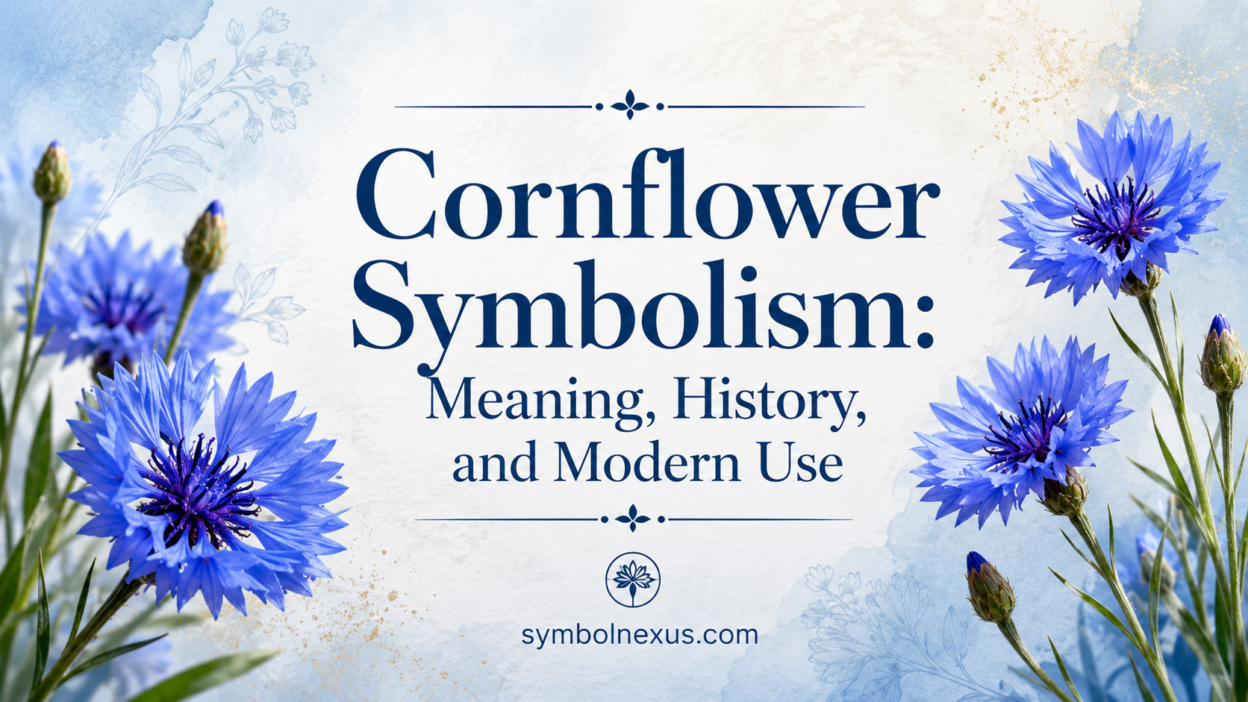
Cornflower symbolism centers on devotion, hopeful love, remembrance, and a calm form of resilience. The vivid blue flower began as a familiar sight among European grain crops, yet its associations later expanded through courtship customs, national identity, wartime commemoration, and modern floral design.
In the United States, the cornflower is better known as a garden flower, cut bloom, and “bachelor’s button” than as an official public emblem. Its message is usually personal rather than ceremonial: sincerity without drama, affection that endures uncertainty, and the ability to remain recognizable in difficult surroundings.
Its meanings are not universal. A blue bloom in a wedding bouquet may suggest loyalty, while the same flower on a French remembrance badge honors veterans and victims of war. Context, location, and presentation matter.
Quick Answer
Cornflower symbolism most commonly represents devotion, hopeful love, remembrance, and steady resilience in modern American use. Historically, the flower has also carried meanings connected with courtship, Prussian identity, Estonian national culture, and French wartime commemoration.
TL;DR
- Cornflowers commonly suggest devotion, hope, and quiet resilience.
- “Bachelor’s button” links the bloom with courtship and availability.
- Blue coloring adds associations of calm, trust, and sincerity.
- France uses the flower as an emblem of wartime remembrance.
- American uses are mainly personal, decorative, and commemorative.
- Political history can alter its meaning in parts of Europe.
What the Cornflower Looks Like and Why Its Name Matters
The common cornflower, Centaurea cyanus, is an annual plant with slender gray-green stems and flower heads made of a darker center surrounded by flaring, fringed florets. Its best-known color is an intense blue, although cultivated varieties may also appear in white, pink, lavender, burgundy, or nearly black.
The plant is native to parts of Europe and the Mediterranean region. It became closely associated with cultivated fields because it once grew abundantly among wheat, barley, rye, and other grain crops. In older British usage, “corn” could mean grain generally, so “cornflower” described a flower of the grainfield rather than a plant related to American sweet corn. It later became naturalized in North America and is classified as introduced rather than native in the United States.
Its other familiar name, “bachelor’s button,” shifts attention from habitat to human behavior. The rounded flower head resembles a decorative button, while later courtship stories connected it with unmarried men wearing a bloom in a lapel. The two names therefore hold different symbolic starting points: one agricultural and communal, the other romantic and individual.
Core Meanings at a Glance
No flower carries one fixed message in every setting. Still, several meanings appear repeatedly around the cornflower because of its color, growth pattern, names, and historical uses.
| Context | Meaning in the USA | Common Associations | Important Note |
|---|---|---|---|
| Romantic gift | Hopeful or faithful affection | Courtship, sincerity, patience | Less intense than a red rose |
| Wedding flowers | Loyalty and calm commitment | “Something blue,” trust, simplicity | Often chosen for color and texture |
| Memorial use | Remembrance and respect | Veterans, loss, endurance | Strongest in French contexts |
| Tattoo design | Resilience and individuality | Survival, gentleness, personal memory | Meaning depends on accompanying imagery |
| Home decor | Rural ease and understated beauty | Cottage gardens, summer, nostalgia | Usually aesthetic rather than ceremonial |
| National or political emblem | Heritage or identity | Estonia, Prussia, German nationalism | Historical context can be sensitive |
The flower’s central message is best understood as steadiness expressed through delicacy. It looks light and informal, but it has survived poor soils, disturbed ground, agricultural change, and repeated reinterpretation. That contrast explains why people use it to represent gentle endurance rather than forceful strength.
From Grain Fields to a Cultural Emblem
The earliest meanings were rooted in ordinary landscape rather than formal ceremony. Cornflowers appeared among grain crops, where their blue heads stood out against green stalks and golden harvest fields. To farmers, they could be weeds competing with crops; to artists and observers, they became vivid markers of rural life.
This double identity shaped later interpretation. The flower belonged to cultivated land but resisted complete human control. It was neither a rare greenhouse specimen nor a carefully guarded aristocratic bloom. Its visibility in working fields made it suitable for ideas such as humility, persistence, common life, and attachment to place.
Modern farming changed that relationship. Herbicides, seed cleaning, and intensified agriculture greatly reduced the plant in parts of its native European range, even while it continued to be grown intentionally in gardens and wildflower plantings. A former field weed consequently became, in some places, a flower associated with conservation and the recovery of disappearing agricultural landscapes.
That reversal adds a contemporary layer to its meaning. The cornflower can now suggest not only survival in disturbed ground but also the fragility of familiar species when farming practices change.
Courtship, Bachelorhood, and the Meaning of Blue
The nickname “bachelor’s button” is commonly explained through a courtship custom in which an unmarried man wore a cornflower in his buttonhole. Later folklore claimed that a fresh-looking bloom signaled hopeful love, while rapid fading suggested affection that would not be returned. The custom is difficult to reduce to one precise origin, but it fits the broader nineteenth-century habit of using flowers to communicate social and romantic messages.
This background gives the flower a different romantic tone from the rose. A red rose usually announces passion or established love. A cornflower is more tentative. It can express admiration, emotional availability, waiting, or trust in a relationship that is still becoming clear.
Color strengthens that interpretation. Blue is often read in American design as calm, dependable, reflective, or sincere. In flowers, which are less commonly blue than red, yellow, or white, the color also feels distinctive. The cornflower therefore communicates loyalty without heaviness and individuality without aggression.
Its blue should not be treated as a universal psychological code. Color meanings vary across cultures and situations. Even so, the bloom’s clear, cool hue helps explain why it is frequently selected for peaceful memorials, restrained romantic arrangements, and designs meant to feel honest rather than extravagant.
What It Commonly Means in the United States
In American culture, the cornflower does not have the single nationwide meaning attached to symbols such as the red poppy, the bald eagle, or the yellow support ribbon. Most Americans encounter it in seed mixes, cottage-style gardens, wedding flowers, botanical art, or floral merchandise.
As a result, its meaning is usually created by the occasion. In a romantic arrangement, it may suggest faithful interest. In a memorial tattoo, it may honor a person whose memory remains vivid. In a garden, it can represent informality, summer, pollinator-friendly planting, or affection for an old-fashioned rural aesthetic.
The name “bachelor’s button” remains familiar in American horticulture and reinforces ideas of courtship and independence. Yet modern users do not need to be unmarried men—or even know the old story—to connect with the bloom. The flower now works more broadly as a sign of self-possession, sincerity, and affection that does not demand attention.
Because the species is introduced in the United States, it should not automatically be described as an American native wildflower. Gardeners may grow it successfully, but ecological appropriateness depends on location and planting conditions. Symbolic admiration and responsible horticulture are separate questions.
Remembrance and the Bleuet de France
The strongest official commemorative meaning belongs to France. The Bleuet de France—the French cornflower—honors veterans, people wounded in war, bereaved families, and victims of war and terrorism. It plays a role comparable to the remembrance poppy in Britain and several Commonwealth countries.
The emblem developed during World War I. Cornflowers were associated with the devastated landscapes of the Western Front, the horizon-blue uniforms worn by French troops, and the nickname bleuets given to young recruits. In 1916, Suzanne Lenhardt and Charlotte Malleterre organized workshops in which wounded soldiers made artificial cornflowers to sell, providing income and supporting rehabilitation. The badge later became part of national remembrance observances.
This history changed the flower’s emotional register. It could still represent youthful love and rural beauty, but it also came to hold grief, public duty, and solidarity with the living consequences of war.
For Americans, that meaning is most accurate when the design clearly references France, French military memory, World War I, or the Bleuet de France tradition. A cornflower is not a direct American substitute for the red remembrance poppy, although both can convey survival and memory.
National Identity in Germany and Estonia
In nineteenth-century Prussia, the blue cornflower became associated with Queen Louise and later with Emperor Wilhelm I. Its color aligned easily with Prussian blue, and the flower developed into an emblem of monarchy, loyalty, and German identity after unification. These associations were historical and political rather than simple extensions of floral romance.
Estonia gives the bloom a different national meaning. The blue cornflower was chosen as a national symbol during the late 1960s and remains recognized as the country’s national flower. Its familiarity in rye fields, decorative clarity, and connection with rural life made it suitable as an emblem of landscape and cultural belonging.
The contrast is important. In Estonia, the flower commonly suggests homeland, fields, folk culture, and national continuity. In Prussian and German history, it may point toward monarchy, unification, or political identity. A symbol can look identical while carrying very different memories.
American designers using cornflowers in European-themed art should therefore avoid treating every national association as interchangeable. A French memorial badge, an Estonian folk motif, and a Prussian emblem do not communicate the same message.
Emotional and Psychological Meaning
Emotionally, the cornflower often appeals to people who identify with resilience but dislike harsh imagery. Its thin petals and open form create a sense of vulnerability, while its history as a field flower suggests persistence. Together, those qualities produce a symbol of remaining gentle without becoming fragile.
It can also represent hope during uncertainty. The courtship tradition is not about guaranteed love; it is about waiting to see whether affection will be returned. That makes the bloom appropriate for transitions, long-distance relationships, recovery periods, or personal milestones whose outcomes are not yet known.
The blue color adds emotional restraint. Cornflower imagery tends to feel reflective rather than celebratory, and comforting rather than mournful. In grief-related art, it can acknowledge absence without making sorrow the only subject. In self-representational art, it can communicate quiet confidence, sensitivity, or loyalty to one’s values.
These interpretations are not clinical claims about color or mental health. They are cultural readings created from the flower’s appearance and stories. Personal association remains more important than any floral dictionary.
Cornflowers in Weddings, Gifts, and Home Decor
Cornflowers work naturally in weddings because they provide a clear blue accent, an informal silhouette, and a connection with faithful affection. They may appear in bouquets, boutonnieres, table flowers, pressed-flower stationery, or embroidered details. Their “bachelor’s button” name also gives them a playful connection to courtship.
For a wedding, the flower can communicate calm commitment, sincerity, or the “something blue” tradition. It is especially suited to garden, summer, rustic, meadow, and European countryside themes. Paired with white flowers, it feels crisp and peaceful; mixed with yellow grain or daisies, it creates a field-inspired look.
As a gift, cornflowers are less declarative than roses. They suit a friend, new partner, graduate, host, or someone beginning a new chapter. The message can be framed as “I believe in you,” “I remember,” or “my affection is steady,” depending on the card and occasion.
In home decor, botanical prints and dried arrangements often evoke cottage gardens, handmade beauty, and seasonal nostalgia. Here the flower is usually not carrying a coded historical message. Its meaning comes from atmosphere: informal, bright, rural, and unpretentious.
Tattoos, Jewelry, Fashion, and Digital Culture
A cornflower tattoo most often represents resilience, loyal love, remembrance, or individuality. The design can be small and minimal because the fringed petals and dark center remain recognizable without a large composition.
Placement and accompanying symbols refine the message. A single stem may suggest independence or a private promise. A cluster can represent family, friendship, or community. Dates, initials, military imagery, wheat, poppies, or national colors can turn the flower toward memorial, agricultural, or cultural meanings.
In jewelry and fashion, the blue bloom often communicates delicacy with a slightly unconventional edge. It is less expected than a rose and less formal than a lily. Enamel pins, embroidered flowers, earrings, and printed fabrics use its distinctive outline effectively, even when the wearer has no specific historical association in mind.
On social media, cornflowers commonly appear in cottage-garden photography, floral tattoos, wedding mood boards, watercolor art, and seasonal nature posts. Digital repetition has broadened the flower’s aesthetic reach, but it can also flatten its history. A decorative blue flower may carry no political or national intent unless captions, colors, or surrounding imagery indicate one.
Spiritual and Religious Interpretations
The cornflower has no single, widely accepted biblical meaning, and it is not a central symbol in mainstream American religious practice. Claims that it universally represents divine messages, angels, or supernatural protection should therefore be treated as personal interpretations rather than established doctrine.
In contemporary spiritual use, people may connect the bloom with truth, calm attention, fidelity, or openness because of its blue color and outward-facing shape. Others use it as a meditation symbol for maintaining tenderness during hardship. These meanings are reflective and modern, not fixed teachings.
The flower can also fit nature-centered practices focused on seasons, fields, pollinators, and gratitude for ordinary beauty. In that setting, its value comes from relationship with the living plant rather than from a secret code.
For memorial rituals, a cornflower may represent continuing love and respectful remembrance. That use can be spiritually meaningful without claiming that the flower has universal religious authority.
Political Associations and Common Misreadings
The cornflower is usually harmless garden imagery in the United States, but its political history requires care in some European settings. In Austria, the blue cornflower was used by pan-German nationalist movements and served as a recognition symbol among illegal Nazis during the 1930s. Later political use revived controversy because viewers could read the flower as a coded reference to that history.
This does not make every cornflower image extremist. Meaning depends on country, era, audience, and surrounding signs. A wedding bouquet, Estonian folk design, French memorial badge, and Austrian political lapel flower belong to different symbolic systems.
Another common mistake is to call the bloom a universal symbol of remembrance. That description is too broad. Its official commemorative importance is especially French, while American remembrance traditions more commonly use other flowers and emblems.
It is also misleading to present Victorian flower meanings as a perfectly standardized code. Nineteenth-century flower books circulated in Britain, France, and the United States, but their definitions could differ. Modern lists often combine folklore, later commercial meanings, and historical floriography into one simplified answer.
FAQs
What does a blue cornflower symbolize?
A blue cornflower commonly symbolizes devotion, hopeful love, sincerity, and calm resilience. In a French military context, it can also represent remembrance and support for veterans and war victims.
Is the cornflower a symbol of love?
Yes, but its romantic meaning is usually gentler than passionate love. The “bachelor’s button” tradition connects it with courtship, emotional availability, and hope that affection will be returned.
What does a cornflower tattoo mean?
A cornflower tattoo often represents quiet strength, loyalty, recovery, or memory of a loved one. Initials, dates, wheat, poppies, or national imagery can make the meaning more specific.
Is the cornflower associated with death?
It is not generally a flower of death. However, the French remembrance tradition links it with people killed or harmed by war, so it can carry mourning alongside solidarity and continued care for survivors.
Does the cornflower have a biblical meaning?
No established biblical passage assigns the cornflower a specific meaning. Religious interpretations involving faithfulness, truth, or heavenly blue are modern devotional readings rather than universal Christian doctrine.
Why is it called a bachelor’s button?
The name partly describes the bloom’s button-like shape and is also associated with stories of unmarried men wearing it in their lapels while courting. That history is why the flower still appears in boutonnieres and romantic symbolism.
Is the cornflower native to the United States?
No. The common cornflower is native to parts of Europe and the Mediterranean region and was introduced to North America. It is widely grown as an ornamental, but its ecological status varies by location.
Conclusion
Cornflower symbolism brings together several ideas that do not usually share one flower: hopeful affection, rural familiarity, national identity, wartime memory, and gentle persistence. The common thread is not a single official definition but the flower’s ability to remain visually clear and emotionally restrained across very different settings.
For most Americans, it represents sincerity, loyalty, remembrance, or resilience in a personal way. Yet its French, Estonian, Prussian, and Austrian histories show why context should never be ignored.
The cornflower’s most grounded message is simple: tenderness and endurance can exist together, but every symbol must be read within the story that surrounds it.