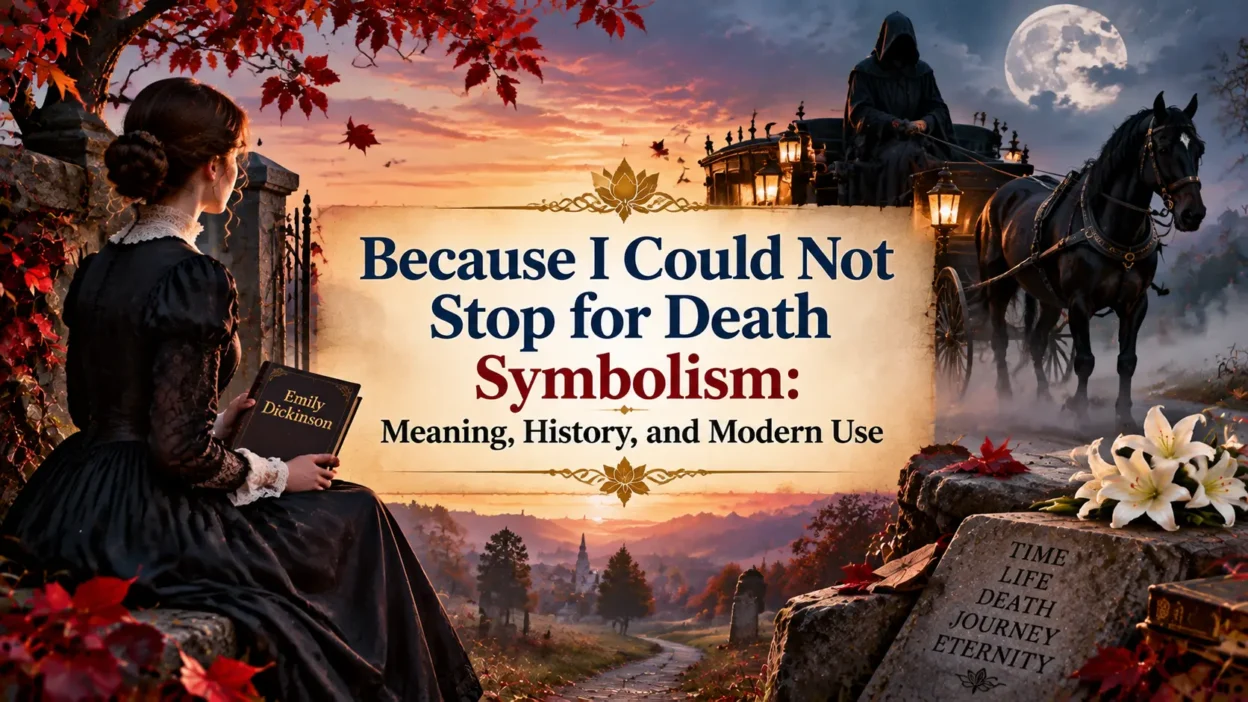
Emily Dickinson’s poem “Because I Could Not Stop for Death” presents death not as a frightening force but as a calm, unavoidable companion. The poem’s symbolism explores ideas of mortality, time, acceptance, and the transition between life and death. Because i could not stop for death symbolism remains widely studied because it offers a different way of thinking about an experience every person eventually faces.
Written in the 19th century, the poem uses simple images — a carriage ride, a sunset, a schoolhouse, fields, and a grave — to represent a person’s journey through existence. Instead of showing death as an enemy, Dickinson creates a scene where death arrives politely and guides the speaker toward a new understanding of life’s final stage.
In modern American culture, the poem continues to influence conversations about grief, aging, spirituality, and the meaning people attach to death. Its symbolism appears in literature classes, memorial discussions, artistic interpretations, and personal reflections on mortality.
Quick Answer
Because I Could Not Stop for Death symbolism commonly represents acceptance of mortality, the passage of time, and the peaceful transition from life to death. In literary and cultural interpretations, it also reflects changing views of death, memory, eternity, and the human relationship with the unknown.
TL;DR
- Death appears as a calm guide rather than a frightening figure.
- The carriage ride symbolizes life’s journey toward eternity.
- Childhood, maturity, and aging appear through passing scenes.
- The poem reflects 19th-century views of mortality.
- Americans often connect it with grief and remembrance.
What Is the Symbolism Behind “Because I Could Not Stop for Death”?
Emily Dickinson’s poem uses ordinary objects and events to represent large human experiences. The central symbol is the carriage ride with Death, where the speaker leaves daily life behind and moves toward a final destination.
The poem suggests that death is not always a sudden interruption. Instead, it can be understood as part of a natural human process. The slow movement of the carriage creates a feeling of reflection rather than panic.
Several symbols work together:
| Symbol | Meaning in the USA | Common Associations | Notes |
|---|---|---|---|
| Carriage ride | Life’s final journey | Transition, movement, change | Represents movement from life toward eternity |
| Death as a gentleman | Acceptance of mortality | Calmness, respect, dignity | Challenges traditional fear of death |
| Setting sun | End of life stage | Aging, completion | Marks the closing of a human day |
| Schoolhouse and fields | Stages of life | Childhood, adulthood, growth | Shows time passing |
| Grave as a house | Rest and permanence | Memory, eternity | Changes the idea of death from fear to stillness |
The poem’s symbolism is not a simple celebration of death. Instead, it explores how humans mentally and emotionally approach something unavoidable.
Emily Dickinson’s View of Death and Its Literary Background
Emily Dickinson wrote during the 19th century, a period when death was a more visible part of everyday life. Illness, shorter life expectancy, and strong religious traditions shaped how many people thought about mortality.
Dickinson often examined death, faith, nature, and isolation in her poetry. Rather than presenting fixed answers, she created poems that explore uncertainty and personal experience.
“Because I Could Not Stop for Death” reflects this style. Death is not shown as a monster or punishment. Instead, Dickinson transforms Death into a polite figure who patiently waits for the speaker.
This approach was unusual because many traditional writings portrayed death as something frightening. Dickinson’s poem introduced a quieter interpretation: death as a moment of change rather than only an ending.
The Carriage Ride as a Symbol of Life’s Final Journey
The carriage is one of the most important symbols in the poem. It represents movement from one state of existence to another.
The speaker rides with Death and Immortality, creating a symbolic journey beyond ordinary human time. The carriage does not rush. It moves slowly, allowing the speaker to observe scenes along the way.
This slow pace represents reflection. Human life often feels fast while people are living it, but the poem presents death as a moment when the entire journey can be viewed from a distance.
In American interpretations, the carriage is often connected with ideas of:
- personal transformation
- spiritual transition
- acceptance of aging
- remembering life experiences
The symbol also changes the usual relationship between humans and death. Instead of running away from death, the speaker travels alongside it.
Why Death Appears as a Gentleman in the Poem
One of Dickinson’s most memorable choices is portraying Death as a courteous gentleman. He does not threaten the speaker or force the journey.
This personification creates a different emotional response. Death becomes something familiar and composed rather than violent.
The gentleman image reflects cultural ideas from Dickinson’s time, when polite manners and formal social behavior were important parts of public life. By giving Death these qualities, Dickinson removes some of the fear surrounding him.
For modern American readers, this image often suggests:
- dignity during the end of life
- peaceful acceptance
- respectful remembrance
- emotional preparation
However, the poem does not claim that death is always easy. Instead, it presents one possible way humans imagine and process it.
The Meaning of Time in “Because I Could Not Stop for Death”
Time is another major symbol in the poem. The speaker moves through scenes that represent different stages of human existence.
The carriage passes:
- a school where children play
- fields of grain
- the setting sun
These images are often interpreted as symbols of childhood, adulthood, and old age.
The poem compresses an entire lifetime into a short journey. It shows that human experiences are connected, moving from one stage to another until life reaches its conclusion.
This idea remains meaningful in American culture because many people use life-stage symbolism when discussing:
- childhood memories
- retirement
- aging
- family history
- personal legacy
The poem reminds readers that time is not only measured by clocks. It is also measured by experiences.
The Symbolism of the Setting Sun and the End of Life
The setting sun represents completion and transition. Just as the day moves toward night, human life moves toward its final stage.
Sunset symbolism appears across many cultures because it naturally represents endings and change. In Dickinson’s poem, the sunset does not create terror. It creates a quiet atmosphere.
The image suggests that endings can be part of a natural cycle.
In modern American art and personal expression, sunsets are often used to represent:
- remembrance
- peaceful endings
- reflection
- emotional closure
The poem uses this familiar natural image to make death feel connected to the rhythms of the world.
How “Because I Could Not Stop for Death” Is Understood in the United States Today
In the United States, the poem is mainly recognized as a major work of American literature, but its symbolism extends beyond classrooms.
Many readers connect it with modern conversations about:
- grief and mourning
- hospice and end-of-life care
- spirituality
- personal beliefs about what happens after death
The poem’s approach is especially meaningful because American attitudes toward death are diverse. Some people interpret it through religious beliefs, while others view it as a philosophical reflection on human existence.
Unlike some traditional funeral imagery that focuses on sadness, Dickinson’s symbols emphasize acceptance and contemplation.
The poem is also frequently discussed during literary studies because it provides a way to examine how language can transform difficult subjects into thoughtful reflection.
Cross-Cultural Interpretations of Death Symbolism
Although Emily Dickinson wrote within a specific American and Christian-influenced cultural setting, the themes in “Because I Could Not Stop for Death” connect with ideas found across many societies.
Different cultures have developed their own ways of understanding death, transition, and remembrance. Some traditions view death as a passage into another existence, while others emphasize cycles of nature, family memory, or spiritual transformation.
For example, many religious traditions describe death as a transition rather than a complete ending. Christianity often connects death with ideas of resurrection and eternal life, while some Eastern philosophies describe existence through cycles of change and renewal.
The poem does not directly represent one religious belief. Instead, it leaves room for different interpretations because it focuses on the human experience of facing mortality.
This openness helps explain why readers from different backgrounds continue to find meaning in Dickinson’s work.
The Emotional and Psychological Meaning of the Poem
Death is one of the most difficult subjects for humans to discuss because it involves uncertainty and loss. Dickinson’s symbolism offers a way to approach the topic without relying only on fear.
The calm personality given to Death may represent the human mind’s attempt to create order around something unknown. By imagining Death as a companion, the poem changes the emotional relationship people have with mortality.
Psychologically, the poem explores several common human experiences:
- accepting that life has limits
- reflecting on personal memories
- finding meaning in change
- understanding aging as part of existence
The journey structure also reflects how people often look back on their lives. Near major life transitions, individuals frequently review past experiences, relationships, and accomplishments.
In this way, the poem is not only about dying. It is also about how people understand the entire journey of being alive.
Why the Poem Appears in Mourning and Remembrance Discussions
Death-related literature often becomes meaningful during times of loss because it gives people language for emotions that are difficult to express.
“Because I Could Not Stop for Death” is sometimes discussed in connection with mourning because it presents death with calmness and dignity. The poem does not focus on physical suffering or despair. Instead, it focuses on transition and reflection.
In American culture, people often use poetry, music, photographs, and personal rituals to remember loved ones. Dickinson’s work fits into this tradition because it encourages people to think about life’s meaning rather than only the sadness of loss.
However, interpretations vary. Some readers find comfort in the poem’s peaceful tone, while others see its portrayal of death as unsettling because the speaker appears unable to return.
Modern Use in Art, Education, and Personal Expression
The symbolism of Dickinson’s poem continues to appear in modern creative spaces.
In education, the poem remains widely taught because it demonstrates how ordinary images can represent complex ideas. Students often analyze the carriage, Death’s personality, and the changing scenes as examples of literary symbolism.
In art and personal expression, themes connected to the poem may appear through:
- illustrations of carriages
- sunset imagery
- clocks and hourglasses
- cemetery landscapes
- nature scenes representing cycles of life
Some people are drawn to these symbols because they communicate acceptance and reflection rather than simple sadness.
The poem’s ideas also appear indirectly in movies, novels, and discussions about mortality. Modern creators often explore similar themes: the passage of time, memory, and the relationship between humans and death.
Tattoo Interpretations Inspired by Death Symbolism
Death-related tattoos are often misunderstood because they do not always represent negativity. Many people choose mortality symbols to express personal experiences, remembrance, or philosophical beliefs.
Inspired by ideas found in Dickinson’s poem, possible symbolic elements include:
| Tattoo Element | Common Interpretation |
|---|---|
| Carriage | Life journey and transition |
| Sunset | Completion and change |
| Clock | Limited time and awareness of life |
| Flowers near graves | Memory and renewal |
| Skeleton imagery | Mortality and acceptance |
A person choosing a death-related tattoo may be honoring someone who passed away, recognizing a major life change, or expressing acceptance of human limitations.
The meaning depends heavily on personal context. Symbols associated with death can represent grief, but they can also represent appreciation for life.
Common Misunderstandings About the Poem’s Symbolism
Because the poem discusses death directly, some readers assume it presents death as completely peaceful or desirable. That interpretation oversimplifies Dickinson’s work.
The poem creates a calm atmosphere, but it also contains uncertainty. The speaker leaves behind familiar life and enters an unknown future.
Another misunderstanding is that Death represents only a physical ending. Many literary scholars interpret the journey more broadly, seeing it as a reflection on transformation, time, and human awareness.
The poem’s strength comes from its complexity. It does not provide one simple message. Instead, it allows readers to consider their own beliefs about mortality.
The Evolution of Death Symbolism From Dickinson’s Era to Today
When Dickinson wrote the poem, death was often discussed through religious language, family rituals, and moral reflection. Public mourning practices were also more visible in American society.
Over time, attitudes toward death changed. Modern Americans often discuss death through medical, psychological, personal, and philosophical perspectives.
The poem’s symbolism remains relevant because it does not depend on one historical moment. Its focus on aging, memory, and change continues to connect with modern concerns.
Today, readers may interpret the carriage ride as:
- a spiritual journey
- a metaphor for aging
- a reflection on personal identity
- a meditation on time itself
The meaning has expanded because each generation brings new experiences to the poem.
Death Symbolism in American Popular Culture
American popular culture frequently explores similar themes found in Dickinson’s poem. Movies, books, songs, and visual art often portray death as a transition rather than only a tragedy.
Common American representations include:
- roads representing life journeys
- seasons representing change
- stars representing remembrance
- gardens representing renewal
- photographs representing memory
These symbols show that people continue searching for ways to discuss mortality in understandable and emotional forms.
Dickinson’s poem remains influential because it presents death through everyday imagery rather than dramatic scenes.
The Difference Between Fear of Death and Acceptance of Death
One of the central ideas in the poem is the difference between fearing death and accepting its existence.
Fear often comes from uncertainty. People may worry about what happens after life ends or how separation affects those left behind.
Acceptance does not necessarily mean happiness about death. Instead, it can mean recognizing mortality as a natural part of existence.
Dickinson’s symbolism explores this middle ground. The speaker does not celebrate death, but she also does not fight against it.
This balanced approach explains why the poem continues to be meaningful for readers exploring questions about aging, loss, and purpose.
Frequently Asked Questions About Because I Could Not Stop for Death Symbolism
What does “Because I Could Not Stop for Death” symbolize?
The poem symbolizes the human journey from life toward death, focusing on acceptance, time, and transition. It presents death as a calm companion rather than a frightening enemy.
Why does Emily Dickinson portray Death as a gentleman?
Dickinson presents Death as a gentleman to create a more peaceful and reflective image of mortality. This personification changes death from something threatening into something that accompanies the speaker.
What does the carriage symbolize in the poem?
The carriage symbolizes a journey from earthly life into another state of existence. It represents movement through time and the stages of human experience.
Is the poem’s message about death positive or negative?
The poem does not present death as simply positive or negative. Instead, it explores death as an unavoidable part of life and invites readers to reflect on their own understanding of mortality.
What does the sunset symbolize in “Because I Could Not Stop for Death”?
The sunset symbolizes the ending of life and the transition from one stage to another. It reflects completion, change, and the closing of a human journey.
Why is “Because I Could Not Stop for Death” still important today?
The poem remains important because people continue to ask questions about aging, loss, memory, and what death means. Its symbols allow different generations to interpret mortality in personal ways.
Does the poem connect to religious symbolism?
Yes, some readers connect the poem with ideas of eternity and spiritual transition. However, Dickinson’s imagery is open to multiple interpretations and does not depend on one specific religious view.
Conclusion
“Because I Could Not Stop for Death symbolism” represents a thoughtful exploration of mortality, time, and the human experience of transition. Through images of a carriage, a journey, and changing landscapes, Emily Dickinson presents death as something that can be examined rather than simply feared.
The poem continues to matter because its symbols connect with universal experiences: growing older, remembering the past, facing change, and considering what life means. In modern American culture, these ideas appear in literature, art, memorial practices, and personal reflections.
Rather than giving a single answer about death, Dickinson’s work creates space for conversation. Its lasting importance comes from its ability to make readers consider how they understand life’s final journey.