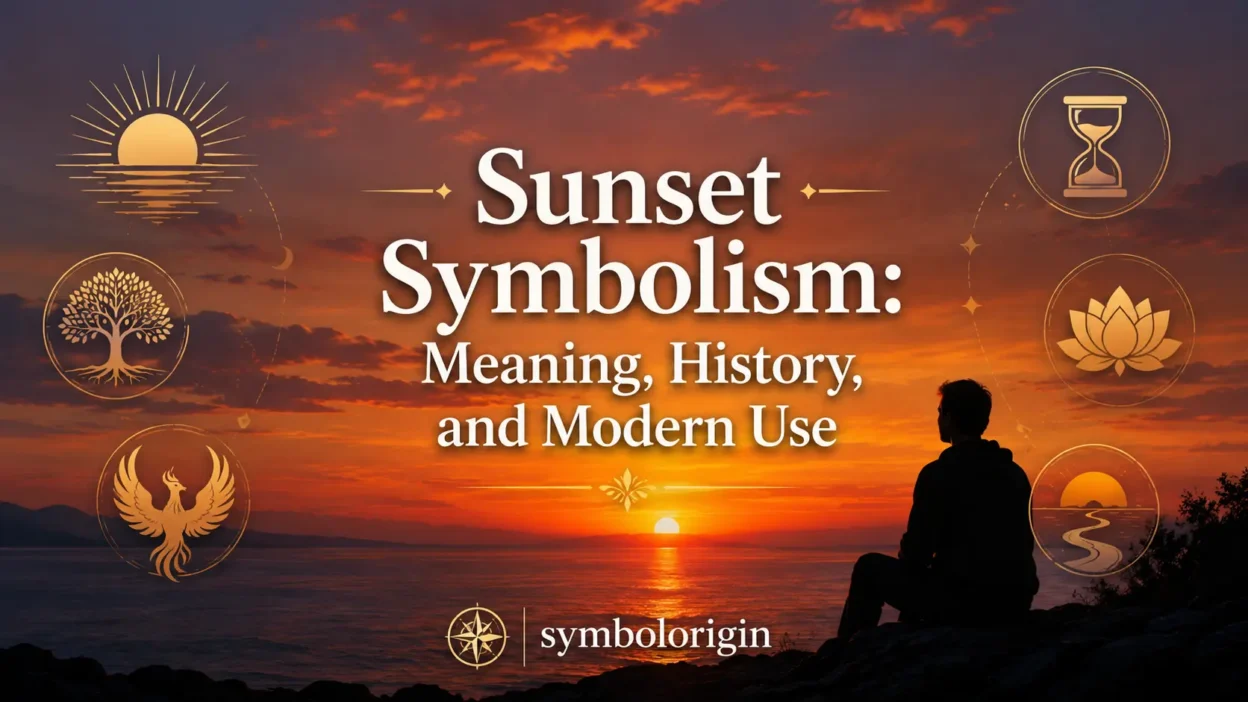
Sunset symbolism usually begins with a simple observation: daylight is ending, but time itself is continuing. Because sunset occupies the boundary between day and night, people commonly connect it with completion, transition, reflection, mortality, and the possibility of renewal.
The image matters because it can hold several emotions at once. A glowing horizon may feel peaceful and romantic, yet the disappearing sun can also suggest separation, aging, or loss. The meaning depends on the setting, the person viewing it, and what is happening in that person’s life.
In modern American culture, sunsets appear in vacation photographs, memorial artwork, tattoos, wedding designs, films, advertisements, and social media posts. Sometimes they communicate nothing more complicated than appreciation for a beautiful evening. In more personal contexts, however, they often mark a turning point or preserve the memory of someone, somewhere, or something that has ended.
Quick Answer
Sunset symbolism commonly represents endings, transition, peace, reflection, and hope for another beginning in modern American culture. Historically, sunset has also marked sacred time, the passage toward death or the afterlife, and the recurring cycle of disappearance and return.
TL;DR
- Sunsets commonly represent endings, transition, peace, and renewal.
- Fading daylight may suggest mortality without necessarily implying hopelessness.
- Ancient Egyptians connected sunset with death and nightly regeneration.
- Religious traditions often treat dusk as a sacred transition.
- American art uses evening light for reflection, hope, and western identity.
- Tattoos and decor personalize sunsets around love, memory, or change.
What a Sunset Looks Like and Why It Becomes Symbolic
A sunset occurs when the sun appears to move below the western horizon as Earth rotates. The event is followed by twilight, when sunlight still illuminates part of the atmosphere even though the sun is no longer visible.
Red, orange, pink, and yellow frequently dominate the sky because sunlight travels through a longer section of the atmosphere near the horizon. Much of the shorter-wavelength blue light is scattered away, allowing warmer colors to reach the observer more directly. Dust, water droplets, smoke, and other airborne particles can intensify or alter the display.
Its physical structure naturally encourages symbolic interpretation. Sunset is not a fixed object; it is a visible process of change. Light fades, colors shift, familiar surroundings become silhouettes, and the boundary between day and night briefly appears uncertain.
That temporary quality makes sunset especially suitable for representing experiences that cannot be held in place. Childhood, relationships, careers, seasons, and human life all move through stages. The evening sky gives those abstract changes a recognizable visual form.
Core Meanings in American Culture
In the United States, the most common interpretation is the end of a chapter. A sunset may mark graduation, retirement, the conclusion of a relationship, the final day of a trip, or the close of a difficult period.
A second major meaning is transition. The sun disappears gradually rather than stopping suddenly, so the image often suggests movement between identities, responsibilities, or emotional states.
Sunsets also communicate peace and release. The workday is ending, activity slows, and people often pause to watch the changing sky. This association makes the image appropriate for spaces or designs intended to create calm.
At the same time, sunset can symbolize hope. Night follows, but the daily cycle implies that daylight will return. The symbol therefore differs from an image of permanent darkness: it can acknowledge an ending while leaving room for continuation.
| Context | Common U.S. Meaning | Typical Associations | Important Note |
|---|---|---|---|
| Personal change | Transition | Growth, relocation, graduation | Usually suggests movement between life stages |
| Memorial use | Farewell | Death, remembrance, continuing love | Can be comforting or sorrowful |
| Romantic imagery | Intimacy | Shared time, warmth, commitment | Meaning depends on the relationship context |
| Travel and leisure | Freedom | Rest, escape, appreciation | Often more experiential than spiritual |
| Art and film | Closure | Final scenes, aging, completed journeys | May be hopeful, tragic, or ambiguous |
| Wellness spaces | Calm | Reflection, slowing down, acceptance | Usually emphasizes emotional balance |
Endings, Closure, Transition, and Renewal
Sunset is one of the clearest natural images of closure. It shows something visibly reaching its conclusion, which is why phrases such as “the sunset of life” or “sunset years” refer to later adulthood. The comparison does not always imply weakness or decline. It can also emphasize maturity, accumulated experience, and the completion of a long journey.
In stories and films, a final sunset may signal that a conflict has ended. A character walking toward the horizon can represent retirement from struggle, departure from an old identity, or acceptance of a decision that cannot be reversed.
The same image can communicate transition rather than finality. Twilight exists between clearly defined conditions: it is no longer daytime, but it is not yet fully night. Someone experiencing a career change, divorce, move, religious change, or period of uncertainty may therefore identify with the image.
Renewal enters the meaning through repetition. Sunset is temporary, and morning is expected to follow. For this reason, the symbol can express the idea that rest, uncertainty, or grief is part of a cycle rather than the final condition.
This balance explains why sunset images frequently appear in recovery spaces and personal-growth designs. They permit a person to honor what has ended without pretending that the ending was easy.
Peace, Awe, and Reflection
Watching the sun go down often interrupts ordinary routines. People stop walking, turn away from their phones, gather at overlooks, or sit quietly near a window. The event becomes a natural pause between the demands of the day and the relative stillness of night.
Psychological research describes awe as a response to experiences that feel vast enough to challenge a person’s usual way of understanding the world. Natural scenes can produce this reaction, sometimes reducing self-focused attention and increasing feelings of connection or perspective. Research does not establish one universal response to every sunset, but it helps explain why expansive evening skies can feel emotionally significant.
Reflection is another common association. The day’s visible ending invites people to review what happened, what remains unresolved, and what should be carried into tomorrow. This is why sunset photographs are often paired with journal entries, retirement messages, recovery milestones, or thoughts about personal change.
The experience can also produce mixed emotions. A person may feel grateful for the view while becoming aware that it will soon disappear. That combination of beauty and impermanence gives sunset its familiar bittersweet quality.
Love, Memory, Grief, and Mortality
Sunsets have become closely associated with romance because they create a limited period of warm light and visual privacy. Couples watch them on beaches, at scenic overlooks, during proposals, and while traveling. The symbolism centers on shared presence: two people pause together while time and light visibly pass.
The image can represent mature love as well as new attraction. Unlike midday sunlight, which is direct and energetic, evening light is softer and less exposed. In anniversary art or wedding decor, it may suggest lasting companionship, emotional warmth, and the decision to remain together through changing stages of life.
In memorial settings, a disappearing sun can stand for death. The association is direct but not necessarily bleak. Warm color remains after the solar disk is gone, which can suggest that a person’s influence continues after physical absence.
A sunset memorial tattoo may preserve the date of a death, the outline of a meaningful landscape, or the memory of evenings shared with the deceased. Similar images appear on funeral programs, condolence cards, urns, and remembrance plaques.
Still, sunset should not automatically be read as a death symbol. In a vacation photograph, it may simply record a place. In romantic art, it may signify closeness. Context determines whether the fading light represents mourning, completion, rest, or appreciation.
Ancient Egyptian Ideas of Death and Solar Return
Ancient Egyptian religion provides one of the clearest historical examples of sunset as part of a death-and-renewal cycle. The sun god Re, also written Ra, was imagined traveling across the daytime sky in a solar boat. At sunset, he entered the underworld and passed through the dangerous hours of night.
This descent represented death, but it did not mean permanent extinction. Re confronted forces that threatened cosmic order, joined with Osiris in the underworld, and emerged renewed with the morning sun. The setting sun therefore expressed both mortality and regeneration.
The west carried a related funerary meaning because it was the direction in which the sun disappeared. The Egyptian underworld was imagined as being entered through the west, and burial grounds were often connected conceptually with that western passage.
This tradition helps explain why later readers often interpret sunset as a symbol of death followed by rebirth. However, that interpretation should not be presented as the single origin of every modern sunset meaning. Many societies developed their own ideas from observing the same daily event.
Dusk in Jewish, Christian, and Islamic Traditions
Sunset has practical religious importance in several traditions, although its meaning differs among them.
In Jewish practice, the religious day runs from evening to evening rather than beginning at midnight. Shabbat and major holidays are welcomed around sunset and conclude after nightfall the following day. Dusk therefore marks entry into sacred time, separation from ordinary labor, and the beginning of communal or family observance.
Christian traditions have long associated evening with prayer, gratitude, self-examination, and trust during approaching darkness. Vespers, or Evening Prayer, is traditionally observed near sunset. Its imagery connects the fading physical light with thanksgiving, the end of daily labor, and continued reliance on divine light.
In Islam, sunset marks the beginning of the Maghrib prayer period. During Ramadan, it also marks the end of the day’s fast. The moment therefore carries meanings of worship, discipline, gratitude, community, and relief after restraint.
These traditions demonstrate why dusk should not be reduced to a generic “spiritual portal.” It functions through specific calendars, prayers, obligations, and communal practices. Respectful interpretation preserves those distinctions.
Sunset in American Art and the Myth of the West
American painters have repeatedly used evening light to express emotion, national identity, religious feeling, and changing ideas about the landscape. Nineteenth-century artists produced both grand western panoramas and quieter local scenes in which sunset transformed ordinary fields, rivers, farms, and marshes.
Edward Mitchell Bannister’s evening landscapes offered intimate views of the American environment rather than only monumental mountains and canyons. Other painters used changing light to emphasize nature as a place of contemplation or divine creation.
During the Civil War era, one lyrical western sunset by Albert Bierstadt was interpreted as a sign of hope for the country’s future. Such paintings could make western territory appear open, peaceful, and destined for national development.
That imagery requires historical caution. Romantic western scenes sometimes minimized Native displacement, environmental destruction, racial exclusion, and the violence of territorial expansion. Contemporary exhibitions and artists have challenged the idea that there is one heroic story of “the West,” replacing it with multiple regional and cultural perspectives.
Modern Americans still connect sunsets with the West through cowboy films, desert photography, national parks, highway travel, and coastal California imagery. The association may suggest freedom and possibility, but it can also repeat an idealized frontier narrative unless the historical context is acknowledged.
Tattoos, Jewelry, Decor, and Personal Style
A sunset tattoo often marks a personal transition. Common designs include the sun touching an ocean horizon, a mountain silhouette, desert plants, birds, waves, or a road leading toward the fading light.
Minimalist designs usually emphasize calm, simplicity, or acceptance. Larger colored tattoos may preserve a specific place or recreate the atmosphere of an important memory. Dates, initials, coordinates, or short phrases can turn a general landscape into a memorial.
When paired with an ocean, the image may suggest emotional depth, travel, or the meeting of two immense forces. Mountains can add endurance and accomplishment. Flying birds may shift the meaning toward freedom, departure, or release.
Sunset jewelry tends to communicate warmth, optimism, or affection rather than death. Pendants and rings often use semicircles, horizon lines, amber stones, or graduated colors. Their small scale makes them suitable as reminders of a journey, relationship, home, or personal promise.
In interior design, sunset palettes create warmth through terracotta, coral, gold, dusty pink, and muted purple. Beach homes, meditation rooms, bedrooms, and travel-inspired spaces commonly use these colors to suggest rest and openness.
Digital Culture, Photography, and Pop Culture
Digital culture has made the sunset one of the most frequently shared natural scenes. It is accessible, changes every day, and can be photographed without specialized equipment. Posting one may communicate gratitude, romance, travel, loneliness, or simply a wish to share a beautiful moment.
Because the image is so familiar, captions often determine its intended meaning. A photograph paired with a farewell message suggests closure. The same photograph beside an engagement announcement communicates intimacy and future commitment.
Films and television frequently place sunsets near endings. A wide shot of the horizon can slow the narrative, distance viewers from immediate action, and indicate that a character’s journey has reached a stopping point. Westerns famously use riders disappearing into evening light, turning sunset into a visual form of departure.
Advertising uses the same emotional shorthand. Travel companies present sunsets as freedom from work, while wellness brands associate them with calm and balance. Retirement communities may use evening light to suggest comfort and fulfillment, though careless campaigns can reinforce the idea that aging is only a period of decline.
The popularity of sunset content can make it feel generic. A meaningful personal photograph becomes more distinctive when it includes a recognizable place, story, person, or reason for being remembered.
How Color and Composition Change the Meaning
A sunset’s meaning is shaped not only by the disappearing sun but also by its colors and surrounding elements.
Orange and gold usually create warmth, vitality, celebration, and affection. These colors work well in romantic, travel, or achievement-related imagery.
Soft pink can suggest tenderness, nostalgia, gentleness, or idealized romance. It often appears in wedding graphics, feminine fashion, and calming decor.
Red intensifies the image. Depending on context, it may communicate passion, courage, danger, anger, sacrifice, or dramatic finality.
Purple and deep blue move the scene toward mystery, introspection, spirituality, or solitude. They emphasize the approach of night rather than the remaining warmth of day.
Silhouettes also affect interpretation. A lone figure may suggest independence or loneliness. A couple implies shared experience, while a family can represent belonging and memory. Bare trees may create a mournful tone; flowers or birds can shift the image toward beauty and continuation.
A sun partly hidden by clouds often suggests uncertainty. A clear, open horizon tends to communicate acceptance, resolution, or possibility.
How the Meaning Evolved—and Where Interpretations Go Wrong
The earliest meanings of sunset were closely connected with timekeeping, agriculture, ritual schedules, cosmology, and the visible disappearance of the sun. In some religious systems, it marked the sun god’s descent or the entrance into sacred evening. In others, it established the beginning of a new day or an appointed period of prayer.
Romantic-era artists later emphasized nature as a source of intense feeling, individuality, melancholy, and awe. Dramatic skies and evening landscapes became visual tools for expressing inner states rather than merely recording weather or geography.
Modern photography expanded the symbol again. Sunsets became personal records of vacations, relationships, milestones, and ordinary evenings. Digital platforms then turned them into widely shared emotional shorthand.
Several misunderstandings remain common. One is the claim that every culture interprets sunset as death and rebirth. The association is important in some traditions, but cultural meanings are not interchangeable.
Another mistake is assigning one universal “Native American meaning” to sunset. Indigenous nations have distinct languages, histories, sacred narratives, and relationships with place. A claim that treats hundreds of communities as one tradition is usually unreliable and disrespectful.
A different problem involves spectacular red skies. Smoke, dust, pollution, and airborne particles can produce striking colors. A beautiful photograph may therefore document wildfire smoke or poor air quality rather than a harmless natural display.
Finally, not every sunset must carry a hidden message. Sometimes it represents a pleasant evening, a successful photograph, or appreciation for color. Symbolic interpretation is most useful when it considers the image’s actual context rather than forcing a predetermined meaning onto it.
FAQs
Is a sunset a positive or negative symbol?
It can be either, but modern American interpretations are often positive or bittersweet. The image may represent peace, achievement, hope, or renewal while still acknowledging loss, aging, or separation.
What does a sunset tattoo mean?
A sunset tattoo commonly represents a completed chapter, personal transformation, freedom, remembrance, or emotional peace. Additional elements such as waves, mountains, dates, or birds usually reveal the more specific meaning.
Does sunset symbolize death?
Sunset can symbolize death because daylight disappears and night begins. In memorial art, however, the remaining afterglow and expectation of sunrise can also suggest continuing influence, spiritual hope, or love that survives physical absence.
What does a sunset mean in love?
In romantic settings, it often represents intimacy, shared time, warmth, and appreciation for a temporary moment. It may also symbolize a mature relationship that remains meaningful as life changes.
Is sunset connected with religion?
Yes, but the connection differs among traditions. It may begin a Jewish sacred day, mark Christian evening prayer, signal Islamic Maghrib prayer, or represent the sun’s nightly journey in ancient Egyptian belief.
What does dreaming about a sunset mean?
There is no scientifically established universal interpretation. A dream involving sunset may reflect the dreamer’s feelings about closure, aging, change, rest, or uncertainty, but the emotional tone and personal circumstances matter more than a fixed dream dictionary definition.
What does a red sunset symbolize?
A red sunset may suggest passion, courage, danger, sacrifice, or dramatic change in art and design. Physically, intense red color can also result from atmospheric dust, smoke, or other particles, so its appearance is not automatically a spiritual sign.
Conclusion
Sunset symbolism brings together several ideas that might otherwise appear contradictory. It represents an ending, yet it belongs to a repeating cycle. It can express grief while offering comfort, or create peace while reminding viewers that time cannot be stopped.
Its meaning is strongest when the context remains visible. A memorial sunset is not the same as a vacation photograph, and a religious observance at dusk is not interchangeable with a decorative design. Each use gives the fading light a different purpose.
A sunset does not promise that every ending will be easy. It offers a more grounded reminder: change is visible, beauty can exist during departure, and the end of one period does not prevent another from beginning.