Meta description:
Fairy symbolism combines wonder with uncertainty. In modern American culture, fairies often represent imagination, freedom, nature, and personal transformation. Yet the cheerful, winged figure seen in children’s books is only one version of a much older supernatural being.
Earlier European traditions did not always portray fairies as tiny, harmless helpers. They could reward kindness, punish disrespect, mislead travelers, interfere with households, or draw people into unfamiliar worlds. Their uncertain nature made them symbols of forces that humans could encounter but not fully control.
That tension explains their lasting appeal. A fairy can suggest childhood wonder and creative possibility, but it can also represent temptation, secrecy, danger, or the unpredictable side of nature.
Quick Answer
Fairy symbolism commonly represents imagination, wonder, freedom, nature, and transformation in modern American culture. Historically, fairies also symbolized supernatural danger, uncertain bargains, hidden realms, and the need to respect forces beyond human control.
TL;DR
- Fairies commonly symbolize wonder, creativity, freedom, and personal transformation.
- Older folklore often portrayed them as unpredictable or dangerous beings.
- Winged miniature fairies became popular largely through Victorian art.
- Americans usually associate fairies with childhood, fantasy, and nature.
- Modern designs also use fairies to express identity and independence.
- Traditional fairy lore should not be reduced to harmless decoration.
What a Fairy Looks Like—and What the Image Communicates
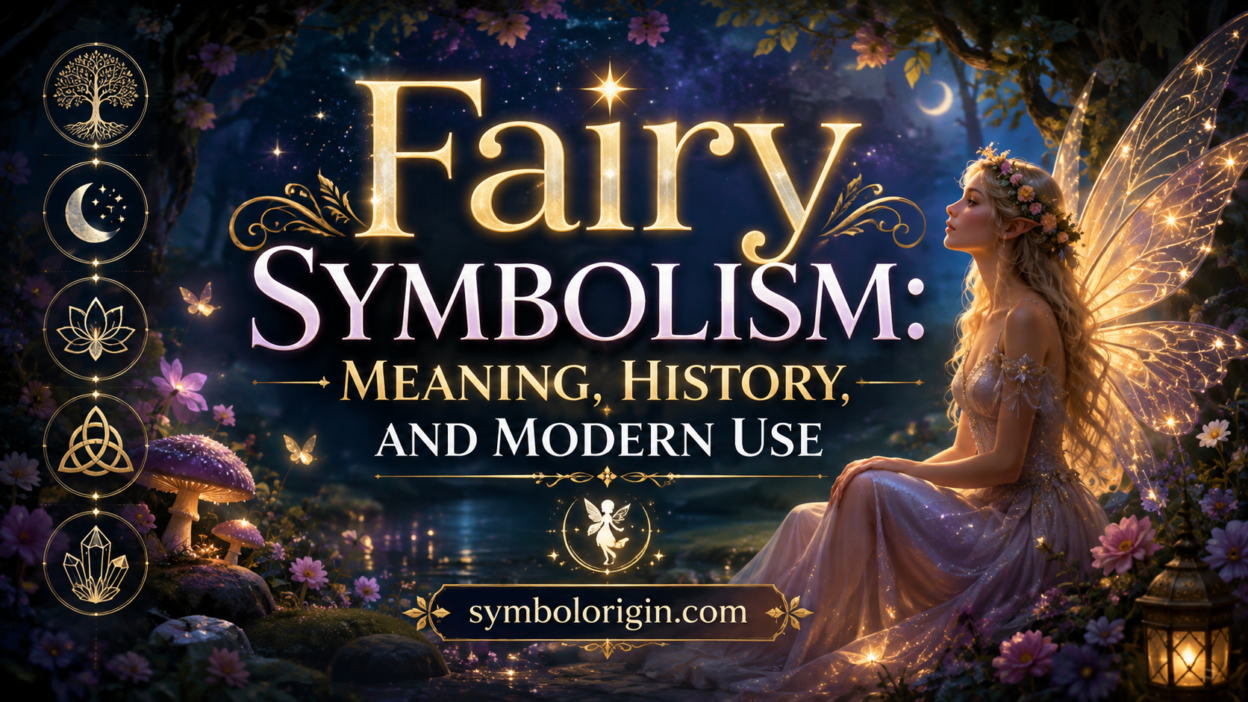
The familiar American fairy usually appears as a small humanlike figure with butterfly or dragonfly wings. It may wear clothing made from petals, leaves, moss, or translucent fabric. Common accessories include a wand, crown, lantern, mushroom, or trail of sparkling dust.
This appearance immediately communicates lightness, mobility, and separation from ordinary life. Wings suggest freedom and access to places humans cannot reach. Small size can represent secrecy, overlooked beauty, or a world hidden within the natural environment.
Traditional folklore, however, does not provide one standard appearance. Fairies may be human-sized or tiny, beautiful or frightening, solitary or organized into communities. Some look youthful, while others appear ancient. A few behave like household spirits, and others resemble rulers, warriors, tricksters, or threatening strangers.
A fairy is also different from a fairy-tale character. A fairy tale is a type of story and does not need to contain fairies. A fairy is a supernatural figure whose meaning comes from folklore, literature, art, and popular culture.
Fairy Meanings at a Glance
| Context | Common Meaning in the United States | Typical Associations | Important Note |
|---|---|---|---|
| Children’s stories | Wonder and helpful magic | Wishes, kindness, imagination | Usually presents a softened version |
| Nature imagery | Connection with the living world | Flowers, forests, insects, moonlight | Can also imply nature’s unpredictability |
| Tattoos and jewelry | Freedom and transformation | Wings, stars, vines, mushrooms | Meaning depends on pose and design |
| Fantasy fiction | Otherworldly power | Hidden kingdoms, bargains, enchantment | Modern fairies may be dangerous |
| Home and garden decor | Whimsy and escape | Fairy doors, miniature houses, lights | Often designed for playful storytelling |
| Older folklore | Risk and uncertain encounters | Changelings, time loss, gifts, warnings | Fairies were not automatically benevolent |
Wonder, Imagination, and the Possibility of More
The most common positive meaning of a fairy is wonder. Fairies suggest that ordinary places may contain more than people immediately notice. A garden, forest path, old tree, or patch of wildflowers becomes a possible entrance to another way of seeing the world.
For children, the fairy often represents imagination without strict limits. It allows invisible companions, wishes, transformations, and miniature societies to feel temporarily possible. Adults may use the same image to preserve curiosity or resist a life defined entirely by practical concerns.
This symbolism does not require literal belief. Someone can appreciate fairies as reminders to notice beauty, experiment creatively, or leave room for surprise. In that sense, the fairy represents imaginative openness rather than proof of a supernatural world.
The image may also express hope. A fairy arriving at a difficult moment suggests assistance from an unexpected source. That meaning appears in stories involving fairy godmothers, magical gifts, and sudden reversals of fortune.
Nature, Hidden Places, and the Wild Edge
Fairies are frequently associated with forests, hills, streams, gardens, mushrooms, flowers, and moonlit clearings. This connection makes them symbols of the natural world, especially its concealed or uncontrollable aspects.
In cheerful modern art, a flower fairy may represent harmony with plants, environmental care, or delight in seasonal change. Garden figures and miniature fairy houses encourage people to imagine nature as inhabited rather than empty.
Older folklore presents a less comfortable relationship. The landscape could contain boundaries that people were expected to respect. Hills, ancient trees, unusual stones, and rings in the grass might mark places where supernatural beings gathered or passed.
The fairy therefore represents both affection for nature and caution before it. A forest can provide beauty and shelter, but it can also disorient anyone who enters carelessly. This double meaning separates traditional fairy imagery from simple environmental decoration.
Transformation, Thresholds, and Personal Change
Fairies often appear at boundaries: dusk and dawn, childhood and adulthood, wilderness and settlement, the human world and an unseen realm. Because they inhabit these thresholds, they commonly symbolize transition.
A fairy transformation may involve a new appearance, new ability, altered social position, or changed understanding. The transformation can be liberating, but it may also carry conditions. A gift can create responsibility, and a wish can produce consequences that the recipient failed to anticipate.
In personal symbolism, fairy wings often represent becoming less restricted by an earlier identity. A person may choose the image after leaving a difficult relationship, accepting a creative side, recovering confidence, or entering a new stage of life.
Fairies can also symbolize adaptability. They move between worlds and resist ordinary categories. This makes them appealing to people who feel that their identity cannot be explained through one fixed role.
Mischief, Bargains, and the Older Warning
Traditional fairies were not simply miniature angels. They could help humans, but they might also deceive them, steal from them, demand payment, or punish rude behavior. Their morality often followed rules different from human expectations.
This older image gives the fairy a warning function. It represents the attraction of something beautiful that may not be safe. An invitation, gift, dance, meal, or promise can appear generous while creating an obligation.
Fairy bargains symbolize the importance of reading conditions carefully. In modern fantasy, characters who accept supernatural favors often discover that every word matters. This reflects a longstanding association between fairies, promises, names, hospitality, and exchanges.
Mischief can have a lighter meaning as well. A playful fairy represents humor, rule-breaking, and harmless rebellion. The distinction depends on the story: a prank that exposes human pride is different from an act that causes lasting harm.
Where the Word and the Idea Came From
The English word fairy developed from Middle English forms connected to Anglo-French faerie. The earlier term could refer to enchantment, a supernatural realm, or its inhabitants. Its deeper linguistic roots are related to the Latin idea of fate.
This history helps explain why older uses were broader than the modern image of one tiny winged being. Fairy could describe an enchanted condition, an otherworld, a collective population, or an individual supernatural figure.
The term fae is now common in fantasy communities. Writers and readers often use it for beings that appear older, stranger, more politically organized, or more dangerous than children’s-book fairies. However, modern usage varies, and fae should not be treated as a perfectly separate historical species.
Other labels, such as “the Fair Folk” or “the Good People,” reflect a tradition of using respectful indirect names. Such expressions suggest caution: speaking too casually about uncertain supernatural neighbors could invite unwanted attention.
Medieval Folklore and the Making of Fairyland
No single ancient story created the fairy. The category developed from several strands of European belief, including accounts of elves, household spirits, supernatural women, hidden peoples, the dead, and inhabitants of otherworldly landscapes.
During the Middle Ages, literature increasingly presented these varied beings as belonging to recognizable enchanted territories. Scholars have identified a gradual British development from loosely connected supernatural figures toward a more coherent fairy kingdom, followed by intense debate about what fairies were and how they fit within a Christian worldview.
Medieval romances often featured supernatural women who offered love, knowledge, wealth, protection, or political advantage. Their relationships with humans usually depended on a prohibition. A person might be told not to ask a question, reveal a secret, enter a room, or break a promise.
These narratives gave fairies several lasting meanings: desire, dangerous knowledge, social advancement, divided loyalty, and the instability of human control. Fairyland could appear beautiful, but returning from it was not always simple.
Shakespeare’s Fairies and the Court of Enchantment
William Shakespeare helped shape the English-speaking world’s image of a structured fairy society. In A Midsummer Night’s Dream, Oberon and Titania rule a fairy court, while Robin Goodfellow—also called Puck—creates confusion through supernatural interference.
These fairies are funny and enchanting, but their actions are not harmless. A dispute between their rulers disrupts the seasons, and magic manipulates affection, perception, and identity. The play connects fairies with love’s irrationality and the instability of ordinary social order.
Shakespeare’s influence encouraged later artists to imagine fairyland as a royal court with ranks, servants, ceremonies, and conflicts. Fairies became theatrical figures who could wear elaborate costumes, dance in groups, and embody the atmosphere of an enchanted forest.
This version softened some earlier fears without eliminating danger. Puck remains a trickster, and the fairy rulers possess enough power to disturb both nature and human relationships.
How Victorian Art Created the Winged Fairy
The nineteenth century changed how fairies looked and whom their stories targeted. Victorian publishers produced large numbers of illustrated collections, literary tales, children’s books, plays, and poems involving folklore and enchanted beings. Fairy material spread through fiction, theater, painting, ballet, and popular entertainment.
Artists increasingly depicted fairies as delicate, youthful figures connected with flowers, moths, butterflies, and woodland plants. Late nineteenth-century theatrical costumes also linked fairy characters with petals, webs, and insectlike details.
This visual tradition helped establish the small winged fairy now familiar in the United States. It made the figure suitable for nurseries, greeting cards, decorative objects, and children’s entertainment.
Victorian culture did not completely abandon darker interpretations. Some paintings contain crowded, unsettling scenes in which beauty and menace coexist. Interest in fairies also overlapped with spiritualism and public debates about unseen worlds. The Cottingley photographs later demonstrated how strongly people could desire visual evidence of fairy life; the images were eventually acknowledged as staged, but not before they gained international attention.
What Fairies Commonly Mean in the United States
American interpretations draw heavily from British and Irish folklore, European children’s literature, stage productions, fantasy novels, animation, and commercial entertainment. The resulting image is usually friendlier than its folkloric predecessors.
Many Americans first encounter fairies through bedtime stories, school plays, animated movies, theme-park imagery, dolls, costumes, or the tooth fairy tradition. These settings connect fairies with childhood milestones, rewards, wishes, and comforting forms of magic.
In adult culture, the meanings become more varied. Fantasy readers may view fairies as politically complex beings governed by strict rules. Artists may use them to represent ecological awareness, sensuality, gender expression, or resistance to ordinary expectations.
Fairy gatherings and cosplay communities also provide space for creative identity. For example, contemporary Black fae events in the United States use fantasy costumes, performance, and communal storytelling to expand who can appear at the center of enchanted worlds.
Cross-Cultural Parallels Without Treating Them as Identical
Many cultures have stories about supernatural beings associated with nature, households, beauty, fate, weather, wilderness, or hidden realms. These figures may resemble fairies in selected ways, but they should not all be renamed as fairies.
Irish traditions involving the aos sí, Scottish accounts of hidden peoples, French stories of fées, and Germanic traditions involving elves helped shape English-language fairy lore. Even within those regions, descriptions and beliefs varied by period and community.
Other traditions contain beings that translators or popular writers sometimes call fairies because the English term is familiar. That translation can be useful as a rough comparison, but it may erase the original being’s name, religious setting, social role, or moral character.
Respectful interpretation begins with specificity. A being from Persian, Slavic, Indigenous American, African, East Asian, or South Asian tradition should be understood within its own cultural framework rather than treated as another costume for a generic European fairy.
Emotional and Psychological Meaning
Emotionally, fairies often express a desire for escape. They represent a world in which social rules can be suspended, appearances can change, and overlooked people can gain unusual abilities.
This does not always signal avoidance of reality. Imaginative escape can provide a temporary space for experimentation. Through fantasy, a person may explore confidence, beauty, gender, independence, vulnerability, or belonging without making an immediate public declaration.
Fairies also symbolize sensitivity. Their small size and association with delicate wings suggest vulnerability, yet their supernatural abilities prevent vulnerability from meaning helplessness. This combination appeals to people who identify with softness but reject the idea that softness equals weakness.
Darker fairy imagery can express distrust, temptation, emotional unpredictability, or fascination with dangerous beauty. It is especially common in stories about manipulative relationships, binding promises, and environments that look inviting while concealing risk.
Tattoos, Jewelry, Decor, Fashion, and Digital Culture
A fairy tattoo commonly represents freedom, imagination, transformation, or loyalty to one’s unconventional side. A flying figure suggests independence, while a seated or sleeping fairy can represent privacy, reflection, or withdrawal from noise.
Design details change the message. Torn wings may symbolize survival after loss. Dark wings can suggest rebellion or guardedness. Flowers connect the fairy with growth and seasons, while moons and stars emphasize intuition, dreams, or nighttime identity.
Fairy jewelry often functions as a quieter personal emblem. Wing pendants and earrings may represent movement, protection, creativity, or remembrance. Some people wear them simply because the design recalls a favorite story or childhood relationship.
In decor, fairy doors, illuminated jars, miniature gardens, and mushroom houses create contained worlds within ordinary spaces. They turn a yard, bedroom, or reading corner into a setting for imaginative play.
Online, fairycore fashion combines flowing fabrics, floral details, translucent layers, wings, shimmer, soft colors, and woodland imagery. Current versions can be sweet and pastoral, but they may also incorporate darker makeup, thorns, metallic elements, or distressed textures.
Misunderstandings, Stereotypes, and Cultural Misuse
One common misunderstanding is that all fairies are kind. That belief comes largely from children’s entertainment and decorative art. Traditional stories contain helpful fairies, but they also contain jealous rulers, kidnappers, deceptive strangers, and beings who react severely to broken rules.
Another mistake is treating fairy, angel, elf, nymph, pixie, and sprite as interchangeable labels. Popular art may blend their features, but the terms come from different literary and folkloric histories.
The word fairy has also been used as an insult directed at gay or gender-nonconforming men. Some LGBTQ+ people have reclaimed fairy imagery as a sign of creativity, queerness, beauty, and resistance. Nevertheless, using the word against another person remains harmful when the intent is ridicule.
Commercial designs can create cultural problems when they remove a named supernatural being from its tradition and sell it as a generic fairy. Decorative similarity does not make two figures identical. Accurate naming helps prevent folklore from becoming a collection of interchangeable costumes.
Claims of literal encounters require a different kind of care. Personal spiritual interpretations may be meaningful to individuals, but historical folklore does not provide scientific evidence that supernatural beings exist. Symbolic analysis should distinguish cultural belief from verified fact.
How the Meaning Keeps Changing
The fairy has moved through several major forms: an uncertain supernatural neighbor, a visitor from an enchanted realm, a literary courtier, a winged Victorian miniature, a children’s helper, and a modern fantasy figure.
These forms now coexist. A birthday card may show a cheerful flower fairy, while a fantasy novel presents an immortal ruler who controls contracts and memories. A garden ornament can represent playful imagination, while a tattoo expresses independence after a major life change.
Modern creators are also revisiting the unsettling elements of older folklore. Their fairies may be beautiful but emotionally distant, unable to understand human morality, or governed by rules that make every conversation risky. This return does not erase the friendly fairy; it restores the figure’s range.
The symbol survives because it can hold opposing ideas at once: delicacy and strength, help and danger, innocence and desire, nature and artifice, freedom and obligation.
Frequently Asked Questions
Are fairies positive or negative symbols?
Fairies can carry either meaning. Friendly versions represent wonder, creativity, hope, and assistance, while darker versions symbolize temptation, mischief, dangerous bargains, or forces that cannot be controlled.
What does a fairy tattoo symbolize?
A fairy tattoo usually represents freedom, transformation, imagination, or an unconventional identity. Its exact meaning changes with the wings, colors, posture, plants, weapons, moons, or other details included in the design.
Do fairies have a religious meaning?
Fairies do not have one universal religious interpretation. European Christian writers sometimes tried to classify them as spirits, fallen beings, illusions, or remnants of older beliefs, but fairy lore never gained a single official theological explanation.
What do fairy wings represent?
Fairy wings commonly symbolize freedom, movement, personal growth, and access to another perspective. Damaged wings may represent hardship or lost innocence, while open wings usually suggest confidence and readiness for change.
Why are fairies associated with flowers and mushrooms?
Flowers connect fairies with beauty, seasons, growth, and small natural spaces. Mushrooms became linked with fairy rings and imagined gathering places, although actual mushroom circles form through the outward growth of underground fungal networks.
What is the difference between a fairy and an angel?
A fairy is a folkloric or literary supernatural being whose behavior may be helpful, harmful, or morally uncertain. An angel belongs to specific religious traditions and usually serves a theological role, so wings alone do not make the figures equivalent.
What does a dark fairy symbolize?
A dark fairy can represent dangerous attraction, rebellion, secrecy, grief, or distrust of appearances. It may also restore the older idea that supernatural beauty does not guarantee kindness.
Conclusion
At its center, fairy symbolism expresses the possibility that familiar reality has hidden edges. In the United States, the figure most often represents imagination, freedom, nature, and transformation, but its older meanings also include caution, obligation, and unpredictable encounters.
The fairy’s lasting value comes from this contrast. It can preserve childhood wonder without remaining childish, and it can celebrate beauty without pretending that beauty is always safe.
Whether it appears in a garden, tattoo, novel, costume, or piece of jewelry, the fairy invites curiosity while reminding people to look beyond appearances.