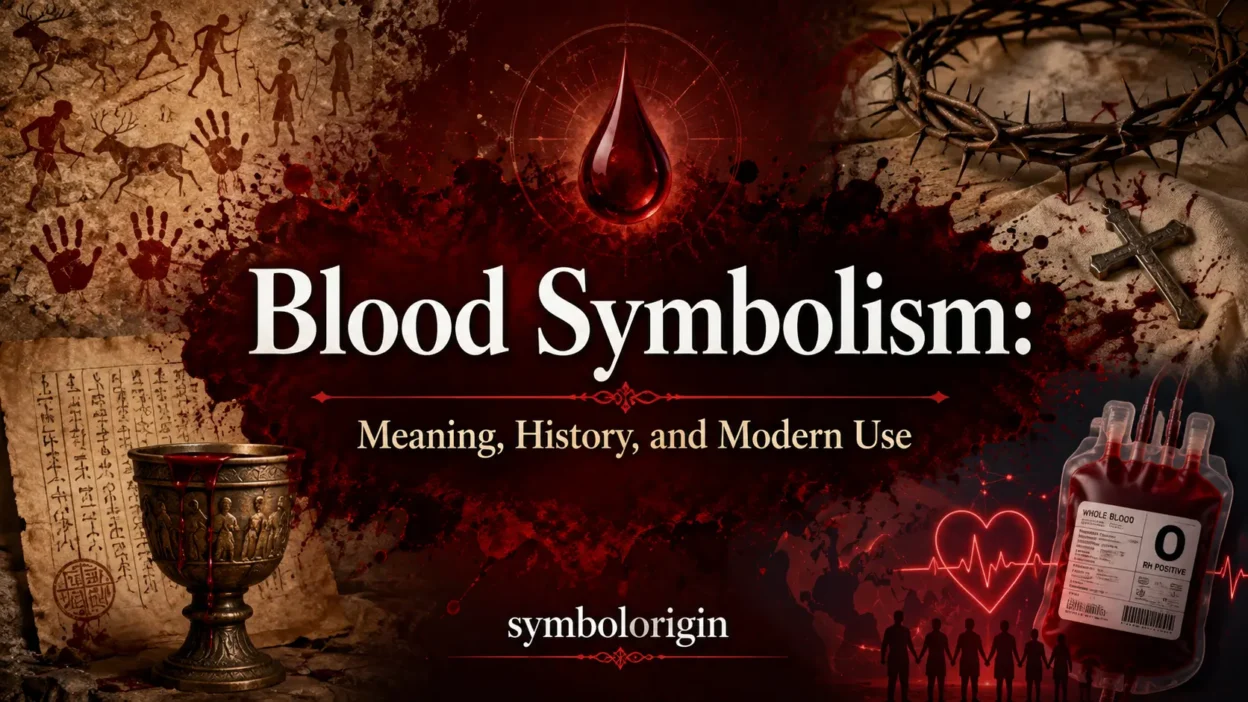
Blood symbolism carries an unusual tension because blood represents both a living body and what happens when that body is wounded. In modern American culture, it can suggest life, family, sacrifice, courage, violence, guilt, fear, or mortality. The surrounding image, story, or ritual determines which meaning comes forward.
People encounter symbolic blood in religious art, horror films, tattoos, medical campaigns, family expressions, political rhetoric, and social media. A red drop on a donation poster communicates generosity, while the same shape on a movie poster may warn of danger.
This range of meanings is not accidental. Blood sustains the body, yet visible blood usually signals injury, childbirth, menstruation, illness, or death. Its symbolism grows from that physical reality.
Quick Answer
Blood symbolism commonly represents life, vitality, family bonds, sacrifice, and mortality in modern American culture. Historically, blood has also signified religious covenant, ritual offering, ancestry, purification, guilt, and the boundary between life and death.
TL;DR
- Blood primarily represents life, injury, sacrifice, and mortality.
- Family language connects blood with ancestry and belonging.
- Religious traditions use blood to express covenant and atonement.
- Donation campaigns frame blood as generosity and shared responsibility.
- Horror media uses blood to signal danger and bodily vulnerability.
- Racial “blood purity” language is historically false and harmful.
What Blood Looks Like and Why It Becomes Symbolic
Blood is usually represented as a red drop, stain, stream, handprint, wound, or filled vessel. In medical settings, it may appear in collection bags, laboratory tubes, transfusion equipment, or diagrams of the circulatory system.
Its actual color ranges from bright red when highly oxygenated to a darker red when carrying less oxygen. Blood circulates oxygen, nutrients, immune cells, hormones, and waste products while also helping the body control bleeding. These life-sustaining functions explain why blood so easily becomes a symbol of vitality.
Visible blood creates a different reaction. Because healthy circulation normally remains inside the body, exposed blood suggests that a boundary has been broken. That breach may mean injury, surgery, violence, birth, menstruation, sacrifice, or medical treatment.
This contrast gives blood its symbolic flexibility. It can represent life itself or the threatened loss of life.
What Blood Commonly Means in the United States
Americans generally understand blood through several overlapping meanings rather than one fixed interpretation.
| Context | Meaning in the USA | Common Associations | Notes |
|---|---|---|---|
| Medical care | Life and survival | Donation, transfusion, healing | Usually positive and community-focused |
| Family language | Kinship and ancestry | Relatives, heritage, inheritance | Can exclude adoptive or chosen family |
| Religion | Sacrifice and covenant | Redemption, martyrdom, communion | Meaning varies by faith tradition |
| Horror and crime | Danger and mortality | Wounds, fear, violence, guilt | Often intensified for entertainment |
| Personal art | Endurance or transformation | Tattoos, grief, resilience | Meaning depends on the wearer |
| Political rhetoric | Identity or conflict | Patriotism, sacrifice, ancestry | Can become manipulative or extremist |
These meanings often coexist. A single image may communicate pain and survival at the same time. A blood-stained bandage, for example, records an injury but may also show that someone endured it.
Life, Vitality, and Human Existence
The most basic meaning of blood is life. A person can lose hair, teeth, or even certain organs and survive, but severe blood loss creates an immediate threat. This biological importance has made blood a natural shorthand for vitality across art, religion, language, and medicine.
Expressions such as “lifeblood” extend the idea beyond the body. Americans may describe volunteers as the lifeblood of an organization or small businesses as the lifeblood of a community. The metaphor identifies whatever keeps a larger system functioning.
Blood may also represent energy and alertness. Phrases such as “get the blood flowing” connect circulation with movement, readiness, and renewed activity. In sports and motivational language, blood can suggest intensity, competitive drive, or physical commitment.
This meaning is generally positive, but it is rarely gentle. Blood represents life as something active, embodied, and vulnerable rather than abstract.
Death, Injury, and the Limits of the Body
Blood becomes a sign of mortality when it appears outside the body. In paintings, films, news photographs, and memorial imagery, it may indicate that a person has been wounded or killed.
Artists do not always show blood realistically. A small red mark can stand for an entire act of violence. This visual shortcut works because viewers already understand that spilled blood means bodily harm.
The phrase “blood was shed” similarly transforms physical injury into a broader statement about conflict or loss. It can refer to war, murder, persecution, or civil unrest without describing individual wounds.
Blood therefore marks the boundary between living and dying. It reminds viewers that the body can be damaged and that human life is not permanent.
Kinship, Ancestry, and Family Bonds
English has long used blood as a metaphor for family descent. Terms such as “blood relative,” “bloodline,” and “related by blood” distinguish biological relationships from relationships created through marriage, adoption, friendship, or community. Modern dictionaries continue to record family origin and shared descent among the established meanings of the word.
In the United States, this language often communicates loyalty. Saying that someone is “family by blood” may imply an enduring obligation, shared history, or inherited identity.
However, the metaphor has limits. It can imply that biological family is more authentic than adoptive, step, foster, or chosen family. Many Americans now use family language more broadly, recognizing that care and commitment do not depend on shared ancestry.
Blood may symbolize where someone came from, but it does not determine the quality of a relationship.
Sacrifice, Covenant, and Sacred Obligation
Many ancient societies treated blood as ritually significant because it was closely associated with life. The act of offering blood could represent the transfer, dedication, or return of life to a deity.
In ancient Israelite ritual, animal blood was placed on or around an altar in ceremonies connected with atonement, purification, and restored relationship. Biblical tradition links blood with life, which helps explain both its ritual importance and prohibitions against consuming it.
Blood could also confirm a covenant. A covenant was not merely a casual promise; it created a binding relationship carrying religious and social responsibilities.
This background still shapes American religious vocabulary. Phrases such as “sealed in blood” or “a blood covenant” suggest that an agreement demands complete loyalty and carries serious consequences.
Christian Interpretations in American Culture
Within Christianity, blood is strongly associated with the crucifixion of Jesus, sacrificial love, forgiveness, redemption, and the establishment of a new covenant. At the Last Supper, wine is identified with the blood of the covenant, forming the basis for later Christian communion traditions.
Catholic and many Protestant traditions interpret Christ’s blood as evidence of suffering accepted for the salvation of others. Red church garments or decorations may also recall the Passion, martyrdom, and sacrificial witness.
These associations remain visible in American hymns, sermons, devotional art, crosses, communion imagery, and religious tattoos. For believers, blood in this setting is not mainly a horror image. It represents the cost of redemption and the seriousness of divine grace.
Interpretations differ among denominations, however. Some churches use highly literal language, while others emphasize blood primarily as a theological symbol of self-giving love.
Blood in Ancient American Traditions
Blood had important ritual meanings in several ancient Mesoamerican societies, but those meanings should not be reduced to stereotypes about violence. Surviving Maya art shows rulers and royal women participating in bloodletting rituals intended to communicate with divine forces, legitimize authority, or seek successful outcomes.
In some Mesoamerican imagery, sacrificial blood was connected with nourishment, agricultural renewal, rulership, and the relationship between human communities and the sacred world. Art associated with the ceremonial ballgame sometimes linked blood, decapitation, vegetation, and regeneration, although scholars continue to debate how particular rituals were practiced.
These traditions were culturally specific. They should not be presented as representing all Indigenous peoples of the Americas, nor should ancient practices be carelessly applied to living Native communities.
Blood Donation and Civic Responsibility
Modern medicine has given blood a distinctly communal meaning. Donated blood and blood components are used in surgeries, trauma care, cancer treatment, chronic illness management, and other forms of care. In the United States, someone needs blood or platelets approximately every two seconds.
Donation campaigns therefore frame blood as a gift that one stranger can offer another. Images of red drops, rolled-up sleeves, adhesive bandages, and collection bags communicate generosity rather than injury.
The donor does not usually know the recipient. That anonymity strengthens the symbolism: shared humanity replaces family connection. Blood becomes something people have in common, regardless of background.
School drives, community events, hospitals, and emergency appeals reinforce this interpretation. In this context, giving blood represents practical compassion, civic participation, and responsibility for people beyond one’s immediate circle.
Emotional and Psychological Meaning
Blood provokes strong reactions because it combines familiarity with alarm. Everyone has blood, but seeing it outside the body can produce fear, disgust, concern, fascination, or urgency.
Its psychological meaning often depends on control. Blood drawn carefully into a medical tube suggests examination and treatment. Blood spreading unpredictably across clothing or a floor suggests danger and loss of control.
For survivors of illness, surgery, or injury, blood imagery may represent endurance. For someone grieving a violent death, the same imagery may feel disturbing or exploitative.
Blood can also communicate emotional intensity. Descriptions such as “boiling blood,” “bad blood,” or “making someone’s blood run cold” convert anger, hostility, and fear into physical sensations. The language works because people experience emotion through changes in heartbeat, temperature, breathing, and muscle tension.
Tattoos and Personal Identity
Blood imagery appears in tattoos as droplets, wounds, anatomical hearts, roses, daggers, religious designs, family names, or red accents. Its meaning depends heavily on the surrounding design.
Paired with a heart, blood may represent emotional vulnerability or a love that carries personal cost. With a dagger, it can symbolize betrayal, danger, revenge, or survival after harm. In Christian designs, drops of blood may refer to sacrifice and redemption. Alongside a family name, they may express ancestry or loyalty.
Some people use blood imagery to mark recovery from illness, violence, grief, or self-destructive behavior. In those cases, the tattoo may acknowledge pain without glorifying it.
Because realistic blood can be visually intense, wearers should consider how the design may be interpreted in workplaces, public settings, or around people with trauma-related sensitivities.
Horror, Halloween, and Popular Entertainment
American horror frequently uses blood to make danger visible. Slasher films, vampire stories, crime dramas, haunted attractions, video games, and Halloween decorations rely on red stains and wounds to signal that ordinary safety has collapsed.
The success of slasher films helped establish blood and graphic bodily injury as recognizable features of modern horror entertainment. Vampires add another layer by turning blood into food, temptation, immortality, and predatory control.
Artificial blood may be exaggerated in color or volume because its purpose is emotional rather than medical. Bright red liquid can create shock, suspense, disgust, dark comedy, or theatrical excitement.
Context remains essential. Decorative blood on a costume is usually understood as fictional, while similar imagery used in a political message or public prank can appear threatening.
Menstruation, Birth, and Bodily Cycles
Blood is not limited to injury and death. It also appears in menstruation and childbirth, connecting it with fertility, bodily change, reproductive health, and the beginning of life.
Menstruation is a normal biological process in which blood and tissue from the uterine lining leave the body. Despite that medical reality, menstrual blood has often been treated with embarrassment, secrecy, or ideas of impurity. Current health efforts increasingly emphasize accurate information, dignity, access to menstrual products, and freedom from stigma.
In art and personal symbolism, menstrual blood may represent adulthood, fertility, recurring time, bodily autonomy, or resistance to shame. Other viewers may experience it simply as a private physical reality without symbolic meaning.
Birth imagery gives blood another double meaning. It records pain and physical risk, yet it accompanies the arrival of new life. Few symbols show the connection between vulnerability and creation as directly.
Guilt, Responsibility, and Moral Consequences
Blood can stand for responsibility when harm has been done. The expression “blood on one’s hands” means that a person or institution bears blame for injury or death. Dictionaries recognize this moral meaning alongside the literal and family-related senses of the word.
The image is effective because blood behaves like a visible stain. Even after an act is over, the symbolic mark remains.
Writers, activists, and political speakers often use this language to accuse leaders of causing preventable suffering. Such claims can be morally serious, but they can also become emotionally manipulative when evidence is weak.
In literature, bloodstains may reveal hidden guilt, expose a crime, or show that the past cannot be erased. The substance becomes a record of consequence.
Misuse in Racial and Political Language
Blood has repeatedly been misused as if it were a scientific measure of racial, national, or cultural purity. Ideas such as “pure blood” treat identity as an inherited biological essence and ignore the complex realities of genetics, culture, citizenship, language, and community.
The Nazi slogan “blood and soil” connected a fictional idea of racial purity with territorial ownership. It was used to support exclusion, displacement, and conquest, and it remains associated with white supremacist ideology.
American history also includes government classifications based on supposed fractions of Native ancestry. “Blood quantum” policies have affected legal status and tribal enrollment, although tribal nations have their own citizenship rules and perspectives. The subject remains politically and culturally sensitive.
Such systems should not be confused with ordinary family metaphors. Describing relatives as connected by blood is not the same as using blood language to rank people, police identity, or claim racial superiority.
How the Meaning Has Changed
The oldest meanings of blood grew directly from bodily experience: life, wounds, death, birth, hunting, and sacrifice. Religious traditions then developed more structured interpretations involving purity, covenant, obligation, atonement, and sacred life.
Later medical knowledge changed how people understood blood without removing its symbolic force. Transfusion transformed blood from something lost in injury into something that could be voluntarily shared and used to sustain another person.
Modern entertainment made blood reproducible. Stage effects, film makeup, digital graphics, and commercial decorations separated the appearance of blood from real bodily harm. It could now be frightening, humorous, stylish, or intentionally excessive.
At the same time, social movements have challenged harmful ideas surrounding menstrual shame, racial purity, inherited status, and biological definitions of family.
Blood still represents life and death, but modern interpretation gives greater attention to consent, identity, medicine, trauma, and social context.
Common Misunderstandings
One mistake is assuming that blood always symbolizes violence. In hospitals and donation campaigns, it more often represents care, recovery, and generosity.
Another is treating all religious blood imagery as interchangeable. Jewish sacrifice, Christian communion, Hindu offerings, and Mesoamerican rituals developed within different belief systems and cannot be collapsed into one universal practice.
It is also inaccurate to assume that “blood family” automatically means the closest or most loyal family. Biological connection describes ancestry, not emotional safety or commitment.
Finally, fictional blood should not be interpreted exactly like real blood. A theatrical stain may be decorative, but actual blood carries medical, emotional, and ethical consequences.
FAQs
Is blood a positive or negative symbol?
It genuinely depends on context, more so than almost any other symbol. In a hospital or donation campaign it reads as care, healing, and generosity; on a movie poster or crime scene it reads as danger and loss. The same red mark can mean life or death depending entirely on what surrounds it.
What does blood mean in a tattoo?
A blood tattoo can represent sacrifice, survival, family loyalty, emotional pain, mortality, or personal transformation, and the surrounding imagery does most of the interpretive work. Paired with a heart it often suggests vulnerability or costly love; paired with a dagger it can suggest betrayal or hard-won survival; alongside a name, it usually points to ancestry or loyalty.
What does blood represent in Christianity?
In Christianity, blood commonly represents Christ’s sacrifice, forgiveness, redemption, and the new covenant established at the Last Supper, where wine is identified with the blood of the covenant. Denominations differ in how literally they interpret that connection, but across traditions, blood in this context signals the cost of grace rather than horror or violence.
Why does blood symbolize family?
The metaphor grew out of the simple biological fact that relatives share inherited traits through descent, which made “blood” a natural shorthand for ancestry and belonging. It’s worth remembering the metaphor has real limits, though — many meaningful families are built through adoption, marriage, or chosen commitment rather than shared biology, and the language shouldn’t be read as ranking one above the other.
Why is blood so common in horror stories?
Blood works instantly as a danger signal because everyone recognizes, on a gut level, what it means when it appears outside the body. Horror leans on that instinctive reaction, often exaggerating color and volume well beyond anything medically realistic, purely to maximize the emotional jolt of fear, suspense, or shock.
Can blood symbolize love?
Yes, particularly love bound up with loyalty, vulnerability, or sacrifice — the idea that real love sometimes costs something. In darker stories, the same imagery can flip toward possessiveness or obsession, which is a reminder that blood rarely carries one clean meaning; it tends to intensify whatever emotional undercurrent is already present in the story.
What does dreaming about blood mean?
There’s no scientifically established interpretation for blood in dreams — despite how often the question gets asked. What a dream involving blood reflects is highly individual, often tied to recent worries about health, family, guilt, or stress, so the dreamer’s own circumstances are a far more reliable guide than any generic dream-symbol chart.
What does “blood on one’s hands” mean?
This is a moral rather than literal expression, meaning a person or institution bears responsibility for injury or death, even if they didn’t directly cause it. It’s a powerful phrase precisely because blood behaves like a stain that doesn’t wash away — which is why it shows up so often in political rhetoric and literature to argue that consequences, and blame, persist long after the event itself.
Why is menstrual blood treated differently from other blood symbolism?
Historically, menstrual blood has carried an added layer of stigma, secrecy, or ideas of impurity that other forms of blood — like a donation or an injury — generally haven’t. That’s shifting: modern health conversations increasingly frame menstruation as a normal biological process and reclaim its symbolism around fertility, bodily autonomy, and resistance to shame rather than embarrassment.
Is “blood purity” or “blood quantum” language scientifically accurate?
No — these systems have never reflected an actual biological measure of identity, even though they’ve been used historically as if they did. “Blood purity” rhetoric, most infamously in Nazi “blood and soil” ideology, was built to justify exclusion and violence, while blood quantum policies in the U.S. affected legal status and tribal enrollment in ways separate from how tribal nations define their own citizenship. Both should be understood as political and historical constructs, not scientific fact.
Conclusion
Blood means so many things because it never stops meaning the one thing underneath all of them: this is what a living body is made of, and this is what happens when that body is opened to the world. Every other meaning — family, sacrifice, guilt, danger, love, generosity — is really just a different answer to the same question of what it costs to be alive and vulnerable at the same time.
That’s why the symbol refuses to settle into something simple. A donation poster and a horror film poster can use the exact same red drop and mean almost opposite things, because blood was never really the message — the story around it always was. Ancient ritual read it as a bridge to the divine; modern medicine reads it as a resource that strangers share with each other; harmful ideology has, at times, tried to twist it into a false measure of who belongs and who doesn’t.
What stays constant through every one of those readings is the reminder blood always delivers, whether the context is sacred, medical, or frightening: life is real precisely because it can be lost, and what people choose to do with that fact — protect it, honor it, exploit it, or give it away to a stranger — is where the actual meaning lives.