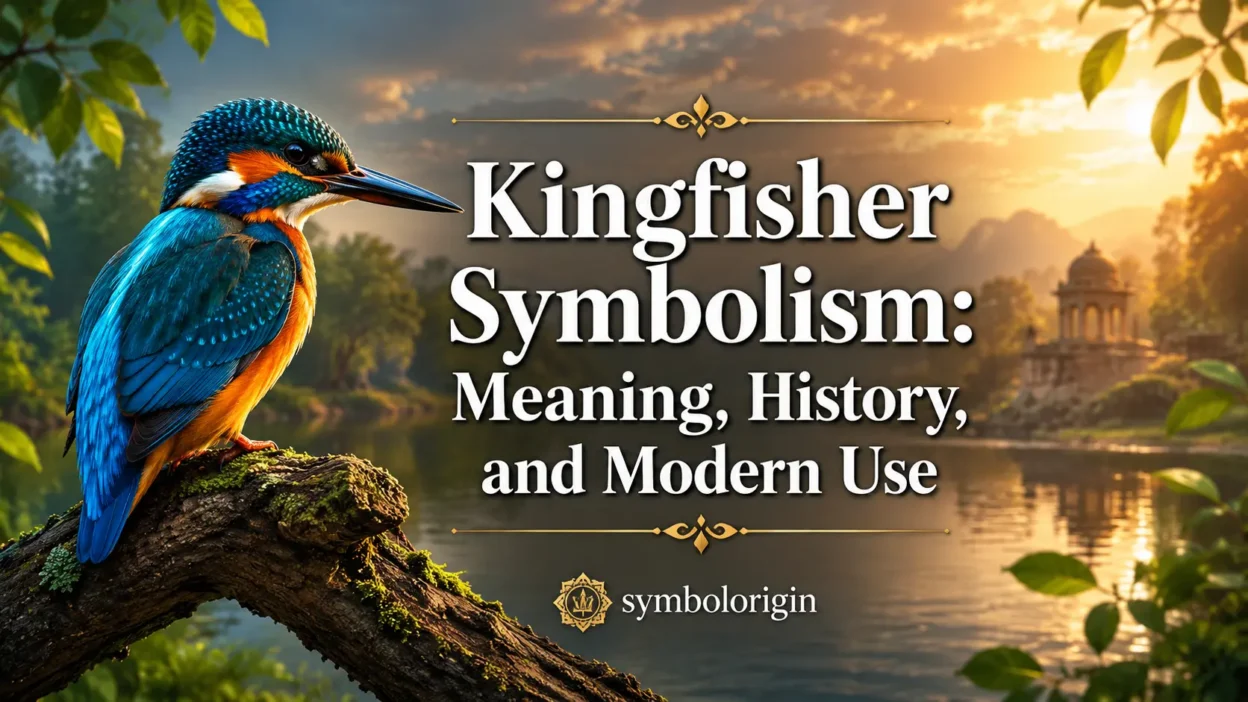
Kingfisher symbolism centers on patience, accurate timing, calm, independence, and the confidence to act when an opportunity appears. The bird’s habit of watching quietly above the water before making a sudden dive gives these meanings a clear foundation in its actual behavior.
For many Americans, the kingfisher is not an abstract mythical creature. It is a noisy, recognizable waterside bird seen near rivers, lakes, ponds, marshes, and coastlines. Its distinctive shape, dramatic hunting style, and blue-gray coloring make it especially appealing in wildlife art, tattoos, jewelry, and personal emblems.
Historical traditions add other layers. An ancient Mediterranean story connected the kingfisher with calm seas and loving devotion, while Māori language and imagery associated it with the alertness of a sentry. Chinese decorative arts valued its brilliant feathers as signs of beauty, refinement, and social status.
Quick Answer
Kingfisher symbolism commonly represents patience, focus, precise action, independence, and calm in modern American culture. Historically, the bird has also been linked with peaceful “halcyon” periods, devotion between partners, watchfulness, and prestigious decorative art.
TL;DR
- The kingfisher represents patience followed by decisive action.
- Its water connection suggests clarity, calm, and emotional balance.
- Greek tradition linked it with peaceful halcyon days.
- Māori culture compared it to an alert sentry.
- Modern designs emphasize focus, independence, and resilience.
- Historical feather jewelry also raises ethical concerns.
What a Kingfisher Looks Like
Kingfishers form a varied family of birds found across much of the world. Although their colors and sizes differ, many have compact bodies, large heads, short necks, strong pointed bills, and bright blue, green, orange, or white plumage.
The belted kingfisher is the species most Americans are likely to recognize. It has a shaggy crest, a thick straight bill, blue-gray upperparts, a white collar, and a band across the chest. Unlike the pattern seen in many bird species, the female has an additional rust-colored band that the male lacks.
These birds are often noticed by sound before sight. A belted kingfisher may fly along a shoreline while producing a loud, mechanical rattle. It then settles on a branch, wire, piling, or other raised position where it can watch the water.
That combination of still observation, sudden movement, bold sound, and vivid color gives the bird an unusually strong visual identity.
Kingfisher Meanings at a Glance
The kingfisher does not have one official or universal meaning. Its interpretation changes according to the bird’s behavior, the cultural tradition being referenced, and the reason someone chooses the image.
| Context | Common Meaning in the United States | Main Association | Important Note |
|---|---|---|---|
| Personal growth | Patience and good timing | Waiting before acting | Patience is active observation, not passivity |
| Work and ambition | Focus and precision | A direct dive toward a target | Often chosen for disciplined goals |
| Emotional life | Calm and mental clarity | Still water and controlled movement | Calm does not mean avoiding difficulty |
| Relationships | Loyalty and reunion | The story of Alcyone and Ceyx | This meaning comes from Greek tradition |
| Tattoos and art | Independence and resilience | A solitary waterside hunter | Personal interpretation remains important |
| Cultural heritage | Watchfulness or prestige | Māori sentry imagery and Chinese featherwork | Meanings should not be blended carelessly |
Patience Before Action
A kingfisher can remain nearly motionless while studying the water below. It does not dive continuously or chase every disturbance. It waits until prey is visible and the angle is favorable.
This behavior makes patience one of the bird’s most convincing modern meanings. The symbolism is not about waiting indefinitely. It describes alert patience: observing conditions, protecting energy, and remaining prepared.
Someone may identify with this image during a period when immediate action would be unwise. The bird can represent the discipline to gather information before accepting a job, ending a relationship, making an investment, or beginning a difficult project.
Its message is therefore more practical than passive: do not confuse movement with progress. A well-timed decision can accomplish more than repeated, poorly directed effort.
Focus, Timing, and Decisive Action
When a kingfisher identifies prey, its behavior changes rapidly. It may plunge directly from a perch or briefly hover before diving into the water. Its heavy bill, direct flight, and concentrated hunting method create a natural image of precision.
For this reason, the bird can symbolize a person who knows when to stop analyzing and commit. Patience without action becomes hesitation; action without observation becomes recklessness. The kingfisher brings those two qualities together.
In professional settings, it may represent:
- Concentration on one clear objective
- Confidence under pressure
- Efficient use of time and energy
- Careful preparation followed by commitment
- The ability to ignore irrelevant distractions
This interpretation explains why the bird suits entrepreneurs, athletes, photographers, anglers, writers, and others whose work depends on timing.
Calm Water and the Meaning of Clarity
Water often functions as a visual metaphor for emotion, uncertainty, memory, and the unconscious. A bird that watches the surface and enters it deliberately can therefore suggest the ability to examine feelings without becoming overwhelmed by them.
The symbolism works especially well when the water in an image is clear or still. Clear water suggests honest perception. A calm surface suggests enough emotional stability to notice what is happening beneath immediate reactions.
This does not mean that a kingfisher represents a life without conflict. The bird lives beside changing water, responds to movement, defends territory, and must repeatedly hunt. Its calm is functional rather than fragile.
In personal art, the image may communicate: “I can enter difficult emotional territory and return with something useful.”
The Greek Roots of “Halcyon Days”
One of the oldest surviving Western associations comes from the story of Alcyone and Ceyx. In a famous Roman retelling of Greek myth, Ceyx dies in a storm at sea. After Alcyone discovers his fate, the couple is transformed into birds associated with the kingfisher.
Ancient tradition connected their nesting period with a temporary winter calm in which the winds and waves became still. This belief eventually produced the expression “halcyon days.”
In modern English, the phrase usually refers to an especially peaceful, happy, or successful period, often remembered from the past. Most people who use it are no longer thinking about the bird, yet the linguistic connection remains.
This background gives the kingfisher several related meanings:
- Peace after disorder
- Temporary safety during hardship
- Rest between difficult periods
- Hope that turbulence will not last forever
- A protected opportunity to create or begin again
The original belief was not an accurate description of kingfisher nesting behavior. Kingfishers generally use cavities or tunnels rather than floating nests at sea. The value of the story is cultural and literary, not zoological.
Love, Loss, and Reunion
The Alcyone and Ceyx story also shaped the bird’s connection with committed love. Its emotional center is not a cheerful romance but separation, mourning, transformation, and reunion.
That makes the kingfisher a more complicated relationship symbol than paired swans or doves. It can honor a bond that survived distance, grief, illness, migration, or a major change in identity.
In memorial art, the bird may stand for someone whose presence is associated with water, coastal places, fishing, or a shared peaceful memory. A paired design can represent partners who endured a difficult period together.
However, this meaning should be described as a classical literary association rather than a universal belief about kingfishers. Other cultures developed their own interpretations from local species and experiences.
What the Kingfisher Commonly Means in the United States
The belted kingfisher appears across much of North America wherever suitable water, prey, perches, and nesting banks are available. Americans encounter it along wooded rivers, reservoirs, coastal inlets, public parks, wildlife refuges, and even modified areas such as gravel pits and roadside cuts.
Its American meaning usually comes from observation rather than from a national religious or ceremonial tradition. Birdwatchers may associate it with the arrival of a loud rattling call over a quiet river. Artists may emphasize the contrast between its rough crest and controlled hunting technique.
In contemporary U.S. imagery, it commonly suggests:
- Practical intelligence
- Self-reliance
- Alertness
- Territorial confidence
- Connection with rivers and wetlands
- The balance between stillness and speed
It may also represent attachment to a particular landscape. Someone raised near the Great Lakes, the Mississippi River, a New England pond, or a Pacific Northwest estuary may use the bird as a symbol of home.
The kingfisher is therefore less likely to carry one fixed national message than the bald eagle. Its appeal is more personal, regional, and ecological.
Independence and Territorial Confidence
Belted kingfishers spend much of the year alone and vigorously defend feeding areas. They may chase intruders while rattling loudly, raising their crests, and flying repeatedly along the water.
This behavior supports interpretations involving independence and boundaries. The bird does not need to symbolize hostility. Instead, it can represent knowing which resources, responsibilities, or personal spaces need protection.
For someone rebuilding confidence, the kingfisher may express the right to be visible, vocal, and protective without apologizing. Its loud call contrasts with its patient hunting posture: quiet concentration does not prevent firm self-assertion.
That distinction makes it useful as an identity symbol for people who are naturally private but willing to defend their work, family, values, or peace.
Hidden Work Beneath the Riverbank
The kingfisher’s nest adds another dimension to its meaning. Rather than constructing an exposed nest from twigs, belted kingfishers excavate tunnels in earthen banks. Both birds may participate in digging, and some tunnels extend several feet into the bank.
Symbolically, the burrow suggests preparation that outsiders cannot see. A finished goal may appear sudden even when it rests on months of private work.
This image fits periods of study, recovery, business development, artistic practice, or family preparation. The visible result is only the entrance; most of the structure lies beneath the surface.
The nesting behavior can also represent creating security within an unstable environment. The river changes, yet the bird searches for a bank high and solid enough to protect its young from flooding.
Māori Associations With Watchfulness
In Māori tradition, the kōtare, or New Zealand kingfisher, was admired for its resemblance to a vigilant guard. It could remain still on an elevated perch and then strike with sudden speed. The same word was sometimes used for a raised observation platform in a fortified settlement.
This association adds a culturally specific meaning of watchfulness, readiness, and protective attention. It resembles the modern interpretation of focus, but it should not be treated as interchangeable with American tattoo symbolism.
Within its proper context, the kōtare image can evoke the qualities of a sentry:
- Seeing danger before it arrives
- Remaining attentive during quiet periods
- Protecting a community
- Acting quickly when observation becomes necessary
People outside Māori culture should avoid presenting this interpretation as a generic “tribal” meaning. Naming the tradition accurately preserves the difference between cultural history and personal invention.
Beauty, Status, and Chinese Kingfisher Featherwork
In Chinese decorative arts, the kingfisher became valued for the extraordinary blue of its feathers. Artisans attached tiny pieces of real feather to metal ornaments, hair accessories, headdresses, fans, and other luxury objects.
Surviving examples from the Qing period combine feathers with gold, pearls, glass, semiprecious stones, and gilded metal. Their labor-intensive construction and expensive materials connected the brilliant blue surface with wealth, courtly refinement, and social distinction.
This history should not be simplified into the claim that “the kingfisher means royalty in China” in every context. The stronger conclusion is that its feathers became prestigious artistic materials, especially in elite adornment.
The tradition also introduces an ethical issue. Historical objects may deserve preservation as evidence of artistic skill and cultural history, while the killing or commercial harvesting of birds for decoration should not be romanticized. Modern reproductions can use enamel, synthetic fibers, painted metal, or other alternatives without repeating the original material practice.
Emotional and Psychological Associations
The kingfisher combines traits that might appear contradictory: stillness and speed, solitude and loudness, surface observation and underwater pursuit.
That combination makes it a useful psychological image for people who do not identify with one-dimensional ideas of confidence. It suggests that a person can be reflective without being timid, independent without being detached, and forceful without remaining constantly active.
Emotionally, the bird may communicate:
- Composure: The ability to wait without losing readiness.
- Discernment: Recognizing which opportunities deserve attention.
- Recovery: Returning to stability after a disruptive period.
- Self-trust: Acting without requiring constant outside approval.
- Healthy boundaries: Protecting time, energy, home, or creative work.
The meaning changes when the image shows an agitated bird, stormy water, an unsuccessful dive, or an abandoned perch. Such details may shift the interpretation toward frustration, missed timing, disrupted peace, or excessive defensiveness.
Why It Appears in Tattoos
A kingfisher tattoo is often chosen for its combination of beauty and behavior. The long bill and crest create a recognizable silhouette, while blue, turquoise, rust, and white offer a strong color palette.
Common tattoo meanings include patience, concentration, emotional recovery, self-reliance, and commitment to a specific goal. A diving bird emphasizes action, while a perched bird emphasizes readiness.
Additional design elements can refine the message:
- A calm river: emotional balance or a peaceful chapter
- Waves or rain: persistence during instability
- A fish: success earned through skill and timing
- Two kingfishers: partnership, reunion, or shared resilience
- A riverbank burrow: home-building and hidden preparation
- The word “halcyon”: remembered happiness or peace after hardship
- Native plants: connection to a particular region or home landscape
Anyone using Māori or Chinese motifs should study their original context rather than combining them as decorative “ancient symbolism.” A personal design becomes more meaningful when it identifies its influences honestly.
Kingfishers in Jewelry, Decor, and Visual Identity
Kingfisher imagery works well in jewelry because the bird can be reduced to a compact shape while remaining recognizable. Designers may focus on its bill, diving posture, feather colors, or association with water.
In home decor, the image often creates a quiet riverside atmosphere. It appears in watercolor prints, ceramic tiles, carved figures, stained glass, garden ornaments, and coastal interiors. Blue-green versions may be selected primarily for color harmony, even when the owner has no interest in historical symbolism.
Businesses and organizations may use the bird to communicate precision, speed, observation, or connection with waterways. A diving kingfisher can suit a sports brand, creative studio, fishing company, environmental group, or technology service built around accurate targeting.
The design should match the intended message. A perched bird looks observant and composed. A bird entering the water looks energetic and committed. A territorial bird with an open bill can appear defensive or aggressive.
Negative Meanings and Common Misunderstandings
Most modern interpretations are positive, but the kingfisher can carry less comfortable meanings when its behavior is viewed from another angle.
Its intense territoriality may represent possessiveness or resistance to cooperation. Long periods of waiting can suggest hesitation when someone repeatedly delays a necessary decision. A missed dive may become an image of poor timing or misplaced confidence.
Several misunderstandings are also common.
First, the bird does not have one universal spiritual definition. Meanings such as abundance, prophecy, marital devotion, or divine protection may come from particular stories, personal interpretations, or modern websites rather than a shared worldwide tradition.
Second, “halcyon days” does not prove that actual kingfishers control weather or nest on floating seas. That image belongs to ancient belief and literature.
Third, cultural meanings should not be merged into a single invented narrative. Māori sentry associations, Mediterranean mythology, Chinese featherwork, and modern American tattoos emerged in different settings.
Finally, seeing a kingfisher is not automatically an omen. A real bird near a pond or river is usually responding to habitat, prey, territory, migration, or nesting conditions.
How the Meaning Has Changed Over Time
The kingfisher’s meaning did not develop along one straight historical line. Different societies observed different species and emphasized different qualities.
Mediterranean tradition connected the bird with transformed lovers and a period of calm at sea. Māori imagery emphasized the alert posture of a sentry. Chinese artisans valued its iridescent feathers as prestigious decorative material.
Modern Americans often encounter these histories indirectly. At the same time, they build new meanings from wildlife observation, photography, environmental awareness, tattoo culture, and personal experiences near water.
As a result, the bird now occupies several symbolic roles at once:
- A literary emblem of remembered peace
- A behavioral model of patience and timing
- A personal symbol of independence
- A visual sign of riverside identity
- A reminder of cultural craftsmanship
- A subject of wildlife ethics and conservation awareness
The most responsible modern interpretation distinguishes documented tradition from newly created personal meaning.
Choosing a Personal Kingfisher Meaning
A person does not need to adopt every historical association. A clearer interpretation begins with the part of the bird that feels most relevant.
Consider whether the image represents waiting, diving, calling, defending territory, returning to a perch, or living beside water. Each behavior tells a different story.
A perched kingfisher may suit someone preparing quietly for a major change. A diving bird may mark the moment preparation became action. A pair may commemorate loyalty or reunion. A solitary bird beside a familiar river may represent home without implying loneliness.
Personal symbolism becomes stronger when it is specific. “Focus during my final year of study” communicates more than a vague claim about spiritual wisdom. “Calm after a difficult move” is more grounded than saying the bird guarantees peace.
FAQs
Is a kingfisher a positive symbol?
Yes, in most modern contexts. Patience, accurate timing, clarity, independence, and peace are its most common favorable associations in art, jewelry, and tattoos. That said, its intense territoriality can also read as defensiveness or possessiveness, so the surrounding imagery matters for tipping the meaning one way or the other.
What does a kingfisher tattoo mean?
A kingfisher tattoo often represents focus, patience, emotional recovery, or the courage to act at the right moment. The pose does a lot of the work: a perched bird emphasizes quiet readiness, while a diving bird marks the moment preparation turns into action — and added elements like water, a fish, or a second bird refine the story further.
Does the kingfisher symbolize love?
It can, largely because of the classical story of Alcyone and Ceyx, in which grief, separation, and transformation ultimately lead to reunion. That gives the kingfisher a more complicated relationship meaning than a simple romantic emblem — it’s better suited to honoring love that survived real hardship than to representing new romance.
What does seeing a kingfisher mean spiritually?
There’s no fixed spiritual rule attached to a kingfisher sighting. Many people treat the encounter personally, as a nudge to observe carefully or commit to a decision, but the bird’s actual presence is almost always explained by ordinary factors — suitable water, available prey, territory, or seasonal movement, not an omen.
Is the kingfisher a biblical symbol?
No, not in any widely recognized sense. The kingfisher doesn’t appear as a major standardized symbol in mainstream biblical interpretation, so claims of a precise Christian meaning are generally modern devotional readings rather than a long-established scriptural tradition.
Why is the kingfisher connected with peace?
The connection traces back to the ancient story behind “halcyon days,” when calm winter weather was believed to protect nesting halcyon birds at sea. Modern symbolism kept that literary association alive and broadened it into a general symbol of tranquility, safety, and relief after a difficult period, even for people unfamiliar with the original myth.
Does a kingfisher symbolize good luck?
It’s sometimes used that way, especially in contexts where success depends on patience and timing paying off. That said, good fortune is a more modern, personal interpretation layered onto the bird rather than a meaning consistently shared across the cultures that have symbolically used kingfishers.
What’s the difference between kingfisher symbolism in Greek, Māori, and Chinese traditions?
Each tradition emphasizes a different quality tied to a different aspect of the bird. Greek myth focused on love, loss, and the calm of “halcyon days”; Māori tradition compared the bird’s alert perch-and-strike behavior to a vigilant sentry; and Chinese decorative arts prized its feathers as a material of wealth and refinement rather than assigning it a behavioral meaning at all.
Why does the kingfisher’s nesting behavior matter symbolically?
Because it complicates the bird’s image in a useful way. Rather than an exposed twig nest, belted kingfishers dig tunnels into riverbanks — invisible, effortful work that only becomes visible once it’s finished. That makes the kingfisher a fitting symbol for private preparation, whether that’s months of study, quiet recovery, or unseen groundwork behind a sudden-looking achievement.
Is it okay to use kingfisher feather imagery inspired by Chinese featherwork?
Drawing inspiration from the aesthetic is generally fine, but it’s worth being aware of the history: traditional Qing-era featherwork used real kingfisher feathers, and that practice raises real questions about wildlife harvesting that shouldn’t be romanticized. Modern reproductions using enamel, synthetic fiber, or painted metal let you reference the visual tradition without repeating its original material cost
Conclusion
The kingfisher earns its symbolism the hard way — by actually doing, in full view, what people spend years trying to learn: watch without being passive, wait without losing your nerve, and move the instant the moment is right. That’s not a metaphor imposed on the bird from outside. It’s just an accurate description of how it hunts.
Every tradition layered onto that behavior adds a different piece without contradicting it. Greek myth turned its stillness into a story about peace found after loss. Māori tradition read the same posture as vigilance in service of a community. Chinese artisans looked past the behavior entirely and prized the bird for the sheer brilliance of its feathers. None of those readings cancel each other out — they’re proof that patience followed by precision is a quality worth naming in more than one language.
That’s the version worth carrying forward: not a bird that promises stillness will always be rewarded, but one that models the discipline of waiting for a real opportunity instead of the next available one — and trusting yourself to know the difference when it finally arrives.