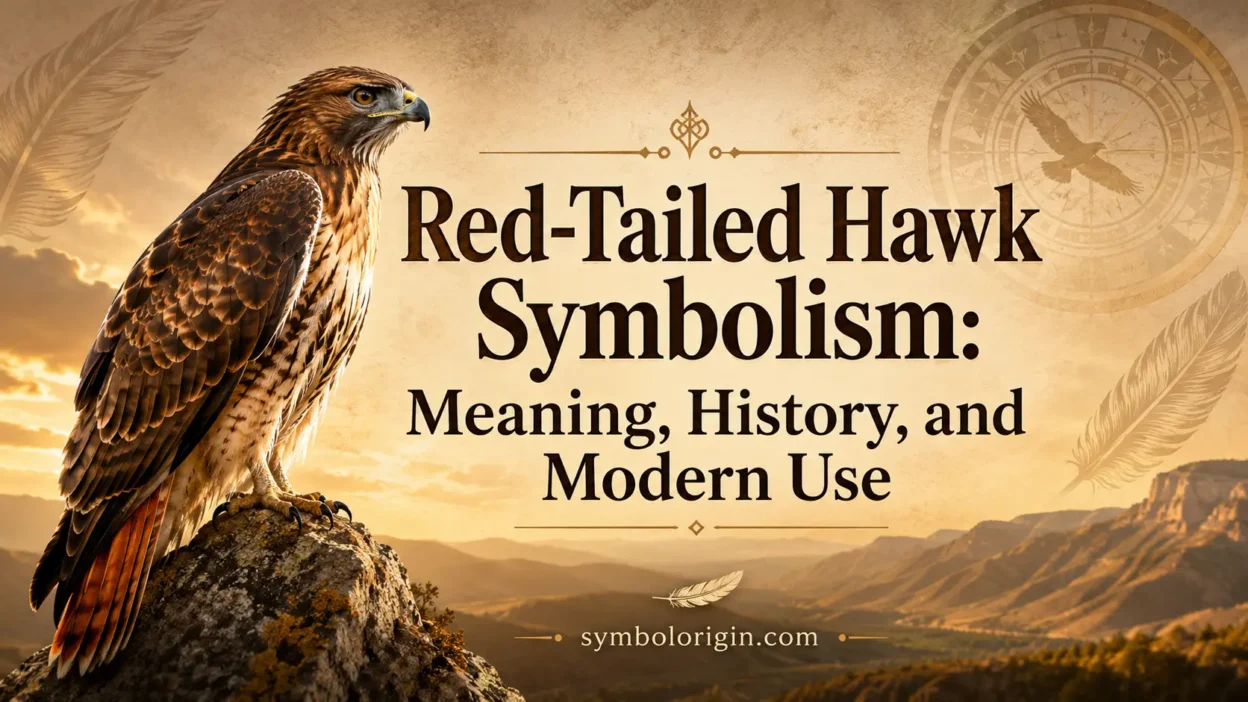
Red-tailed hawk symbolism commonly centers on clear vision, patience, independence, protection, and the ability to recognize an opportunity before acting. These meanings feel especially familiar in the United States because the bird is widely seen soaring over fields, sitting above highways, and nesting near both rural communities and large cities.
Unlike an abstract mythical creature, the red-tailed hawk is a living North American predator. Its broad wings, watchful posture, controlled hunting style, and reddish adult tail shape the qualities people associate with it.
However, no single interpretation applies to every sighting, culture, or person. Some meanings come from observable behavior, while others developed through personal spirituality, art, popular culture, and particular community traditions.
Quick Answer
Red-tailed hawk symbolism most commonly represents awareness, perspective, patience, confidence, and decisive action in modern American culture. Historically, hawks have also carried community-specific meanings connected with hunting, protection, communication, kinship, and relationships between people, animals, and the land.
TL;DR
- Clear eyesight represents awareness and careful judgment.
- Soaring suggests perspective beyond immediate problems.
- Patient hunting symbolizes timing and disciplined action.
- Territorial behavior represents protection and firm boundaries.
- Urban survival makes the hawk a sign of adaptability.
- Cultural meanings vary and should not be treated as universal.
How to Recognize a Red-Tailed Hawk
The red-tailed hawk is a large, broad-winged bird of prey. Most adults are brown above and lighter underneath, often with a streaked band across the belly. The upper side of the adult tail usually has a warm cinnamon or brick-red color, although juveniles have brown, banded tails.
Its shape is often easier to recognize than its coloring. Red-tailed hawks have wide, rounded wings and relatively short, broad tails. While soaring, they frequently circle without much flapping, using rising warm air to remain above open ground.
Americans often encounter them on utility poles, fence posts, roadside trees, cliffs, buildings, and other elevated structures. The species occupies open habitats ranging from grasslands and deserts to parks, pastures, wooded edges, and urban areas.
What the Hawk Commonly Means in the United States
The bird’s central modern meanings come from the way it appears to human observers: elevated, alert, patient, and prepared to move.
The most common associations include:
- Awareness
- Clear judgment
- Perspective
- Patience
- Independence
- Protection
- Adaptability
- Decisive action
These qualities are interpretations rather than scientific properties. A hawk does not soar to teach people a lesson. Still, people naturally use visible animal behavior as a metaphor for human decisions, emotions, and identity.
In American art and personal symbolism, the red-tail often represents someone who observes carefully before committing. It can also express confidence without unnecessary display: the bird spends long periods waiting, but it acts quickly when an opportunity appears.
Why It Represents Vision and Awareness
Hawks depend heavily on visual information while hunting. A red-tail may circle above a field or remain almost motionless on a high perch while watching the ground below. This behavior explains why it has become associated with alertness and the ability to notice what others miss.
Symbolically, vision can mean more than eyesight. It may represent:
- Understanding the larger situation
- Recognizing a hidden problem
- Seeing through distraction
- Anticipating consequences
- Developing a clearer personal direction
A hawk image may therefore appeal to someone who values observation, strategy, or thoughtful leadership. It can also serve as a reminder to gather enough information before reacting.
This meaning does not suggest knowing everything. Instead, the hawk represents improving one’s viewpoint by creating distance from confusion.
Soaring as a Symbol of Perspective
A red-tailed hawk soaring over a landscape can see relationships that are invisible from ground level. Roads, fields, trees, buildings, and movement become part of one larger scene.
For this reason, soaring is frequently interpreted as a metaphor for perspective. A person facing conflict may identify with the hawk because it suggests stepping back from immediate emotion and viewing the full situation.
The symbolism is especially relevant during:
- Major career decisions
- Relationship conflicts
- Periods of uncertainty
- Leadership responsibilities
- Personal reassessment
This does not mean avoiding practical details. The bird’s example combines a broad view with close attention. Symbolically, it encourages people to understand the whole problem without losing sight of the specific action required.
Patient Hunting and the Importance of Timing
Red-tailed hawks commonly hunt by waiting from an elevated perch or circling above open land. Once suitable prey is located, the bird descends in a controlled attack rather than wasting energy on constant pursuit. Mammals make up much of its diet, although it also eats birds, reptiles, and carrion.
That hunting pattern has produced an association with patience. In personal symbolism, the hawk may represent the difference between passivity and purposeful waiting.
Passive waiting involves hoping that circumstances will improve without preparation. Hawk-like patience means remaining attentive, conserving resources, and acting when conditions become favorable.
This symbolism can be useful for someone who tends to rush decisions. It can also speak to a person who has prepared carefully and now needs the confidence to move.
Protection, Courage, and Personal Boundaries
Red-tailed hawks defend nesting areas and territories from perceived threats. They may chase other hawks, owls, or even larger raptors when protecting a nest. Mated pairs also build or restore large nests together and may remain paired for years.
These behaviors support symbolic associations with protection, courage, and boundaries.
Protection does not have to mean aggression. In a human context, it may involve:
- Defending personal values
- Creating emotional limits
- Protecting children or family
- Preserving time and attention
- Speaking clearly when something is wrong
A red-tail symbol can communicate that kindness and firmness are compatible. Healthy boundaries do not require constant hostility; they require clarity about what must be protected.
Adaptability Across Wild and Urban Landscapes
One reason the red-tailed hawk has become such an effective American symbol is its adaptability. It lives in remote open country, agricultural landscapes, suburban areas, and major cities. It may build a nest in a tall tree, on a cliff, or on an artificial structure such as a building ledge or platform.
Urban red-tails have attracted public attention because they demonstrate that wildness can persist in developed environments. Pale Male, a well-known New York City red-tail, became the subject of books, news coverage, photography, and a television documentary after successfully living around Central Park.
As a result, the bird can represent adjustment without complete surrender. It survives changing surroundings while retaining the instincts and behaviors that make it a hawk.
For people experiencing relocation, career change, or unfamiliar circumstances, this interpretation can be especially meaningful.
Meanings in Different Contexts
| Context | Common U.S. Meaning | Typical Association | Important Note |
|---|---|---|---|
| A hawk soaring overhead | Perspective | Seeing the larger situation | Usually a personal interpretation |
| A hawk watching from a perch | Awareness | Patience and observation | Normal hunting behavior |
| A defending hawk | Protection | Boundaries and courage | Often related to nesting territory |
| A red-tail tattoo | Identity | Independence and confidence | Meaning depends on the wearer |
| A hawk in a dream | Attention | A concern demanding notice | Context and emotion matter |
| A hawk in city imagery | Adaptability | Wildness surviving development | Common in modern nature culture |
How the Symbolism Developed in North America
There was no single moment when the red-tailed hawk acquired one official meaning. Its symbolism developed through many separate relationships between people and raptors.
Indigenous peoples observed North American birds for thousands of years before modern scientific naming. Meanings connected with animals emerged within particular languages, environments, families, stories, ceremonies, and systems of knowledge.
European settlers brought their own attitudes toward birds of prey. Hawks were sometimes admired for strength but also viewed as competitors or threats, particularly when people blamed raptors for losses of poultry or game. During the early twentieth century, thousands of hawks and other raptors were killed before stronger wildlife protections and conservation ethics changed public attitudes.
Over time, field guides, wildlife films, migration counts, rehabilitation programs, and urban birdwatching helped shift the hawk’s image. It became less commonly treated as a harmful predator and more often understood as an important participant in functioning ecosystems.
Today’s symbolic meanings therefore combine older observations, community traditions, conservation awareness, and modern personal interpretation.
Native American Meanings Require Cultural Specificity
It is inaccurate to claim that the red-tailed hawk has one meaning shared by all Native American peoples. Tribal nations have distinct histories, languages, religious practices, clan systems, and relationships with local animals.
In some Native traditions, animal imagery may communicate family history, spiritual values, kinship, or responsibilities toward the natural world. Meanings can belong to a particular nation, clan, ceremony, story, family, or individual rather than to a broad category called “Native American symbolism.”
Terms such as “spirit animal” are often applied casually in popular culture, but that language can flatten or misrepresent specific Indigenous beliefs. A respectful discussion should avoid assigning invented tribal meanings to a random encounter or copying sacred designs without understanding their origin.
People researching a particular tradition should consult materials created or approved by that community. Specific voices are more reliable than generalized lists that combine unrelated nations.
Spiritual and Religious Interpretations Today
Some people interpret a hawk encounter as a spiritual prompt to become more attentive. The bird’s elevated flight may suggest prayer, reflection, moral perspective, or a desire to rise above distraction.
However, these interpretations are personal rather than universal religious doctrine. The red-tailed hawk does not have a fixed biblical meaning, and the Bible does not present this particular North American species as a coded message.
In contemporary spirituality, a sighting may be understood as encouragement to:
- Pay closer attention
- Reconsider a decision
- Trust disciplined preparation
- Protect an important responsibility
- Look beyond immediate frustration
Such readings can support reflection as long as they are not presented as guaranteed predictions. The meaning comes from the observer’s circumstances and beliefs, not from a scientifically measurable message delivered by the bird.
Emotional and Psychological Meaning
Psychologically, the hawk often appeals to people seeking control, direction, or emotional distance. Its calm posture and elevated position create an image of composure in contrast with confusion on the ground.
Someone may identify with the bird during a stressful period because it represents the wish to see clearly before making a choice. Others connect it with independence, especially after leaving a restrictive situation or rebuilding confidence.
The symbol can also express vigilance. For a person who has experienced betrayal or instability, the watchful hawk may feel protective. Yet vigilance has a negative side when it becomes constant suspicion.
A balanced interpretation combines awareness with restraint. The goal is not to remain permanently guarded, but to notice genuine risks without treating every uncertainty as danger.
What Seeing a Red-Tailed Hawk May Mean
A real hawk sighting has a straightforward biological explanation: the bird is traveling, hunting, resting, courting, defending territory, or caring for young. Seeing one is not objective proof that a future event will occur.
Still, an encounter can become personally meaningful. A hawk appearing during an important moment may give someone a useful image through which to organize thoughts and emotions.
Consider what was happening when you noticed it:
- Were you avoiding a decision?
- Did you need a wider perspective?
- Were you preparing to act?
- Did a boundary need reinforcement?
- Were you adjusting to a new environment?
These questions keep the interpretation grounded. Instead of asking the bird to predict the future, they use the encounter as a prompt for self-examination.
Repeated sightings may simply indicate that a pair lives or hunts nearby. Once people learn to recognize red-tails, they also begin noticing birds that were present all along.
Meaning in Dreams
A red-tailed hawk in a dream often represents attention, independence, ambition, or a need to examine a situation from a greater distance. The dream’s emotional tone is usually more informative than the bird alone.
A calmly soaring hawk may reflect confidence or growing perspective. A hawk that is trapped could suggest restricted independence, while an attacking hawk may represent pressure, fear, or a boundary conflict.
A perched hawk can symbolize waiting for the right moment. An injured bird may reflect weakened confidence, neglected instincts, or concern about someone who normally appears strong.
Dream meanings are not standardized predictions. Personal associations, recent experiences, and the dream’s setting should guide interpretation.
Tattoos, Jewelry, and Personal Identity
Red-tailed hawk tattoos commonly represent freedom, observation, resilience, courage, and self-reliance. A person may choose the bird after surviving a difficult transition or learning to make decisions with greater confidence.
The pose changes the message:
- A soaring hawk emphasizes freedom and perspective.
- A perched hawk suggests patience and vigilance.
- A diving hawk represents commitment and action.
- A nesting pair may symbolize partnership and protection.
- A visible red tail can emphasize maturity or identity.
Feathers, arrows, circles, mountains, and Indigenous-style patterns should be used thoughtfully. Combining a hawk with copied ceremonial imagery may turn a personal design into cultural appropriation, particularly when the wearer does not know the design’s community or meaning.
Jewelry and clothing usually carry a broader message. A simple hawk silhouette tends to communicate independence, alertness, or connection with American landscapes.
The Red Tail as a Symbol of Maturity
The reddish tail is primarily an adult feature. Young red-tailed hawks have brown, barred tails and develop the familiar warmer coloring as they mature. Plumage varies considerably across regions and color forms, so not every adult looks identical.
Because the red tail appears with maturity, modern artists sometimes use it to represent growth, earned identity, or entering a more confident stage of life.
The color can also suggest vitality, intensity, or visibility. Against a pale sky, a sunlit red tail may become the most memorable part of the bird.
This meaning should be described as a modern visual interpretation, not an ancient universal tradition. The symbolism comes from the bird’s life cycle and appearance rather than from a single historical teaching.
The Hawk’s Unexpected Role in Pop Culture
Many Americans know the red-tailed hawk’s voice without realizing it. Its hoarse, descending scream is frequently used in movies and television when an eagle or almost any large bird of prey appears onscreen.
Actual bald eagle calls are usually lighter and less dramatic, so filmmakers often substitute the more forceful red-tail cry. This sound-design habit has given the hawk an indirect place in American patriotic and wilderness imagery.
As a result, the sound communicates danger, open country, strength, freedom, or heroic arrival even when the visible bird is not a red-tail.
The example shows how symbolism can develop through media repetition. Audiences learn an association, and that association becomes culturally familiar despite being biologically inaccurate.
Negative Meanings and Warning Symbolism
The red-tailed hawk is generally interpreted positively, but it can carry more difficult meanings depending on context.
As a predator, it may represent danger, ruthless competition, or the fear of being watched. Its territorial behavior can symbolize aggression or excessive defensiveness. A circling hawk may feel threatening to someone who associates circling birds with vulnerability or approaching loss.
These interpretations do not make the animal evil. Predation is part of its ecological role, not a moral failure.
A negative symbolic reading often reveals the observer’s emotional condition. Someone feeling exposed may see threat where another person sees freedom. Someone struggling with control may focus on the hawk’s dominance rather than its patience.
The symbol therefore holds both sides of awareness: clear observation can protect, but constant surveillance can intimidate.
Common Misunderstandings and Misuse
One common mistake is treating every hawk as a supernatural warning. Hawks are widespread, visible birds that often use roadsides and developed landscapes because those places provide open hunting areas and elevated perches.
Another mistake is confusing a red-tail with a bald eagle, red-shouldered hawk, Swainson’s hawk, or turkey vulture. Lighting, distance, age, and regional color variation can make identification difficult.
Cultural overgeneralization is another problem. Claims such as “all Native Americans believed the hawk meant prophecy” erase meaningful differences among tribal nations.
People should also avoid collecting wild hawk feathers as souvenirs. Red-tailed hawks are federally protected migratory birds, and possession of their feathers or remains for personal use is generally prohibited without authorization. A feather found outdoors should be left where it is.
Respecting the bird involves more than admiring what it symbolizes. It also means protecting nests, observing from a reasonable distance, and allowing wild animals to remain wild.
How Its Meaning Continues to Evolve
The red-tail’s meaning has changed as American relationships with wildlife have changed.
Earlier generations often encountered hawks mainly through farming, hunting, or conflict over domestic animals. Modern Americans may discover them through birding apps, nest cameras, wildlife rehabilitation, nature photography, city parks, and social media.
Scientific understanding is evolving as well. Research published in 2025 highlighted the species’ remarkable geographic and plumage variation and the unanswered questions surrounding its populations across North America.
These developments add new associations. The bird now represents not only strength and hunting skill, but also biodiversity, coexistence, ecological awareness, and the surprising presence of wildlife in ordinary places.
Its modern symbolism remains flexible because the bird occupies several American worlds at once: wilderness, farmland, suburb, highway, and city skyline.
FAQs
Is seeing a red-tailed hawk a good sign?
Most people interpret the sighting positively, connecting it with awareness, opportunity, confidence, or gaining perspective. Biologically, however, the hawk is simply carrying out normal activities such as hunting, resting, migrating, or defending territory.
What does a red-tailed hawk symbolize in love?
In relationships, the bird may represent loyalty, protection, independence, and the need to respect boundaries. Because pairs may remain together for extended periods and cooperate around nesting, some people also use the hawk as a symbol of committed partnership.
What does a red-tailed hawk tattoo mean?
A tattoo commonly represents clear vision, patience, resilience, freedom, or decisive action. Its exact meaning depends on the bird’s pose, accompanying imagery, and the wearer’s personal story.
Does the red-tailed hawk have a biblical meaning?
The Bible mentions hawks as birds, but it does not assign a specific coded meaning to the North American red-tailed hawk. Christian interpretations involving watchfulness, prayer, or spiritual perspective are modern personal applications rather than established biblical definitions.
Why does a red-tailed hawk keep appearing near my home?
A nearby pair may have suitable hunting territory, nesting habitat, or reliable perches in the area. Repeated sightings usually reflect local wildlife behavior rather than a supernatural prediction.
What is the difference between hawk and eagle symbolism?
Eagles are more strongly connected with national authority, victory, and American patriotism, while hawks more often suggest observation, strategy, timing, and alertness. The distinction is not absolute, and popular media frequently blends the two.
Conclusion
Red-tailed hawk symbolism draws its clearest meanings from the bird’s real behavior. Its elevated flight suggests perspective, its watchful hunting represents awareness and patience, and its ability to occupy both wild and developed landscapes supports associations with independence and adaptability.
Its cultural meaning should remain grounded in context. Personal spiritual readings can be meaningful, but they should not be presented as predictions or attributed broadly to Indigenous peoples without specific cultural evidence.
The red-tail’s enduring appeal comes from a recognizable combination of restraint and action. It watches carefully, adjusts to changing conditions, and moves with purpose when the moment arrives.