The snowy owl symbolism most familiar to Americans centers on wisdom, alertness, resilience, independence, and the ability to remain composed in difficult conditions. Its nearly white plumage, direct yellow-eyed gaze, Arctic habitat, and unusual visibility in open landscapes give this bird a symbolic character that feels different from the darker, nighttime image commonly attached to other owls.
Some of those associations come from the animal itself. A snowy owl survives in an environment defined by cold, wind, limited cover, and changing food supplies. Other meanings are borrowed from older owl traditions, particularly the long connection between owls and wisdom in Western culture.
There is no single ancient system that defines what a snowy owl must mean. Its symbolism has developed from several sources: owl mythology, Arctic life, Indigenous art, modern wildlife culture, personal spirituality, and popular entertainment.
Quick Answer
Snowy owl symbolism commonly represents wisdom, awareness, resilience, independence, and calm strength in modern American culture. It also carries associations with winter, the Arctic, adaptation, and clear perception, while some meanings come from older owl traditions rather than from the snowy owl specifically.
TL;DR
- Snowy owls often symbolize wisdom, awareness, and careful observation.
- Their Arctic survival suggests resilience and adaptability.
- White plumage creates associations with winter, clarity, and simplicity.
- Solitary behavior can represent independence and self-reliance.
- Inuit owl imagery has important artistic and cultural contexts.
- Modern entertainment has strengthened associations with magic, loyalty, and intelligence.
What a Snowy Owl Looks Like and Why Appearance Shapes Its Meaning
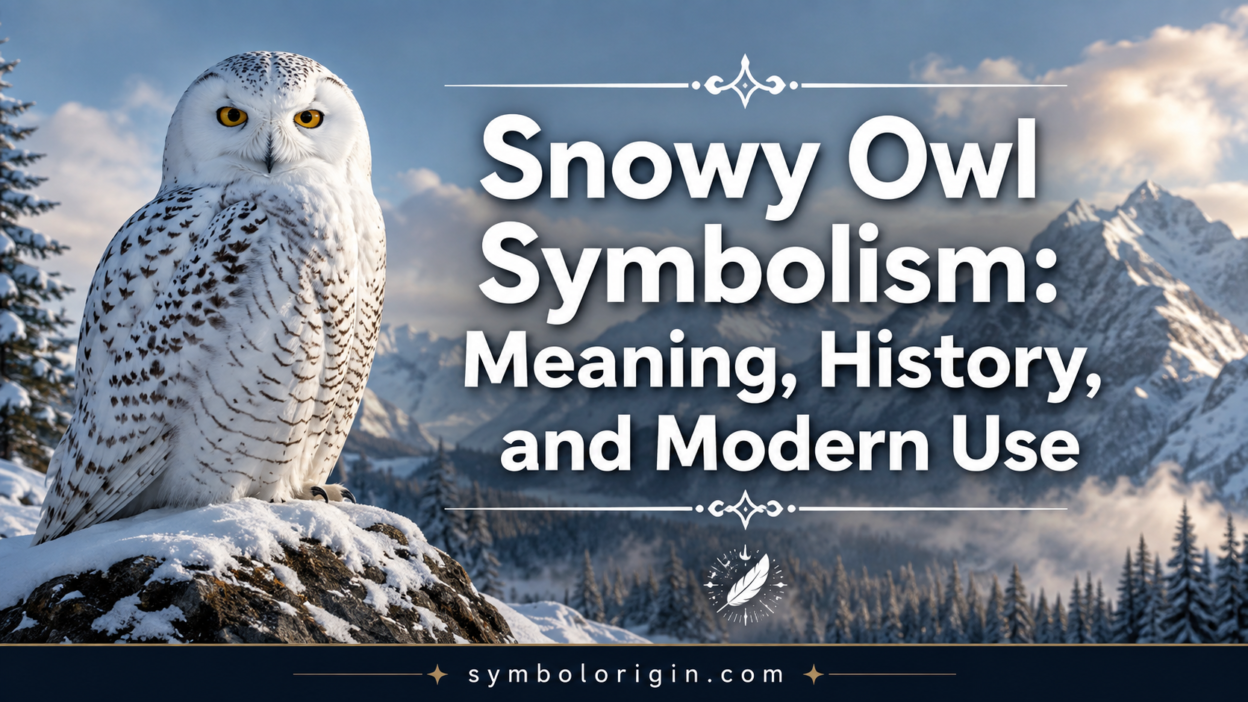
The snowy owl is a large Arctic owl with a rounded head, yellow eyes, heavily feathered legs, and white plumage marked to varying degrees with dark bars or spots. Adult males often become whiter with age, while females and younger birds generally retain heavier dark markings.
That appearance contributes strongly to its modern symbolism.
A mostly white bird standing against snow can seem almost invisible until it moves. Its eyes, by contrast, are immediately noticeable. This combination of concealment and intense visual attention encourages associations with observation, restraint, and noticing what other people miss.
Its physical environment matters too. Snowy owls favor broad, open spaces rather than dense forests. In winter, Americans may see them in fields, coastal dunes, airports, marshes, and other open landscapes resembling their Arctic habitat.
These real characteristics help explain why the bird is frequently used as an image of quiet confidence rather than loud aggression.
What Snowy Owls Commonly Symbolize in the United States
There is no official American meaning assigned to the snowy owl, but several interpretations appear repeatedly in art, tattoos, decor, personal symbolism, and popular culture.
| Context | Common U.S. Meaning | Why the Association Fits | Important Note |
|---|---|---|---|
| Wisdom | Knowledge and good judgment | Inherited from broader owl symbolism | Not unique to snowy owls |
| Awareness | Observation and perception | Strong eyes and hunting behavior | Often interpreted personally |
| Resilience | Endurance under difficulty | Arctic habitat and long movements | Grounded in real ecology |
| Independence | Self-reliance and freedom | Solitary, wide-ranging lifestyle | Should not imply total isolation |
| White plumage | Clarity, winter, simplicity | Visual association with snow | Color meanings vary |
| Popular culture | Magic, loyalty, companionship | Reinforced by fictional snowy owls | A modern association |
The most useful way to understand the bird is therefore as a combination of general owl symbolism and characteristics specific to Arctic life.
Wisdom and Careful Judgment
Wisdom is probably the best-known symbolic meaning attached to owls in modern Western culture.
One historical reason comes from ancient Greek imagery. The owl was sacred to Athena, the goddess associated with wisdom, strategy, and Athens itself. Owls appeared beside Athena and on Athenian objects and coinage.
That tradition concerned owls generally, not the Arctic snowy owl specifically. Modern symbolism often merges the two.
As a result, a snowy owl may represent someone who thinks before acting, watches carefully, learns from experience, or values knowledge over impulse.
Its pale coloring gives that familiar wisdom motif a different emotional tone. Instead of the shadowy scholar or nighttime observer suggested by many owl images, the snowy owl can suggest intelligence that is clear, exposed, and calm.
Awareness, Observation, and Seeing Clearly
Snowy owls are visual hunters that spend considerable time scanning open landscapes. Unlike the common stereotype that every owl belongs to darkness, snowy owls can be highly active during daylight, an adaptation suited to Arctic summers when daylight may continue around the clock.
That makes awareness an especially fitting modern interpretation.
In personal symbolism, the snowy owl can stand for:
- paying closer attention
- noticing details others ignore
- judging a situation before reacting
- becoming more aware of surroundings
- separating useful information from distraction
This does not mean the animal possesses supernatural perception. The symbolism comes from human interpretation of its behavior and distinctive gaze.
For someone choosing a snowy owl as a personal emblem, “awareness” is often more precise than the vague idea of mystery.
Resilience and Survival in Difficult Conditions
The snowy owl is closely associated with the Arctic tundra, where survival requires coping with low temperatures, strong winds, seasonal extremes, and fluctuating prey. The birds may also travel great distances in response to changing conditions.
Because of that ecology, resilience has become one of the bird’s most natural symbolic meanings.
A snowy owl image can communicate:
I can function in difficult circumstances without allowing those circumstances to define me.
That interpretation differs from symbols of brute strength. Snowy owl resilience is more often imagined as patience, adjustment, endurance, and efficient action.
This makes the bird appealing in tattoos or artwork marking recovery from a difficult period, a demanding move, personal growth, or the ability to continue when circumstances change unexpectedly.
Independence, Freedom, and Self-Reliance
Snowy owls often travel across enormous areas, and their movements can be unpredictable from one year to another. Some remain farther north while others migrate south, with occasional irruptions bringing unusually large numbers into parts of the United States.
That wide-ranging life encourages associations with freedom and independence.
In modern symbolism, the bird can represent a person who is comfortable making decisions alone or following a path that differs from what others expect.
There is an important distinction, however. Independence does not automatically mean emotional detachment. Snowy owls reproduce, defend territories, and care for young like other birds.
Symbolically, the stronger interpretation is self-reliance without unnecessary dependence, rather than isolation from everyone else.
Why White Plumage Suggests Clarity and Simplicity
White animals frequently attract symbolic interpretations because their coloring is visually unusual and immediately recognizable.
With snowy owls, white is particularly meaningful because it connects the bird directly with snow and the Arctic landscape. Instead of treating white as automatically “pure” or “holy,” it is more grounded to connect the color with winter, openness, visual simplicity, and adaptation.
In contemporary American design, a snowy owl may therefore suggest:
- clarity
- minimalism
- calm
- winter
- stillness
- renewal
- an uncluttered state of mind
Purity is another common interpretation, but it should be treated as a cultural color association rather than a biological fact.
The snowy owl’s white feathers exist primarily because they are part of the species’ natural appearance and camouflage, not because the animal carries an inherent moral meaning.
The Difference Between Owl Symbolism and Snowy Owl Symbolism
Many online explanations mix all owl traditions together. That creates historical problems.
General owl symbolism may include wisdom, night, secrecy, death, protection, prophecy, intelligence, or fear depending on the culture involved. Those meanings developed around different owl species in different places.
Snowy owl symbolism adds characteristics that ordinary owl imagery does not necessarily contain:
Arctic survival. Few animals are visually connected with extreme northern winter as strongly.
White coloration. This introduces meanings connected with snow, clarity, and visual simplicity.
Open-country behavior. The snowy owl is often seen sitting visibly on the ground or on exposed perches rather than disappearing entirely into forests.
Daylight activity. Its behavior complicates the familiar idea that owls symbolize darkness simply because they are nocturnal.
The result is a symbol that tends to feel more open, stark, and resilient than traditional dark-forest owl imagery.
Ancient Owl Traditions and Their Influence Today
The snowy owl does not have one traceable ancient symbolic origin shared across civilizations.
Instead, modern interpretations often borrow from older beliefs about owls generally.
Ancient Greek culture provides the clearest Western example. Athena’s connection with the owl helped establish an enduring relationship between owls, knowledge, strategic thinking, and intellectual judgment.
Later European traditions were less consistent. Owls could be treated as intelligent creatures in one setting and unsettling nighttime birds in another.
Modern Americans inherit pieces of these traditions through education, literature, art, logos, school mascots, fantasy stories, and ordinary expressions about wise owls.
When these inherited meanings are applied to a snowy owl, they mix with a much newer appreciation of Arctic wildlife.
Snowy Owls in Inuit and Arctic Cultural Contexts
The snowy owl has a much more direct relationship with Arctic peoples than it does with ancient Mediterranean mythology.
In Inuktitut usage, ookpik has been used for the snowy or Arctic owl and became associated with well-known Inuit-made owl figures. Owls have also appeared repeatedly in Inuit graphic art, sculpture, textiles, and other forms of artistic expression.
Artists have not treated the owl in one uniform way. Kenojuak Ashevak, for example, repeatedly explored owl imagery as part of a larger artistic vocabulary involving birds, animals, transformation, pattern, and imaginative form. Her Enchanted Owl became one of the most widely recognized images in Inuit art.
This history is important because phrases such as “Native American owl meaning” can be misleading.
Indigenous peoples across North America do not share one religion, one folklore system, or one interpretation of owls. Different nations and communities may treat particular birds very differently.
It is therefore more respectful to name a specific tradition when reliable information exists rather than claiming that a snowy owl universally represents one idea for all Indigenous peoples.
What the Snowy Owl Means in Modern American Culture
For many Americans, encountering a snowy owl is memorable simply because the species is uncommon across much of the country.
Some snowy owls regularly winter around parts of the Great Lakes, northern Plains, New England, and nearby regions. During strong irruption years, birds can appear much farther south.
These appearances have helped turn the snowy owl into an emblem of wild northern nature.
In wildlife photography, environmental art, winter advertising, and seasonal decor, it can suggest the Arctic without requiring an entire landscape.
For birdwatchers, the symbolism is often less mystical and more emotional. Seeing a snowy owl can represent patience, rarity, discovery, or a memorable encounter with an animal far from its breeding grounds.
This real-world experience has become an important part of the bird’s American meaning.
How Harry Potter Changed the Snowy Owl’s Modern Image
Modern entertainment has had an unusually large effect on how younger generations perceive snowy owls.
Hedwig, Harry Potter’s snowy owl, is portrayed as Harry’s companion and messenger. She is closely associated with loyalty, intelligence, freedom, magical communication, and companionship during periods when Harry feels isolated.
Because the books and films became enormously familiar to American audiences, the snowy owl now carries a fantasy association that would have been far weaker before the series.
For some people, seeing a snowy owl instantly suggests:
- magic
- letters and messages
- loyalty
- friendship
- intelligence
- the wizarding world
Those meanings belong to modern popular culture rather than ancient folklore.
The distinction matters because it shows how symbolism keeps changing. A fictional character can reshape the public image of a real animal within a generation.
Snowy Owl Tattoos and Personal Symbolism
A snowy owl tattoo can carry several meanings depending on its composition.
A flying snowy owl often emphasizes freedom, movement, and independence.
A front-facing owl with prominent eyes may represent perception, judgment, vigilance, or awareness.
A snowy owl surrounded by winter scenery can emphasize survival, endurance, northern identity, or comfort with difficult environments.
A minimalist white owl design may communicate calm, simplicity, or clarity.
Some people use snowy owl tattoos as memorial symbols. In that setting, the bird may represent quiet remembrance, continued guidance, or the personality of the person being honored.
Those meanings are personal rather than universal. A tattoo does not need an ancient tradition behind it to be meaningful.
The strongest designs usually work because the person can explain why the bird’s actual qualities connect with the experience being represented.
Snowy Owls in Jewelry, Decor, Fashion, and Art
In jewelry and decorative design, snowy owls generally communicate a softer set of meanings than they do in tattoos.
An owl pendant may suggest intelligence or watchfulness. White and silver designs often emphasize winter, elegance, or simplicity. Holiday ornaments commonly use snowy owls because their plumage fits naturally with snow-covered seasonal imagery.
Home decor frequently places the bird in rustic, woodland, Scandinavian-inspired, or winter-themed settings.
The species is also attractive to photographers because its pale plumage, bright eyes, and open habitat create visually dramatic images.
These uses have made the snowy owl simultaneously a wildlife symbol and a design motif.
That popularity can reduce the bird to an aesthetic object, but its visual appeal also introduces people to a real Arctic predator with unusual behavior and extensive migrations.
Emotional and Psychological Meaning
As a personal symbol, the snowy owl often communicates composure more than excitement.
Its typical symbolic personality is observant, independent, controlled, and difficult to distract.
Someone drawn to the snowy owl may therefore use it to represent an identity built around:
Quiet confidence. Strength does not require constant display.
Observation before action. Understanding a situation may be more valuable than reacting immediately.
Adaptability. Changing conditions require adjustment rather than panic.
Comfort with solitude. Time alone can support reflection without becoming social withdrawal.
Resilience. Difficult environments can demand new skills rather than surrender.
These are interpretations humans place on the animal. They should not be confused with psychological evidence that seeing or dreaming about an owl reveals a person’s hidden personality.
Spiritual Meaning and the Idea of a Snowy Owl “Sign”
Modern spiritual communities sometimes interpret a snowy owl encounter as a message about clarity, intuition, transition, protection, or paying attention.
Those interpretations belong to personal spiritual belief rather than established biological fact.
A rare wildlife encounter can certainly feel meaningful. Someone going through a major decision may remember seeing a snowy owl and connect that moment with patience or awareness.
The meaning comes from the relationship between the experience and the person’s circumstances.
It is unnecessary to claim that the bird predicts an event.
A grounded spiritual interpretation would therefore be: the snowy owl can serve as a reminder to observe carefully and respond thoughtfully, rather than proof that a supernatural message has been delivered.
Common Misunderstandings About Snowy Owl Symbolism
Several popular claims deserve caution.
“Snowy owls always symbolize death.”
No. Some cultures have traditions in which certain owls can be associated with death, warning, or the spirit world, while others give owls protective or positive roles. Applying one tradition to every owl and every culture is inaccurate.
“A snowy owl is universally a symbol of wisdom.”
Wisdom is a very common Western interpretation, strongly influenced by broader owl imagery, but it is not universal.
“White snowy owls symbolize spiritual purity.”
That is a modern color-based interpretation, not an objective property of the species.
“Seeing one means something will happen.”
Wild snowy owls move according to food availability, migration patterns, breeding conditions, weather, and other ecological factors. Their appearance does not provide evidence of a future personal event.
“All Indigenous traditions give owls the same meaning.”
They do not. Indigenous cultures are distinct, and their stories and beliefs should not be blended into a single generic interpretation.
How Snowy Owl Symbolism Has Evolved
The meaning of the snowy owl today is layered rather than fixed.
Older Western owl traditions contributed wisdom and intellectual awareness. Arctic environments added resilience, endurance, snow, and northern identity. Inuit artistic traditions made owls an important and highly visible subject in major works of northern art.
Wildlife photography and birdwatching then strengthened the image of the snowy owl as a rare visitor from the Arctic.
Popular entertainment added another layer. Hedwig brought ideas of loyalty, magical communication, companionship, and fantasy to millions of people.
Modern tattoos and personal spirituality have expanded the symbol further toward independence, awareness, emotional resilience, and life transitions.
None of those meanings completely replaces the others.
Instead, the snowy owl has become a good example of how symbolism evolves when biology, history, art, personal experience, and entertainment overlap.
FAQs
Is a snowy owl a good symbol?
A snowy owl is generally a positive symbol in modern American use, especially when it represents wisdom, resilience, independence, or awareness. Negative interpretations usually come from broader cultural traditions involving owls rather than from one universal meaning attached specifically to snowy owls.
What does a snowy owl symbolize spiritually?
In contemporary spirituality, a snowy owl may represent clarity, intuition, watchfulness, transition, or the need to observe before acting. These are personal or religious interpretations rather than scientifically established messages.
What does a snowy owl tattoo mean?
Snowy owl tattoos commonly represent wisdom, independence, resilience, freedom, and careful observation. White plumage and winter imagery can add meanings related to calm, clarity, survival, or connection with northern landscapes.
Does a snowy owl symbolize wisdom?
Yes, wisdom is one of its most common modern meanings. However, that association largely comes from older Western owl symbolism, including the owl’s historical connection with Athena, rather than from an ancient tradition centered specifically on snowy owls.
Is seeing a snowy owl considered good luck?
Some individuals may interpret an unusual encounter as fortunate, but there is no universal tradition establishing snowy owls as signs of good luck. In the United States, a sighting is often considered special because the birds are seasonal or uncommon visitors across much of the country.
What does a white owl symbolize compared with a regular owl?
White owl imagery tends to add associations with snow, clarity, winter, simplicity, or renewal to the familiar owl themes of observation and wisdom. Those color meanings are culturally created and should not be treated as universal rules.
Are snowy owls symbols of death?
Not universally. Some traditions connect certain owls with death or warnings, but others associate owls with protection, knowledge, or other ideas, so describing the snowy owl as a universal death symbol oversimplifies diverse beliefs.
Conclusion
Snowy owl symbolism combines wisdom and awareness with qualities that come directly from the bird’s Arctic life: resilience, adaptability, independence, patience, and the ability to function in difficult surroundings.
Its meaning has never belonged to one tradition alone. Ancient owl imagery contributed associations with wisdom; Arctic cultures developed their own relationships with owls; wildlife encounters gave Americans an image of a rare northern visitor; and modern entertainment added loyalty, magic, and companionship.
Perhaps the most grounded way to interpret the snowy owl today is as a symbol of clear observation and steady adaptation. It survives not by appearing stronger than its environment, but by being remarkably well suited to it.