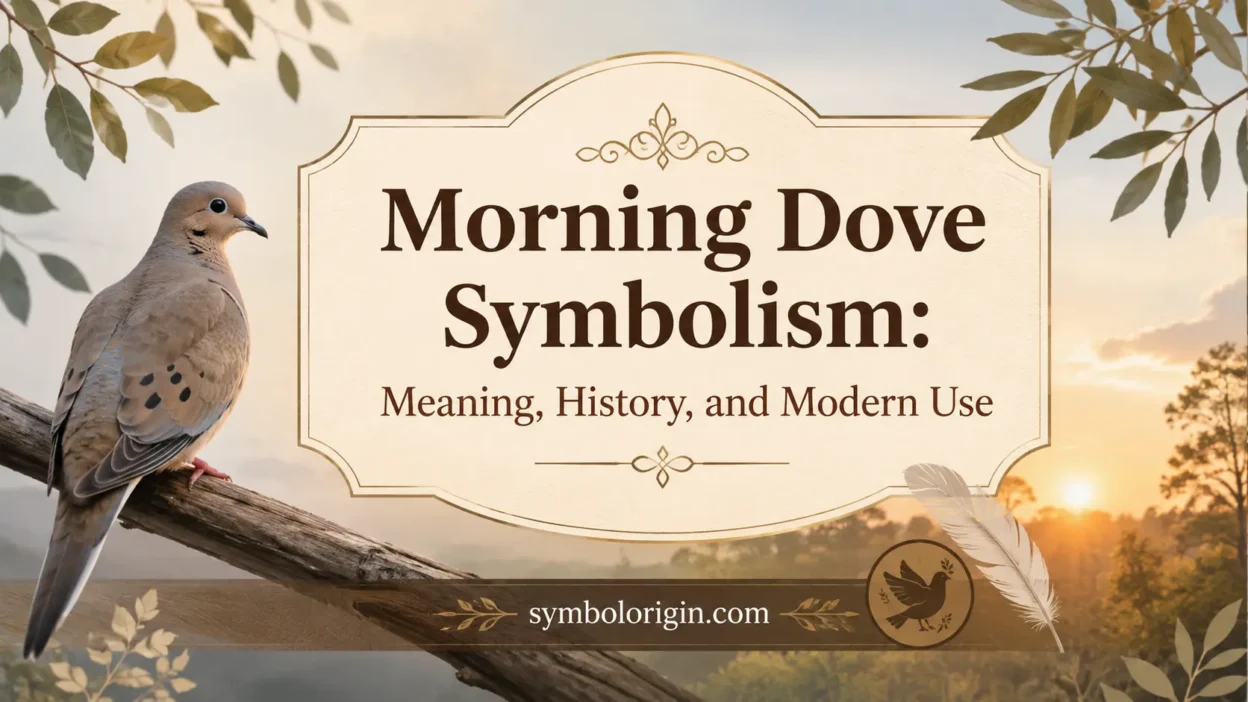
The soft call of a dove at sunrise can sound peaceful to one person and almost sorrowful to another. That emotional contrast helps explain why morning dove symbolism is commonly associated with peace, remembrance, love, grief, hope, and emotional renewal in American culture.
The bird people usually mean by “morning dove” is actually the mourning dove, scientifically known as Zenaida macroura. Its name refers to its long, plaintive coo, which early listeners compared with the sound of mourning or lament.
Mourning doves are familiar across much of the United States. They perch on telephone wires, feed in lawns and fields, visit backyard feeders, and nest surprisingly close to homes. Because Americans encounter them in ordinary surroundings, their symbolism often feels personal rather than distant or ceremonial.
Their meaning also overlaps with the broader symbolism of doves, especially ideas of peace, devotion, spirituality, and hope. Still, some meanings attached specifically to mourning doves come from their gentle appearance, paired behavior, quiet presence, and melancholy-sounding call.
Quick Answer
Morning dove symbolism commonly represents peace, remembrance, faithful love, emotional healing, and hope in modern American culture. Historically, these meanings developed from broader dove traditions involving peace and devotion, while the mourning dove’s sorrowful call added strong associations with grief, memory, and comfort after loss.
TL;DR
- Mourning doves commonly represent peace, remembrance, love, and emotional healing.
- Their mournful call explains their strong connection with grief and reflection.
- Dove traditions contributed older meanings of peace, devotion, and hope.
- Americans often connect sightings with deceased loved ones or comforting memories.
- Paired behavior encourages symbolism of commitment, partnership, and loyalty.
- Modern uses include tattoos, memorial art, jewelry, and home decor.
What a Mourning Dove Looks and Sounds Like
The mourning dove is a slender, medium-sized bird with a small head, pointed wings, and a long tapered tail. Its plumage is mostly soft gray-brown, often with subtle pinkish or warm tones on the chest and dark spots on the wings.
Its understated coloring contributes to its symbolic character. Unlike brightly colored birds that attract attention immediately, the mourning dove often blends into yards, roadsides, open woodland, farms, parks, and suburban areas.
The feature people notice most, however, is its voice.
A male mourning dove produces a low, drawn-out coo that can sound like “oo-AH-oo-oo-oo.” People unfamiliar with the species sometimes mistake the sound for an owl. Its slow rhythm also resembles a sigh or lament, which explains the word mourning in the bird’s common name.
That sound plays a major role in symbolism. A cheerful birdcall may suggest celebration, but the mourning dove’s call tends to encourage stillness and reflection. This is one reason the bird is frequently associated with memory, grief, quietness, and contemplation.
What Mourning Doves Commonly Symbolize
In modern American interpretation, mourning doves usually carry several overlapping meanings rather than one fixed definition.
| Context | Common Meaning in the USA | Why the Association Exists | Typical Use |
|---|---|---|---|
| Peace | Calm, reconciliation | Gentle appearance and wider dove symbolism | Art, decor, spiritual imagery |
| Grief | Mourning, remembrance | Sad-sounding call and name | Memorials, tattoos, sympathy imagery |
| Love | Loyalty, companionship | Strong pair bonds and courtship behavior | Wedding art, jewelry, tattoos |
| Hope | Recovery after difficulty | Quiet presence after sadness | Inspirational art and personal symbolism |
| Home | Safety, familiarity | Common nesting around human homes | Backyard and family symbolism |
| Spirituality | Comfort or perceived messages | Personal beliefs about meaningful encounters | Memorial posts and spiritual reflection |
These meanings should be understood as cultural interpretations rather than scientific facts. A mourning dove does not appear because a particular event is destined to happen. Symbolism develops because people connect the bird’s appearance and behavior with their own experiences.
Peace and the Wider Tradition of Dove Symbolism
Peace is probably the most recognizable meaning connected with doves.
Across Western culture, the image of a dove has long served as a symbol of peace, reconciliation, innocence, and the ending of conflict. White doves are especially prominent in this tradition, but those associations often extend to other members of the dove family.
The mourning dove adds a quieter version of this symbolism.
Its soft coloration, gentle movements, and subdued call can suggest calm rather than triumph. For many Americans, seeing one sitting quietly on a fence, branch, rooftop, or power line creates a moment of stillness.
For that reason, the bird can symbolize the return of peace after emotional conflict. Someone going through family tension, a breakup, bereavement, or another difficult period may interpret the dove as a reminder that calm can eventually return.
This interpretation does not require a supernatural belief. The bird can simply function as a visual metaphor for slowing down and allowing emotional intensity to settle.
Why Mourning Doves Symbolize Grief and Remembrance
Grief is one of the meanings most specifically associated with the mourning dove rather than doves in general.
The connection begins with sound. Its call resembles lamenting closely enough that English speakers gave the species its familiar name.
As a result, mourning doves became easy symbols for emotional absence, memory, and quiet sorrow.
In modern American memorial culture, people sometimes encounter a mourning dove shortly after losing a parent, spouse, friend, or other loved one. Because grief naturally heightens awareness of emotionally meaningful events, the sighting may become attached to that person’s memory.
For some, the bird represents the sadness of separation. For others, it represents comfort during the process of accepting a loss.
This distinction matters. Mourning dove symbolism is not simply about sadness. It often represents grief moving toward peace.
That combination helps explain why images of doves appear in memorial art, cemetery decorations, sympathy cards, remembrance jewelry, tattoos, and online tributes.
Love, Partnership, and Faithfulness
Mourning doves are also connected with romantic and family symbolism.
During courtship and pair bonding, mourning doves perform coordinated behaviors, including mutual preening and close physical interaction. Mated birds may often be seen together, reinforcing the human impression of companionship.
People have long interpreted paired birds as symbols of lovers. Doves are especially suited to this imagery because they generally appear gentle rather than aggressive.
A pair of mourning doves can therefore represent:
- mutual affection
- partnership
- commitment
- emotional closeness
- marriage
- companionship through difficulty
In wedding symbolism, two doves may signify two people joining their lives while maintaining a peaceful relationship.
The symbolism should not be exaggerated into claims that mourning doves demonstrate human-style lifelong romance in every circumstance. Their actual breeding behavior is biological, while ideas about marriage and devotion come from human interpretation.
Even so, the visible closeness of paired doves gives the symbolism a recognizable natural foundation.
Hope and Emotional Renewal
A bird associated with mourning may seem like an unusual symbol of hope, yet the two meanings often appear together.
Grief rarely remains emotionally identical forever. Memories change, pain becomes easier to carry, and daily life gradually continues.
For that reason, the mourning dove may represent the transition from sorrow toward acceptance.
Its familiar presence can also make the symbolism feel reassuring. Mourning doves return to feeders, courtyards, porches, parks, farms, and neighborhood trees as part of ordinary life. Their repeated appearance suggests continuity.
Someone who has experienced a difficult year may interpret a dove as a reminder that life continues even after disruption.
In this sense, hope does not mean pretending that sadness never occurred. Instead, the bird symbolizes the possibility of finding calm while still remembering what was lost.
Home, Safety, and Familiar Places
Mourning doves frequently live close to people.
They may nest in trees, shrubs, vines, gutters, building ledges, and other structures around homes. They also forage openly on lawns and beneath backyard feeders.
That everyday familiarity gives the bird another symbolic meaning: home.
A mourning dove near a porch or garden may represent domestic calm, belonging, or the comfort of familiar surroundings.
This interpretation differs from the symbolism of migratory animals that represent adventure or departure. Mourning doves often appear settled into ordinary human environments.
Their symbolism can therefore fit ideas such as creating a peaceful household, returning home after a difficult period, protecting family bonds, or appreciating quiet domestic life.
In home decor, dove imagery sometimes communicates exactly this type of atmosphere: gentleness, simplicity, and emotional safety.
Mourning Doves in Christian Interpretation
Doves hold an important place in Christian symbolism, but one distinction is necessary: biblical passages generally refer to doves as birds, not specifically to the North American species known as the mourning dove.
In Christianity, the dove is strongly associated with the Holy Spirit, purity, peace, divine presence, and reconciliation.
The symbolism also connects with the biblical account of Noah, in which a dove returns with an olive leaf after the flood. In later Christian interpretation, the image became closely connected with peace, hope, and restoration.
Because mourning doves belong to the dove family, American Christians sometimes extend these familiar meanings to them.
A mourning dove appearing during prayer, bereavement, or another emotional moment may therefore be personally interpreted as a reminder of God’s peace or comfort.
However, describing every mourning dove encounter as a biblical message goes beyond what scripture itself states. Christian symbolism provides a framework for interpretation, while the meaning of an individual sighting remains a matter of personal belief.
Mourning Doves and Spiritual Messages
One of the most common modern beliefs surrounding mourning doves is that they may appear as messages from deceased loved ones.
This idea is especially visible in memorial communities, personal spirituality, social media posts, and grief-related conversations.
Someone might see a dove outside a window on an anniversary and feel that the encounter represents the continuing presence of a loved one’s memory.
Another person may view the same bird simply as wildlife.
Neither response changes what the bird biologically is. The symbolic interpretation comes from the human experience surrounding the encounter.
It is therefore more accurate to say that mourning doves can serve as personal symbols of connection with someone who has died rather than claiming they objectively carry messages from the dead.
That distinction keeps emotional symbolism meaningful without presenting personal belief as established fact.
Cultural Meaning Requires Careful Interpretation
It is common for online symbolism articles to assign one universal “Native American meaning” to an animal. That approach is misleading.
Indigenous nations across North America have different languages, religious traditions, histories, stories, and relationships with birds. A meaning found in one community cannot automatically be applied to another.
Doves and related birds may appear in particular stories or cultural practices, but there is no single Indigenous interpretation that represents every nation.
The same caution applies internationally.
Pigeons and doves have appeared in Mediterranean religion, Jewish and Christian traditions, European art, Asian cultures, and many local folk traditions. Their meanings include peace, sacrifice, love, purity, fertility, devotion, and communication.
Modern mourning dove symbolism in the United States inherits some of this broader dove imagery while also developing meanings connected specifically with the North American bird’s call and familiar presence.
Why the Bird Can Represent Silence and Reflection
Mourning doves are not completely silent birds, yet their symbolic atmosphere is often quiet.
Their call is slow rather than frantic. Their muted coloring rarely dominates a landscape. Even when they live near busy human spaces, they often sit motionless for noticeable periods.
These characteristics encourage symbolic connections with introspection.
A mourning dove can therefore represent the need to think before reacting, accept an uncomfortable emotion, spend time alone, or listen rather than speak.
This interpretation is especially common when someone notices the bird during an emotionally complicated period.
In psychological terms, the bird may act as a focus for reflection. Human beings naturally attach meaning to memorable sights and sounds, especially when those experiences occur during grief, stress, love, or major life transitions.
The symbolism becomes emotionally useful because it gives an abstract feeling a visible form.
What Seeing a Mourning Dove May Mean Personally
Seeing a mourning dove does not have one predetermined meaning.
Context matters more than any fixed symbolic dictionary.
If you see one after losing someone, remembrance may be the strongest association. During conflict, the bird may suggest peace. Around a wedding or relationship milestone, paired doves may bring commitment to mind.
A dove nesting near your home may simply make you think about family, protection, or belonging.
Personal symbolism becomes meaningful when the association fits the experience rather than when a person forces an event into a prediction.
For that reason, a useful question is not “What is the bird trying to tell me?” but “Why did seeing this bird matter to me at this particular moment?”
That approach allows symbolism to remain reflective without turning an ordinary wildlife encounter into certainty about future events.
Mourning Dove Symbolism in Tattoos
Mourning dove tattoos commonly focus on remembrance, peace, love, and survival after loss.
A single dove may symbolize a deceased family member or a period of grief. Two doves can represent a couple, marriage, partnership, or reunion.
Design details can change the meaning.
A dove with flowers may emphasize memory or affection. Names and dates turn the image into a direct memorial. An olive branch usually strengthens the meaning of peace. Open wings may suggest freedom, release, or moving forward.
Some people choose a mourning dove rather than a white dove because the species feels more personal and recognizable. A bird that regularly appeared in a grandparent’s yard, for example, may carry a stronger memory than a generic peace dove.
As a tattoo, the mourning dove usually communicates something quiet rather than confrontational. Its meaning often centers on carrying a memory without allowing grief to define an entire life.
Jewelry, Memorial Art, and Home Decor
Dove imagery appears frequently in necklaces, charms, urn decorations, memorial plaques, garden stones, wall art, wedding accessories, and home decorations.
In memorial jewelry, the bird may represent continuing love after death.
In wedding pieces, two doves usually suggest harmony and partnership.
In gardens, a dove sculpture can create an atmosphere of peace while also serving as a private remembrance marker.
Home decor often uses doves differently. Rather than referring directly to grief, the image may communicate serenity, hospitality, gentleness, or family harmony.
The bird’s subdued gray and brown tones also work well in natural, rustic, farmhouse, and minimalist design styles.
This variety shows how symbols change with context. The same bird can communicate mourning on a cemetery marker and peaceful domestic life on a decorative print.
Is Mourning Dove Symbolism Positive or Negative?
Mourning dove symbolism is mainly positive, although it contains an element of sadness.
Its connection with grief can make the bird seem negative at first. Yet grief symbolism is not the same as symbolism of danger or bad luck.
In most modern American interpretations, the mourning dove does not predict death.
Instead, it tends to represent how people respond to loss: remembering someone, seeking peace, maintaining love, and gradually accepting change.
The bird may feel melancholy because of its call, but melancholy can be reflective rather than threatening.
This balance between sadness and comfort is one reason the mourning dove has such distinctive symbolism. It does not represent happiness without difficulty. It represents calm that can exist alongside memory.
Common Misunderstandings About Mourning Doves
Several popular claims about mourning doves should be treated carefully.
One is that every dove sighting is automatically a sign from the spirit world. That is a spiritual interpretation, not a verifiable rule.
Another is that the Bible specifically identifies the American mourning dove as a sacred messenger. Biblical dove imagery is important, but the modern species name should not be inserted into ancient texts without evidence.
A third misunderstanding is that mourning doves are universally sacred across Indigenous cultures. Indigenous traditions are far too diverse for a single meaning to be applied to all communities.
There is also an interesting contrast between symbolic and practical American views of the bird. Mourning doves may appear in memorial art and spiritual imagery, yet they are also legally hunted as game birds in many parts of the United States.
That contrast demonstrates an important principle of symbolism: cultural meanings are rarely universal. The same animal can hold emotional, religious, recreational, ecological, and everyday meanings at the same time.
How the Meaning Has Changed Over Time
The modern meaning of the mourning dove developed from several layers of interpretation.
Older traditions surrounding doves contributed associations with love, peace, devotion, sacrifice, purity, and spiritual life.
The mourning dove’s distinctive call added another layer. English-speaking listeners heard something sorrowful in the sound, giving the North American bird an identity closely linked with lament and remembrance.
During the modern era, particularly in American memorial and popular culture, those meanings expanded.
Today, people may use mourning dove imagery to remember someone who died, express emotional healing, celebrate a relationship, decorate a peaceful home, or describe a meaningful wildlife encounter.
Social media has strengthened another interpretation: the mourning dove as a personal sign from someone who has passed away.
That belief should be understood as a contemporary spiritual or emotional interpretation rather than a universal historical tradition.
The bird’s symbolism continues to evolve because people keep encountering mourning doves in places connected with everyday memory—backyards, porches, family homes, parks, cemeteries, and neighborhood streets.
Why Mourning Doves Feel Meaningful in American Life
The mourning dove’s symbolic importance comes partly from familiarity.
Americans do not usually need to travel into wilderness to see one. Mourning doves live alongside people in cities, suburbs, farmland, and rural communities across a large part of the country.
That closeness allows personal memories to form around them.
Someone may remember hearing their calls outside a childhood home. Another person may associate them with mornings spent with a grandparent. Someone grieving may notice one repeatedly near a porch and connect its sound with the person they miss.
These experiences transform an ordinary native bird into a personal symbol.
The mourning dove also combines several emotional qualities that rarely appear together in one image: sadness without despair, gentleness without weakness, companionship without spectacle, and peace without celebration.
That emotional balance explains much of its continuing appeal.
Frequently Asked Questions
What does it mean when a mourning dove visits you?
A mourning dove visit is commonly interpreted as a symbol of peace, remembrance, or emotional reassurance. The bird is also widespread around American homes, so a visit can be completely ordinary wildlife behavior while still holding personal meaning for the observer.
Does a mourning dove symbolize someone who has died?
It can symbolize a deceased loved one in modern memorial and spiritual traditions. Many people use the bird as a personal reminder of someone they miss, but there is no factual basis for saying every mourning dove is literally carrying a message from the dead.
Are mourning doves a sign of good luck?
They are not traditionally defined as universal good-luck birds. However, their associations with peace, love, hope, and renewal can make an encounter feel encouraging, particularly during a difficult period.
What does a pair of mourning doves symbolize?
Two mourning doves often represent companionship, commitment, partnership, or romantic love. The symbolism is reinforced by their visible courtship and pair-bonding behavior, which makes paired doves a natural image for couples.
What does a mourning dove mean in Christianity?
Christian interpretation usually draws from broader biblical dove symbolism, which includes the Holy Spirit, peace, purity, reconciliation, and hope. The Bible does not specifically assign those meanings to the North American mourning dove species, so the connection is an extension of general dove symbolism.
What does a mourning dove tattoo mean?
A mourning dove tattoo commonly represents remembrance, peace after loss, love, commitment, or emotional recovery. Memorial dates, flowers, names, olive branches, or paired birds can make the intended meaning more specific.
Is seeing a mourning dove a warning?
Mourning doves are not generally regarded in modern American culture as warnings of danger or approaching death. Their sad-sounding call can create a melancholy impression, but their symbolism is more often connected with comfort, remembrance, peace, and reflection.
Conclusion
The mourning dove has become meaningful because its natural qualities closely match emotions people often struggle to express. Its soft call evokes mourning, its gentle appearance suggests peace, its paired behavior encourages associations with love, and its familiar presence near American homes makes it easy to connect with personal memories.
In modern American culture, morning dove symbolism most often brings together remembrance, calm, faithful love, hope, and emotional healing. Religious tradition and older dove imagery contributed part of that meaning, while the mourning dove’s distinctive call and everyday presence gave the symbol its uniquely reflective character.
A mourning dove does not need to predict the future or carry a supernatural message to be meaningful. Sometimes its greatest symbolic value lies in the simple fact that a familiar bird can make someone stop, remember, and find a quiet moment of peace.