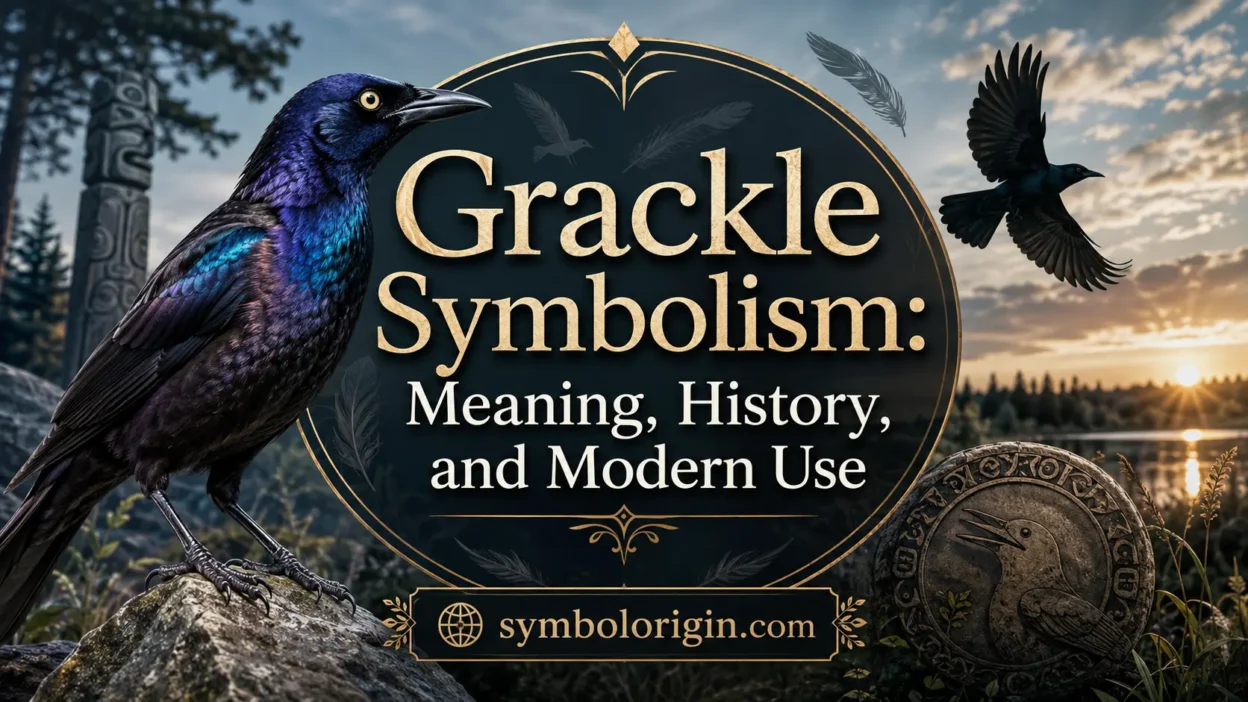
Grackles are among the most recognizable blackbirds in many American neighborhoods. Their metallic feathers, pale eyes, noisy calls, confident walk, and habit of thriving around people give grackle symbolism an unusual mix of meanings centered on adaptability, resourcefulness, communication, and self-assurance.
Unlike birds such as the dove or bald eagle, the grackle does not have one fixed symbolic definition carried through centuries of Western art. Much of its modern meaning comes directly from observing how the bird lives: it adjusts quickly, eats opportunistically, gathers socially, makes itself heard, and often succeeds in environments dramatically altered by humans.
That makes the grackle especially relevant as a contemporary symbol. It can represent the ability to function in imperfect circumstances without losing individuality, while its loud communal behavior also raises themes of confidence, cooperation, visibility, and occasionally conflict.
Quick Answer
Grackle symbolism most commonly represents adaptability, resourcefulness, confidence, communication, and strength within a community. Its darker plumage and forceful behavior can also suggest mystery, assertiveness, or disruption, while some Mexican traditions connect the Great-tailed Grackle with song and the full range of human emotion.
TL;DR
- Grackles commonly symbolize adaptability, resourcefulness, and confident self-expression.
- Their large flocks can represent community, cooperation, and collective strength.
- Iridescent feathers suggest complexity hidden beneath an ordinary exterior.
- Loud calls make the bird a natural symbol of communication.
- Modern American meanings often reflect the grackle’s success in human environments.
What Is a Grackle?
Grackles are long-bodied members of the New World blackbird family, Icteridae. Several species carry the name, but Americans most often encounter the Common Grackle, Great-tailed Grackle, and Boat-tailed Grackle.
The Common Grackle occurs widely across eastern and central North America. From a distance it can appear nearly black, but sunlight reveals bronze, violet, green, and blue iridescence across its feathers. Its bright yellowish eyes, long bill, and elongated tail give it an especially alert appearance.
Great-tailed Grackles are particularly familiar in Texas, the Southwest, and the southern Great Plains. Males have glossy dark plumage and dramatically long tails, while females are brown and noticeably smaller. The species regularly uses lawns, parking lots, agricultural areas, parks, and other landscapes shaped by people.
These physical and behavioral characteristics matter because most modern symbolic interpretations develop from what people repeatedly notice about the birds.
What Grackles Commonly Symbolize
The strongest modern interpretations of the grackle come from its observable behavior rather than from a single ancient symbolic system.
| Context | Common Meaning in the USA | Why the Association Fits |
|---|---|---|
| Urban environments | Adaptability | Grackles function well around changing human landscapes |
| Opportunistic feeding | Resourcefulness | They make use of many available food sources |
| Large flocks | Community | They gather and roost in substantial social groups |
| Loud vocalizations | Communication | Their varied calls make them difficult to ignore |
| Iridescent feathers | Hidden complexity | Their apparent blackness changes dramatically in light |
| Bold behavior | Confidence | They often move through crowded spaces assertively |
Because several of these traits occur together, the grackle can symbolize a person who survives through flexibility while still maintaining a noticeable identity.
It is therefore less a symbol of quiet endurance than of active adjustment. The bird does not simply tolerate change. It finds ways to use altered circumstances to its advantage.
Why Iridescent Feathers Shape the Meaning
A grackle can look plain black until light strikes its feathers at the correct angle. Then purple, blue, bronze, or green becomes visible.
That visual change naturally supports interpretations involving complexity, perspective, and looking beyond first impressions. Something initially dismissed as ordinary can reveal considerable variation when viewed more carefully.
The symbolism is especially appropriate because grackles themselves are frequently underestimated. A person seeing a flock in a grocery-store parking lot may regard the birds as little more than noisy black shapes. A closer look reveals elaborate plumage, unusual eyes, complex behavior, and a surprisingly varied vocal repertoire.
In personal symbolism, the iridescence can therefore represent an identity that cannot be understood from surface appearances alone. It may suit someone who appears reserved, unconventional, or ordinary from a distance but possesses qualities that become visible through familiarity.
It should not, however, automatically be interpreted as supernatural transformation. The connection works perfectly well as a visual metaphor grounded in the bird’s actual plumage.
Adaptability and Resourcefulness
Adaptability is probably the clearest symbolic meaning associated with grackles today.
They use fields, suburbs, wetlands, lawns, shopping centers, roadsides, agricultural landscapes, and city environments. Great-tailed Grackles have dramatically expanded their geographic range, and research has linked their success in new environments with behavioral flexibility and persistence.
This makes the bird an effective symbol for adjusting to conditions that were not designed for you.
A grackle-inspired interpretation of adaptability is not about surrendering identity to fit in. The bird remains conspicuous. It changes its behavior when useful while retaining the traits that make it recognizable.
Resourcefulness follows naturally from the same behavior. Grackles forage for insects, grain, seeds, discarded food, and many other available resources. Their willingness to exploit opportunities can symbolize practical intelligence, improvisation, and making something useful from limited circumstances.
For someone experiencing a career change, relocation, financial uncertainty, or a new social environment, the grackle can therefore represent flexible problem-solving rather than passive optimism.
Community and Social Intelligence
Grackles are highly social birds. Common Grackles frequently gather with other blackbirds, while Great-tailed Grackles can form enormous communal roosts.
These gatherings make community one of the bird’s most natural symbolic associations. Great-tailed Grackle flocks may number in the thousands, with birds dispersing to feed and later returning to shared roosting locations.
Symbolically, this can represent the practical value of belonging to a group.
The meaning differs slightly from symbols of family devotion. Grackle communities are noisy, competitive, active spaces. Individuals still jostle for position and resources. As a result, their social symbolism fits communities where cooperation and individuality coexist rather than idealized harmony.
A flock can therefore suggest networking, mutual awareness, collective protection, shared resources, or the ability to function among strong personalities.
It may also offer a useful reminder that independence does not always require isolation.
Voice, Communication, and Being Heard
Anyone familiar with a large grackle gathering understands why the bird becomes associated with communication.
Common Grackles produce whistles, croaks, squeaks, harsh calls, and a short song sometimes compared to the sound of a rusty gate. Great-tailed Grackles possess an even wider range of whistles, rattles, and other striking vocalizations.
Their symbolic connection with communication is therefore straightforward: grackles make themselves audible.
In personal interpretation, the bird may represent speaking clearly, expressing feelings, contributing to a group, or refusing to remain invisible simply because one’s style of communication differs from what others expect.
There is also a caution within this symbolism. Being heard and communicating effectively are not identical.
A noisy flock can symbolize the difference between meaningful expression and constant broadcasting. Depending on context, a grackle can therefore represent either finding your voice or learning when that voice will be most effective.
Confidence, Assertiveness, and Boundaries
Grackles rarely create an impression of timidity.
They walk deliberately across lawns and pavement, compete around food sources, occupy visible perches, and may dominate smaller birds at feeding locations. This behavior has helped produce modern associations with confidence and assertiveness.
The distinction between confidence and aggression matters.
As a personal symbol, the grackle works best when interpreted as willingness to occupy space rather than permission to disregard everyone else. Assertiveness means protecting one’s needs, expressing preferences, and refusing unnecessary submission while remaining aware of others.
That interpretation is especially relevant for people who habitually make themselves smaller to avoid attention.
The bird can function as a reminder that visibility itself is not arrogance.
Historical Background of the Grackle
The symbolic history of grackles differs from that of animals with well-established roles in European mythology or Christian iconography.
Even the English name reflects comparison rather than an ancient American symbolic tradition. The word grackle entered English in the eighteenth century and traces through New Latin to a Latin term associated with the jackdaw, a different dark-colored bird of the Old World.
European settlers therefore encountered American grackles while already carrying cultural ideas about other dark birds such as crows, ravens, and jackdaws.
This helps explain why grackles are sometimes casually assigned symbolism associated with those birds, including prophecy, death, supernatural knowledge, or trickery.
Such overlap should be treated cautiously. Grackles are not crows or ravens, and symbolic traditions belonging specifically to corvids cannot automatically be transferred to them.
Modern grackle symbolism has developed much more strongly from direct encounters with the living bird.
The Mexican Zanate Tradition
The Great-tailed Grackle has a particularly important cultural presence in Mexico, where it is widely known as the zanate.
One popular Mexican folk story tells of the zanate acquiring or stealing seven songs from a sea turtle. Different retellings connect those songs with human passions or emotional states such as love, fear, courage, joy, sadness, anger, and hate.
The story fits the bird remarkably well because Great-tailed Grackles produce an unusually varied assortment of sounds.
Within that cultural setting, the bird can be understood not merely as noisy but as possessing many voices. Symbolically, it becomes connected with emotional range, storytelling, expression, and the ability to move among contrasting feelings.
This tradition should be identified specifically as Mexican rather than generalized into a universal meaning for every grackle species or every culture of the Americas.
What Grackles Symbolize in the United States
In the United States, grackle imagery is strongly shaped by everyday encounters rather than formal ceremony.
Americans see these birds on lawns, campuses, power lines, farm fields, suburban streets, supermarket parking lots, beaches, golf courses, and city trees. Their closeness to ordinary life gives them a very different symbolic tone from uncommon birds encountered primarily in wilderness.
A grackle can represent survival inside the modern human landscape.
This makes adaptability particularly relevant in U.S. interpretation. The bird succeeds beside traffic, buildings, commercial development, discarded food, irrigation, landscaping, and other products of human activity.
In Texas and parts of the Southwest, the Great-tailed Grackle has become especially recognizable as part of everyday urban identity. Writers and residents sometimes treat its bold personality with a mixture of annoyance and affection.
That combination has produced a modern image of the grackle as an unapologetic survivor: noisy, difficult to overlook, opportunistic, and entirely comfortable occupying spaces humans consider their own.
Urban Grackles and the Parking-Lot Image
Few birds are as strongly associated with parking lots and commercial spaces in parts of the United States as the grackle.
That setting might initially appear unromantic, but it gives the bird unusually contemporary symbolism.
A parking lot is an artificial environment built for cars and commerce, not wildlife. Yet grackles turn such spaces into feeding grounds, meeting places, and stages for social behavior.
As a metaphor, the urban grackle suggests creating opportunity in environments that offer little obvious beauty or support.
It can represent resilience without romanticizing hardship: use what is available, remain observant, move when circumstances change, and do not wait for perfect conditions before functioning effectively.
The image also explains why some Americans identify the bird with outsider confidence. Grackles behave as though environments designed without them in mind still contain room for them.
Grackles in Tattoos, Art, and Personal Style
A grackle tattoo can carry several meanings depending on pose and design.
An iridescent bird shown in sunlight may emphasize individuality, complexity, and being underestimated. A calling grackle can represent outspoken communication or finding one’s voice. Several birds together may symbolize friendship, chosen community, or collective survival.
A solitary bird perched prominently can communicate independence and self-possession.
Because the grackle lacks one universally recognized tattoo meaning, the wearer has more freedom than with established symbols such as hearts, anchors, or mourning doves. That flexibility can be useful, although it also means the intended meaning may need explanation.
Artists are often drawn to the contrast between dark plumage and hidden color. Purple, blue, bronze, and green highlights can turn a seemingly monochrome subject into something visually complex.
In decor or illustration, that same effect works well for themes involving individuality, urban nature, unconventional beauty, and overlooked wildlife.
Emotional and Psychological Meaning
Psychologically, the grackle often works as a symbol of self-acceptance without requiring social withdrawal.
The bird is conspicuous, vocal, communal, and adaptable. These qualities can represent a person learning to participate in a group while remaining comfortable with traits that make them noticeable.
Its symbolism may also resonate with someone who has been dismissed because of appearance, background, communication style, or unconventional behavior.
The grackle’s iridescence supports another psychological metaphor: perception changes when attention changes.
What looks flat from one position becomes colorful from another. In human terms, that can represent reconsidering a situation, identity, or person before settling on a first judgment.
Its opportunistic behavior can additionally symbolize practical resilience. Instead of waiting for circumstances to match expectations, the grackle responds to the environment actually available.
Positive and Negative Interpretations
Grackle symbolism is neither inherently positive nor inherently negative.
The same trait can produce different meanings depending on context.
Adaptability may become clever resourcefulness, but extreme opportunism can suggest taking advantage of every situation. Confidence may represent healthy self-respect, while excessive dominance can resemble aggression. Vocal expression may indicate honesty, while constant noise can symbolize poor judgment or unnecessary conflict.
Large flocks can suggest community and shared strength, yet to someone uncomfortable around mass bird gatherings they may feel chaotic or intimidating.
Dark coloration can also lead observers to connect grackles with death, bad luck, or supernatural warnings. Those interpretations usually come from broader cultural associations with black birds rather than a specific, historically established grackle tradition.
Seeing a grackle should therefore not be treated as evidence that misfortune is approaching.
Symbolic interpretation is most useful when understood as metaphor, not prediction.
Common Misunderstandings About Grackle Symbolism
One frequent mistake is assuming that every black bird carries the same meaning.
Grackles, ravens, crows, starlings, and blackbirds belong to different biological groups and have distinct cultural histories. A legend involving ravens should not automatically become a grackle legend simply because both birds can appear dark.
Another problem is presenting broad claims about “Native American grackle symbolism” as though hundreds of Indigenous nations shared one belief system.
Indigenous cultures of North America have distinct languages, histories, animal traditions, and ceremonial practices. Unless a meaning can be connected to a particular community and reliable cultural record, generalized claims such as “Native Americans believed the grackle always meant good luck” should be treated skeptically.
The Mexican zanate tradition provides a better model: identify the specific regional context rather than turning it into a universal Indigenous belief.
A third misunderstanding is assuming grackles are invasive simply because they thrive around humans. Grackle species encountered naturally across the United States belong to the Americas, although individual species have expanded their ranges substantially.
How Grackle Meaning Has Evolved
Older American attitudes toward grackles often emphasized agricultural conflict and nuisance behavior.
Large flocks can consume crops, gather noisily around cities, monopolize feeders, and create sanitation problems around communal roosts. Government wildlife guidance has consequently treated grackles partly in terms of managing conflicts with agriculture and human infrastructure.
Modern urban culture has added another perspective.
Many people now admire precisely the qualities once used against the bird: boldness, adaptability, persistence, social complexity, and the ability to thrive around humans.
This creates an interesting reversal. A bird dismissed as common, messy, or troublesome can become an emblem of resilience and unconventional beauty.
There is also an environmental lesson in avoiding assumptions about abundance. Although some Great-tailed Grackle populations have expanded dramatically, Common Grackles have experienced substantial long-term declines in parts of their range. Broader American bird populations also continue to face significant conservation pressures.
Being highly visible does not necessarily mean a species faces no ecological challenges.
Is Seeing a Grackle a Sign?
There is no objective evidence that encountering a grackle predicts a future event.
Symbolically, however, an unexpected sighting can become personally meaningful because people use natural encounters to reflect on circumstances in their own lives.
A grackle adapting to a crowded city space might remind someone to reconsider how they are handling change. A vocal bird could prompt thoughts about communication. A flock might call attention to community, while sunlight revealing hidden colors could encourage reconsideration of first impressions.
The useful part of such an interpretation is reflection rather than fortune-telling.
The bird does not need to be a supernatural messenger for the encounter to inspire a meaningful idea.
Frequently Asked Questions
What does a grackle symbolize spiritually?
In modern personal spirituality, a grackle is often interpreted as a symbol of adaptability, communication, resourcefulness, and comfortable self-expression. These interpretations are largely modern and behavior-based rather than parts of one universal religious tradition.
Is a grackle a symbol of good luck?
A grackle does not have a universally established meaning of good luck. Some contemporary spiritual interpretations describe it positively, but seeing one should not be treated as a reliable omen predicting fortunate events.
What does a grackle tattoo mean?
A grackle tattoo can represent adaptability, individuality, confidence, resourcefulness, or finding one’s voice. Designs emphasizing its iridescent feathers may also symbolize qualities that become visible only when someone looks beyond first impressions.
What does a flock of grackles symbolize?
A flock naturally lends itself to themes of community, social awareness, collective survival, and strength through numbers. Because grackle gatherings can also be loud and competitive, a flock may additionally represent the challenge of maintaining individuality within a group.
Does a black grackle symbolize death?
Not specifically. Associations with death usually come from broader Western ideas about dark-colored birds, especially ravens and crows, rather than from a well-established historical tradition involving grackles themselves.
What does a Great-tailed Grackle symbolize?
The Great-tailed Grackle commonly lends itself to meanings of adaptability, boldness, urban resilience, and communication because of its expanding range, conspicuous behavior, and varied voice. In Mexican cultural tradition, the zanate is also connected with a folk story about acquiring seven songs associated with human emotions.
Conclusion
The grackle earns its symbolic meaning less from ancient mythology than from the remarkable way it behaves in plain sight. Its iridescent plumage encourages closer observation, its voice suggests expression, its social gatherings evoke community, and its success in changing environments makes adaptability difficult to overlook.
At its most useful, grackle symbolism represents resourcefulness, confidence, communication, complexity, and the ability to adjust without becoming invisible. Its less flattering associations with noise, competition, and opportunism remind us that strengths can become liabilities when taken too far.
Perhaps that is what makes the grackle such an effective modern symbol: it finds possibility in ordinary places and refuses to require perfect surroundings before making itself at home.