
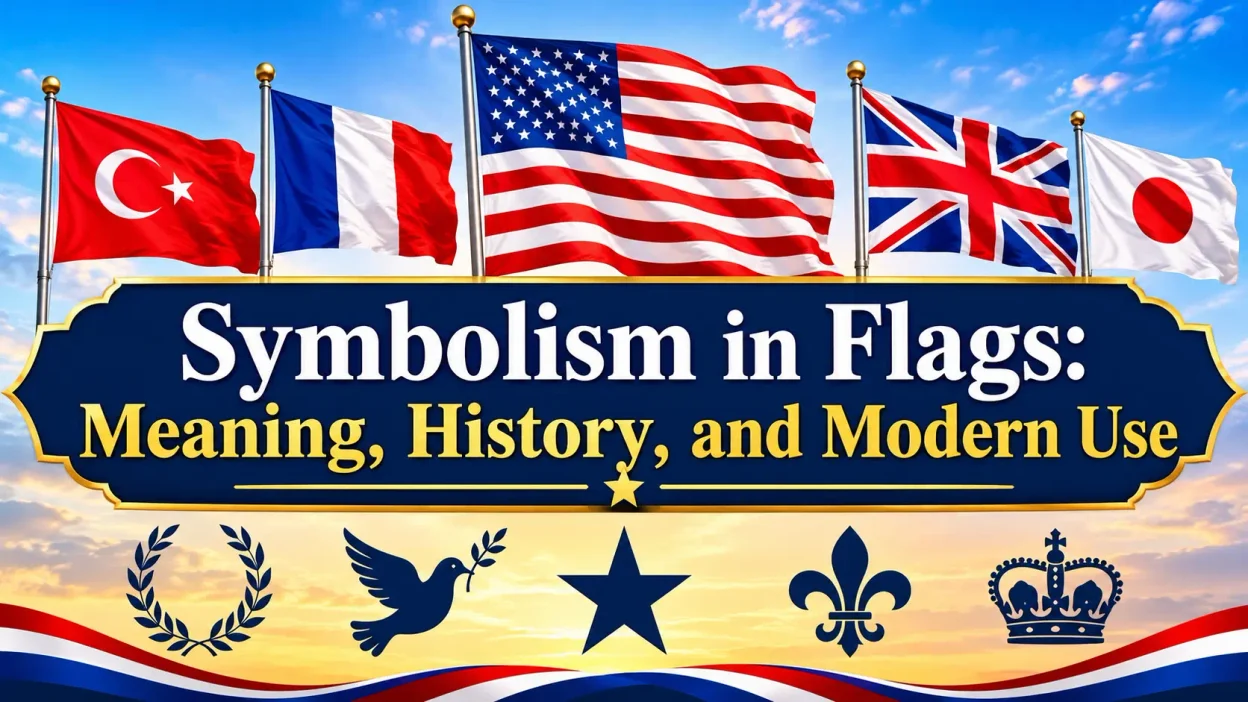
Flags are more than pieces of colored fabric. They are visual symbols that represent nations, communities, movements, institutions, and shared beliefs. The symbolism in flags helps people communicate ideas about freedom, unity, heritage, sacrifice, peace, and national identity without using words.
In the United States, flags appear at government buildings, schools, public ceremonies, sporting events, and private homes. The American flag, for example, represents the nation and its ideals, while flags from other countries reflect their own histories, struggles, cultural traditions, and aspirations.
Understanding flag symbolism requires looking beyond individual colors. A star, stripe, crescent, cross, sun, or coat of arms may carry a specific historical meaning. The same color or shape can also mean different things in different countries, making each flag a distinctive expression of collective identity.
Quick Answer: What Does Symbolism in Flags Mean?
Symbolism in flags represents the identity, history, values, and aspirations of a nation or community through colors, shapes, patterns, and emblems. Historically, flags identified rulers, armies, and territories; today, they also communicate national pride, cultural heritage, political beliefs, unity, and remembrance.
TL;DR
- Red often represents courage, sacrifice, revolution, or historical struggle.
- Blue commonly symbolizes freedom, peace, loyalty, or justice.
- White frequently represents peace, purity, or hope.
- Stars can symbolize unity, states, ideals, or aspirations.
- Stripes may represent historical regions, communities, or principles.
- Flags communicate identity, but their meanings depend on cultural and historical context.
1. What Colors Symbolize in Flags

Colors are among the most recognizable elements of a flag. They can communicate values, historical events, religious traditions, or the identity of a particular community.
However, there is no universal dictionary of flag colors. Red does not always mean courage, and blue does not always mean freedom. The same color may carry different meanings depending on a country’s history and the traditions behind its design.
Red: Courage, Sacrifice, and Revolution
Red often represents courage, sacrifice, revolutionary struggle, or the bloodshed associated with a nation’s history. In some flags, it reflects the struggle for independence; in others, it has religious, political, or cultural significance.
For example, red appears on the flags of the United States, China, and many European and Asian countries, but its historical meaning differs in each case.
Red can also represent prosperity, happiness, or celebration in certain cultural contexts. Its meaning should therefore be interpreted through the history of the specific flag.
Blue: Freedom, Loyalty, and Justice
Blue is frequently associated with loyalty, stability, freedom, or the sky and sea. Some flags use it to represent ideals of justice or the relationship between different parts of a nation.
In the United States, blue is traditionally associated with vigilance, perseverance, and justice in commonly taught explanations of the national flag’s colors.

USAGov
+1
Elsewhere, blue may reflect geography, religious heritage, or political history.
White: Peace and Purity
White often communicates peace, honesty, purity, or hope. In some national flags, it represents a desire for peaceful relations; in others, it reflects religious or cultural associations.
White also appears in flags that use contrasting colors to distinguish different communities or historical groups.
Its meaning can vary significantly. In some cultures, white is associated with mourning rather than celebration, which illustrates why flag symbolism cannot be interpreted through color alone.
Green: Land, Growth, and Hope
Green is frequently associated with vegetation, agriculture, fertility, renewal, and the natural environment. It can represent a country’s landscape or the importance of farming and natural resources.
In some national flags, green also has religious or historical significance. Its meaning may be closely connected to the beliefs or political movements that shaped the flag’s design.
Black: Heritage, Resilience, and Identity
Black can symbolize historical struggle, resilience, determination, or the identity of a particular community. In some flags, it represents people or cultural heritage; in others, it reflects past conflicts or political ideals.
Black may also communicate mourning or resistance, depending on the setting.
The key is to understand the story behind the design rather than assuming the color has one fixed meaning.
2. What Stars Symbolize on Flags

Stars are among the most common symbols on national flags. They can represent states, provinces, territories, communities, aspirations, or ideals.
Their precise meaning depends on the country. In some flags, a star represents a particular administrative region. In others, it reflects a political or religious tradition.
The United States flag provides a clear example of stars representing political unity. Its 50 white stars correspond to the 50 states, while its 13 stripes represent the original 13 colonies.
Smithsonian Music
+1
Stars may also symbolize guidance, hope, or the aspiration to achieve a shared goal. These interpretations are common in symbolic art, although they should not automatically be assigned to every national flag containing stars.
The arrangement matters, too. A circle of stars may suggest unity, while a single prominent star can emphasize a central ideal or political identity.
3. Stripe Symbolism: Unity, History, and Division

Stripes provide structure and visual order to many flags. Their meaning often comes from a specific historical or political decision rather than the shape itself.
In the American flag, the 13 alternating red and white stripes represent the original colonies. This design connects the present-day nation with its origins during the struggle for independence.
Smithsonian Music
+1
Other flags use horizontal or vertical stripes to represent regions, historical communities, political movements, or national ideals.
Stripes can also create visual contrasts between colors that communicate different parts of a country’s identity. A flag with several distinct bands may reflect the desire to bring different groups together under one national identity.
However, stripes do not always symbolize unity. Their meaning depends on the history of the flag and the reasons its designers chose that arrangement.
4. Crosses and Religious Symbols on Flags

Crosses and other religious symbols appear on many national and regional flags. They may reflect a country’s religious history, cultural identity, or the influence of a particular tradition.
The Scandinavian cross, for example, appears on the flags of Denmark, Sweden, Norway, Finland, and Iceland. Its placement and use connect these flags with a shared regional design tradition, although each country’s flag has its own history and identity.
Other flags contain crescents, stars, religious emblems, or combinations of symbols that reflect their cultural and historical backgrounds.
It is important not to assume that a religious symbol has the same meaning in every country where it appears. Some designs reflect historical institutions, while others communicate religious identity more directly.
In contemporary use, these symbols can also become expressions of cultural belonging, national heritage, or debates about the relationship between religion and public life.
5. Sun and Moon Symbolism in Flags

The sun and moon are ancient visual symbols that appear in national flags around the world.
The sun commonly suggests life, energy, renewal, enlightenment, or national identity. Depending on the design, it may represent a historical tradition, a political ideal, or a connection with the natural world.
The moon, particularly the crescent, appears on flags associated with several countries and cultural traditions. Its meaning depends on the specific flag and its historical development.
When the sun and moon appear together, they may communicate balance, continuity, or the relationship between different forces. However, that interpretation is not universal and should not be imposed on flags without historical evidence.
These celestial symbols are especially effective because they are widely recognizable while allowing each nation to give them a distinctive meaning.
6. Animal Symbolism on Flags

Animals on flags often represent qualities that a nation or community wishes to emphasize.
Eagles may symbolize authority, freedom, or strength. Lions are frequently associated with courage, leadership, and heritage. Dragons can communicate power, cultural identity, or mythological tradition.
These associations often come from folklore, heraldry, national mythology, or historical political institutions.
An animal may also represent a country’s natural environment. A bird, fish, or other creature can reflect local wildlife or a connection to the landscape.
Animal emblems sometimes have meanings that differ from their general symbolic associations. A lion on a national coat of arms, for instance, may refer to a particular dynasty or historical institution rather than simply representing bravery.
Understanding the specific story behind the animal makes it easier to interpret the flag accurately.
7. The History of Flag Symbolism
Flags have long served as practical tools for identifying groups, rulers, armies, and territories. Before modern communications, a recognizable banner helped people identify allies, leaders, or opposing forces from a distance.
Over time, flags acquired additional meanings. A banner that once identified a ruler or military unit could later become a symbol of a nation, political movement, or shared community.
During wars of independence and political revolutions, flags often became expressions of collective identity. They provided a visible symbol around which people could gather and communicate their aspirations.
The American flag developed in this historical context. The first official national flag was established through a congressional resolution on June 14, 1777, specifying 13 stripes and 13 stars. The design evolved as new states joined the Union, and the 50-star flag became official on July 4, 1960, after Hawaii became a state.
Stories
+1
Today, flags serve both practical and emotional purposes. They identify nations and institutions, but they can also recall wars, independence movements, cultural traditions, and important historical events.
8. Flag Symbolism in American Culture
In the United States, the national flag is closely associated with patriotism, civic identity, independence, and the ideals of the nation.
It appears in schools, public buildings, sporting events, military ceremonies, and national holidays. Americans may display it to express national pride, commemorate military service, or recognize an important public occasion.
The flag also has a significant place in historical memory. The large American flag raised at Fort McHenry during the War of 1812 inspired Francis Scott Key to write the poem that became the national anthem. This event helped establish the flag as a lasting symbol in American public life.
amhistory.si.edu
+1
Its symbolism is not always interpreted in the same way. For some people, the flag primarily represents freedom and national unity. Others use it to call attention to gaps between national ideals and lived experiences.
These differing interpretations demonstrate that national symbols can inspire both shared belonging and public debate.
9. How Flags Represent Unity and National Identity
A flag can create a sense of belonging among people who speak different languages, come from different regions, or have different family histories.
By placing a recognizable design in public spaces, a flag provides a shared visual reference. People may gather around it during celebrations, sporting events, political demonstrations, or national commemorations.
National flags often combine several symbols to express a common identity. Colors may reflect historical struggles, stars may represent administrative regions, and emblems may recall cultural traditions.
Regional and community flags serve a similar purpose on a smaller scale. They can represent local history, shared experiences, or a commitment to a common cause.
Nevertheless, a flag does not automatically unite everyone it represents. People may disagree about its meaning, and some may feel excluded by the history or political associations attached to it.
Flag symbolism is therefore both a statement of identity and a reflection of how communities understand themselves.
10. Political and Social Movement Flags

Flags are not limited to countries. Political parties, social movements, organizations, and communities also use them to communicate their beliefs and goals.
A movement’s flag may employ a distinctive color, geometric pattern, or emblem that makes it recognizable at demonstrations and public gatherings.
Such flags can express solidarity, resistance, equality, independence, or a demand for political change. They may also become historical symbols after the movement has achieved its objectives or entered the public record.
Their meanings can evolve. A flag initially associated with one event may later represent a broader cause or become a subject of controversy.
When interpreting a movement’s flag, it is useful to examine its origin, intended message, and current use. A symbol’s meaning should not be assumed solely from its colors or shapes.
11. Psychological and Emotional Meaning of Flags
Flags can evoke strong emotions because they connect visible designs with memories, identities, and shared experiences.
For some people, a national flag recalls family traditions, military service, immigration, or the history of their homeland. For others, a community flag may represent acceptance, solidarity, or the experience of belonging.
Several emotional functions are especially common:
- Belonging: A flag can identify a group or community.
- Pride: It can communicate appreciation for cultural or national heritage.
- Remembrance: It may honor people who died or events that shaped a community.
- Hope: A flag can represent aspirations for independence, equality, or peace.
- Resistance: It may express opposition to a government, policy, or social condition.
- Continuity: It can connect present generations with earlier historical experiences.
These responses are personal and cultural rather than automatic. The same flag may inspire pride in one person and painful memories in another.
This is why flag symbolism is best understood as a relationship between the design, its history, and the people who interpret it.
12. Flags in Art, Fashion, and Modern Media
Flags are widely used in visual culture because their bold colors and recognizable patterns make them easy to identify.
In art, a flag may represent patriotism, political criticism, memory, or the changing meaning of national identity. Artists sometimes alter or fragment flag designs to explore disagreement, conflict, or social change.
In fashion, flag patterns can communicate cultural pride, support for a sports team, or admiration for a particular country. The same pattern may also be used simply for its visual appeal.
Films and television use flags to establish location, identify opposing groups, or communicate the political atmosphere of a story. In video games and digital media, flags often function as emblems for teams, territories, or fictional factions.
On social media, people may use flag emojis to communicate nationality, language, heritage, or support for an event.
Modern uses can differ from historical meanings, so a flag’s appearance in popular culture should not automatically be treated as an accurate representation of its original symbolism.
13. Common Misunderstandings About Flag Symbolism
Several misconceptions can make flags difficult to interpret correctly.
Colors do not have universal meanings. Red can represent sacrifice, revolution, prosperity, or other ideas depending on the flag. Blue and white also have varied cultural associations.
Every element does not necessarily have an official explanation. Some flag designs have documented meanings for their colors and shapes, while other interpretations developed later or remain disputed.
Similar designs do not guarantee identical meanings. Two countries may use the same colors or symbols for different historical reasons.
Flags can change over time. A design may be updated when a country gains independence, changes its political system, or incorporates new territories.
Modern use may differ from original intent. A flag created for a specific historical purpose can acquire additional political or emotional associations over generations.
The most reliable approach is to examine the particular flag’s history before assigning meaning to its individual elements.
14. How to Interpret a Flag’s Symbolism
Understanding a flag involves examining its individual features and the context in which they were created.
Start with the colors. Consider which colors dominate the design and whether the country or organization has officially explained their meaning.
Next, examine the shapes and emblems. Stars, crosses, crescents, animals, suns, and coats of arms may refer to specific historical events, religious traditions, or political institutions.
Then look at the arrangement. Stripes, circles, diagonal divisions, and central emblems can help distinguish different elements of the design.
Finally, research the historical context. Determine when the flag was created, who adopted it, and whether its meaning changed over time.
A useful interpretation combines these details rather than treating any single color or shape as a complete explanation.
Frequently Asked Questions
What is the most common meaning of flags?
Flags most commonly represent identity, belonging, and shared values. National flags often communicate a country’s history, political identity, and aspirations, while community flags can represent cultural heritage or a shared cause.
What do colors symbolize on flags?
Colors can represent courage, peace, freedom, prosperity, heritage, or other ideals. Their meanings vary by country, so it is important to examine the history of the particular flag rather than assume universal definitions.
What do stars symbolize on flags?
Stars may represent states, provinces, unity, aspirations, or political ideals. On the United States flag, the 50 stars represent the 50 states.
What do stripes symbolize on flags?
Stripes can represent historical regions, communities, political ideals, or significant events. On the United States flag, the 13 stripes represent the original 13 colonies.
Why are flags important to national identity?
Flags provide a recognizable symbol through which people express belonging, heritage, and shared history. They are often displayed during public ceremonies, national holidays, sporting events, and moments of remembrance.
Can a flag have more than one meaning?
Yes. A flag can represent a country’s history, national identity, and political ideals at the same time. Its meaning may also differ among individuals and change as society evolves.
Why do flag meanings change over time?
Political changes, wars, independence movements, social movements, and new historical interpretations can alter how people understand a flag. Its original purpose may remain important while additional meanings develop.
Conclusion
Symbolism in flags helps people express complex ideas through simple visual designs. Colors, stars, stripes, crosses, animals, and celestial symbols can represent national identity, historical struggles, cultural heritage, unity, and hope.
The meaning of a flag depends on more than its appearance. Its history, the intentions of its designers, and the experiences of the people who use it all shape its significance.
By examining these details, we can better understand why flags matter and how they continue to represent the changing identities, values, and aspirations of communities around the world.