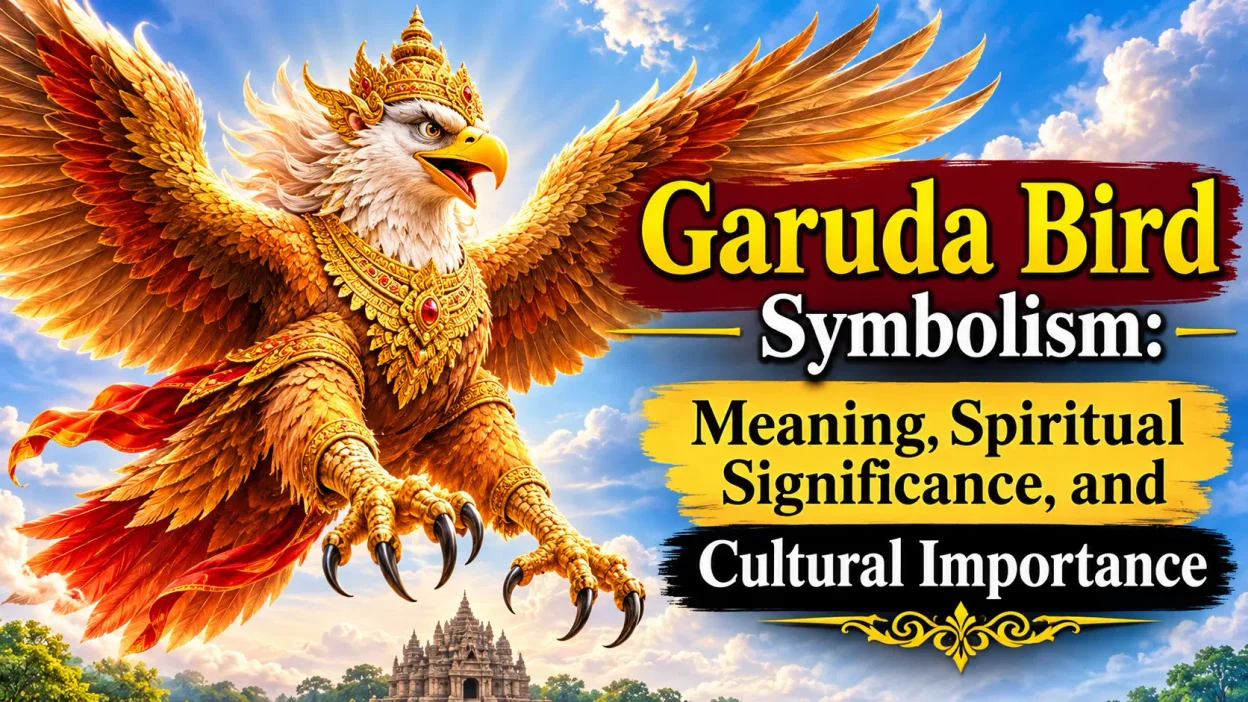
Garuda is one of the most powerful and recognizable mythical birds in Asian religious and cultural traditions. Often depicted as a majestic eagle-like creature with enormous wings, a powerful body, and a human-like face, Garuda represents strength, courage, freedom, divine protection, and spiritual power.
In Hinduism, Garuda is best known as the vehicle (vahana) of Lord Vishnu. He is also associated with the struggle against evil, the pursuit of freedom, and the protection of righteousness. In Buddhism, Garuda appears as a powerful supernatural being and is sometimes included among the protective or wise beings represented in Buddhist art and teachings.
Garuda’s symbolism extends beyond religion into architecture, national identity, traditional art, literature, and popular culture. His image continues to inspire people through its associations with bravery, loyalty, independence, and the triumph of good over evil.
Quick Answer: What Does Garuda Symbolize?
Garuda commonly symbolizes:
- Strength and power: Physical, spiritual, and divine strength.
- Freedom and liberation: Breaking away from limitations and overcoming bondage.
- Protection: Defending righteousness and opposing harmful forces.
- Courage: Facing challenges and confronting fear.
- Wisdom: Understanding truth and recognizing the difference between good and evil.
- Loyalty and devotion: Serving a higher purpose with dedication.
- Victory over evil: Triumphing over negativity and destructive forces.
- Spiritual transformation: Rising above worldly limitations and developing higher awareness.
These meanings come from different religious, cultural, and modern interpretations. Their significance can vary across traditions.
1. Strength and Divine Power
One of the most important meanings of Garuda is strength. His enormous wings, sharp vision, powerful form, and ability to travel through the skies make him an image of extraordinary power.
In Hindu mythology, Garuda is a mighty divine being who demonstrates exceptional strength and determination. His association with Lord Vishnu further connects him with divine authority and the protection of cosmic order.
Symbolically, Garuda represents the ability to face difficult situations without surrendering to fear.
His strength is not limited to physical power. It can also represent emotional resilience, determination, and the inner courage required to overcome personal struggles.
Symbolic message: True strength includes the ability to remain courageous, disciplined, and committed to what is right.
2. Freedom and Liberation
Garuda is especially significant as a symbol of freedom because of his role in the story of his mother, Vinata.
According to Hindu mythology, Vinata became enslaved to her sister Kadru and the serpent beings associated with her. Garuda undertook a difficult mission to obtain amrita, the nectar of immortality, as the price of securing his mother’s freedom.
His determination and willingness to overcome extraordinary obstacles make him a powerful symbol of liberation.
This story gives Garuda a meaning that goes beyond flight. He represents the desire to break free from oppression, limitations, and circumstances that prevent people from living with dignity.
In modern symbolism, Garuda can represent:
- Freedom from fear and insecurity.
- Independence from restrictive situations.
- Overcoming personal limitations.
- The courage to defend loved ones.
- The pursuit of a meaningful and independent life.
Symbolic message: Freedom often requires courage, sacrifice, and determination.
3. Protection and the Victory of Good Over Evil
Garuda is closely associated with protection and the defense of righteousness.
As the vehicle of Lord Vishnu, who is connected with preserving cosmic order, Garuda is often represented as a powerful guardian figure. His image can communicate divine authority, vigilance, and the defeat of destructive forces.
His traditional rivalry with the Nagas, or serpent beings, is also important to his mythology. This relationship has been interpreted in different ways across stories and traditions.
In symbolic interpretations, Garuda’s victory over harmful forces can represent overcoming:
- Fear and negativity.
- Injustice and oppression.
- Dishonesty and deception.
- Destructive habits.
- Obstacles that prevent spiritual growth.
Symbolic message: Stand against injustice and protect the values that matter to you.
4. Courage and Fearlessness
Garuda’s mythological adventures demonstrate courage and determination. His willingness to face powerful obstacles makes him an enduring symbol of fearlessness.
In the story of obtaining amrita, Garuda encounters formidable challenges but continues his mission. His actions demonstrate that courage is not simply the absence of fear; it is the willingness to act despite difficulty.
This meaning can be applied to everyday life. Garuda may serve as a symbolic reminder to confront challenges, defend your beliefs, and pursue important goals with confidence.
Symbolic message: Courage means moving forward even when the journey is difficult.
5. Wisdom and Spiritual Awareness
Garuda is also associated with wisdom and higher understanding.
His eagle-like appearance, especially his sharp eyesight and ability to soar above the earth, creates a natural symbolic connection with perspective and awareness.
In modern spiritual interpretations, Garuda’s ability to rise above the ground can represent seeing beyond immediate problems and understanding the larger picture.
His symbolism may encourage people to:
- Seek truth rather than accept deception.
- Think carefully before making decisions.
- Recognize harmful influences.
- Develop self-awareness.
- Look beyond temporary difficulties.
Symbolic message: Wisdom allows you to see situations more clearly and choose your direction thoughtfully.
6. Loyalty and Devotion
Garuda’s relationship with Lord Vishnu is central to his identity in Hindu tradition.
As Vishnu’s vahana, Garuda is often portrayed as a devoted and dependable companion. His service represents loyalty, dedication, and commitment to a higher purpose.
His actions to free his mother also demonstrate devotion to family and the willingness to make sacrifices for loved ones.
Symbolically, Garuda can represent:
- Loyalty to family and friends.
- Commitment to personal values.
- Dedication to spiritual beliefs.
- Faithfulness to responsibilities.
- Service guided by integrity.
Symbolic message: Genuine loyalty is demonstrated through consistent actions and sincere commitment.
7. Spiritual Transformation and Rising Above Limitations
Garuda’s flight offers one of the most powerful images in his symbolism.
By soaring through the sky, he represents the ability to move beyond ordinary limitations and develop a broader understanding of life.
In spiritual interpretations, this movement can symbolize transformation, enlightenment, and the desire to rise above ignorance.
His story may inspire people who are going through important changes, including leaving behind unhealthy patterns, developing stronger values, or pursuing spiritual growth.
Symbolic message: Personal transformation begins when you choose growth over limitation.
Garuda Spiritual Meaning
The spiritual meaning of Garuda is closely connected with freedom, divine protection, courage, wisdom, and the victory of higher principles over destructive forces.
In Hindu traditions, Garuda’s connection with Lord Vishnu gives him an important role in the preservation of cosmic order. His stories also emphasize devotion, sacrifice, and liberation.
In broader modern spiritual interpretations, Garuda may represent the ability to rise above fear, recognize truth, and move toward a more meaningful life.
| Spiritual Meaning | Symbolic Interpretation |
|---|---|
| Divine protection | The defense of righteousness and cosmic order |
| Freedom | Breaking away from bondage and limitations |
| Courage | Facing challenges with determination |
| Wisdom | Recognizing truth and developing awareness |
| Devotion | Remaining committed to a higher purpose |
| Transformation | Rising above old habits and limitations |
| Victory | Overcoming destructive forces |
| Spiritual growth | Developing greater understanding and awareness |
Garuda’s spiritual symbolism is rooted in specific religious traditions, especially Hinduism and Buddhism. Modern personal interpretations should not be confused with formal religious teachings.
Garuda Symbolism in Hinduism
Garuda has a particularly important place in Hindu mythology and religious tradition.
Garuda as the Vahana of Lord Vishnu
Garuda is the vahana, or divine mount, of Lord Vishnu. Vishnu is widely associated with preserving and maintaining cosmic order.
Garuda is frequently depicted carrying Vishnu through the heavens. This image represents divine service, protection, and the relationship between divine authority and powerful action.
Garuda and the Story of Amrita
One of the best-known stories about Garuda appears in the Mahabharata.
Garuda seeks amrita, the nectar of immortality, to secure his mother’s freedom from bondage. His journey involves extraordinary obstacles and demonstrates his strength, intelligence, and determination.
This story helps explain why Garuda is associated with liberation, sacrifice, and devotion.
Garuda and the Nagas
Garuda has a famous rivalry with the Nagas, or serpent beings, in Hindu mythology.
This conflict is an important part of his traditional stories. In symbolic interpretations, the eagle-like Garuda is sometimes associated with overcoming danger, deception, or destructive forces.
However, the relationship between Garuda and the Nagas is more complex than a simple universal opposition between good and evil. Its meaning depends on the particular story and religious context.
Garuda Symbolism in Buddhism
Garuda also appears in Buddhist traditions, particularly in South and Southeast Asian religious art and mythology.
In Buddhist cosmology, Garudas are powerful supernatural beings often portrayed as enormous bird-like creatures.
1. Power and Protection
Garudas are associated with extraordinary strength and can appear as powerful figures in Buddhist stories and artwork.
Their presence may communicate protection, courage, and the ability to overcome harmful influences.
2. Wisdom and Spiritual Understanding
In some Buddhist symbolic contexts, Garuda imagery can be associated with spiritual insight and freedom from limitations.
The image of a powerful bird rising through the sky can serve as a metaphor for moving beyond ignorance and developing a clearer understanding.
3. Garuda and the Nagas
Buddhist stories also include relationships and conflicts between Garudas and Nagas.
These beings appear in different narratives and artistic traditions, and their relationship is not always presented in exactly the same way.
4. Garuda in Tibetan Buddhist Traditions
Garuda imagery is particularly prominent in Tibetan Buddhist art and iconography. The bird may appear as a powerful protector and can be represented in forms associated with overcoming obstacles and harmful influences.
Its exact meaning depends on the deity, ritual, and artistic context in which it appears.
Garuda Symbolism in Different Cultures
Garuda’s influence extends beyond religious stories into national identity, architecture, and cultural traditions.
1. Indonesia
<text> </text>Garuda is one of Indonesia’s most important national symbols.
The national emblem, known as Garuda Pancasila, features a golden Garuda-like bird carrying a shield and a banner reading Bhinneka Tunggal Ika, commonly translated as “Unity in Diversity.”
In this context, Garuda represents national identity, strength, sovereignty, and unity.
The five principles of Pancasila are represented through symbols on the shield carried by the bird.
2. Thailand
Garuda, known in Thailand as Krut, has an important place in royal and national symbolism.
It is used as an emblem associated with the Thai monarchy and appears in official contexts. The figure represents authority, royal legitimacy, and divine association.
Its use reflects the historical influence of Hindu and Buddhist traditions in Thai culture.
3. Nepal
Garuda appears in Nepalese religious art and Hindu-Buddhist cultural traditions.
Images of Garuda can be found in temples, sculptures, and traditional representations associated with Vishnu.
In this context, Garuda can communicate devotion, protection, and divine power.
4. India
In India, Garuda is widely recognized through Hindu mythology, temple traditions, sculptures, and religious art.
His connection with Vishnu makes him an important figure in Vaishnavism. Garuda images are also found in temples dedicated to Vishnu and his various forms.
Garuda Symbolism in Art and Architecture
Garuda has been represented in sculpture, paintings, temple decorations, and architectural designs for centuries.
<text> </text>Common visual features include:
- Wings: Freedom, movement, and the ability to rise above limitations.
- Eagle-like face: Sharp vision, awareness, and strength.
- Powerful body: Courage, endurance, and protection.
- Human-like features: Intelligence, devotion, and the ability to serve a higher purpose.
- Serpent imagery: The traditional mythological relationship between Garuda and the Nagas.
- Golden appearance: In some artistic traditions, divine power, dignity, and majesty.
Garuda’s appearance differs across regions and artistic periods. Some depictions are more bird-like, while others combine human and bird characteristics.
Garuda Symbolism in Dreams
Dreaming about Garuda can be interpreted in several ways, depending on the dream’s details and your personal beliefs.
Dream interpretation is subjective and does not establish that a particular event will happen in the future.
Dreaming of a Flying Garuda
A flying Garuda may symbolize freedom, ambition, confidence, and spiritual growth.
It could reflect your desire to overcome limitations or pursue a larger goal.
Dreaming of Garuda Protecting You
This dream may represent a desire for safety, support, and reassurance.
It can also reflect your own determination to protect yourself or someone you care about.
Dreaming of Garuda Fighting a Snake
This image may connect with Garuda’s traditional rivalry with the Nagas.
Symbolically, it could represent confronting fear, overcoming conflict, or dealing with a difficult situation.
Dreaming of a Golden Garuda
A golden Garuda may represent strength, dignity, ambition, and spiritual aspiration.
The golden color may add associations with prosperity or divine majesty in your personal interpretation.
Dreaming of Garuda Standing Still
A stationary Garuda may suggest patience, preparation, and the importance of observing a situation before taking action.
It may encourage you to develop confidence before making a significant decision.
Garuda Symbolism in Modern Life
Garuda continues to inspire people through its associations with courage, independence, protection, and strength.
Its image is used in many modern contexts, including:
- Logos and emblems: Representing authority, strength, and identity.
- Military and official insignia: Communicating courage and national pride.
- Art and tattoos: Expressing freedom, spiritual devotion, and resilience.
- Architecture: Reflecting religious heritage and cultural identity.
- Literature and entertainment: Representing powerful guardians, mythical creatures, and heroic qualities.
For many people, Garuda is more than a mythical bird. It is an enduring symbol of determination and the desire to rise above challenges.
What Can We Learn from Garuda Symbolism?
Garuda’s mythology offers several meaningful lessons for everyday life.
1. Defend what matters: His stories emphasize protecting loved ones and standing against injustice.
2. Pursue freedom: His mission to free his mother illustrates the importance of overcoming restrictive circumstances.
3. Develop courage: Difficult challenges can require patience, determination, and confidence.
4. Remain loyal: His relationship with Vishnu represents dedication and commitment to a higher purpose.
5. Seek wisdom: Strength becomes more meaningful when guided by understanding and thoughtful decisions.
6. Rise above limitations: Garuda’s flight offers a powerful metaphor for personal growth and spiritual development.
Frequently Asked Questions About Garuda Bird Symbolism
1. What does Garuda symbolize?
Garuda symbolizes strength, freedom, courage, protection, wisdom, loyalty, and victory over evil. In Hinduism, he is especially associated with Lord Vishnu and the preservation of cosmic order.
2. What is the spiritual meaning of Garuda?
Garuda’s spiritual meaning includes liberation, divine protection, spiritual awareness, and overcoming limitations. In modern interpretations, he can represent the courage to move beyond fear and pursue personal growth.
3. Is Garuda a Hindu god?
Garuda is a divine or semi-divine bird-like being in Hindu traditions, rather than one of the principal creator or preserver deities. He is best known as the vahana of Lord Vishnu and is revered in his own right.
4. Why is Garuda associated with Lord Vishnu?
Garuda serves as Lord Vishnu’s divine vehicle. Their association represents devotion, service, divine authority, and the preservation of cosmic order.
5. What does Garuda represent in Buddhism?
In Buddhist traditions, Garuda is a powerful supernatural bird-like being. Depending on the tradition and context, he may represent strength, protection, and the overcoming of harmful influences.
6. What does Garuda symbolize in Indonesia?
Garuda represents national identity, strength, sovereignty, and unity in Indonesia. The national emblem, Garuda Pancasila, carries the shield representing the country’s five foundational principles.
7. What does a Garuda tattoo symbolize?
A Garuda tattoo may represent courage, freedom, protection, strength, loyalty, spiritual devotion, and cultural heritage. Its meaning depends on the person’s beliefs and the design’s cultural context.
8. What is the relationship between Garuda and snakes?
In Hindu and Buddhist mythology, Garuda has a traditional rivalry with the Nagas, who are serpent-like beings. This relationship is a recurring part of their mythological stories and artistic representations.
9. What does a flying Garuda symbolize?
A flying Garuda may symbolize freedom, ambition, independence, spiritual growth, and the ability to rise above difficult circumstances.
10. Is Garuda a symbol of protection?
Yes. Garuda is associated with protection in several Hindu and Buddhist traditions. He is also represented as a guardian-like figure in religious art and cultural imagery.
11. What does a golden Garuda symbolize?
A golden Garuda may represent divine authority, strength, dignity, prosperity, and spiritual aspiration. These associations depend on the artistic and cultural context.
12. What is the main message of Garuda symbolism?
The central message of Garuda symbolism is to remain courageous, pursue freedom, protect what is valuable, and rise above limitations through wisdom and determination.
Conclusion
Garuda bird symbolism represents some of the most powerful ideas found in Hindu and Buddhist mythology, including strength, courage, freedom, protection, devotion, and spiritual transformation.
As the divine vehicle of Lord Vishnu, Garuda is closely connected with the preservation of cosmic order. His story of obtaining amrita to free his mother makes him an enduring symbol of sacrifice, determination, and liberation.
Beyond religious traditions, Garuda has become an important cultural emblem, particularly in Indonesia and Thailand. His image continues to inspire people through its association with national identity, dignity, and courage.
Ultimately, Garuda reminds us to face challenges with determination, protect what we value, and rise above limitations with wisdom and confidence.