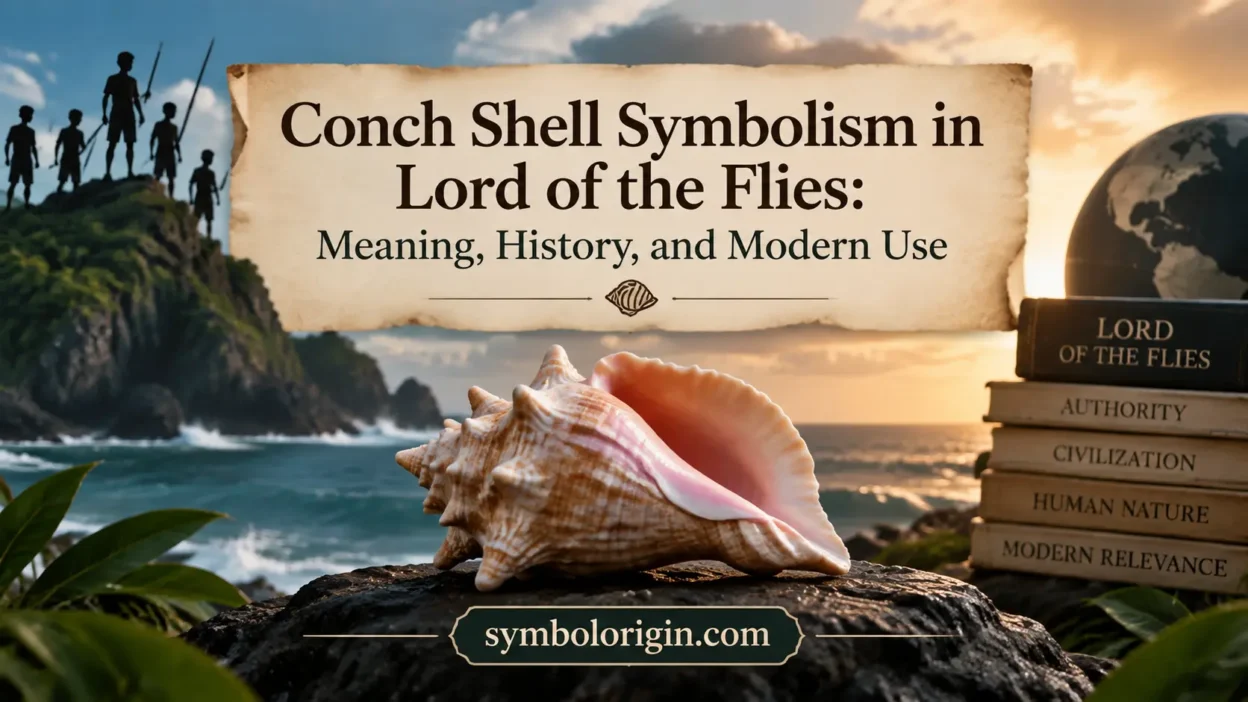
The conch shell in Lord of the Flies is one of the most recognizable symbols in modern literature. In William Golding’s 1954 novel, the shell becomes more than a natural object found on a deserted island; it represents order, communication, leadership, and the fragile systems that hold society together. Conch shell symbolism in Lord of the Flies remains widely discussed because it shows how quickly human rules can weaken when people abandon shared values.
Golding uses the conch shell as a physical reminder of civilization. When Ralph discovers the shell and uses it to call the stranded boys together, it creates a system where everyone has a chance to speak. The shell’s authority does not come from its appearance alone but from the agreement among the boys that it represents fairness and cooperation.
The symbol continues to interest readers because it connects the fictional island to real-world questions about democracy, leadership, conflict, and social responsibility. In American classrooms, the conch is often studied as an example of how objects can carry larger ideas about human behavior.
Quick Answer
Conch shell symbolism in Lord of the Flies commonly represents order, democracy, and civilized communication in modern literary interpretation. In William Golding’s novel, it also reflects the gradual collapse of social rules as power shifts toward violence and chaos.
TL;DR
- Conch shell represents order and democratic communication.
- Ralph uses it to create rules among survivors.
- Its authority declines as civilization breaks down.
- The shell reflects conflicts between society and human instincts.
- The symbol remains important in American literature studies.
What the Conch Shell Represents in Lord of the Flies
The conch shell represents the structure that allows a group of individuals to function as a society. When Ralph and Piggy first find the shell, they recognize its usefulness as a tool for gathering the scattered boys. The sound of the shell brings everyone together, creating the first organized meeting on the island.
From that moment, the conch becomes connected with rules. Whoever holds it has the right to speak during meetings, and the other boys are expected to listen. This simple agreement creates a miniature democratic system.
The shell’s meaning comes from collective acceptance. It has no natural authority over the boys, but they give it importance because they believe in the rules surrounding it. Golding uses this idea to show that social systems depend on shared cooperation rather than physical force.
The conch therefore symbolizes several connected ideas:
| Context | Meaning in the USA | Common Associations | Notes |
|---|---|---|---|
| Island meetings | Democracy and fair discussion | Voting, leadership, public voice | Shows organized society |
| Ralph’s leadership | Civil responsibility | Rules and cooperation | Authority based on agreement |
| Broken conch | Collapse of order | Conflict and violence | Loss of civilization |
| Literary study | Human behavior | Society vs. instinct | Common classroom symbol |
Ancient Roots and Cultural Meaning of the Conch Shell
Although the conch shell is most famous in Lord of the Flies because of Golding’s novel, conch shells have carried meanings in many cultures long before modern literature.
Large spiral shells have often been connected with communication because they can produce sound when blown like a horn. In several traditions, shell trumpets were used for ceremonies, announcements, and religious practices.
In Hindu traditions, the conch shell, known as a shankha, holds religious importance and is associated with sacred rituals, protection, and divine announcements. In some Pacific Island cultures, shells have also been used as ceremonial objects and symbols of status.
These cultural meanings help explain why Golding’s choice of a conch shell works so effectively. A shell that can create a powerful sound naturally connects with ideas of gathering, warning, and communication.
However, the meaning of the conch in Lord of the Flies is not simply borrowed from these traditions. Golding transforms the object into a literary symbol focused on human society, authority, and the struggle between cooperation and destruction.
How the Conch Creates Civilization on the Island
At the beginning of the novel, the conch helps the boys establish a sense of community. Before the shell is used, the survivors are only a group of frightened children. The meetings organized around it give them identity and purpose.
The conch creates several basic elements of civilization:
- A place for discussion
- A system for taking turns speaking
- A shared symbol of authority
- A method for making group decisions
Ralph’s leadership is strengthened because he respects the rules connected to the shell. Unlike Jack, who gains influence through hunting and physical dominance, Ralph’s power comes from organization and cooperation.
The contrast between Ralph and Jack becomes central to the novel. Ralph represents structured society, while Jack increasingly represents control through fear and force. The conch stands between these two approaches.
As long as the boys respect the shell, they maintain some connection to civilized behavior. Once they stop recognizing its authority, the social order begins to disappear.
The Conch Shell and Democracy in Modern American Interpretation
American readers often interpret the conch as a symbol of democracy because it represents equal participation. The rule that only the person holding the shell may speak resembles democratic ideas about public debate and giving people a voice.
The symbol connects with familiar American concepts such as:
- Town hall discussions
- Freedom of speech
- Voting systems
- Community decision-making
The conch does not represent a perfect government. The boys still experience disagreement and conflict even when the shell controls meetings. Instead, it represents the effort to create fairness despite human differences.
This interpretation remains relevant because modern societies also depend on people respecting shared systems. Laws, elections, and public institutions work only when communities recognize their legitimacy.
Golding’s message is not that rules automatically solve human problems. Instead, he shows that rules require continued support from the people who follow them.
Why the Conch Loses Its Power
One of the most important moments in the novel is the gradual decline of the conch’s influence. At first, every boy respects it. Later, the rules surrounding it become weaker as fear, competition, and violence increase.
The shell loses power because the boys no longer believe that cooperation matters more than personal desires.
Jack’s group challenges the authority represented by the conch because they value hunting, strength, and control over discussion and fairness. As the island society changes, the shell becomes a reminder of a civilization that the boys are abandoning.
The destruction of the conch marks a major turning point. When the shell breaks, it represents the final collapse of the organized society Ralph tried to maintain.
Golding uses this moment to show that civilization is not guaranteed. It depends on shared beliefs, responsibility, and respect for others.
The Conch Shell as a Symbol of Authority and Leadership
In Lord of the Flies, authority does not come only from being physically strong. At the beginning of the story, leadership comes from the ability to organize people and create cooperation. The conch becomes the object that gives Ralph’s leadership legitimacy because the boys accept its rules.
The shell represents a type of authority based on agreement rather than fear. Ralph does not control the group because he is the strongest boy on the island. Instead, he gains influence because the group believes in meetings, discussion, and shared decisions.
This idea creates a major contrast with Jack’s leadership style. Jack gradually builds power through hunting, intimidation, and emotional control. His influence depends on personal loyalty and fear rather than a common system.
The conflict between Ralph and Jack shows two competing ideas of leadership:
- Ralph’s leadership: cooperation, discussion, rules, and responsibility
- Jack’s leadership: strength, dominance, competition, and control
The conch stands on Ralph’s side because it represents a society where authority must be recognized by others.
What the Conch Reveals About Human Psychology
The conch is not valuable because of the shell itself. Its importance comes from what people believe it represents. Golding uses this object to explore a basic psychological question: why do humans follow rules?
The boys follow the conch because they still remember the expectations of their previous society. They understand that meetings, speaking turns, and leadership structures create stability.
Psychologically, the shell represents the human desire for:
- Predictability during uncertainty
- Fair treatment within groups
- Recognition and belonging
- Protection from uncontrolled conflict
However, the novel also shows that symbols only work when people continue to respect them. Once the boys lose their commitment to fairness, the shell becomes powerless.
This reflects a broader social idea: institutions are not maintained by objects, buildings, or written rules alone. They survive because people continue to value the principles behind them.
The Conch Compared With Other Symbols in Lord of the Flies
William Golding uses several important symbols throughout the novel. Each object represents a different part of human society and behavior.
| Symbol | Represents | How It Changes |
|---|---|---|
| Conch shell | Democracy, order, communication | Loses authority as society collapses |
| Piggy’s glasses | Knowledge, intelligence, problem-solving | Damaged as rational thinking declines |
| Signal fire | Hope and connection to civilization | Becomes neglected by the group |
| The beast | Fear and human violence | Gains influence through panic |
The conch is closely connected with Piggy’s glasses because both represent civilized thinking. The shell protects discussion, while the glasses allow the boys to create fire and use practical knowledge.
Together, these symbols show that civilization depends on both social cooperation and rational thinking.
When the conch disappears, the boys lose more than an object. They lose the idea that everyone deserves a voice.
The Conch Shell’s Meaning in American Literary Education
In the United States, Lord of the Flies is frequently taught in middle school, high school, and college literature courses. American teachers often use the conch as an example of how symbolism allows authors to communicate complex ideas through simple objects.
Students commonly analyze the shell through themes such as:
- Democracy and government
- Rules versus personal freedom
- Social responsibility
- Human nature
- The dangers of unchecked power
The symbol remains relevant because many modern discussions about society involve similar questions. Communities still debate how leaders gain authority, how groups make decisions, and what happens when people reject shared rules.
The conch provides a simple image for a complicated idea: a society can only remain organized when people believe cooperation matters.
Emotional Meaning of the Conch Shell
Beyond politics and leadership, the conch also carries emotional meaning in the novel. At the beginning, it represents comfort and hope. The boys are frightened after the crash, and the shell gives them a way to feel less alone.
The sound of the conch brings people together. It transforms confusion into organization and fear into action.
Later, the emotional meaning changes. The shell becomes associated with disappointment because the boys stop respecting what it represents.
Its decline mirrors Ralph’s emotional journey. At first, he believes people can create a fair society. As violence increases, he realizes that rules alone cannot control human behavior.
The changing meaning of the conch reflects the emotional movement of the story:
Beginning: safety and cooperation
Middle: conflict and struggle
End: loss and destruction
Golding uses the shell’s transformation to show how quickly hope can weaken when people abandon responsibility.
The Conch Shell in Modern Culture and Design
Outside literature, conch shells continue to appear in American culture, especially in coastal areas and decorative traditions.
People often associate conch shells with:
- Ocean life
- Travel memories
- Relaxation
- Beach homes
- Natural beauty
In home decor, shell designs are commonly used to create coastal themes. They appear in artwork, furniture details, jewelry, and souvenirs.
However, the meaning of a conch shell in everyday design is usually different from its meaning in Lord of the Flies. A decorative shell may suggest peaceful ocean environments, while Golding’s conch represents social order and political authority.
This difference shows how symbols change depending on context. The same object can represent relaxation in one setting and conflict in another.
Conch Shell Tattoos and Personal Symbolism
Conch shell tattoos are less common than symbols like roses, anchors, or waves, but they can carry personal meanings for people who choose them.
A person may use a conch shell tattoo to represent:
- Connection to the ocean
- A meaningful coastal memory
- Travel experiences
- Communication and self-expression
- Personal growth
For readers of Lord of the Flies, a conch tattoo may also represent ideas connected with the novel, such as the importance of fairness, community, and protecting social values.
Tattoo symbolism is personal, so the meaning depends on the individual’s experience rather than a fixed definition.
Misunderstandings About the Conch Shell Symbol
One common misunderstanding is that the conch represents perfect civilization. In reality, Golding presents a more complicated picture.
The boys create rules with the help of the shell, but problems still exist. Fear, jealousy, and disagreements remain even while the conch has authority.
The symbol does not suggest that laws automatically eliminate human conflict. Instead, it shows that organized society requires constant effort.
Another misunderstanding is that the conch represents weakness because it is physically fragile. The opposite is closer to Golding’s point. The shell represents ideas that seem fragile but are extremely important.
Democracy, fairness, and communication are not protected by strength alone. They depend on continued belief and participation.
Controversies and Different Interpretations of the Conch Shell
The conch shell is usually interpreted as a symbol of democracy and civilization, but literary analysis often allows multiple readings. Some readers argue that the shell does not represent a perfect social system because the boys’ first attempt at order is already limited and unstable.
The boys create rules, but those rules do not remove inequality, fear, or competition. Some voices are still ignored, especially Piggy’s, even though he often provides the most logical ideas. This suggests that a society can have democratic structures while still struggling to treat every person fairly.
Another interpretation focuses on the weakness of symbols themselves. The conch has authority only because people agree that it does. Once the group stops respecting the idea behind it, the object loses influence.
This interpretation connects the novel to real-world discussions about institutions. Governments, laws, and social agreements are not powerful because of physical objects. They function because people continue to support the values they represent.
The conch also raises questions about whether civilization is natural or learned. Golding suggests that civilized behavior requires effort, discipline, and cooperation. Without those commitments, fear and personal ambition can quickly challenge social order.
How the Meaning of the Conch Evolves Throughout the Novel
The meaning of the conch changes as the boys’ society changes. Golding does not introduce the shell with one fixed message; instead, its symbolism develops through the events of the story.
At the beginning, the conch represents hope. The boys have survived a disaster, and the shell gives them a way to organize themselves. It represents the possibility that they can rebuild a functioning community.
During the middle of the novel, the shell becomes a symbol of conflict. Ralph continues to defend its authority, while Jack’s group increasingly rejects its importance. The struggle over the conch becomes a struggle between two visions of society.
By the later parts of the story, the shell represents a fading connection to civilization. The boys no longer see discussion and fairness as valuable compared with hunting, excitement, and power.
The final destruction of the conch marks the complete collapse of the social system created after the crash. The event symbolizes more than the breaking of an object; it represents the loss of the shared agreement that kept the group together.
Golding’s use of the shell shows that symbols change meaning depending on how people treat them. An object can represent order one moment and failure the next.
Cross-Cultural Meaning of Conch Shells
Outside Lord of the Flies, conch shells have many cultural associations. Their meanings depend on geography, religion, and tradition.
In parts of the Pacific and Caribbean, shells have been connected with ocean life, ceremonies, and community traditions. Their connection with the sea often gives them meanings related to nature, travel, and heritage.
In Hindu religious traditions, the conch shell or shankha is used in ceremonies and represents sacred sound, ritual practice, and spiritual communication.
In coastal communities around the world, shells may represent:
- Connection to the ocean
- Protection of cultural traditions
- Travel and exploration
- Natural beauty
- Memory of important places
These meanings are different from Golding’s literary use. In Lord of the Flies, the conch is not primarily a religious or decorative object. It functions as a symbol of human organization and political authority.
Understanding these differences helps readers avoid assuming that every conch symbol carries the same meaning.
Why the Conch Still Matters in Modern Society
The conch remains relevant because many modern discussions involve similar issues: who gets a voice, how leaders gain authority, and what happens when communities lose trust in shared systems.
In American culture, the symbol connects with ideas such as:
- Public discussion
- Democratic participation
- Community responsibility
- Respect for different opinions
Modern audiences often relate the conch to situations beyond the novel. It can represent the importance of listening during disagreements, maintaining respectful conversations, and protecting systems that allow people to participate.
The symbol also appears in discussions about social media and digital communication. Online communities often struggle with the same questions shown in the novel: who controls conversations, whose voices are heard, and how groups manage conflict.
The conch offers a simple reminder that communication systems require cooperation. A platform for speaking only works when people respect the process.
The Conch Shell’s Place in Popular Culture
Because Lord of the Flies remains widely read, the conch has become one of the most recognizable literary symbols associated with social order and political breakdown.
The shell appears in:
- Literature classrooms
- Essays and discussions about leadership
- Film and stage adaptations
- Educational materials
- Literary analysis
Its popularity comes from its simplicity. A single shell communicates a complex idea about society. Readers immediately understand that the object represents something larger than itself.
The continued discussion of the conch shows why literary symbols remain valuable. They provide a way to examine human behavior through memorable images rather than abstract arguments.
Frequently Asked Questions
What does the conch shell symbolize in Lord of the Flies?
The conch shell symbolizes democracy, order, and civilized communication. It creates a system where the boys can hold meetings and share ideas, but its power decreases as they abandon those values.
Why is the conch important to Ralph’s leadership?
The conch gives Ralph a form of accepted authority because the boys agree to follow its rules. His leadership depends on cooperation and discussion rather than fear or physical strength.
What does the broken conch symbolize?
The broken conch symbolizes the destruction of order and the end of the boys’ democratic system. It represents the moment when violence replaces discussion and shared rules.
Is the conch shell a positive or negative symbol?
The conch is mainly a positive symbol because it represents fairness, communication, and organization. However, Golding also shows that these values can disappear when people stop supporting them.
Why did William Golding choose a conch shell as a symbol?
Golding chose a conch because it naturally connects with communication and gathering. Its ability to produce sound makes it a fitting symbol for bringing people together and giving them a shared voice.
Does the conch have meanings outside Lord of the Flies?
Yes. Conch shells have cultural, religious, and decorative meanings in different societies. They may represent ceremony, the ocean, tradition, or communication depending on the context.
Conclusion
The conch shell in Lord of the Flies represents the fragile foundation of civilization. It begins as a symbol of communication, fairness, and democratic order, but its decline shows how easily social systems can collapse when people stop valuing cooperation.
Conch shell symbolism in Lord of the Flies remains important because it connects a fictional island conflict to real questions about leadership, responsibility, and community. The shell itself is simple, but the ideas attached to it are complex.
Golding’s message is not that civilization is guaranteed or impossible. Instead, the novel suggests that order survives only when people actively protect the principles behind it. The conch reminds readers that a society depends not only on rules, but also on the willingness of individuals to respect one another.