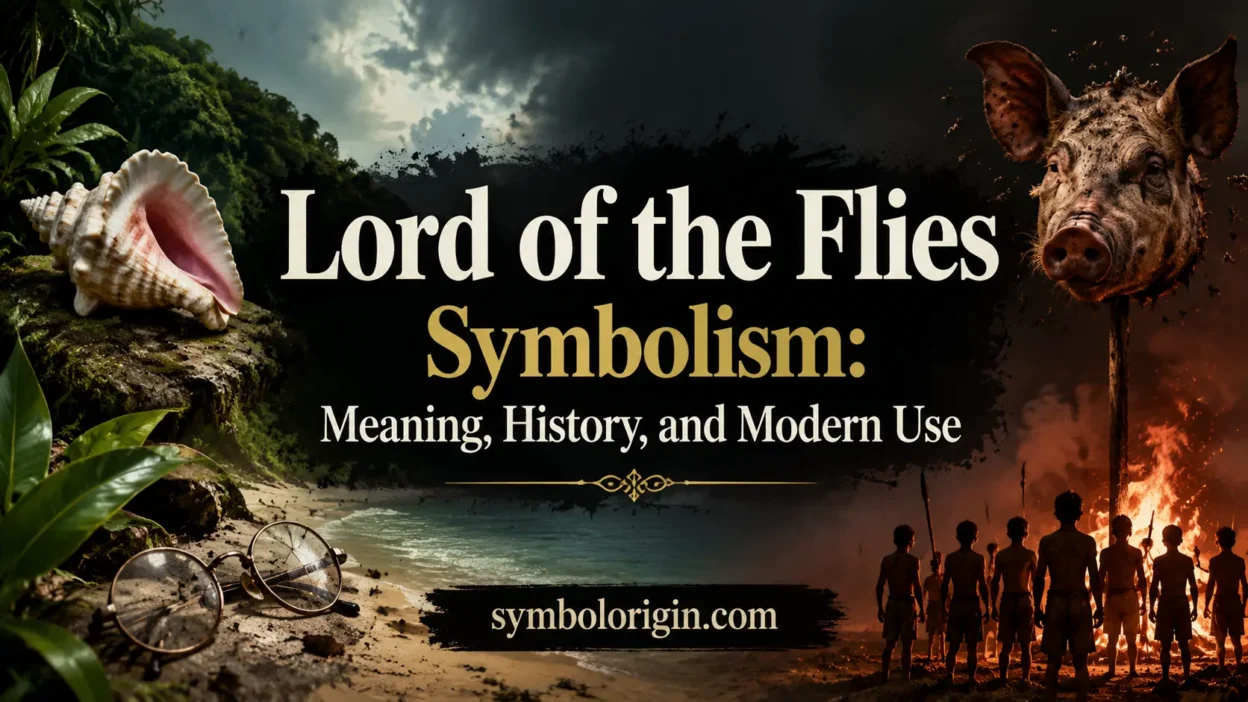
Lord of the Flies symbolism explores how William Golding’s novel uses characters, objects, and events to represent ideas about human nature, power, fear, morality, and society. Published in 1954, the novel remains widely studied in American schools because its symbols connect with lasting questions about civilization and human behavior.
The story follows a group of British schoolboys stranded on an uninhabited island after a plane crash. Without adult supervision, the boys attempt to create their own society, but their community slowly breaks apart as fear, violence, and the desire for control take over.
The symbols in the novel are not limited to the island itself. They represent broader human experiences, including the struggle between order and chaos, reason and instinct, innocence and cruelty. These ideas continue to influence how readers understand leadership, social rules, and personal responsibility today.
Quick Answer
Lord of the Flies symbolism commonly represents the conflict between civilization and human savagery, especially the idea that social order can collapse when rules and accountability disappear. The novel’s symbols also explore fear, power, morality, and the darker sides of human behavior.
TL;DR
- The conch symbolizes democracy, order, and shared authority.
- The beast represents fear and humanity’s inner darkness.
- Piggy’s glasses symbolize intelligence and problem-solving.
- The island reflects society and human conflict.
- The Lord of the Flies represents violence and corruption.
- Modern readers connect symbols to power and leadership.
What the Lord of the Flies Symbol Represents in Literature
William Golding’s novel is filled with symbols that operate on multiple levels. The island setting may appear simple, but each major object and character represents a larger idea about human society.
The central message of the novel is not that humans are naturally evil. Instead, Golding examines how quickly social structures can weaken when fear, competition, and unchecked authority replace cooperation.
The symbolism encourages readers to question what keeps communities stable. Laws, traditions, communication, and moral responsibility all play important roles in preventing disorder.
Ancient and Literary Roots Behind the Symbolism
Although the novel was written in the twentieth century, its themes connect with older literary and philosophical traditions.
Stories from ancient mythology, religious texts, and political philosophy often examine the tension between human instincts and social responsibility. Writers have long explored what happens when people lose external structures that guide behavior.
Golding drew inspiration from real human conflicts, especially the violence and destruction witnessed during World War II. His experiences influenced his view that civilization could be fragile rather than guaranteed.
The novel became a modern exploration of an old question: what happens when people must create rules for themselves?
The Conch Shell Symbolizes Democracy and Order
The conch is one of the most recognizable symbols in the novel. When Ralph discovers the shell, it becomes a tool for organizing meetings and giving individuals permission to speak.
In the beginning, the conch represents cooperation and fairness. Whoever holds it has the right to talk, creating a simple democratic system where every voice matters.
For many American readers, the conch connects with ideas of civic participation, voting, and public discussion. It represents the belief that communities function better when people respect shared rules.
However, as the boys become more violent, the authority of the conch weakens. Its destruction marks the collapse of organized society on the island.
| Symbol | Meaning in the USA | Common Associations | Notes |
|---|---|---|---|
| Conch shell | Democracy and order | Rules, discussion, leadership | Loses power as society breaks down |
| Beast | Fear and inner conflict | Anxiety, uncertainty, human instincts | Exists mostly through belief |
| Piggy’s glasses | Knowledge and technology | Intelligence, solutions, progress | Connects to rational thinking |
| Signal fire | Hope and responsibility | Rescue, survival, cooperation | Shows commitment to a shared goal |
| Lord of the Flies | Corruption and violence | Evil, temptation, destruction | Represents humanity’s darker side |
The Beast Symbolizes Fear and Human Anxiety
The beast is one of the novel’s most important symbols because it shows how fear can influence human decisions.
The younger boys become frightened by the idea that a dangerous creature exists on the island. Although they cannot clearly prove the beast is real, their fear grows stronger and begins controlling their actions.
The beast represents more than an imaginary monster. It symbolizes the fears people create when they face uncertainty. In society, fear can influence politics, relationships, and group behavior when people allow emotions to replace reason.
For modern American readers, the beast can represent many forms of anxiety, including fear of the unknown, fear of losing control, or fear of threats that may not be fully understood.
Piggy’s Glasses Represent Intelligence and Innovation
Piggy’s glasses symbolize knowledge, science, and practical thinking.
The glasses are essential because they allow the boys to create fire, which becomes their main hope for rescue. Unlike physical strength or popularity, Piggy’s intelligence provides a solution to their survival problem.
The symbol also reveals how societies often depend on knowledge and technology. When the glasses are stolen, it shows how power can be taken away from thoughtful people and placed in the hands of those seeking control.
Piggy’s treatment throughout the novel also highlights how groups sometimes reject intelligence when emotions and aggression become more influential.
The Signal Fire Represents Hope and Responsibility
The signal fire represents the boys’ connection to civilization and their desire to return home.
At first, maintaining the fire is their shared responsibility. It requires cooperation, discipline, and long-term thinking.
However, the boys gradually abandon the fire as their priorities change. Their focus shifts from rescue toward hunting and personal power.
The symbol shows how important goals can disappear when immediate desires become more attractive than future benefits.
In modern interpretations, the signal fire represents commitment, responsibility, and the effort required to maintain social progress.
The Island Represents Society and Human Behavior
The island is more than a survival location. It acts as a miniature version of society.
At first, the boys attempt to recreate familiar systems from the adult world. They hold meetings, establish rules, and organize responsibilities.
As those systems weaken, the island becomes a place where deeper human conflicts appear. The setting allows Golding to examine how communities change under pressure.
American readers often connect the island symbolism with discussions about leadership, institutions, and the importance of maintaining social trust.
The Lord of the Flies Symbolizes Violence and Moral Corruption
The title itself comes from the phrase “Lord of the Flies,” a translation of the biblical name Beelzebub, traditionally associated with evil.
Within the novel, the pig’s head placed on a stick becomes a symbol of the darkness developing among the boys.
The Lord of the Flies represents the idea that cruelty does not only come from outside forces. It can emerge from human choices, desires, and impulses.
The symbol challenges readers to consider how individuals behave when they believe there are no consequences.
Ralph Symbolizes Leadership and Civilization
Ralph represents organized leadership and the desire to maintain civilized behavior.
His priorities focus on rescue, meetings, and cooperation. He believes rules are necessary because they protect everyone.
However, Ralph’s leadership struggles because authority requires more than good intentions. Leaders also need support, trust, and the ability to manage fear.
His character represents the challenges faced by anyone trying to preserve order during conflict.
Jack Symbolizes Power, Control, and Savagery
Jack represents a different approach to leadership. He gains influence through hunting, strength, and the ability to create excitement among the boys.
Unlike Ralph, Jack focuses on immediate rewards and personal authority. His rise demonstrates how groups can be attracted to leaders who promise protection or power.
The contrast between Ralph and Jack represents a larger conflict between democratic leadership and authoritarian control.
Roger Symbolizes Extreme Cruelty
Roger represents the most destructive side of human behavior.
While Jack seeks power and control, Roger enjoys causing harm. His actions show what can happen when social restrictions disappear completely.
The character symbolizes the danger of removing moral boundaries and accountability.
Through Roger, Golding examines how ordinary individuals may commit harmful acts when they feel free from consequences.
Religious and Cultural Interpretations of the Symbolism
Many readers interpret the novel through religious and philosophical perspectives.
The conflict between good and evil, temptation, and human weakness connects with themes found in many religious traditions. However, the novel does not present a simple message about morality.
Instead, Golding presents human behavior as complicated. People can create communities, show compassion, and develop knowledge, but they can also choose violence and selfishness.
Different cultures may interpret these symbols differently depending on their views about human nature, society, and responsibility.
How Americans Understand Lord of the Flies Symbolism Today
In the United States, the novel remains common in literature classes because its symbols connect with modern discussions about leadership, social responsibility, and group behavior.
Teachers often use the book to discuss topics such as government, democracy, bullying, and ethical decision-making.
Beyond classrooms, the symbols appear in conversations about workplace culture, politics, and social movements. The story continues to provide a framework for discussing how groups respond during stressful situations.
Modern Uses in Media, Education, and Popular Culture
The symbols from Lord of the Flies appear in modern discussions about human behavior and society.
The phrase “Lord of the Flies” is sometimes used when describing situations where rules disappear and conflict grows. It may appear in discussions about online communities, survival stories, or social experiments.
The novel’s themes also influence movies, television, and books that explore isolated groups, power struggles, and moral choices.
Common Misunderstandings About the Symbolism
One common misunderstanding is that the novel simply argues humans are naturally evil. Golding’s message is more complex.
The story shows that humans have the ability to create order and cooperation, but those systems require effort and responsibility.
Another misunderstanding is that every symbol has only one meaning. Literary symbols often have multiple interpretations depending on the reader’s perspective.
The conch, beast, and fire can represent different ideas while still supporting the novel’s central themes.
Frequently Asked Questions
What does Lord of the Flies symbolize?
Lord of the Flies symbolizes the conflict between civilization and human instincts. It explores how fear, power, and violence can influence people when social rules weaken.
Why is the conch important in Lord of the Flies?
The conch symbolizes democracy, fairness, and organized communication. Its destruction represents the collapse of order among the boys.
Is the beast real in Lord of the Flies?
The beast is not presented as a normal physical creature. It mainly represents fear and the darker parts of human nature.
What does Piggy’s glasses symbolize?
Piggy’s glasses symbolize intelligence, technology, and rational thinking. They show the importance of knowledge in solving problems.
Why is Lord of the Flies still studied in America?
The novel remains popular because its themes connect with questions about leadership, society, morality, and human behavior.
Is Lord of the Flies a religious story?
The novel contains religious symbolism, especially through the Lord of the Flies figure, but it is primarily a literary exploration of human nature and society.
Conclusion
The symbols in William Golding’s novel continue to encourage discussion about how societies function and what happens when shared values disappear. The conch, beast, fire, glasses, and Lord of the Flies each represent different aspects of human experience, from cooperation and knowledge to fear and violence.
Understanding Lord of the Flies symbolism helps readers see why the novel remains relevant decades after its publication. Its message is not simply about darkness in humanity, but about the constant need for responsibility, compassion, and social awareness.
The lasting importance of the novel comes from its ability to make readers examine how individuals and communities choose between order and chaos.