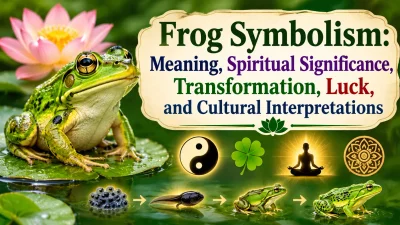
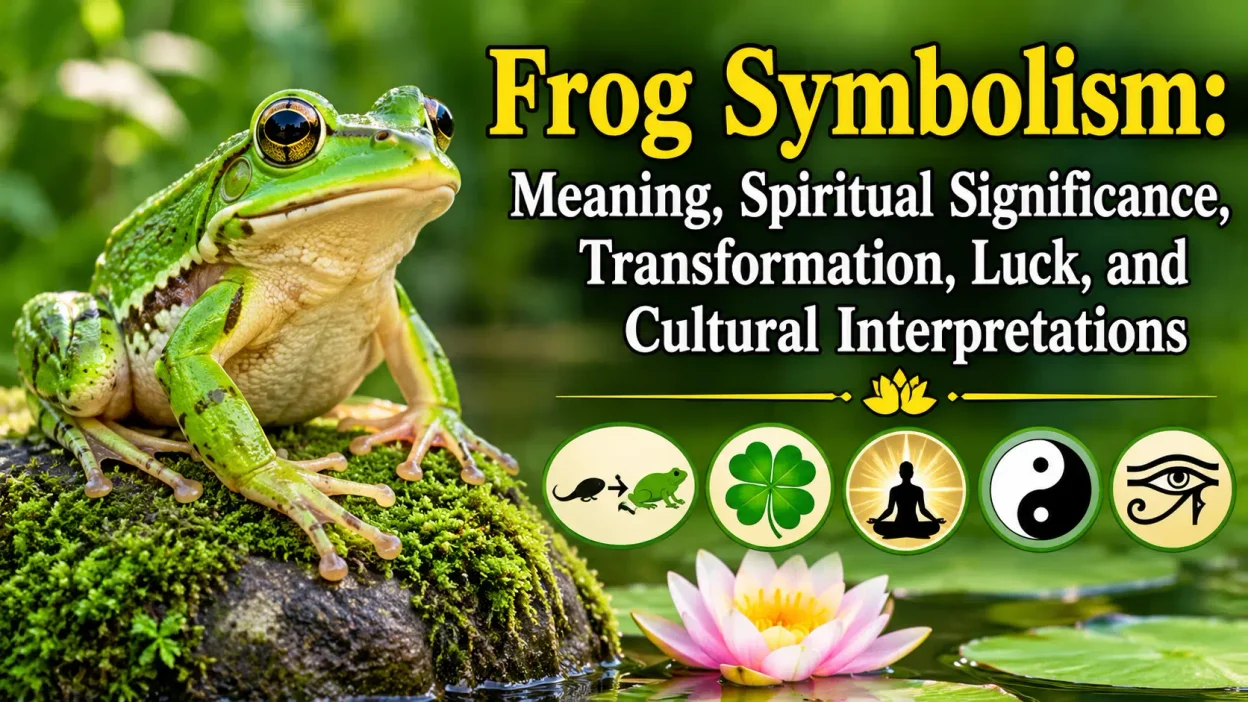
Frogs are fascinating creatures that have inspired myths, spiritual beliefs, folklore, and artistic traditions across the world. Their ability to live both in water and on land, their remarkable life cycle, and their association with rain and wetlands have made them powerful symbols of transformation, renewal, fertility, and adaptability.
In many cultures, frogs are associated with good fortune, prosperity, and new beginnings. Their development from tadpoles into adult frogs also makes them natural symbols of personal growth and change. However, frog symbolism is not always positive. In certain religious and cultural traditions, frogs can represent impurity, danger, chaos, or unwanted change.
So, what does a frog symbolize? The answer depends on the cultural context, spiritual tradition, and circumstances in which the frog appears.
This guide explores frog symbolism, its spiritual significance, cultural meanings, biblical references, dream interpretations, and its role in art and mythology.
What Does a Frog Symbolize?
A frog commonly symbolizes transformation, renewal, adaptability, fertility, abundance, and good fortune. Its life cycle represents the process of growing, changing, and entering a new stage of life.
Because frogs depend on healthy aquatic environments and are closely associated with rain and water, they are also connected with nature, emotional renewal, and the cycles of life.
Here are some of the most common symbolic meanings of frogs:
- Transformation: The transition from tadpole to adult frog represents personal development and significant life changes.
- Renewal: Frogs are associated with water, rain, and the return of life after dry periods.
- Adaptability: Their ability to live in aquatic and terrestrial environments symbolizes flexibility.
- Fertility: Their reproductive behavior and association with water connect them with fertility and new life.
- Abundance: In some cultural traditions, frogs represent prosperity, wealth, and good fortune.
- Emotional cleansing: Their connection with water can symbolize emotional release and renewal in modern spiritual interpretations.
- Rebirth: Their life cycle can represent leaving an old identity behind and beginning a new chapter.
Although these meanings appear in different traditions, they should not be treated as universal beliefs. A frog may represent prosperity in one cultural setting and an unpleasant or threatening presence in another.
Frog Spiritual Meaning
In contemporary spiritual interpretations, frogs are often viewed as symbols of transformation, emotional healing, adaptability, and new beginnings.
Their life cycle provides a natural example of change. A tadpole begins life in water, develops legs, gradually loses its tail, and eventually becomes an adult frog. This process can represent the journey from an earlier stage of life toward greater independence and maturity.
1. Transformation and Personal Growth
One of the strongest symbolic associations of frogs is transformation.
A frog’s development from a tadpole into an adult demonstrates how dramatically a living creature can change throughout its life. This makes frogs powerful symbols of personal growth, self-discovery, and transition.
A frog may represent:
- Leaving behind outdated habits
- Developing confidence and independence
- Accepting major life changes
- Learning from difficult experiences
- Becoming comfortable with a new identity
In spiritual writing, seeing a frog is sometimes interpreted as a reminder to embrace change rather than resist it. This is a personal or modern symbolic interpretation, not evidence that a frog predicts a particular event.
2. Renewal and New Beginnings
Frogs are closely connected with water and rainfall, which are essential for many ecosystems. Rain can restore dry landscapes, support plant growth, and create favorable conditions for reproduction.
Because of these associations, frogs can symbolize renewal, fresh opportunities, and the beginning of a new chapter.
In personal symbolism, a frog may represent:
- Starting over after a difficult period
- Releasing old emotional burdens
- Welcoming new opportunities
- Restoring balance in life
- Finding hope after uncertainty
3. Adaptability and Flexibility
Frogs are adapted to different environments, although their specific habitats and lifestyles vary by species. Many frogs spend different stages of their lives in aquatic and terrestrial environments.
This makes them symbols of flexibility and the ability to adjust to changing circumstances.
A frog can represent the importance of:
- Remaining open to new experiences
- Adjusting to unfamiliar situations
- Learning new skills
- Finding creative solutions
- Maintaining balance during transitions
4. Fertility and Abundance
Frogs are associated with fertility in several cultural traditions. Their reproductive cycles, large numbers of eggs, and connection with rainwater have contributed to their association with fertility, agricultural renewal, and abundance.
In some traditions, frogs represent the continuation of life and the potential for growth.
Modern spiritual interpretations may also connect frog symbolism with financial abundance and prosperity. However, this association is not universal, and seeing a frog does not guarantee wealth or financial success.
5. Emotional Cleansing and Healing
Water is frequently associated with emotions, purification, and renewal in religious and symbolic traditions. Since frogs are strongly connected with aquatic environments, they can also represent emotional change.
In contemporary spiritual interpretations, frog symbolism may encourage people to:
- Acknowledge difficult emotions
- Let go of unnecessary worries
- Seek emotional balance
- Accept personal vulnerability
- Make space for healing and renewal
These meanings are interpretive rather than established biological or supernatural facts.
Frog Symbolism Across Different Cultures
Frogs have appeared in mythology, folklore, religious traditions, and artistic representations for thousands of years. Their meanings differ significantly across cultures.
<PRIVATE_PERSON>
1. Ancient Egyptian Frog Symbolism
<AsyncImage query=”Ancient Egyptian goddess Heqet frog headed deity ancient Egyptian artwork” aspectRatio=”16:9″ width=”100%” />
In ancient Egypt, frogs were associated with fertility, birth, and regeneration.
One important figure was Heqet, a goddess commonly depicted with a frog’s head or in frog form. She was connected with childbirth, fertility, and the protection of mothers and newborn children.
Frogs were also associated with the annual flooding of the Nile. The floodwaters supported agriculture and renewed the land, making frogs meaningful symbols of life and regeneration.
In this context, frog imagery could represent:
- Birth and fertility
- Protection during childbirth
- Renewal and regeneration
- The continuation of life
- Agricultural abundance
The association between frogs and creation also appears in Egyptian religious imagery connected with the Ogdoad, a group of primordial deities.
2. Chinese Frog Symbolism
<AsyncImage query=”Chinese three legged money frog Jin Chan traditional feng shui statue coins” aspectRatio=”16:9″ width=”100%” />
In Chinese culture, frogs have several symbolic associations, particularly with prosperity, fertility, and good fortune.
One well-known figure is the three-legged money frog, often called Jin Chan or the money toad. It is commonly represented sitting on coins and is associated with wealth and financial prosperity in some Chinese folk and feng shui traditions.
The three-legged money frog is frequently displayed in homes and businesses as a traditional prosperity symbol.
Its common associations include:
- Wealth and financial success
- Good fortune
- Prosperity
- Protection of resources
- Business success
These associations belong to particular Chinese folk and feng shui traditions rather than representing the meaning of every frog in Chinese culture.
3. Japanese Frog Symbolism
<AsyncImage query=”Japanese kaeru frog traditional folk art lucky frog ornament” aspectRatio=”16:9″ width=”100%” />
In Japan, frogs are associated with good fortune and safe returns.
The Japanese word for frog is kaeru (カエル), which is also pronounced like a verb meaning “to return.” This wordplay has contributed to the frog’s association with returning home safely.
As a result, frog charms are sometimes carried by travelers or kept as good-luck objects.
Japanese frog symbolism can include:
- Safe journeys
- Returning home
- Good fortune
- Prosperity
- Protection during travel
The cultural meaning is particularly connected with the Japanese language and traditional folk practices.
4. Native American Frog Symbolism
<AsyncImage query=”Native American frog motif traditional pottery indigenous art southwestern” aspectRatio=”16:9″ width=”100%” />
Frogs appear in the stories, artwork, and traditions of various Indigenous peoples of North America. Their meanings differ among nations and communities.
In some traditions, frogs are connected with rain, water, fertility, renewal, and the natural environment. These associations reflect the frog’s relationship with seasonal changes and aquatic habitats.
Some Indigenous stories also feature frogs as important characters in explanations of natural events or relationships between living beings.
However, there is no single Native American interpretation of frog symbolism. Each nation’s stories and cultural practices should be understood within their own context.
5. Celtic Frog Symbolism
<AsyncImage query=”Celtic inspired green frog nature knotwork illustration” aspectRatio=”16:9″ width=”100%” />
Frogs are sometimes associated with water, fertility, healing, and transformation in modern interpretations of Celtic-inspired symbolism.
Their connection with wetlands, seasonal rainfall, and changing environments makes them suitable symbols of natural cycles and renewal.
However, claims that all ancient Celtic communities considered frogs sacred or assigned them one specific spiritual meaning should be treated cautiously. Modern spiritual interpretations are not necessarily evidence of a widespread historical Celtic belief.
Frog Symbolism in the Bible
Frogs have a significant but complicated role in the Bible. Unlike their positive associations with fertility and good fortune in some cultures, biblical references primarily connect frogs with judgment, divine power, and unclean spirits.
1. The Plague of Frogs in Exodus
The most well-known biblical reference to frogs appears in Exodus 8:1–15.
In the account, God sends a plague of frogs upon Egypt after Pharaoh refuses to release the Israelites. Frogs emerge from the Nile and spread throughout the land, entering houses, bedrooms, ovens, and other places.
The plague demonstrates God’s power and challenges the authority of Pharaoh and the religious structures of ancient Egypt.
In this passage, frogs represent:
- Divine judgment
- Disruption and suffering
- The consequences of Pharaoh’s refusal
- God’s power over nature
- The limits of human authority
This is an important distinction: frogs in the Exodus account are not presented as symbols of good fortune or spiritual transformation.
2. Frogs in Revelation
Frogs also appear in Revelation 16:13.
In this passage, three unclean spirits resembling frogs emerge from the mouths of the dragon, the beast, and the false prophet.
The imagery is connected with deception, spiritual impurity, and forces that gather the kings of the earth for battle.
In this context, frogs are associated with:
- Unclean spirits
- Deception
- Spiritual corruption
- Opposition to God
- The gathering of forces for conflict
3. Overall Biblical Meaning of Frogs
The biblical meaning of frogs depends on the passage, but the main references are negative or associated with judgment.
| Biblical Reference | Context | Symbolic Association |
|---|---|---|
| Exodus 8:1–15 | Plague of frogs in Egypt | Divine judgment and disruption |
| Psalm 78:45 | Frogs sent among the Egyptians | God’s power and judgment |
| Psalm 105:30 | Frogs filling the land of Egypt | The consequences of divine judgment |
| Revelation 16:13 | Three unclean spirits resembling frogs | Deception and spiritual impurity |
The Bible does not establish frogs as universal symbols of prosperity, good luck, or personal transformation. Those meanings come from other cultural and modern spiritual interpretations.
Frog Symbolism in Dreams
Dreaming about frogs can have different symbolic interpretations depending on the dream’s setting, the frog’s behavior, and the emotions experienced by the dreamer.
In modern dream interpretation, frogs are often connected with transformation, emotional experiences, renewal, and adaptability.
These interpretations are subjective rather than scientifically established predictions.
1. Dreaming of a Green Frog
A green frog may symbolize growth, nature, renewal, or fresh opportunities.
Green is commonly associated with vegetation and new life, so a green frog may reflect a desire for personal development or a fresh beginning.
2. Dreaming of a Frog Jumping
A jumping frog may represent movement, progress, or a transition from one stage of life to another.
It may also reflect a desire to take action or move beyond a difficult situation.
3. Dreaming of a Frog in Water
A frog swimming or sitting in water may symbolize emotional awareness and personal reflection.
The meaning may depend on whether the water appears calm, muddy, clear, or turbulent.
4. Dreaming of a Frog in Your House
A frog inside a home may represent a personal change, an unexpected situation, or something that has entered your private life.
Some modern interpretations associate this dream with new opportunities or family-related changes, but there is no universal meaning.
5. Dreaming of a Dead Frog
A dead frog may symbolize the end of a transition, a missed opportunity, disappointment, or the feeling that personal growth has stopped.
It may also reflect concerns about environmental damage or the loss of something important.
6. Dreaming of Many Frogs
A large number of frogs may represent overwhelming changes, numerous responsibilities, or a period of uncertainty.
Depending on the dreamer’s emotions, the image may feel positive, uncomfortable, or frightening.
Different Frog Colors and Their Symbolic Meanings
Frogs come in many colors, and their appearances have inspired different symbolic interpretations.
The meanings below are primarily modern symbolic associations rather than fixed cultural traditions.
<AsyncImageGroup query={[“bright green tree frog on leaf close up”,”golden yellow poison dart frog macro”,”blue poison dart frog tropical rainforest”,”red eyed tree frog close up”,”black frog on wet forest floor”]} aspectRatio=”5:4″ layout=”carousel”/>
| Frog Color | Common Symbolic Associations |
|---|---|
| Green frog | Growth, renewal, nature, and prosperity |
| Yellow frog | Optimism, happiness, energy, and creativity |
| Blue frog | Peace, emotional balance, and communication |
| Red frog | Passion, courage, energy, and intensity |
| Black frog | Mystery, protection, uncertainty, and hidden emotions |
| White frog | Purity, spiritual renewal, and new beginnings |
| Golden frog | Wealth, abundance, success, and good fortune |
| Brown frog | Stability, grounding, and connection with nature |
The actual colors of frogs serve biological purposes, including camouflage and warning signals. Some brightly colored frogs use their appearance to warn predators that they are toxic or distasteful.
Frog Symbolism in Mythology and Folklore
Frogs appear in myths and folktales from different parts of the world. Their unusual life cycle, connection with water, and distinctive calls have made them important figures in stories about creation, rain, fertility, and transformation.
1. Frog Symbolism in Ancient Egyptian Mythology
In ancient Egyptian mythology, frogs were associated with the goddess Heqet and the processes of birth and regeneration.
Frog imagery also appeared in connections with the primordial forces of creation. The frog’s association with water and new life made it a meaningful symbol in Egyptian religious traditions.
2. Frog Symbolism in Chinese Folklore
Chinese folklore includes the three-legged money toad, which is associated with prosperity and wealth.
This figure is particularly recognizable in traditional decorative objects and feng shui practices. Its symbolic importance is connected with good fortune and financial abundance.
3. Frog Symbolism in European Fairy Tales
Frogs appear in several European fairy tales, most famously in the story commonly known as The Frog Prince.
In this tale, a frog is transformed into a prince, connecting the animal with transformation, hidden identity, and the relationship between appearance and inner character.
The story has many versions, and the details differ between retellings.
4. Frog Symbolism in Rainmaking Traditions
Because frogs are often heard calling during rainy periods and many species depend on water for reproduction, they have become associated with rainfall in various traditions.
Some cultural stories connect frogs with bringing rain, renewing the land, or restoring agricultural fertility.
These associations vary widely and should not be generalized across all communities.
Frog Symbolism in Literature and Art
Frogs have been used in literature, painting, sculpture, decorative objects, and popular culture to communicate different ideas.
Their symbolic meanings depend on the work and its cultural setting.
1. Transformation and Hidden Identity
In fairy tales such as The Frog Prince, the frog represents a hidden identity and the possibility of transformation.
The contrast between the frog’s appearance and the prince’s identity creates themes involving acceptance, character, and change.
2. Nature and Environmental Balance
In modern environmental art and literature, frogs can represent the health of ecosystems.
Because many amphibians are sensitive to environmental changes, their presence or decline can draw attention to pollution, habitat destruction, climate change, and biodiversity loss.
3. Humor and Playfulness
Frogs also appear in cartoons, children’s stories, and humorous illustrations.
Their jumping movements, unusual appearance, and recognizable calls can make them symbols of playfulness, curiosity, and lightheartedness.
Frog Spirit Animal Meaning
In contemporary spiritual traditions, the frog spirit animal is commonly associated with adaptability, emotional renewal, transformation, and personal growth.
People who connect with frog symbolism may interpret it as encouragement to accept change and remain flexible when facing unfamiliar circumstances.
Common qualities associated with the frog spirit animal include:
- Adaptability: Adjusting to changing environments and situations.
- Transformation: Accepting personal development and new stages of life.
- Emotional awareness: Recognizing feelings and allowing space for reflection.
- Renewal: Moving beyond old patterns and beginning again.
- Resilience: Continuing to grow despite difficulties.
The idea of a frog spirit animal belongs to modern spiritual interpretation in this context. It should not be presented as a universal belief shared by all Indigenous cultures.
Frog Totem Meaning
In some modern animal-symbolism practices, a frog totem represents transformation, adaptability, fertility, and renewal.
A person who identifies with frog symbolism may see the animal as a reminder to:
- Welcome meaningful changes.
- Remain flexible during uncertain periods.
- Develop emotional awareness.
- Appreciate the natural environment.
- Recognize opportunities for growth.
The concept of animal totems has specific meanings in different Indigenous traditions. It is important not to treat every modern use of the term as equivalent to those culturally distinct practices.
Frog Symbolism in Love and Relationships
Frogs can represent renewal, fertility, emotional growth, and the development of relationships in modern symbolic interpretations.
Their transformation from tadpoles to adult frogs can be compared with the way relationships change over time.
1. New Beginnings in Love
A frog may symbolize the beginning of a new relationship or a fresh chapter in an existing partnership.
2. Emotional Growth
Frog symbolism can represent the importance of learning, communicating, and adapting as a relationship develops.
3. Fertility and Family
In some cultural traditions, frogs are associated with fertility and childbirth. This connection is partly related to their reproductive cycles and association with water.
4. Accepting Change
A frog can represent the idea that healthy relationships require patience, flexibility, and the ability to adjust to changing circumstances.
These are symbolic interpretations, not predictions about someone’s romantic future.
Frog Tattoo Symbolism
<AsyncImageGroup query={[“minimalist frog tattoo fine line design”,”traditional Japanese frog tattoo art”,”realistic green tree frog tattoo floral”,”small jumping frog tattoo design”]} aspectRatio=”5:4″ layout=”carousel”/>
Frog tattoos can carry different personal and cultural meanings. Some people choose them because of their connection with nature, while others appreciate their associations with transformation, renewal, or good fortune.
Common frog tattoo meanings include:
- Transformation: Representing personal change and growth.
- Good fortune: Inspired by frog imagery in certain cultural traditions.
- Adaptability: Celebrating the ability to adjust to life’s challenges.
- Nature: Expressing an appreciation for wildlife and the environment.
- Fertility: Representing new life and family.
- Playfulness: Reflecting humor, curiosity, and a lighthearted personality.
A three-legged money frog tattoo may specifically reference Chinese prosperity symbolism, while a Japanese-style frog design may reflect traditional ideas about safe returns and good fortune.
Why Are Frogs Associated With Rain and Water?
Frogs are closely associated with rain and water for biological and ecological reasons.
Most frog species depend on moist environments, and many lay their eggs in water or other damp habitats. Rainfall can create favorable conditions for breeding and movement.
Their calls also become especially noticeable during certain breeding seasons, which may coincide with rainy weather.
These natural connections have contributed to symbolic associations with:
- Fertility and reproduction
- Agricultural renewal
- Water and life
- Seasonal change
- Abundance and growth
Frogs can also act as indicators of environmental conditions because many species are sensitive to changes in water quality, habitat, and climate.
Are Frogs a Sign of Good Luck?
In some cultures, frogs are considered symbols of good luck, prosperity, and protection.
For example, the Japanese word kaeru is associated with returning home, making frog charms popular in some traditional good-luck practices. In Chinese folk and feng shui traditions, the three-legged money frog is associated with wealth and prosperity.
However, frogs do not have the same meaning everywhere. In biblical accounts, they appear in the context of plagues and unclean spirits.
Therefore, whether a frog represents good luck depends on the cultural or spiritual tradition being considered. There is no scientific evidence that encountering a frog predicts future fortune.
Ecological Meaning of Frogs
Beyond cultural and spiritual symbolism, frogs have important ecological significance.
They play valuable roles in many ecosystems by controlling insect populations and serving as food for other animals. Their presence can also provide information about environmental conditions.
Frogs are often described as environmental indicators because their permeable skin and life cycles can make them vulnerable to pollution, disease, habitat loss, and other environmental pressures.
Their ecological importance gives them additional symbolic associations in modern environmental discussions:
- Biodiversity
- Environmental protection
- Ecological balance
- Clean water
- Habitat conservation
- The interconnectedness of life
Frog populations are declining in many parts of the world due to multiple threats, making their conservation an important environmental concern.
Conclusion
Frog symbolism carries a wide range of meanings, including transformation, renewal, adaptability, fertility, abundance, and good fortune. Their remarkable life cycle makes them natural symbols of personal growth and change, while their relationship with water connects them with rain, reproduction, and the renewal of nature.
Different cultures interpret frogs in different ways. Ancient Egyptians associated them with birth and regeneration, Chinese folk traditions connected certain frog figures with prosperity, and Japanese traditions linked frogs with safe returns. Biblical references, however, associate frogs with the plague of Egypt and unclean spirits.
Ultimately, the meaning of a frog depends on its cultural context, historical background, and personal interpretation. Whether viewed as a symbol of transformation, an emblem of good fortune, or an important part of the natural world, the frog remains a fascinating symbol of life’s ability to change and renew itself.
Frequently Asked Questions (FAQs)
1. What does a frog symbolize spiritually?
In contemporary spiritual interpretations, a frog commonly symbolizes transformation, renewal, adaptability, emotional growth, fertility, and new beginnings. Its life cycle represents the process of moving through different stages of development.
2. Are frogs a sign of good luck?
Frogs are considered lucky in some cultural traditions. Japanese frog charms are associated with safe returns, while the Chinese three-legged money frog represents wealth and prosperity in certain folk and feng shui practices. However, this belief is not universal.
3. What does a frog symbolize in the Bible?
In the Bible, frogs are associated with the plague of Egypt in Exodus and unclean spirits in Revelation 16:13. These passages connect frogs with divine judgment, disruption, and spiritual impurity rather than general good fortune.
4. What does a green frog symbolize?
A green frog commonly symbolizes growth, renewal, nature, and prosperity in modern symbolic interpretations. Its green color is associated with vegetation and new life.
5. What does it mean when you see a frog?
Symbolically, seeing a frog may be interpreted as a reminder of transformation, adaptability, or new beginnings. In some cultures, frogs are also associated with good fortune. However, seeing one does not have a scientifically established spiritual meaning.
6. What does a frog symbolize in dreams?
In modern dream interpretation, frogs may represent change, emotional renewal, adaptability, and personal growth. The meaning depends on the dream’s details and the feelings experienced by the dreamer.
7. What does a frog symbolize in ancient Egypt?
In ancient Egypt, frogs were associated with fertility, birth, and regeneration. The goddess Heqet was commonly represented with a frog’s head and was connected with childbirth and protection.
8. What does a frog symbolize in Chinese culture?
In some Chinese folk traditions, frogs are associated with fertility and prosperity. The three-legged money frog, or Jin Chan, is particularly well known as a symbol of wealth and good fortune.
9. What does a frog symbolize in Japanese culture?
In Japan, frogs are associated with safe returns and good fortune. This symbolism is connected with the word kaeru, which means frog and shares its pronunciation with a Japanese verb meaning “to return.”
10. What does a frog tattoo symbolize?
A frog tattoo can symbolize transformation, adaptability, renewal, fertility, good fortune, and a connection with nature. Its meaning often depends on the design and the personal reasons behind choosing it.
11. What does a dead frog symbolize?
In modern symbolic interpretations, a dead frog may represent the end of a transition, disappointment, missed opportunities, or a change that has not developed as expected. It does not have one universally accepted meaning.
12. Why are frogs associated with transformation?
Frogs undergo metamorphosis, developing from aquatic tadpoles into adult frogs. This dramatic biological process makes them natural symbols of personal growth, change, and transformation.
13. Are frogs associated with fertility?
Yes. Frogs are connected with fertility in several cultural traditions because of their reproductive cycles, large numbers of eggs, and relationship with water. Ancient Egyptian traditions also associated frogs with childbirth and regeneration.
14. What does a frog symbolize in love?
In modern symbolic interpretations, frogs may represent emotional growth, new beginnings, fertility, and adaptability in relationships. These meanings are interpretive rather than universal cultural rules.
15. What does it mean if a frog enters your house?
A frog entering a house may have a simple natural explanation, such as seeking moisture, shelter, or access to insects. In some folk and modern spiritual interpretations, it may symbolize renewal or good fortune, but these beliefs vary by culture.