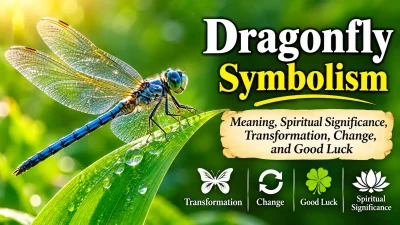
Dragonflies are among nature’s most fascinating insects. With their delicate wings, shimmering bodies, and remarkable flying abilities, they have inspired stories, beliefs, and symbolic interpretations across different cultures. Their ability to move in almost every direction and their life cycle, which begins underwater before emerging into the air, make them powerful symbols of change and personal growth.
Dragonfly symbolism is commonly associated with transformation, freedom, adaptability, wisdom, emotional maturity, and renewal. In spiritual interpretations, seeing a dragonfly may remind someone to embrace change, release old limitations, and approach life with greater awareness.
Although dragonflies carry different meanings in different traditions, their connection with water, air, movement, and transformation makes them meaningful symbols in art, folklore, literature, and modern spirituality.
What Does a Dragonfly Symbolize?
A dragonfly generally symbolizes transformation, adaptability, freedom, self-awareness, and the ability to move through life’s challenges.
Its meanings often come from its natural characteristics. A dragonfly spends much of its early life underwater before emerging as a flying adult. This dramatic change makes it a natural symbol of personal development and new beginnings.
Common symbolic meanings include:
- Transformation: Personal growth and significant life changes.
- Freedom: Independence, movement, and breaking away from limitations.
- Adaptability: Adjusting to new circumstances and unexpected challenges.
- Wisdom: Developing a deeper understanding of yourself and the world.
- Emotional growth: Learning to manage feelings and gain perspective.
- Renewal: Leaving the past behind and beginning a new chapter.
- Self-awareness: Recognizing your strengths, weaknesses, and potential.
These are symbolic interpretations rather than universal meanings. Their significance can vary depending on cultural background and personal experience.
Spiritual Meaning of Dragonflies
In modern spiritual traditions, dragonflies are often viewed as symbols of awakening, inner change, and personal development. Their appearance may be interpreted as an invitation to examine your life, recognize opportunities, and become more comfortable with uncertainty.
1. Spiritual Transformation
The dragonfly’s life cycle represents transformation. It begins as an aquatic nymph and eventually emerges into an adult insect with wings.
Spiritually, this process can represent moving beyond an old identity, learning from difficult experiences, and becoming more confident in who you are.
2. Awakening and Self-Discovery
Dragonflies are sometimes associated with spiritual awareness and seeing life from a different perspective. Their large, multifaceted eyes can inspire interpretations about observation, clarity, and recognizing things that were previously overlooked.
3. Living in the Present
A dragonfly’s quick, unpredictable flight can symbolize the importance of enjoying the present moment. Rather than becoming trapped in past regrets or future worries, its symbolism encourages awareness of what is happening now.
4. Letting Go of the Past
Because dragonflies undergo a dramatic physical transformation, they can represent releasing outdated habits, negative experiences, and limiting beliefs.
In personal reflection, a dragonfly may serve as a reminder that change does not have to mean losing yourself. It can also mean discovering a stronger version of yourself.
Dragonfly Symbolism Across Different Cultures
Dragonflies appear in the folklore, art, and traditional beliefs of several societies. Their meanings are not identical, and cultural interpretations should be understood within their specific historical contexts.
Japanese Dragonfly Symbolism
<PRIVATE_PERSON>
In Japan, dragonflies have traditionally been associated with courage, victory, strength, and success. They are sometimes called kachimushi, meaning “victory insect.”
Their forward-moving flight has contributed to their association with determination and progress. Dragonflies also appear in Japanese art, poetry, and decorative designs.
The dragonfly has a notable place in Japanese cultural history and is sometimes associated with samurai imagery.
Chinese Dragonfly Symbolism
In Chinese art and traditional symbolism, dragonflies can be associated with summer, lightness, grace, and prosperity. Their presence near water also connects them with natural beauty and seasonal change.
In some modern interpretations, dragonflies represent harmony, good fortune, and emotional balance. These meanings are not fixed across all Chinese traditions.
Native American Dragonfly Symbolism
Dragonfly meanings differ among Indigenous nations and communities. Some contemporary interpretations connect the insect with transformation, swiftness, illusion, or the natural world.
However, there is no single Native American interpretation of dragonflies. Individual tribal traditions, stories, and teachings should be considered separately rather than combined into one universal belief.
European Dragonfly Folklore
European folklore has sometimes portrayed dragonflies with mystery and supernatural associations. Their unusual appearance and rapid movements contributed to traditional stories that connected them with enchantment, fairies, or otherworldly creatures.
Some older European names for dragonflies also carried frightening associations. These historical beliefs are examples of folklore, not evidence that dragonflies are dangerous or supernatural.
Celtic-Inspired Interpretations
Modern Celtic-inspired spirituality sometimes associates dragonflies with nature, transformation, imagination, and the connection between different worlds.
These interpretations are often contemporary spiritual readings rather than a single established belief shared throughout ancient Celtic cultures.
Dragonfly Symbolism by Color
Dragonflies come in many beautiful colors, including blue, green, red, yellow, black, and metallic shades. Modern symbolic interpretations often connect these colors with different emotions and qualities.
| Dragonfly ColorCommon Symbolic Meaning | |
|---|---|
| Blue | Peace, wisdom, communication, and emotional clarity |
| Red | Passion, courage, energy, and determination |
| Green | Growth, renewal, balance, and nature |
| Yellow | Happiness, optimism, creativity, and hope |
| Black | Mystery, protection, independence, and inner strength |
| White | Purity, clarity, peace, and spiritual reflection |
| Purple | Intuition, imagination, and spiritual awareness |
| Brown | Stability, grounding, patience, and connection with nature |
These color meanings are primarily modern symbolic interpretations. They are not universal cultural rules.
Blue Dragonfly Symbolism
Blue dragonflies are commonly associated with peace, wisdom, communication, and emotional balance.
Blue is often connected with water and the sky, making it a natural color for interpretations involving calmness and clarity. A blue dragonfly can symbolize the importance of expressing your feelings honestly and approaching difficult situations with patience.
In modern spiritual interpretations, it may also represent trust, confidence, and a desire for deeper understanding.
Red Dragonfly Symbolism
A red dragonfly is often interpreted as a symbol of passion, strength, courage, and determination.
Its striking color can represent powerful emotions, motivation, and the confidence to pursue personal goals. Some modern interpretations also connect red dragonflies with love, romantic energy, and renewed enthusiasm.
Green Dragonfly Symbolism
Green dragonflies are associated with growth, healing, balance, and renewal in contemporary symbolic traditions.
Because green is strongly connected with plants and nature, it can represent fresh opportunities and the ability to recover after difficult experiences.
A green dragonfly may serve as a personal reminder to nurture relationships, appreciate nature, and make room for positive change.
Yellow Dragonfly Symbolism
Yellow dragonflies commonly symbolize happiness, optimism, creativity, and intellectual energy.
Their bright appearance can inspire feelings of hope and enthusiasm. In personal symbolism, a yellow dragonfly may represent a fresh perspective, a creative opportunity, or the importance of maintaining a positive outlook.
Black Dragonfly Symbolism
Black dragonflies are often associated with mystery, independence, protection, and inner strength.
Black can represent the unknown, but it does not necessarily symbolize something negative. A black dragonfly may be interpreted as a reminder to trust your judgment, explore your inner thoughts, and remain confident during uncertain periods.
Dragonfly Symbolism in Different Situations
The meaning people assign to a dragonfly can change depending on where and how they encounter it.
Seeing a Dragonfly
Seeing a dragonfly is often interpreted as a symbol of change, freedom, and awareness. In modern spirituality, it may encourage you to remain open to new experiences and recognize opportunities for personal development.
From a natural perspective, dragonflies are commonly found near water because many species depend on aquatic environments during their early life stages.
Dragonfly Landing on You
A dragonfly landing on you can feel like a memorable experience. Symbolically, some people interpret it as a reminder to slow down, appreciate the present, and welcome change.
It may also represent confidence, patience, and a closer connection with nature.
There is no scientific evidence that a dragonfly landing on someone predicts a particular event. The experience can simply be an opportunity to appreciate wildlife.
Dragonfly Flying Around You
A dragonfly flying around you may symbolize movement, curiosity, and freedom in modern spiritual interpretations.
Its quick changes in direction can also inspire thoughts about flexibility and responding calmly when life does not follow a predictable path.
Dragonfly Near Water
Because dragonflies are closely connected with ponds, lakes, wetlands, and streams, seeing one near water can symbolize emotional awareness and renewal.
Water is frequently used as a metaphor for feelings, intuition, and the unconscious mind. Together, water and dragonfly imagery can represent emotional growth and transformation.
Dead Dragonfly Symbolism
A dead dragonfly may be interpreted symbolically as the ending of a chapter, the passage of time, or the acceptance of change.
However, its death is a natural part of the insect’s life cycle and does not predict misfortune. Its meaning depends on the personal or artistic context in which it appears.
Dragonfly Symbolism in Dreams
Dreams involving dragonflies can have different meanings depending on the dreamer’s emotions, experiences, and surroundings. There is no scientifically established universal interpretation of dragonfly dreams.
In symbolic dream interpretation, dragonflies may represent change, freedom, self-discovery, and emotional development.
| Dragonfly Dream | Possible Symbolic Interpretation |
|---|---|
| Seeing a dragonfly | Awareness, change, or a new perspective |
| Blue dragonfly | Calmness and emotional clarity |
| Red dragonfly | Passion, courage, or strong emotions |
| Green dragonfly | Growth and renewal |
| Dragonfly flying | Freedom and independence |
| Dragonfly landing on you | Personal reflection or awareness |
| Many dragonflies | New opportunities or changing circumstances |
| Dead dragonfly | Endings, acceptance, or transition |
| Dragonfly near water | Emotional reflection and personal growth |
Rather than treating a dream as a prediction, consider what the dragonfly represents to you and how its appearance relates to your current experiences.
Dragonfly Symbolism in Love and Relationships
In love and relationships, dragonflies are often associated with emotional growth, freedom, understanding, and positive change.
Their symbolism can represent a relationship that develops through patience and mutual understanding.
Common interpretations include:
- Emotional maturity: Learning to communicate and understand one another.
- Freedom: Maintaining individuality within a relationship.
- Transformation: Growing together through different stages of life.
- Renewal: Rebuilding trust or beginning a fresh chapter.
- Connection: Appreciating meaningful relationships and shared experiences.
A dragonfly can also serve as a reminder that healthy love requires both connection and personal independence.
Dragonfly Symbolism in Christianity
Dragonflies are not specifically mentioned in the Bible, so Christianity does not establish a direct biblical meaning for them.
However, some Christians may use the dragonfly as a personal symbol of transformation, renewal, and the beauty of God’s creation.
Several biblical passages can be connected thematically with these ideas:
- 2 Corinthians 5:17: Describes becoming a new creation in Christ.
- Romans 12:2: Encourages transformation through the renewal of the mind.
- Isaiah 43:19: Speaks of God doing a new thing.
- Psalm 104:24: Celebrates the variety and wisdom of God’s creation.
These verses do not refer to dragonflies directly. Rather, they provide themes that some people connect with the insect’s life cycle and natural beauty.
Dragonfly as a Spirit Animal
In contemporary spiritual practices, the dragonfly spirit animal is often associated with adaptability, transformation, freedom, and self-awareness.
People who identify with dragonfly symbolism may see it as a representation of someone who:
- Adapts easily to changing situations.
- Values independence and personal freedom.
- Enjoys exploring new ideas.
- Learns from difficult experiences.
- Appreciates beauty and creativity.
- Seeks emotional balance and personal growth.
The dragonfly spirit animal is best understood as a modern personal or spiritual interpretation rather than a belief shared by every culture.
Dragonfly as a Symbol of Transformation
Transformation is one of the strongest associations connected with dragonflies because of their unusual life cycle.
A dragonfly begins its life as an aquatic nymph, living underwater and developing through several stages. When it reaches maturity, it emerges from the water, sheds its old exoskeleton, and develops into a winged adult.
This process creates several symbolic connections:
- The aquatic stage: Represents beginnings, preparation, and development.
- Emergence from water: Symbolizes leaving a familiar environment.
- Shedding the old exoskeleton: Represents releasing outdated identities or habits.
- Developing wings: Represents freedom, independence, and new possibilities.
- Adult flight: Symbolizes confidence, movement, and personal growth.
The dragonfly’s life cycle is a natural example of metamorphosis and offers a powerful metaphor for human change.
Dragonfly Tattoo Symbolism
Dragonfly tattoos are popular because they combine delicate beauty with meaningful symbolism. Depending on the design, they can represent personal transformation, freedom, resilience, and individuality.
Common dragonfly tattoo designs include:
- Simple dragonfly outline: Represents elegance, freedom, and simplicity.
- Blue dragonfly: Symbolizes peace, wisdom, and emotional clarity.
- Red dragonfly: Represents passion, courage, and confidence.
- Dragonfly with flowers: Connects transformation with beauty and natural growth.
- Dragonfly near water: Represents emotional awareness and renewal.
- Flying dragonfly: Symbolizes independence and the desire to move forward.
- Dragonfly with a butterfly: Represents transformation and freedom.
A dragonfly tattoo can also commemorate a personal milestone, a major life transition, or a meaningful connection with nature.
What Does a Dragonfly Represent in Art and Literature?
Dragonflies frequently appear in paintings, decorative objects, poetry, and literature because of their distinctive appearance and symbolic associations.
In art, they can represent:
- The beauty and fragility of nature.
- The temporary nature of life.
- Freedom and movement.
- Transformation and renewal.
- Mystery and imagination.
- The relationship between water and air.
In Japanese decorative arts, dragonflies have appeared in patterns on textiles, ceramics, and other objects. Their association with courage and victory has also made them meaningful in traditional imagery.
In modern literature and visual storytelling, dragonflies may represent a character’s personal transformation, a brief moment of beauty, or a connection with the natural world.
Interesting Facts About Dragonflies and Their Symbolism
Understanding dragonflies’ natural characteristics helps explain why people associate them with transformation and freedom.
- They begin life underwater: Dragonfly nymphs live in aquatic environments before becoming adults.
- They undergo incomplete metamorphosis: Unlike butterflies, dragonflies do not have a pupal stage.
- They have exceptional vision: Their large compound eyes help them detect movement and navigate their surroundings.
- They are skilled fliers: Dragonflies can hover, move forward, and change direction rapidly.
- They are important predators: Adult dragonflies catch mosquitoes and other small flying insects.
- They are ancient insects: Dragonfly ancestors appeared hundreds of millions of years ago, long before modern humans.
- They are connected with healthy aquatic environments: Their presence can provide useful information about local ecosystems, although individual sightings do not automatically indicate perfect water quality.
These facts highlight the remarkable biology behind the symbolic meanings people have developed over time.
Dragonfly vs. Butterfly Symbolism
Dragonflies and butterflies are both commonly associated with transformation, but their symbolism often emphasizes different qualities.
| Feature | Dragonfly Symbolism | Butterfly Symbolism |
|---|---|---|
| Main meaning | Transformation and adaptability | Transformation and rebirth |
| Freedom | Independence and movement | Liberation and personal growth |
| Emotional meaning | Awareness and balance | Hope and emotional renewal |
| Natural connection | Water and air | Flowers and changing seasons |
| Spiritual interpretation | Self-awareness and adaptability | New beginnings and the soul |
| Common message | Embrace change and remain flexible | Welcome growth and transformation |
Both insects can represent personal development, but the dragonfly is especially associated with adaptability, while the butterfly is widely recognized as a symbol of metamorphosis and rebirth.
Is Seeing a Dragonfly Good Luck?
In some cultural and modern spiritual interpretations, seeing a dragonfly is considered a positive experience associated with good fortune, courage, renewal, and new opportunities.
Japanese traditions, for example, have connected dragonflies with victory and strength.
However, beliefs about good luck vary across cultures. There is no scientific evidence that seeing a dragonfly guarantees a fortunate event or predicts the future.
You can appreciate the encounter as a meaningful reminder to stay open to change and recognize the beauty of the natural world.
Conclusion
Dragonfly symbolism is closely connected with transformation, freedom, adaptability, wisdom, and renewal. Its remarkable life cycle and ability to move gracefully through the air have made it a meaningful symbol in art, folklore, and modern spiritual interpretations.
Across different cultures, dragonflies have represented courage, victory, beauty, mystery, and the changing nature of life. Their colors and appearances also inspire personal interpretations involving love, emotional balance, and new beginnings.
Whether you see a dragonfly near water, encounter one in a dream, or choose it as a tattoo, its symbolism can offer a simple reminder: change is a natural part of life, and growth often begins when you are willing to move beyond what is familiar.
Frequently Asked Questions (FAQs)
1. What does a dragonfly symbolize spiritually?
Spiritually, a dragonfly commonly symbolizes transformation, freedom, adaptability, self-awareness, and personal growth. Modern interpretations often connect it with embracing change and discovering new possibilities.
2. Is a dragonfly a symbol of transformation?
Yes. Its life cycle, which involves developing underwater before emerging as a winged adult, makes it a powerful natural symbol of transformation, renewal, and personal development.
3. What does a blue dragonfly symbolize?
A blue dragonfly is commonly associated with peace, wisdom, communication, trust, and emotional clarity in modern symbolic interpretations.
4. What does a red dragonfly mean?
A red dragonfly often represents passion, courage, energy, determination, and strong emotions. Some modern interpretations also connect it with romantic love.
5. What does it mean when a dragonfly lands on you?
Some people interpret a dragonfly landing on them as a symbol of awareness, patience, and personal change. Scientifically, it is a natural insect behavior and does not predict a particular event.
6. Are dragonflies a sign of good luck?
Dragonflies are considered positive symbols in some cultural traditions and modern spiritual beliefs. They may represent courage, success, renewal, and good fortune, but these meanings are not universal.
7. What does a dragonfly symbolize in Japanese culture?
In Japanese culture, dragonflies have traditionally been associated with courage, strength, victory, and success. The term kachimushi, or victory insect, reflects this historical association.
8. What does a dragonfly symbolize in Christianity?
The Bible does not mention dragonflies directly. Some Christians interpret their transformation as a personal reminder of renewal and spiritual growth, connecting these ideas with passages such as 2 Corinthians 5:17.
9. What does a dragonfly in a dream mean?
A dragonfly in a dream may symbolize change, freedom, emotional development, or a new perspective. Its meaning depends on the dreamer’s personal experiences and feelings.
10. What does a black dragonfly symbolize?
A black dragonfly is often associated with mystery, independence, protection, and inner strength in modern symbolism. Its color does not automatically represent negativity or danger.
11. What does a dragonfly tattoo represent?
A dragonfly tattoo commonly represents transformation, freedom, resilience, adaptability, and personal growth. Its meaning can also reflect an important life experience or personal milestone.
12. What is the difference between dragonfly and butterfly symbolism?
Dragonflies are often associated with adaptability, awareness, and transformation, while butterflies are commonly connected with rebirth, hope, and new beginnings. Both symbolize change and personal growth.