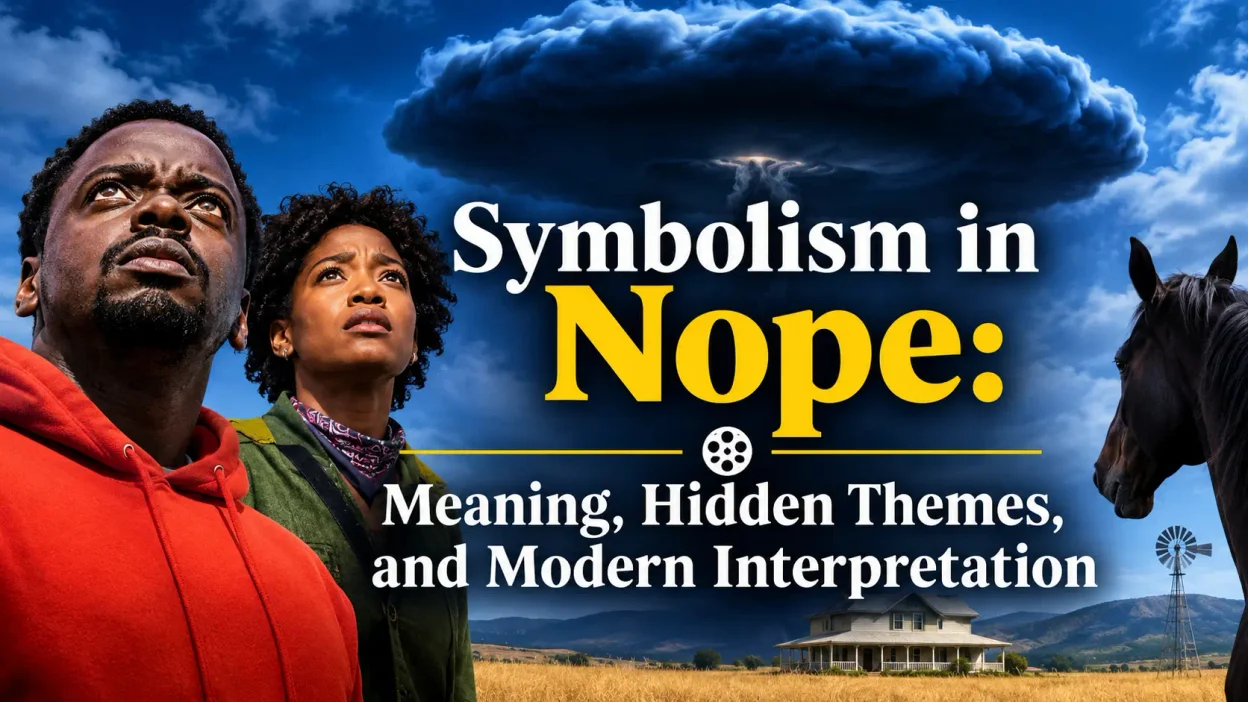
Jordan Peele’s Nope (2022) is more than a science-fiction horror film. Beneath its mysterious creature, frightening encounters, and spectacular visuals lies a story about fame, exploitation, trauma, and humanity’s desire to turn extraordinary events into entertainment.
The film follows OJ and Emerald Haywood, siblings who work with horses on their family’s ranch in California. After strange events begin occurring near their property, they suspect something unusual is living in the sky. Their attempts to capture evidence lead them to confront a dangerous creature—and the risks of trying to turn a terrifying experience into a spectacle.
The symbolism in Nope works on several levels. The creature represents the danger of treating nature as entertainment, while cameras symbolize humanity’s desire to record and control what it sees. The film also explores the exploitation of Black performers, the cost of fame, and the difference between observing something and truly understanding it.
Quick Answer: What Does Nope Symbolize?
Nope primarily symbolizes humanity’s obsession with spectacle and the consequences of exploiting living beings for attention, money, and fame. Its alien creature, cameras, horses, and recurring images of watching and being watched explore how people try to control the unknown by turning it into something they can capture and sell.
TL;DR
- The alien creature: Nature’s power and the danger of assuming the unknown can be controlled.
- Cameras: The human desire to document, possess, and profit from extraordinary experiences.
- Horses: Vulnerability, labor, and the exploitation of animals for entertainment.
- The Haywood family: Black history, overlooked contributions, and the struggle for recognition.
- Gordy’s tragedy: The violence and trauma hidden behind the entertainment industry.
- The spectacle: The temptation to risk everything for a memorable image or public attention.
1. Jean Jacket: Symbolism of Nature and the Unknown

The most important symbol in Nope is Jean Jacket, the mysterious creature that initially appears to be a flying saucer. As the story develops, OJ realizes that it is not simply a spacecraft but a living organism with its own instincts and behavior.
Jean Jacket symbolizes the danger of misunderstanding the natural world. People often assume that something unfamiliar must follow human rules, but the creature challenges this belief. It cannot be treated like a machine, a trained horse, or a predictable attraction.
The creature also represents the limits of human control. The characters try to study it, attract it, photograph it, and profit from its existence. Their plans repeatedly reveal how dangerous it is to assume that observation gives someone power over what they observe.
Key symbolic meanings of Jean Jacket:
- The unknown: Something that cannot immediately be explained or understood.
- Nature’s power: A reminder that humans are not always in control.
- Dangerous curiosity: The risks of approaching something merely to satisfy curiosity.
- Exploitation: The consequences of treating a living being as a source of profit.
The film’s transformation of Jean Jacket from a seemingly mechanical UFO into a living creature also challenges the familiar science-fiction idea that an unexplained object must be an alien vehicle.

MDPI
+1
2. The Meaning of Spectacle in Nope
One of the central themes of Nope is spectacle: something extraordinary that attracts attention and encourages people to watch.
The characters repeatedly encounter situations in which danger becomes entertainment. Ricky “Jupe” Park builds an attraction around the mysterious creature, while OJ and Emerald attempt to capture extraordinary footage that could make them famous.
This behavior raises an important question: Why do people continue watching something dangerous when they know it could harm them?
In the film, spectacle becomes a symbol of society’s appetite for dramatic images, shocking events, and viral moments. The desire to witness something incredible can become stronger than the instinct to remain safe.
The opening biblical quotation from Nahum 3:6 reinforces this theme by connecting the idea of being made a spectacle with humiliation and exposure. The film explores what happens when suffering becomes something people consume for entertainment.
Los Angeles Times
+1
In modern life, this symbolism can be connected to social media, viral videos, reality television, and news coverage of tragedies. People may record dangerous events instead of helping, or turn another person’s distress into content.
The film does not suggest that every act of observation is wrong. Instead, it asks viewers to consider the difference between witnessing something responsibly and exploiting it for attention.
3. Cameras: The Symbolism of Control and Recognition

Cameras play a major symbolic role in Nope. OJ and Emerald want to obtain clear evidence of Jean Jacket, hoping to capture what they call their opportunity for an extraordinary, career-changing shot.
The camera represents more than technology. It symbolizes the human desire to preserve an event, prove that it happened, and gain recognition for witnessing it.
For the Haywood siblings, filming the creature is also connected to their family’s place in cinema history. They believe that documenting the phenomenon could bring attention to a family whose contribution to the film industry has been overlooked.
However, the camera creates a contradiction. The characters want to record the creature, but getting the footage requires them to approach something that may kill them.
This creates several layers of meaning:
- Proof: Images can make an extraordinary claim believable.
- Power: The person holding the camera can influence how an event is remembered.
- Fame: A remarkable image can bring money, status, and recognition.
- Risk: The pursuit of evidence can become more important than personal safety.
The film also complicates the idea that cameras give people complete control. Recording something does not mean understanding it, and capturing an image does not mean mastering the subject.
The Haywoods’ desire to obtain footage is tied to a broader question about who gets remembered in Hollywood and whose contributions are erased from its history.
TIME
+1
4. Gordy the Chimpanzee: Exploitation and Suppressed Anger

Gordy’s storyline is one of the film’s most disturbing symbolic elements. Gordy is a chimpanzee trained to perform on a television sitcom called Gordy’s Home. During a violent incident on the set, he attacks several people, leaving the young Ricky Park deeply traumatized.
Gordy symbolizes the consequences of exploiting living beings for entertainment. He is expected to behave as a performer even though he is a wild animal placed in an artificial environment.
The film does not present Gordy as simply an evil monster. Instead, his story invites viewers to consider the conditions that lead to violence, including the pressure of forcing an animal to participate in a human-controlled spectacle.
Director Jordan Peele has described the sequence in terms of exploitation and anger toward the entertainment industry.
Dexerto
+1
Gordy’s symbolism can be understood in several ways:
- Exploitation: Animals and people can be treated as products rather than individuals.
- Suppressed anger: Harmful conditions can produce unpredictable consequences.
- The illusion of control: Training and familiarity do not guarantee safety.
- Hidden trauma: A seemingly entertaining production can conceal lasting suffering.
Gordy’s story also connects to Jean Jacket. Both are living beings whose behavior is misunderstood by people attempting to turn them into attractions.
The connection suggests that the apparent monster is not always the only source of danger. Sometimes the danger also comes from the human systems that exploit other living beings.
5. The Upright Shoe: Trauma and the Mind’s Need to Escape
One of the film’s strangest images is a sneaker standing upright during the Gordy incident. Ricky, who survives the attack as a child, becomes fixated on the shoe and later keeps it as a treasured object.
The shoe is often interpreted as a symbol of trauma and dissociation. Rather than fully processing the horrifying event around him, Ricky focuses on an unusual detail.
Director Jordan Peele has explained the moment as one in which Ricky mentally disconnects from the trauma he is experiencing.
The Independent
+1
The shoe can symbolize:
Psychological escape: The mind may focus on a small or seemingly irrelevant detail when an experience becomes overwhelming.
False meaning: A random occurrence can become deeply significant when someone builds a personal story around it.
Unresolved trauma: A person may preserve an object or memory without fully understanding the pain associated with it.
Misinterpreted survival: Surviving a terrible event does not necessarily mean someone has learned how to deal with danger.
Ricky’s attachment to the shoe helps explain his later behavior. He treats his survival as evidence that he has a special understanding of dangerous events, even though his trauma remains unresolved.
The shoe therefore contrasts with OJ’s approach. Ricky turns a frightening experience into a personal mythology, while OJ gradually learns to observe behavior and recognize the limits of his knowledge.
6. The Haywood Family: Black History and Recognition
The Haywood siblings’ story adds a historical and cultural dimension to the film’s symbolism.
OJ and Emerald come from a family that works with horses in the film industry. Emerald explains that their ancestor was the Black rider depicted in Eadweard Muybridge’s famous nineteenth-century photographic sequence, often discussed as an important precursor to motion pictures.
Yet the Haywoods find that their family’s contribution is not widely recognized.
Their pursuit of the extraordinary footage is therefore about more than money. It also represents their desire to make their place in cinema history visible.
The family symbolizes:
- Erased contributions: The people behind important cultural achievements may not receive recognition.
- Inherited responsibility: Younger generations carry the history and work of those who came before them.
- Visibility: Being seen and being acknowledged are not necessarily the same thing.
- Reclaiming history: Documenting an event can become a way of asserting one’s place in a larger narrative.
The film connects the Haywoods’ quest to a broader critique of Hollywood, where Black performers and workers have historically been overlooked or marginalized.
Their desire for recognition is understandable, but the story also shows how the pursuit of visibility can become dangerous when it is tied to the need for a spectacular image.
Los Angeles Times
+1
7. Horses: Labor, Trust, and the Treatment of Animals

Horses are central to the Haywood family’s livelihood. Their work involves training and handling animals for film productions, placing them within an industry that often depends on animals to create visual excitement.
The horses symbolize the relationship between humans and animals, particularly the tension between care and exploitation.
A horse may be treated as a partner that requires patience and understanding, or as a commodity that can be bought, sold, and used to generate profit. The film repeatedly explores the consequences of the second approach.
OJ’s knowledge of horses helps him recognize that animals cannot always be controlled through force or confidence. He learns to pay attention to behavior rather than assuming that an animal will behave as expected.
This understanding becomes essential to his response to Jean Jacket.
The horses also create a direct connection between the familiar and the extraordinary. Although Jean Jacket initially appears alien, it behaves in ways that OJ can begin to understand through his experience with animals.
Their symbolism includes:
- Trust: A relationship built through observation and patience.
- Labor: The often-unrecognized work that makes entertainment possible.
- Vulnerability: Animals can suffer when people prioritize profit over their needs.
- Respect: Understanding another living being requires more than attempting to control it.
The horses remind viewers that the film’s central conflict is not only about extraterrestrial danger. It is also about how humans behave toward creatures they believe they own or understand.
MDPI
+1
8. Ricky “Jupe” Park: Fame, Denial, and the Illusion of Mastery
Ricky Park, known as Jupe, is a former child actor who witnessed the Gordy incident. As an adult, he runs a Western-themed attraction and attempts to turn the mysterious creature into a profitable show.
Jupe symbolizes the way fame can shape a person’s identity. His childhood experience was terrifying, but he builds a public persona around entertainment, humor, and business success.
Rather than confronting his trauma, he seems to reinterpret his survival as evidence that he has a special relationship with danger.
This belief becomes central to his fatal mistake. Jupe assumes that the creature can be managed as a performance, much like the animals and attractions he uses in his business.
His character illustrates several ideas:
- Denial: Painful memories can remain unresolved beneath a confident public image.
- Commercialization: Personal experiences can be transformed into products for an audience.
- Overconfidence: Surviving one dangerous event does not guarantee safety in another.
- The cost of fame: The need to remain relevant can distort judgment.
Jupe and the Haywoods both want to profit from the creature, but their attitudes differ. OJ gradually recognizes the importance of observing the animal’s behavior, whereas Jupe tries to fit it into an entertainment business he believes he understands.
His storyline reveals one of the film’s key warnings: danger becomes even more destructive when people mistake their desire for control for genuine understanding.
Los Angeles Times
+1
9. The Cloud: Concealment and the Fear of the Unseen
The mysterious cloud hanging over the ranch is another important visual symbol. It appears ordinary enough to blend into the sky, yet it conceals the creature responsible for the strange events.
The cloud represents the uncertainty that surrounds the unknown. Something can remain hidden in plain sight while people struggle to interpret what they are seeing.
It also creates a contrast between visibility and knowledge. The characters can see the sky, but they cannot immediately understand what is happening within it.
This symbolism can be interpreted in three ways:
- Hidden danger: Threats are not always obvious or recognizable.
- Uncertainty: People may lack enough information to understand an event.
- False reassurance: A familiar environment can conceal something unfamiliar.
The cloud is especially effective because it looks harmless. Instead of revealing the threat directly, the film allows the audience to anticipate danger from a seemingly ordinary part of the landscape.
That visual strategy reflects the broader symbolism of Nope: the things people believe they understand may be much more complicated than they appear.
10. The American West: Freedom, Myth, and Commercialization
Nope uses the landscape, horses, ranches, and Western imagery associated with the American frontier.
Traditional Western stories often celebrate courage, independence, mastery over the land, and the ability to overcome dangerous forces. Peele uses these familiar elements while questioning the idea that people can always dominate their environment.
OJ resembles a traditional Western protagonist in his quiet manner, practical skills, and careful observation. However, his most important strength is not the ability to conquer everything around him. It is his willingness to recognize that he cannot control everything.
The film also links Western imagery to modern entertainment. The Haywood ranch sits near Jupiter’s Claim, a theme park that turns a romanticized version of the frontier into a commercial attraction.
The setting therefore symbolizes the transformation of history and nature into products that people can consume.
| Western symbol | Meaning in Nope |
|---|---|
| The ranch | Family history, labor, and responsibility |
| The horse | Trust, vulnerability, and animal-human relationships |
| The open landscape | Freedom mixed with exposure to danger |
| The theme park | History transformed into entertainment |
| The cowboy image | Courage, but also the limits of individual control |
The film suggests that the American West is not merely a place of heroic conquest. It is also a setting where commercial ambition, cultural memory, and the desire to control nature collide.
Universal Pictures At Home
+1
11. The Title “Nope”: Fear, Instinct, and Refusal
The title Nope is short, informal, and deliberately ambiguous. It can be understood as an instinctive response to something frightening, dangerous, or deeply unsettling.
In ordinary conversation, saying “nope” can mean refusing to participate, declining an invitation, or deciding that a situation is not worth the risk.
Within the film, the title reflects the moment when curiosity should give way to caution. The characters are repeatedly tempted to approach the unknown because of the attention and rewards it might bring.
The title also captures the film’s mixture of horror and humor. Rather than relying only on grand statements about fear, it uses a familiar expression that people might say when confronted with something they do not want to face.
Its symbolic meanings include:
- Self-preservation: Recognizing when it is safer to leave something alone.
- Refusal: Rejecting the pressure to participate in a dangerous spectacle.
- Humility: Accepting that not every mystery needs to be conquered.
- Instinct: Responding to danger before curiosity overrides judgment.
The title can also be read as a challenge to the culture of constant attention. Sometimes the wisest response to something extraordinary is not to film it, monetize it, or move closer—but to refuse.
12. Looking and Being Looked At: The Power of the Gaze
A recurring feature of Nope is the relationship between watching and being watched.
The characters want to look at Jean Jacket, but the creature also responds to the attention directed toward it. OJ eventually recognizes that looking directly at the creature can trigger an attack.
This creates a symbolic reversal. The humans believe they are the observers, but they are also potential targets.
The gaze can represent several kinds of power:
- Curiosity: The desire to understand what is hidden.
- Surveillance: The act of observing another being without its consent.
- Performance: The expectation that something or someone must remain visible for an audience.
- Vulnerability: The possibility that observation can expose the observer to danger.
The film’s treatment of looking also relates to cinema itself. Films invite audiences to stare at images, characters, and extraordinary events from a position that usually feels safe.
Nope unsettles that relationship by making the act of looking part of the danger. The audience must consider whether the desire to see something is always harmless.
The creature’s behavior does not translate into a simple rule that looking is morally wrong. Rather, the film uses the gaze to question the assumption that observing something means having power over it.
TIME
+1
13. The Balloon and the Danger of Unexpected Triggers
The balloon in the Gordy’s Home incident is a small but significant part of the film’s symbolism. Its sudden popping contributes to the chaotic sequence in which Gordy becomes violent.
The balloon represents the fragility of a carefully constructed performance. A television production depends on predictable behavior, controlled surroundings, and the expectation that everyone will follow the script.
Yet a single unexpected event can shatter that illusion.
The balloon can therefore symbolize:
- Unpredictability: Small events can produce consequences no one anticipated.
- Fragile control: A carefully organized environment may still be unstable.
- Suppressed tension: An apparently entertaining situation can contain hidden risks.
- The collapse of performance: Reality can interrupt the story people have constructed.
The balloon also reinforces the connection between Gordy and Jean Jacket. Both storylines challenge the assumption that a living being will behave according to the expectations of the people watching it.
In this sense, the balloon is not simply a plot device. It contributes to the film’s wider warning against confusing a controlled performance with genuine control.
14. The Biblical Quote: Being Turned Into a Spectacle
Nope opens with a quotation from the biblical Book of Nahum that refers to someone being made a spectacle.
This passage establishes the film’s central concern with humiliation, public exposure, and the transformation of suffering into something people watch.
The quotation connects the different storylines. Gordy’s violence becomes part of a television production’s history, Jupe’s childhood trauma becomes something he attempts to convert into personal mythology, and the Haywoods pursue footage that could bring them recognition.
The biblical reference gives the film’s idea of spectacle a darker dimension. Being seen is not always a positive experience. A person or animal can become visible to an audience while losing control over how their suffering is interpreted.
The quote also encourages viewers to think about the difference between recognition and exploitation. The Haywoods want their work and family history to be acknowledged, while Jupe tries to turn a dangerous phenomenon into a commercial attraction.
Both stories involve visibility, but the moral consequences are different.
The opening quotation thus frames Nope as a story about the costs of making people, animals, and frightening events into public entertainment.
Harper’s BAZAAR
+1
15. Modern Meaning of Symbolism in Nope
The symbolism in Nope remains relevant because contemporary culture often rewards attention more quickly than responsibility.
Social media encourages people to capture unusual events, share dramatic footage, and compete for views. Entertainment companies may turn real experiences into content, while public figures can feel pressure to remain visible even when attention becomes harmful.
The film invites audiences to consider the consequences of this behavior.
In social media: The creature can symbolize the danger of chasing viral attention without considering the risks.
In entertainment: Gordy and the horses reflect concerns about exploiting performers and animals for profit.
In personal life: Jupe’s story illustrates how unresolved experiences can shape later decisions.
In history and culture: The Haywood family’s search for recognition highlights the importance of remembering overlooked contributions.
In relationships with nature: Jean Jacket represents the limits of human assumptions and the need to observe other living beings with care.
These are interpretations rather than a single definitive explanation of every image in the film. Nope combines horror, science fiction, Western imagery, and social commentary, allowing its symbols to work on several levels at once.
Frequently Asked Questions
1. What is the main symbolism in Nope?
The main symbolism in Nope concerns spectacle, exploitation, and humanity’s desire to control the unknown. The film shows how the pursuit of fame and extraordinary images can lead people to ignore danger and treat living beings as entertainment.
2. What does Jean Jacket symbolize in Nope?
Jean Jacket symbolizes the power of the unknown and the danger of assuming that nature can be controlled. Its transformation from an apparent UFO into a living creature challenges the characters’ expectations and forces them to reconsider how they understand it.
3. What does Gordy symbolize in Nope?
Gordy symbolizes exploitation, suppressed anger, and the risks of forcing an animal to perform for entertainment. His story also highlights the lasting psychological effects of witnessing violence and the danger of treating trauma as a source of profit.
4. What does the standing shoe mean in Nope?
The standing shoe can be interpreted as a symbol of trauma and dissociation. Ricky fixates on the unusual object during the Gordy incident, and the moment reflects how the mind may focus on a strange detail when an experience becomes overwhelming. Director Jordan Peele has discussed the moment in these terms.
The Independent
+1
5. What do the cameras symbolize in Nope?
The cameras symbolize the desire to document events, establish proof, gain recognition, and profit from extraordinary experiences. They also raise questions about whether recording something gives people genuine understanding or control over it.
6. What does the Haywood family symbolize?
The Haywood family symbolizes overlooked Black contributions to cinema, the importance of family legacy, and the struggle for recognition. Their pursuit of evidence is connected to their desire to make their place in film history visible.
7. What is the message behind the title Nope?
The title can symbolize refusal, self-preservation, and the wisdom of recognizing danger. It reflects the idea that curiosity and the pursuit of attention are not always worth the risks they create.
Conclusion
The symbolism in Nope transforms a story about a mysterious creature into a broader exploration of fame, exploitation, trauma, and human behavior. Jean Jacket represents the danger of misunderstanding the unknown, Gordy exposes the consequences of treating living beings as entertainment, and the cameras reveal the desire to turn extraordinary experiences into proof and profit.
The Haywood family’s story adds another layer by exploring the struggle for recognition in an industry that has often overlooked Black contributions. Meanwhile, Jupe’s tragedy demonstrates how unresolved trauma and the pursuit of fame can encourage people to mistake survival for mastery.
Ultimately, Nope asks viewers to think carefully about what they choose to watch, why they want to watch it, and what happens when attention becomes more important than respect. Its central lesson is that not everything extraordinary exists for our entertainment, and seeing something does not mean we understand or control it