
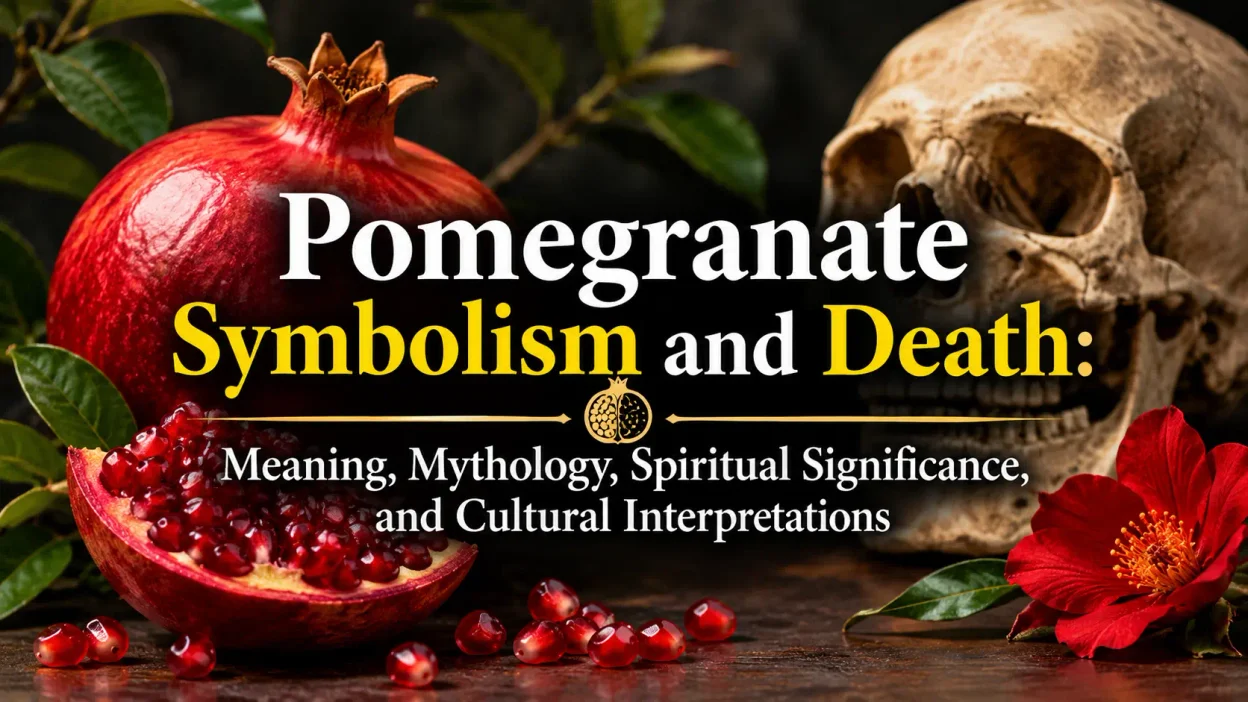
The pomegranate is one of the most powerful and layered symbols in mythology, religion, art, and literature. Its bright red seeds, tough outer skin, and abundance of fruit have inspired associations with life, fertility, love, blood, renewal, and immortality. Yet the pomegranate also has a fascinating connection to death, the underworld, mourning, and the mysteries of the afterlife.
One of the best-known examples comes from ancient Greek mythology, where Persephone eats pomegranate seeds while in the underworld. This act connects the fruit with her seasonal journey between the world of the living and the realm of the dead. As a result, the pomegranate can represent the boundary between life and death, the inevitability of change, and the possibility of renewal after loss.
However, the fruit does not symbolize death in every culture. In many traditions, it represents fertility, prosperity, abundance, and life. Its meaning depends on the historical, religious, and artistic context in which it appears.
This article explores the relationship between pomegranate symbolism and death, including its mythological origins, spiritual interpretations, cultural meanings, and appearance in dreams and art.
What Does a Pomegranate Symbolize in Relation to Death?
The pomegranate can symbolize death, the underworld, the cycle of life, rebirth, grief, and transformation. Its strongest association with death comes from the Greek myth of Persephone, who eats its seeds after being taken to the underworld.
Its symbolism can include:
- The underworld: A connection with the realm of the dead and the unseen world.
- Life and death: The relationship between endings and new beginnings.
- Blood and mortality: Its deep-red juice can evoke blood, sacrifice, and human mortality.
- Rebirth and renewal: Its many seeds suggest life continuing after an ending.
- Grief and remembrance: The fruit can represent love, loss, and memories that remain.
- Transformation: Its association with Persephone reflects the transition between different states of existence.
The pomegranate is therefore not simply a symbol of death. It often represents the complicated relationship between mortality, life, and renewal.
1. The Greek Myth of Persephone: The Pomegranate and the Underworld
The most famous connection between pomegranates and death comes from ancient Greek mythology.
Persephone, the daughter of Demeter, is taken to the underworld by Hades. Demeter, goddess of agriculture and fertility, becomes devastated by her daughter’s disappearance. Her grief causes the earth to become barren, creating a mythological explanation for the changing seasons.
While in the underworld, Persephone eats pomegranate seeds. In many versions of the story, eating food from the underworld binds her to that realm. As a result, she must spend part of the year with Hades and the remaining part with her mother.
This myth gives the pomegranate several symbolic meanings.
Connection to the land of the dead
Because Persephone eats the fruit in the underworld, it becomes associated with death, the afterlife, and the invisible world. It represents a connection between the living and the dead.
The cycle of life and death
Persephone’s annual movement between the underworld and the world above represents seasonal change. Her return brings renewed growth, while her departure corresponds with the earth becoming less fertile.
The pomegranate therefore symbolizes the recurring relationship between endings and beginnings.
Transformation and acceptance
Persephone’s experience changes her identity. She becomes both a daughter of Demeter and a queen of the underworld. Her story can be interpreted as a symbol of transformation, maturity, and the acceptance of life’s difficult transitions.
2. Pomegranate Seeds as a Symbol of Blood and Mortality
The deep-red color of pomegranate seeds and juice has inspired associations with blood, sacrifice, passion, and mortality.
In symbolic art and literature, red fruit can evoke the physical realities of human life, including birth, suffering, injury, and death.
The comparison between pomegranate juice and blood can suggest several ideas:
- Human mortality: A reminder that life is temporary.
- Sacrifice: The emotional or physical cost of important choices.
- Grief: The pain associated with losing someone.
- Life force: The connection between blood, vitality, and existence.
- Passion: Powerful emotions that can accompany love, loss, and transformation.
These are artistic and symbolic associations rather than fixed meanings shared by every culture.
3. Pomegranate Symbolism and Rebirth After Death
Although the pomegranate is associated with the underworld, it also represents renewal and the continuation of life.
Its many seeds are especially important. A single fruit contains numerous individual seeds, making it a natural image of abundance and potential.
This creates a symbolic contrast: the fruit can represent death while also suggesting that life continues.
New beginnings after loss
In modern spiritual interpretations, the pomegranate may represent the possibility of rebuilding after grief, separation, or a major life change.
The continuation of life
Its seeds can symbolize generations, family connections, and the continuation of life beyond an individual’s lifetime.
Hope and renewal
The fruit’s association with Persephone’s return from the underworld can inspire the idea that difficult periods do not necessarily last forever.
In this interpretation, the pomegranate represents hope after darkness rather than death as a final ending.
4. Pomegranate Symbolism in Ancient Egyptian Beliefs
Pomegranates were known in ancient Egypt and appeared in Egyptian material culture, including tomb contexts and funerary settings.
Their presence in burial-related contexts can invite associations with nourishment, abundance, and the continuation of life after death. Ancient Egyptian beliefs placed great importance on preparation for the afterlife, and food offerings were part of funerary practices.
However, it is important not to assume that every pomegranate found in an Egyptian tomb had one fixed meaning. Its significance depended on the object, setting, and period.
In a broader symbolic interpretation, the pomegranate can represent:
- Nourishment for the journey beyond death.
- Abundance and the hope of continued existence.
- The relationship between earthly life and the afterlife.
- The desire for renewal beyond physical mortality.
Its symbolism in Egyptian contexts should be understood through specific archaeological and historical evidence rather than modern spiritual assumptions.
5. Pomegranate Symbolism in Christianity and the Bible
The pomegranate has an important place in biblical imagery, although it is not explicitly established as a symbol of death.
It appears in descriptions of sacred objects and religious decoration, particularly in connection with the Tabernacle and the clothing of the high priest.
Pomegranates on the high priest’s garments
Exodus 28:33–34 describes decorative pomegranates made of blue, purple, and scarlet yarn, alternating with golden bells on the hem of the high priest’s robe.
Exodus 39:24–26 also describes these decorations.
In this setting, the fruit is associated with sacred design and religious service. Later Christian interpretations have connected its many seeds with unity, abundance, and the community of believers.
Pomegranates in Solomon’s Temple
Pomegranates also appear in descriptions of the decoration of Solomon’s Temple in 1 Kings 7:18–20 and 2 Chronicles 3:16.
These references establish the fruit as part of important biblical religious imagery.
Does the pomegranate symbolize death in Christianity?
The Bible does not directly identify the pomegranate as a symbol of death. However, some later Christian artistic interpretations associate its many seeds with resurrection, eternal life, and the unity of believers.
The fruit can therefore carry themes of life beyond death in Christian art, but these interpretations should be distinguished from explicit biblical teachings.
6. Pomegranate Symbolism in Persian Culture
Pomegranates have a long history in Persian culture, where they are associated with fertility, abundance, beauty, celebration, and prosperity.
The fruit is especially recognizable in celebrations such as Yalda Night, which marks the winter solstice. During this celebration, pomegranates are commonly enjoyed alongside other symbolic foods.
Their red color is often associated with warmth, vitality, and the return of light after the longest night of the year.
Although the pomegranate is not primarily a death symbol in this context, its connection with seasonal change can inspire reflections on darkness, endurance, and renewal.
The fruit can represent the idea that life and hope continue even during the darkest part of the year.
7. Pomegranate Symbolism in Mourning and Grief
In modern symbolic interpretation, the pomegranate can represent grief, remembrance, and the emotional complexity of losing someone.
Its red seeds may evoke the intensity of love and sorrow, while its many seeds can represent memories, family relationships, and experiences that remain meaningful after a person’s death.
Possible interpretations include:
- Remembering loved ones: The seeds represent memories that remain.
- Love beyond loss: The fruit represents emotional bonds that continue through remembrance.
- Acceptance: Its association with Persephone reflects the difficulty of accepting change.
- Healing: Its connection with renewal suggests the possibility of finding meaning after grief.
- Family legacy: Its many seeds can symbolize descendants and the continuation of a family story.
These meanings are personal and artistic interpretations, not universal mourning traditions.
8. Pomegranate Symbolism in Art and Literature
Artists and writers often use pomegranates because their appearance carries several meanings at once.
The fruit can suggest beauty, fertility, temptation, sacrifice, death, and renewal.
The opened pomegranate
An opened pomegranate reveals its many red seeds. In artwork, this image can represent vulnerability, hidden truths, mortality, or the exposure of inner emotions.
The whole pomegranate
An intact fruit can symbolize life, potential, protection, and the mysteries hidden beneath the surface.
The fallen pomegranate
A fallen or damaged fruit may represent loss, the passage of time, the end of a relationship, or the fragility of life.
The pomegranate in literary symbolism
Writers may use the fruit to explore the relationship between love and loss, innocence and experience, or life and death. Its connection to Persephone makes it particularly useful in stories about separation, transformation, and returning from darkness.
9. Spiritual Meaning of Pomegranate and Death
In contemporary spiritual interpretations, the pomegranate can represent a transition from one stage of existence to another.
Its symbolism is often connected with the idea that endings can create space for personal growth.
Common spiritual interpretations include:
| Spiritual meaning | Symbolic interpretation |
|---|---|
| Transformation | Moving from one stage of life into another |
| Rebirth | Finding hope after a difficult ending |
| Protection | Feeling emotionally or spiritually secure |
| Remembrance | Honoring people and experiences from the past |
| Inner strength | Continuing through grief and uncertainty |
| Life’s cycles | Understanding that change is part of existence |
Some people also associate pomegranates with ancestral connections or the afterlife. These are modern or tradition-specific interpretations rather than universally accepted spiritual beliefs.
10. What Does It Mean to Dream About a Pomegranate and Death?
Dreams involving pomegranates and death can feel powerful, especially when the fruit appears alongside deceased relatives, funerals, darkness, or unfamiliar places.
However, dreaming about a pomegranate does not predict someone’s death. Dreams do not provide reliable evidence of future events.
Instead, the fruit may reflect emotions, memories, personal experiences, or concerns about change.
Here are some possible interpretations:
Dreaming of a red pomegranate
A red pomegranate may represent intense emotions, love, memories, or concerns about mortality.
Dreaming of an opened pomegranate
An opened fruit may suggest vulnerability, emotional honesty, or the discovery of feelings that were previously hidden.
Dreaming of rotten pomegranates
A rotten fruit may reflect disappointment, unresolved grief, or anxiety about something coming to an end.
Dreaming of eating pomegranate seeds
Eating the seeds may symbolize accepting a difficult experience or becoming emotionally connected to a new stage of life.
Dreaming of a pomegranate near a deceased person
This dream may reflect remembrance, longing, or the emotional process of coping with loss. It should not automatically be treated as a supernatural message.
11. Pomegranate Symbolism: Death vs. Life
One of the most interesting aspects of pomegranate symbolism is that the fruit can represent apparently opposite ideas.
| Symbolism connected to death | Symbolism connected to life |
|---|---|
| The underworld | Fertility |
| Mortality | Longevity |
| Grief | Love |
| Separation | Family unity |
| Sacrifice | Abundance |
| Endings | New beginnings |
| Darkness | Hope and renewal |
These contrasting meanings make the pomegranate a powerful symbol of life’s cycles.
It reminds us that life and death are often explored together in mythology, religion, and art.
12. Is the Pomegranate a Good or Bad Omen?
The pomegranate is not universally considered either a good or bad omen.
In many cultures, it is a positive symbol of fertility, prosperity, abundance, and good fortune. Its connection with the underworld in Greek mythology gives it a darker symbolic dimension, but that does not make the fruit an automatic warning of death or misfortune.
If you encounter a pomegranate in a dream, artwork, or meaningful personal moment, its significance may depend on your emotions, cultural background, and the surrounding circumstances.
There is no reliable evidence that seeing a pomegranate predicts death, illness, or a future event.
Frequently Asked Questions About Pomegranate Symbolism and Death
1. Why is the pomegranate associated with death?
The pomegranate is associated with death mainly because of the Greek myth of Persephone. She eats its seeds in the underworld, connecting the fruit with Hades, the realm of the dead, and the cycle of life and death.
2. Does the pomegranate symbolize the underworld?
Yes, particularly in Greek mythology. Persephone’s consumption of pomegranate seeds connects the fruit with the underworld and her yearly return to the world of the living.
3. Does a pomegranate symbolize death or rebirth?
It can symbolize both. Its mythological connection with the underworld suggests death and separation, while its many seeds represent fertility, potential, and renewal in other interpretations.
4. What does a pomegranate symbolize in Greek mythology?
The pomegranate is closely associated with Persephone, Hades, the underworld, seasonal change, fertility, and the relationship between life and death.
5. Does the pomegranate symbolize death in the Bible?
No direct biblical passage identifies the pomegranate as a symbol of death. The fruit appears in Exodus and descriptions of Solomon’s Temple, where it is part of sacred decoration.
6. What does a red pomegranate symbolize?
A red pomegranate may symbolize love, passion, blood, fertility, vitality, sacrifice, and mortality. Its meaning depends on the cultural or artistic context.
7. Does dreaming about a pomegranate mean someone will die?
No. A pomegranate dream is not a reliable prediction of death. It may reflect personal emotions, memories, grief, transformation, or concerns about change.
8. Can a pomegranate symbolize remembrance of the dead?
In modern symbolic interpretations, yes. Its seeds can represent memories, family connections, and the continuation of love after someone has passed away. However, this is not a universal traditional meaning.
9. Is the pomegranate a symbol of eternal life?
In some religious and artistic traditions, the pomegranate has been associated with immortality, resurrection, and life beyond death. These meanings vary by historical context.
10. What does an opened pomegranate symbolize?
An opened pomegranate can symbolize vulnerability, hidden beauty, abundance, emotional exposure, and the contrast between mortality and the potential for new life.
Conclusion
Pomegranate symbolism and death are deeply connected through mythology, religion, art, and modern spiritual interpretation. The fruit’s strongest association with death comes from the Greek story of Persephone, whose pomegranate seeds connect her to the underworld and the changing seasons.
Beyond this myth, the pomegranate can represent blood, mortality, grief, remembrance, transformation, and rebirth. Its many seeds create a powerful contrast between the ending of life and the possibility of renewal.
Ultimately, the pomegranate is not simply a symbol of death. It represents the complex relationship between endings and beginnings, loss and hope, and the mysteries of life beyond what we can see.


