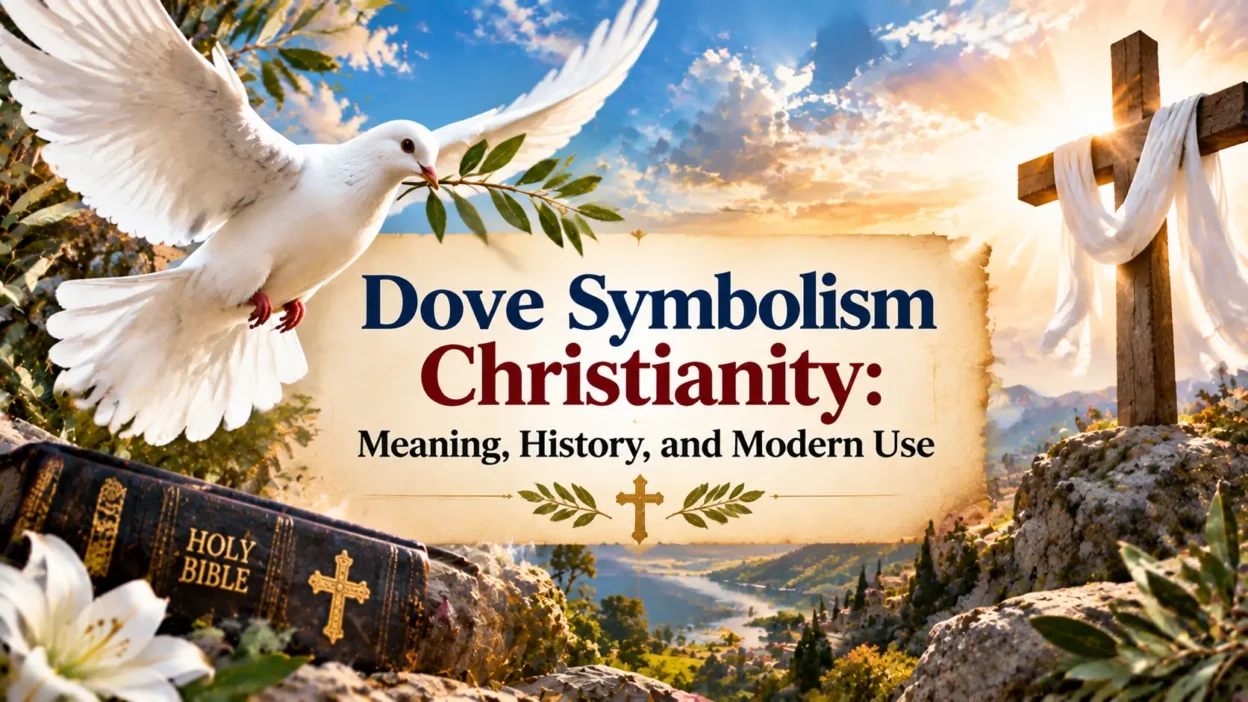
The dove is one of the most recognizable symbols in Christianity, often associated with peace, the Holy Spirit, purity, and divine guidance. Dove symbolism Christianity has developed through biblical stories, religious traditions, artwork, and worship practices, making the bird a familiar image in churches and Christian communities across the United States.
From the dove appearing during Noah’s flood to its connection with the baptism of Jesus, this bird carries meanings that combine faith, hope, renewal, and spiritual presence. Today, Americans encounter the dove in church decorations, wedding ceremonies, memorial services, jewelry, tattoos, and religious artwork.
Understanding the Christian meaning of the dove requires looking at its biblical roots, historical development, and the ways people use this symbol in modern life.
Quick Answer
Dove symbolism Christianity commonly represents the Holy Spirit, peace, purity, and God’s presence in modern Christian culture, especially in worship, baptism, and religious art. Historically, the dove gained meaning through biblical stories such as Noah’s Ark and the baptism of Jesus, where it became connected with hope, renewal, and divine guidance.
TL;DR
- The dove represents the Holy Spirit in Christian tradition.
- Noah’s dove became a symbol of hope and renewal.
- Jesus’ baptism connected the dove with God’s presence.
- American Christians use doves in worship and ceremonies.
- Dove imagery appears in art, tattoos, and memorials.
- The symbol has meanings beyond Christianity worldwide.
What the Dove Represents in Christianity
In Christianity, the dove is most commonly connected with the Holy Spirit. This association comes from the New Testament account of Jesus’ baptism, where the Spirit descends upon Him in the form of a dove.
The image represents God’s presence becoming visible in a gentle and peaceful form. Unlike symbols connected with strength or authority, the dove communicates calmness, spiritual connection, and divine comfort.
Many Christians also associate the dove with:
- Peace between God and humanity
- Purity of heart and intention
- Spiritual transformation
- Hope after difficult times
- Guidance from God
The meaning depends on the context. A dove in a church window may represent the Holy Spirit, while a dove at a funeral may represent comfort, peace, and the hope of eternal life.
Biblical Origins of Dove Symbolism
The Christian meaning of the dove comes from several important biblical passages. Two of the most influential are the story of Noah’s Ark and the baptism of Jesus.
The Dove in Noah’s Ark
One of the earliest biblical references to a dove appears in Genesis after the flood. Noah sends out a dove to discover whether the waters have disappeared.
The dove returns carrying an olive leaf, showing that dry land has appeared and that restoration is beginning.
This story created a connection between the dove and:
- New beginnings
- God’s promise
- Restoration after hardship
- Hope following destruction
The olive branch later became another important symbol of peace, often appearing alongside the dove in Christian and broader cultural imagery.
The Dove at the Baptism of Jesus
The most direct connection between the dove and the Holy Spirit appears during Jesus’ baptism.
According to the Gospels, after Jesus is baptized, the Holy Spirit descends upon Him like a dove. This event became one of the central reasons Christians view the dove as a representation of God’s Spirit.
The image communicates:
- Divine approval
- Spiritual awakening
- The beginning of Jesus’ public ministry
- God’s relationship with humanity
Because of this biblical moment, the dove became one of the most recognizable symbols in Christian art.
Why the Dove Became a Symbol of the Holy Spirit
Early Christians needed visual ways to express spiritual ideas, especially in artwork and worship spaces. Since the Holy Spirit is not described as having a physical human form, artists used symbols to communicate its presence.
The dove became the preferred image because of its biblical connection and natural characteristics.
A dove’s appearance contributed to its symbolism:
- Its white feathers suggested purity.
- Its gentle behavior suggested peace.
- Its flight suggested movement between heaven and earth.
- Its quiet nature represented spiritual calm.
Over time, paintings, mosaics, stained-glass windows, and church decorations commonly included the dove as an image of the Holy Spirit.
Dove Symbolism in American Christianity
In the United States, the dove remains a common Christian symbol used in both traditional and modern religious settings.
American churches often use dove imagery in:
- Baptism decorations
- Sanctuary artwork
- Stained-glass windows
- Religious logos
- Worship materials
- Confirmation ceremonies
The symbol is especially common in churches that emphasize the work of the Holy Spirit, spiritual renewal, and personal faith experiences.
During Christian holidays and events, the dove may appear in decorations connected with:
- Baptism celebrations
- Pentecost services
- Easter themes
- Weddings
- Memorial ceremonies
For many American Christians, the dove is not only a religious image but also a reminder of comfort, faith, and spiritual connection.
The Dove in Christian Art and Church Design
Artists have used the dove for centuries to represent important Christian beliefs. It appears in paintings showing biblical events, especially the baptism of Jesus and scenes involving the Trinity.
In church architecture, dove imagery can appear through:
- Ceiling paintings
- Stone carvings
- Stained glass
- Altar designs
- Religious symbols
A common example is the dove placed above or near baptismal areas. This placement reinforces the connection between water, spiritual rebirth, and the Holy Spirit.
The dove is often shown with open wings, creating a visual connection between heaven and earth.
Dove Symbolism During Christian Ceremonies
The dove appears in many Christian ceremonies because its meaning fits moments of transition, commitment, and remembrance.
| Context | Meaning in Christianity | Common Associations | Notes |
|---|---|---|---|
| Baptism | Holy Spirit and spiritual renewal | Faith, rebirth, divine presence | Based on Jesus’ baptism |
| Weddings | Peace and devotion | Love, unity, blessing | Often used in decorations |
| Funerals | Comfort and hope | Rest, eternal peace | Represents spiritual reassurance |
| Pentecost | Arrival of the Holy Spirit | Inspiration, faith, transformation | Connected to early church history |
At weddings, dove imagery often represents a peaceful and faithful relationship. At funerals, it can represent the soul’s journey and the hope of life beyond death.
The Dove as a Symbol of Peace
Although the dove has strong Christian meaning, its association with peace is also widely recognized outside Christianity.
The connection comes partly from the story of Noah, where the dove carrying an olive leaf signals the end of the flood and the restoration of peace between God and humanity.
In American culture, the dove and olive branch together are often used to represent:
- Reconciliation
- Nonviolence
- Cooperation
- The end of conflict
Christian communities may use this symbolism when discussing forgiveness, reconciliation, and peaceful living.
Dove Meaning in Different Christian Traditions
Although the dove is recognized throughout Christianity, different Christian traditions may emphasize slightly different aspects of its meaning. The central connection with the Holy Spirit remains consistent, but the symbol can highlight different spiritual ideas depending on the community.
Catholic Christianity
In Catholic tradition, the dove is strongly connected with the Holy Spirit and the mystery of the Trinity. It frequently appears in religious artwork showing the Father, Son, and Holy Spirit together.
Catholic churches may use dove imagery in:
- Baptismal areas
- Confirmation materials
- Church decorations
- Paintings of biblical events
The dove also represents God’s action in the world, especially through spiritual transformation and guidance.
Eastern Orthodox Christianity
Eastern Orthodox Christians often use the dove in icons and religious art connected with the Holy Spirit. The symbol appears in representations of Jesus’ baptism and other important biblical moments.
In Orthodox tradition, the dove emphasizes the connection between heaven and earth. It represents divine revelation and the presence of God working through spiritual life.
Protestant Christianity
Many Protestant churches use the dove as a symbol of the Holy Spirit, especially in communities that emphasize personal faith and spiritual renewal.
The dove may appear in:
- Church logos
- Worship spaces
- Baptism ceremonies
- Christian educational materials
For many Protestant believers, the dove represents the guidance and comfort of the Holy Spirit in everyday life.
Cross-Cultural Meanings of the Dove
While the dove has a major role in Christianity, it also carries meanings in many other cultures and belief systems. These interpretations sometimes overlap with Christian symbolism, especially around peace and purity.
Ancient Mediterranean Associations
In ancient Mediterranean cultures, doves were sometimes connected with love, fertility, and female deities. Their gentle nature and association with reproduction gave them symbolic importance.
These earlier meanings influenced some later artistic traditions, although Christian symbolism developed its own specific interpretation based on biblical stories.
Jewish Tradition
The dove appears in Jewish scripture, especially in the story of Noah’s Ark. The bird’s return with an olive leaf represents the discovery of land after the flood.
This story became an important foundation for later interpretations of the dove as a sign of hope and restoration.
Global Peace Symbolism
Today, the dove is widely recognized as a symbol of peace around the world. This meaning extends beyond religious communities and appears in:
- Peace movements
- Humanitarian artwork
- International symbols
- Public memorials
The Christian connection remains important, but the dove has become a broader cultural symbol.
Emotional and Psychological Meaning of the Dove
Symbols often communicate emotions before people consciously analyze their meaning. The dove creates certain associations because of its appearance and behavior.
A dove’s calm movements, soft appearance, and ability to fly naturally create connections with feelings such as:
- Safety
- Calmness
- Hope
- Freedom
- Comfort
For many Christians, seeing a dove can create a feeling of spiritual reassurance. It may remind them of faith, prayer, or moments when they experienced personal growth.
In times of loss, dove imagery often provides emotional comfort because it represents peace and the belief that life continues beyond physical existence.
The symbol can also represent a desire for inner peace. People may use dove imagery as a reminder to practice forgiveness, patience, and compassion.
Dove Tattoos and Personal Expression
Dove tattoos are popular among people who want to express ideas connected with faith, peace, love, and personal transformation.
The meaning of a dove tattoo depends on the person’s experience and beliefs. Common interpretations include:
| Tattoo Style | Common Meaning | Personal Connection |
|---|---|---|
| White dove | Purity and peace | Faith or peaceful identity |
| Flying dove | Freedom and change | Personal growth or new beginnings |
| Dove with olive branch | Reconciliation | Forgiveness or overcoming conflict |
| Dove with cross | Christian faith | Religious devotion |
| Pair of doves | Love and commitment | Marriage or relationships |
Christian believers may choose a dove tattoo as a permanent reminder of the Holy Spirit, their faith journey, or a meaningful spiritual event.
Others may use the image without a religious connection, focusing instead on peace, freedom, or emotional healing.
Modern Uses of Dove Symbolism
The dove continues to appear in many areas of modern American culture. Its meaning changes slightly depending on where it appears.
Religious Design
Churches, Christian organizations, and religious products often use dove imagery because it immediately communicates spiritual themes.
Common examples include:
- Church branding
- Prayer books
- Religious jewelry
- Cross designs
- Worship artwork
Weddings
Doves are sometimes used in Christian weddings to symbolize:
- Peace between partners
- Faith-centered commitment
- A blessed relationship
Some ceremonies include dove decorations, while others use the symbol in invitations, artwork, or wedding themes.
Memorials and Funerals
The dove is frequently used in memorial settings because it communicates peace and comfort.
Families may include dove imagery on:
- Funeral programs
- Memorial cards
- Grave decorations
- Remembrance artwork
The symbol can represent hope, spiritual rest, and the continuation of love after loss.
Home Decor
Christian households may display dove artwork as a reminder of faith and peace.
Examples include:
- Wall paintings
- Sculptures
- Decorative crosses
- Religious signs
The dove often appears in spaces designed for prayer, reflection, or family gatherings.
Common Misunderstandings About Dove Symbolism
Because the dove is used in many cultures, its meaning is sometimes simplified or misunderstood.
The Dove Is Not Only a Christian Symbol
One common misunderstanding is that the dove belongs exclusively to Christianity. While it has major Christian importance, the symbol also exists in Jewish traditions, ancient cultures, and modern peace movements.
Its meaning depends on the context where it appears.
The Dove Does Not Always Mean the Holy Spirit
Within Christianity, the dove often represents the Holy Spirit, but not every dove image has that specific meaning.
A dove on a memorial card may represent peace and comfort rather than a direct reference to the Holy Spirit.
White Doves Are Not Required for Christian Meaning
Many people associate Christianity with white doves because white represents purity. However, the biblical meaning comes from the role of the dove itself, not only its color.
The symbolic importance comes from the biblical events connected with the bird.
How Dove Symbolism Has Changed Over Time
The meaning of the dove has developed through thousands of years of religious and cultural interpretation.
In biblical times, the dove represented signs from God, renewal, and spiritual events. Early Christians adopted the symbol because of its connection with the Holy Spirit and important biblical stories.
During later centuries, artists expanded the dove’s role through paintings, church decorations, and religious architecture.
In modern America, the dove carries several connected meanings:
- Christian faith
- Peace and reconciliation
- Personal transformation
- Emotional comfort
- Hope during difficult moments
The symbol has remained recognizable because its meanings continue to connect with human experiences such as forgiveness, loss, love, and renewal.
Frequently Asked Questions About Dove Symbolism Christianity
What does a dove symbolize in Christianity?
A dove symbolizes the Holy Spirit, peace, purity, and God’s presence in Christianity. The meaning comes especially from the baptism of Jesus, where the Holy Spirit appears in the form of a dove.
Why is the Holy Spirit represented as a dove?
The Holy Spirit is represented as a dove because the New Testament describes the Spirit descending upon Jesus like a dove during His baptism. The image communicates divine presence, gentleness, and spiritual guidance.
What does a dove symbolize at a Christian funeral?
At a Christian funeral, a dove often represents peace, comfort, and hope. It can remind mourners of spiritual rest and the belief in eternal life.
Is a dove tattoo a Christian symbol?
A dove tattoo can be a Christian symbol when it represents the Holy Spirit, faith, or biblical meaning. However, many people also choose dove tattoos to represent peace, freedom, love, or personal change.
What is the difference between a dove and an olive branch symbol?
The dove is often connected with hope, renewal, and the Holy Spirit, while the olive branch is strongly associated with peace and reconciliation. Together, they create a widely recognized symbol of restored harmony.
Are doves mentioned in the Bible?
Yes, doves appear several times in the Bible. The most important examples include Noah’s dove returning with an olive leaf and the dove appearing during Jesus’ baptism.
Conclusion
The dove has become one of Christianity’s clearest symbols of the Holy Spirit, peace, purity, and spiritual renewal. Its meaning comes from important biblical stories and has continued through centuries of worship, art, and personal expression.
Today, dove symbolism Christianity remains meaningful for many Americans because it connects religious belief with experiences people recognize: finding peace after hardship, seeking guidance, celebrating new beginnings, and remembering loved ones.
Whether displayed in a church, worn as jewelry, chosen as a tattoo, or used in a ceremony, the dove continues to represent ideas of hope, faith, and a desire for harmony. Its lasting importance comes from the way it connects ancient religious stories with modern human experiences.