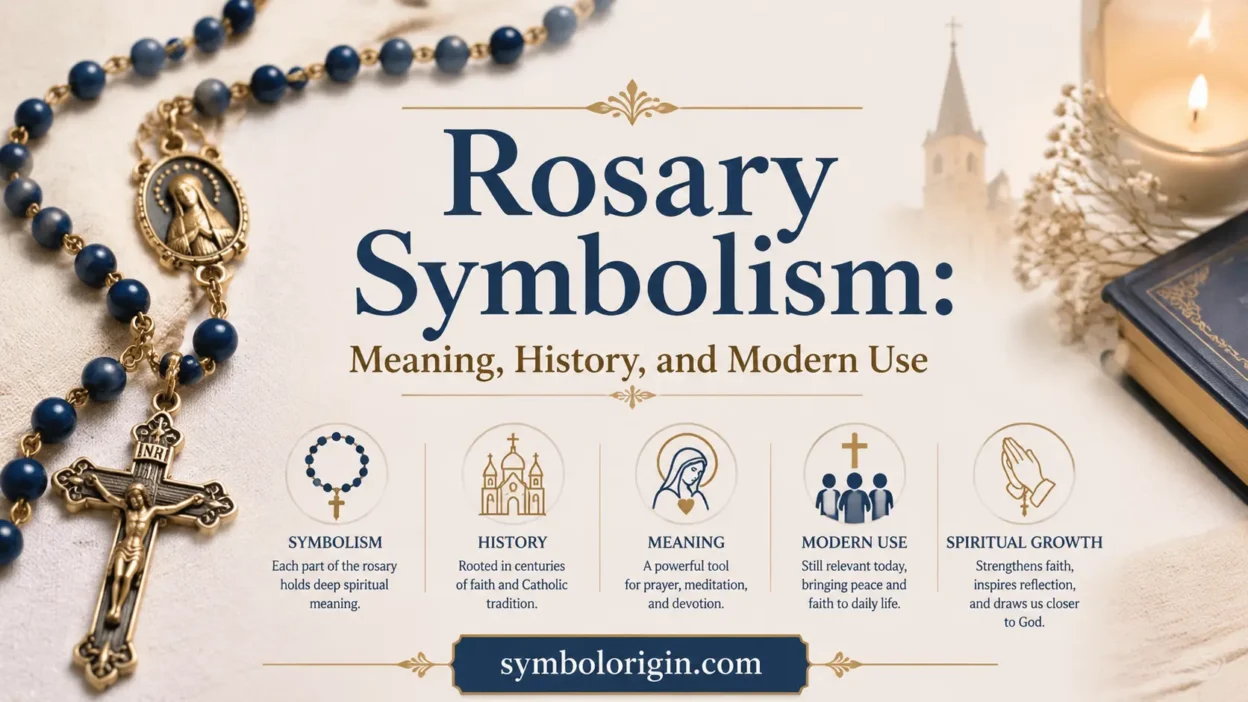
A rosary is a string of beads used for prayer, meditation, and personal reflection, most commonly associated with Catholic Christianity. Rosary symbolism reflects ideas of faith, devotion, remembrance, comfort, and spiritual discipline, while its meaning has also expanded into cultural, artistic, and personal expressions in modern America.
For many people in the United States, the rosary represents more than a religious object. It can serve as a reminder of family traditions, personal beliefs, important life moments, or emotional connections with loved ones. Some people keep rosaries in their homes, wear them as jewelry, carry them during difficult times, or display them as meaningful cultural items.
Understanding the rosary requires looking at both its religious foundation and its broader place in society. Its beads, prayers, materials, and uses each carry layers of meaning shaped by centuries of Christian practice and changing cultural interpretations.
Quick Answer
Rosary symbolism commonly represents faith, prayer, devotion, and spiritual reflection in modern American culture, especially within Catholic communities. Historically, it has also symbolized connection with Mary, meditation on Christian teachings, remembrance, and personal guidance during difficult moments.
TL;DR
- Rosaries symbolize prayer, faith, and personal devotion.
- Beads represent structured reflection and repeated prayers.
- Catholic traditions shaped the rosary’s primary meaning.
- Americans use rosaries for faith, memory, and identity.
- Modern designs include jewelry, art, and cultural expressions.
What a Rosary Looks Like and Represents
A traditional rosary consists of connected beads arranged in a specific pattern, usually ending with a crucifix or cross. The beads help guide prayers through a sequence of reflections known as mysteries, which focus on important events in the life of Jesus Christ and the Virgin Mary.
The physical design itself carries meaning. The circular arrangement of beads can represent continuity and devotion, while the cross points to Christian beliefs about sacrifice, redemption, and salvation.
Rosaries are commonly made from materials such as wood, glass, metal, gemstones, or plastic. The material may add personal meaning, with some people choosing certain designs because they connect with family heritage, special memories, or individual preferences.
The Core Meanings Associated With the Rosary
The rosary carries several major symbolic meanings, especially among Christians.
Faith and Religious Commitment
The most common meaning of a rosary is an expression of faith. For many Catholics, holding and praying with a rosary represents dedication to God and participation in a long-standing spiritual practice.
The beads provide a physical reminder to slow down, focus attention, and engage in prayer. They help believers create a structured moment for reflection in daily life.
Comfort During Difficult Times
Many people associate rosaries with comfort and emotional support. They are often used during illness, grief, uncertainty, or personal struggles.
In American households, a rosary may be kept as a reminder of prayers offered during challenging periods or as an object connected to someone who provided emotional strength.
Memory and Family Connection
Rosaries are often passed between generations. A grandmother’s rosary, a gift from a parent, or a keepsake from a religious ceremony can carry strong emotional value.
In these situations, the rosary becomes connected not only to religion but also to family history, love, and remembrance.
Ancient Roots and Early Development of Rosary Traditions
The modern rosary developed gradually from earlier Christian prayer practices. Early Christians used counting methods, including stones, knots, or prayer cords, to keep track of repeated prayers.
Over time, structured prayer traditions developed within Christian communities. The practice became especially connected with the Catholic Church and devotion to the Virgin Mary.
The rosary as it is widely recognized today became established through centuries of religious development. Its use expanded through churches, religious communities, and personal devotion.
Although the exact historical development involved many stages, the central purpose remained consistent: using repeated prayers and meditation to deepen religious reflection.
The Rosary’s Meaning in Catholic Tradition
Within Catholicism, the rosary has a specific spiritual role. It is a prayer practice that combines spoken prayers with meditation on important events from Christian history.
The prayers often include the Hail Mary, the Our Father, and the Glory Be. The repetition is not intended as meaningless repetition but as a way to focus the mind and reflect on religious themes.
The rosary is also strongly associated with devotion to the Virgin Mary. Many Catholics view Mary as an important figure of compassion, humility, and spiritual guidance.
Rosary Symbolism in the United States
In the United States, the rosary is most strongly connected with Catholic identity, but its cultural presence extends beyond church settings.
Many Americans encounter rosaries through:
- Family traditions
- Religious ceremonies
- Funeral practices
- Personal jewelry
- Cultural artwork
- Community events
For Catholic Americans, a rosary may represent belonging to a faith community. For others, it may represent heritage, respect for religious traditions, or appreciation of religious art.
The symbol can appear in homes, cars, churches, and personal collections. Its meaning depends greatly on the person using or displaying it.
Rosary Symbolism in Mourning and Remembrance
The rosary often appears in mourning traditions, especially among Catholic families. During funerals and memorial services, prayers with a rosary may provide comfort and create a shared spiritual experience.
A rosary belonging to someone who has passed away can become a treasured reminder of that person. Families may preserve it as an heirloom because it represents both faith and personal connection.
In this context, the rosary symbolizes remembrance, hope, and the continuation of relationships through memory.
Emotional and Psychological Meaning of the Rosary
Beyond religious interpretation, the rosary can have emotional significance.
The physical act of holding beads and moving through prayers can create a sense of routine and calm. Some people find comfort in the repetitive structure because it provides a focused activity during moments of stress.
From a psychological perspective, meaningful objects often become connected to personal experiences. A rosary may represent safety, childhood memories, family relationships, or moments of personal growth.
Its meaning comes not only from tradition but also from the individual experiences attached to it.
Rosary Symbolism in Jewelry and Personal Style
Rosary-inspired jewelry has become common in modern fashion. Necklaces, bracelets, and accessories featuring crosses or beads appear in various styles.
For some people, wearing a rosary necklace is a public expression of faith. For others, it may be a cultural fashion choice or an item connected to family background.
However, within Catholic communities, there is often a distinction between wearing a rosary as a devotional object and wearing it purely as decoration. Many believers view the rosary primarily as a prayer tool rather than a fashion accessory.
Rosary Symbolism in Art, Design, and Popular Culture
Artists and designers often use rosary imagery because of its recognizable connection with spirituality and tradition.
The symbol appears in:
| Context | Meaning in the USA | Common Associations | Notes |
|---|---|---|---|
| Religious practice | Prayer and devotion | Catholic faith, meditation | Primary meaning |
| Family heirlooms | Memory and connection | Heritage, loved ones | Often passed down |
| Jewelry | Identity or style | Faith, culture, fashion | Meaning varies |
| Artwork | Spiritual themes | Reflection, tradition | Used symbolically |
In movies, music, photography, and visual art, rosaries may represent faith, conflict, identity, or personal history depending on the story being told.
Cross-Cultural Interpretations of Beaded Prayer Symbols
Although the rosary is primarily associated with Catholic Christianity, prayer beads exist in many cultures and religions.
Different traditions use beads for counting prayers, meditation, or spiritual focus. Examples include Buddhist malas, Islamic prayer beads known as misbaha or tasbih, and other forms of devotional counting tools.
These objects share a common idea: using a physical item to support concentration, reflection, and spiritual practice.
The rosary’s specific meanings remain connected to Christian traditions, but its broader connection to prayer beads places it within a wider human practice of using objects for contemplation.
Common Misunderstandings About the Rosary
Because the rosary appears in religious, cultural, and fashion settings, misunderstandings sometimes occur.
One common misunderstanding is viewing every rosary necklace as a simple accessory. For many Catholics, the rosary is a sacred prayer object with personal religious importance.
Another misunderstanding is assuming the rosary has only one meaning for every person. While its foundation is Christian prayer, individuals may connect it with family, memory, art, or personal experiences.
Respecting the context helps avoid reducing the symbol to a single interpretation.
How Rosary Meaning Has Changed in Modern Culture
The rosary’s central religious meaning has remained stable, but its cultural use has expanded.
Today, people may encounter rosaries in churches, homes, museums, fashion, photography, and online spaces. Social media has also introduced new ways of sharing religious symbols, personal stories, and cultural discussions.
Modern interpretations often combine traditional faith with personal identity. A rosary may represent devotion for one person, heritage for another, and artistic inspiration for someone else.
Positive and Negative Associations of Rosary Imagery
The rosary is generally associated with positive ideas such as:
- Faith
- Hope
- Compassion
- Reflection
- Family connection
However, like many religious symbols, it can also appear in debates about cultural representation or personal expression.
Some people question when sacred objects are used mainly as fashion items. Others view artistic or cultural adaptations as normal parts of how symbols evolve.
The meaning depends heavily on context, intention, and respect for the tradition behind the object.
Why People Still Connect With the Rosary Today
The rosary continues to matter because it combines physical tradition with personal meaning.
In a modern world filled with constant distractions, many people value objects that encourage reflection and intentional moments. For believers, the rosary remains a way to practice faith. For families, it may preserve memories. For artists, it may represent cultural and spiritual themes.
Its continued presence shows how traditional symbols can maintain their original meaning while gaining new interpretations over time.
Frequently Asked Questions
What does a rosary symbolize in Christianity?
A rosary symbolizes prayer, devotion, and meditation on important events in Christian faith. In Catholic tradition, it is especially connected with prayers honoring the Virgin Mary and reflecting on the life of Jesus.
What does wearing a rosary necklace symbolize?
Wearing a rosary necklace can symbolize religious faith, cultural identity, or personal connection to family traditions. However, many Catholics view rosaries primarily as prayer objects rather than ordinary jewelry.
What does a rosary symbolize in American culture?
In the United States, a rosary often represents Catholic heritage, personal faith, family memories, and spiritual comfort. Its meaning can vary depending on the person and situation.
Is the rosary only a Catholic symbol?
The rosary is most strongly associated with Catholic Christianity, but prayer beads exist in many religious traditions. Other cultures use similar objects for meditation, counting prayers, and spiritual focus.
What does a rosary tattoo mean?
A rosary tattoo may represent faith, protection, remembrance, family heritage, or personal beliefs. The meaning depends on the person’s experiences and the design elements included.
Why are rosaries used during funerals?
Rosaries are used during many Catholic funerals because they provide a structured way to pray and remember the deceased. They can represent hope, comfort, and spiritual connection during mourning.
Conclusion
The meaning of rosary symbolism comes from centuries of Christian prayer tradition while continuing to develop through personal, cultural, and artistic uses. In modern America, the rosary represents faith for many people, but it can also carry memories, family connections, and personal identity.
Whether found in a church, a family keepsake box, artwork, or personal jewelry, the rosary remains a symbol shaped by both tradition and individual experience. Its significance depends on the beliefs, memories, and intentions of the person who holds it.