The Last Supper is one of the most recognized religious images in Western culture. The Last Supper symbolism represents ideas of sacrifice, faith, loyalty, forgiveness, and the relationship between Jesus and his followers. The scene appears in churches, museums, religious materials, and popular culture because it captures a moment that carries both spiritual and historical importance.
Painted most famously by Leonardo da Vinci during the late 15th century, the image shows Jesus Christ sharing a final meal with his twelve disciples before his crucifixion. The artwork is not only a religious scene but also a study of human emotions, including surprise, fear, doubt, and devotion.
For many Americans, The Last Supper is connected with Christianity, Easter traditions, church teachings, and reflections on faith. At the same time, the artwork has become a broader cultural symbol used in art, design, education, and discussions about human relationships.
Quick Answer
The Last Supper symbolism commonly represents faith, sacrifice, forgiveness, and the importance of spiritual connection in modern American culture, especially within Christian traditions and Easter observances. Historically, the scene symbolizes Jesus’ final meal with his disciples, the beginning of the Eucharist, and themes of loyalty, betrayal, and redemption.
TL;DR
- Represents Jesus’ final meal before his crucifixion.
- Symbolizes sacrifice, forgiveness, and spiritual devotion.
- Became central to Christian Eucharist traditions.
- Leonardo da Vinci’s painting shaped Western art.
- Americans view it through faith and cultural heritage.
- Modern uses include art, decor, and media.
What Is The Last Supper and Why Is It Important?
The Last Supper refers to the final meal Jesus shared with his twelve disciples before his arrest and crucifixion. According to Christian teachings, this event occurred shortly before Passover in Jerusalem and became one of the most important moments in the life of Jesus.
The scene is especially significant because Jesus used the meal to explain his coming sacrifice. During the gathering, he shared bread and wine with his disciples, creating the foundation for the Christian practice of Communion or Eucharist.
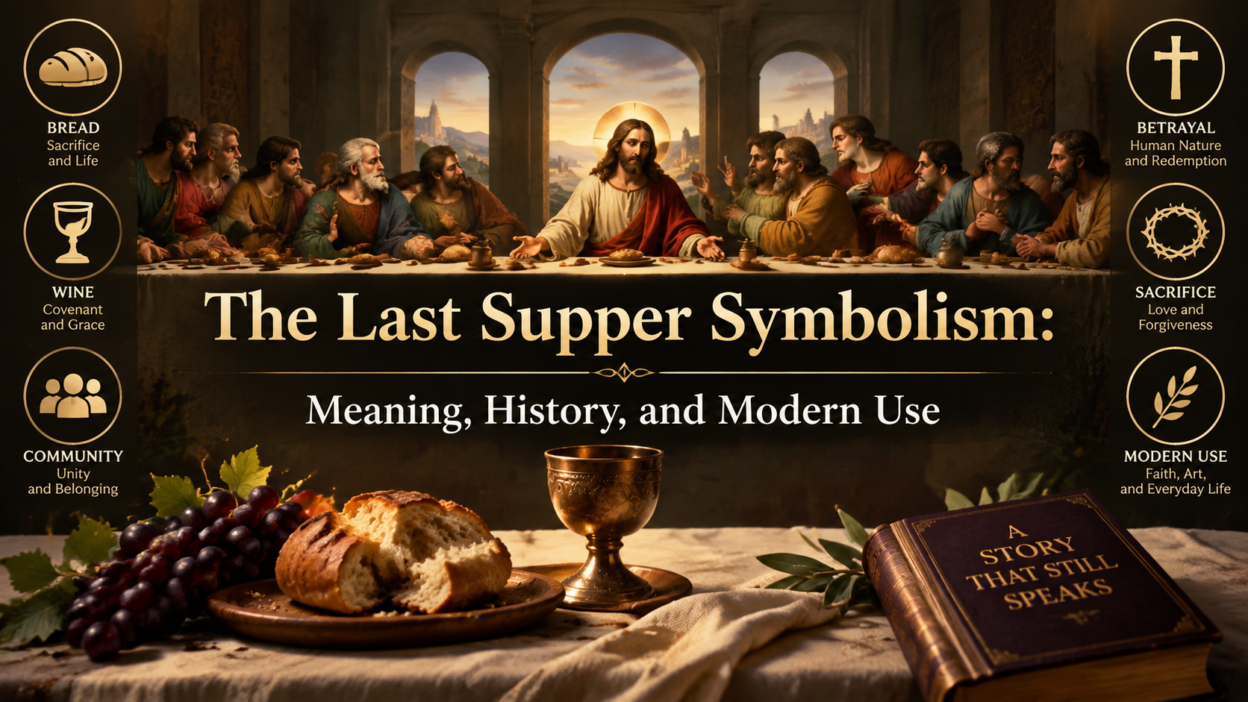
The image usually shows Jesus sitting at the center of a long table surrounded by his followers. This arrangement highlights Jesus as the spiritual focus while showing the different reactions of the disciples after hearing that one of them would betray him.
The importance of the scene comes from its combination of religious meaning and human emotion. It presents ideas about love, trust, suffering, and the choices people make during difficult moments.
Core Meanings Behind The Last Supper Symbolism
The Last Supper carries several connected meanings. Different Christian traditions may emphasize different aspects, but some themes appear consistently.
Sacrifice and Redemption
One of the strongest meanings connected with The Last Supper is sacrifice. Jesus’ words during the meal are understood by Christians as a prediction of his death and its purpose for humanity.
The bread and wine represent Jesus’ body and blood in Christian belief. These elements became symbols of salvation, remembrance, and spiritual renewal.
In American Christian communities, this meaning is often reflected during Communion services, especially on important religious occasions such as Easter.
Faith and Spiritual Connection
The Last Supper also symbolizes the relationship between Jesus and his followers. The gathering represents a moment of teaching, trust, and spiritual guidance.
The image reminds believers of the importance of maintaining faith during uncertainty. Jesus’ calm position in the center contrasts with the emotional reactions of the disciples, creating a message about stability and devotion.
Loyalty and Betrayal
A major theme in The Last Supper is the contrast between loyalty and betrayal. Jesus announces that one disciple will betray him, creating a scene filled with emotional tension.
Judas Iscariot’s presence represents betrayal and the difficult reality that relationships can include disappointment and conflict.
This theme has allowed the artwork to remain meaningful beyond religious settings. Many people view it as a reflection on trust, human choices, and moral responsibility.
| Context | Meaning in the USA | Common Associations | Notes |
|---|---|---|---|
| Christianity | Faith and salvation | Communion, Jesus, Easter | Most common interpretation |
| Art | Human emotion and storytelling | Leonardo da Vinci, Renaissance | Studied worldwide |
| Family Decor | Religious identity | Home paintings, wall art | Often displayed by believers |
| Education | Historical importance | Renaissance art, culture | Used in museums and classrooms |
| Popular Culture | Social commentary | Movies, advertisements | Sometimes adapted creatively |
Ancient Roots and Religious Origins of The Last Supper
The Last Supper is rooted in the New Testament accounts of Jesus’ final meal with his disciples. The event is described in the Gospels of Matthew, Mark, and Luke, with additional discussion appearing in John.
The meal took place during the period of Passover, a Jewish celebration remembering the Israelites’ freedom from slavery in Egypt. This connection gives the event additional historical and religious layers.
Early Christians remembered the meal as a key moment in understanding Jesus’ mission. Over time, the practice of Communion developed as a way for believers to remember this event.
Before famous paintings existed, Christian communities represented The Last Supper through symbols, writings, and early religious artwork. The meaning developed gradually as Christianity spread across Europe and other regions.
Leonardo da Vinci’s Painting and Its Symbolic Details
The most famous representation of The Last Supper is the mural created by Leonardo da Vinci between 1495 and 1498 in Milan, Italy.
Da Vinci’s painting became famous because of its realistic human expressions and carefully arranged composition. Instead of showing a simple religious gathering, he created a dramatic moment where each disciple reacts differently to Jesus’ announcement of betrayal.
Several visual elements carry symbolic meaning:
Jesus at the center:
His central position represents spiritual importance and balance.
The twelve disciples:
They represent the followers of Jesus and the beginning of the Christian Church.
Bread and wine:
These symbolize Communion and Jesus’ sacrifice.
The table arrangement:
The long table creates a sense of connection between Jesus and his followers while allowing viewers to observe each reaction.
Light and perspective:
Da Vinci used artistic techniques to draw attention toward Jesus and create a sense of order.
The Last Supper Symbolism in the United States
In the United States, The Last Supper is most commonly understood through Christian faith and religious tradition. Many churches display versions of the image as a reminder of Jesus’ teachings and the meaning of Communion.
The artwork also appears in American homes, religious schools, and community spaces. For many families, it represents devotion, heritage, and connection to Christian beliefs.
During Easter, churches often discuss the Last Supper as part of the events leading to Jesus’ crucifixion and resurrection. It helps believers reflect on themes of sacrifice, forgiveness, and hope.
Outside religious settings, Americans also recognize The Last Supper as an important example of Renaissance art. Museums and educational programs often study it for its artistic methods and historical influence.
Cross-Cultural Interpretations of The Last Supper
Although The Last Supper comes from Christian tradition, its influence extends into global culture.
In European countries, the image has been deeply connected with church art and Renaissance history. Many famous churches and museums preserve artistic interpretations of the scene.
In Latin American communities, The Last Supper often appears in religious celebrations and family traditions influenced by Catholic Christianity.
In other parts of the world, people may approach the image mainly as an artwork rather than a religious object. Its themes of friendship, conflict, and human emotion allow it to be studied from cultural and artistic perspectives.
Emotional and Psychological Meaning of The Last Supper
The Last Supper stands out because it shows a wide range of human emotions. The disciples are not presented as identical figures; each person responds differently to the news of betrayal.
This emotional variety makes the scene relatable. It reflects common human experiences such as fear, confusion, loyalty, and uncertainty.
Psychologically, the image can represent moments when people face difficult truths. It shows how individuals react when relationships are tested or when major changes occur.
For believers, the scene also provides comfort by showing trust in a larger purpose despite suffering.
The Last Supper in Tattoos, Jewelry, and Personal Expression
Religious imagery is often used in tattoos and personal artwork, and The Last Supper is one of the most recognizable Christian designs.
People who choose this image may use it to represent:
- Christian faith
- Family traditions
- Personal spiritual beliefs
- Respect for religious history
- Connection to Jesus’ teachings
Some tattoo designs focus on the entire scene, while others use smaller elements such as bread, wine, a cross, or Jesus’ figure.
Because the image has strong religious importance, many people consider it a meaningful design rather than simply a decorative choice.
Modern Uses in Media, Design, and Popular Culture
The Last Supper continues to appear in modern culture. Artists, filmmakers, advertisers, and designers sometimes recreate the composition to communicate different messages.
Some adaptations are respectful religious references, while others use the familiar arrangement for humor, criticism, or social commentary.
Because most viewers recognize the basic structure, creators can use the image to discuss topics such as teamwork, conflict, leadership, or cultural events.
However, modern adaptations can create disagreements when people feel that a sacred image has been used in an inappropriate way.
Common Misunderstandings About The Last Supper
One common misunderstanding is that Leonardo da Vinci created the original event. In reality, the meal comes from Christian scripture, while Leonardo created one famous artistic interpretation centuries later.
Another misunderstanding is that every detail in the painting has a confirmed hidden meaning. Some interpretations are based on artistic analysis, while others are later theories without strong historical evidence.
The painting’s importance comes from its clear themes and artistic achievement rather than unsupported claims about secret messages.
How The Meaning of The Last Supper Has Changed Over Time
The meaning of The Last Supper has evolved as societies changed. Originally, it was mainly understood as a religious event connected with Jesus’ sacrifice and Christian worship.
During the Renaissance, artists focused more on human emotion, realism, and storytelling. Leonardo’s version reflected this shift by showing individual personalities rather than symbolic figures.
Today, the image functions in several ways. It remains a religious symbol for Christians while also serving as an important cultural and artistic reference.
Its ability to represent both faith and human experience explains why it continues to appear in different settings.
Frequently Asked Questions
What does The Last Supper symbolize?
The Last Supper symbolizes sacrifice, faith, forgiveness, and the relationship between Jesus and his disciples. It also represents the beginning of the Christian Communion tradition.
Why is The Last Supper important in Christianity?
The Last Supper is important because Christians believe Jesus used this final meal to explain his upcoming sacrifice. It became the foundation for Eucharist and Communion practices.
What does The Last Supper painting represent?
Leonardo da Vinci’s painting represents the moment Jesus announces that one disciple will betray him. It focuses on emotional reactions, spiritual meaning, and human relationships.
What does The Last Supper mean in American culture?
In the United States, The Last Supper is mainly viewed as a Christian symbol connected with faith, Easter, and religious identity. It is also recognized as a major work of Renaissance art.
Is The Last Supper a positive or negative symbol?
The Last Supper is generally viewed as a positive symbol of faith, sacrifice, and forgiveness. However, it also includes difficult themes such as betrayal and suffering.
Why do people use The Last Supper in tattoos?
People often choose The Last Supper as a tattoo to express religious devotion, personal beliefs, family traditions, or respect for Christian symbolism.
What is the difference between the historical Last Supper and Leonardo’s painting?
The historical Last Supper refers to Jesus’ final meal with his disciples. Leonardo’s painting is a Renaissance interpretation of that event created many centuries later.
Conclusion
The Last Supper remains one of the most recognized religious and cultural images in the world. Its themes of sacrifice, faith, loyalty, and forgiveness continue to shape how people understand the relationship between belief and human experience.
In the United States, the Last Supper symbolism is mainly connected with Christianity, Easter traditions, and personal expressions of faith, while the artwork also holds importance as a masterpiece of Renaissance history.
Whether viewed as a religious image, a work of art, or a cultural symbol, The Last Supper continues to represent a moment where spiritual teaching and human emotion meet.