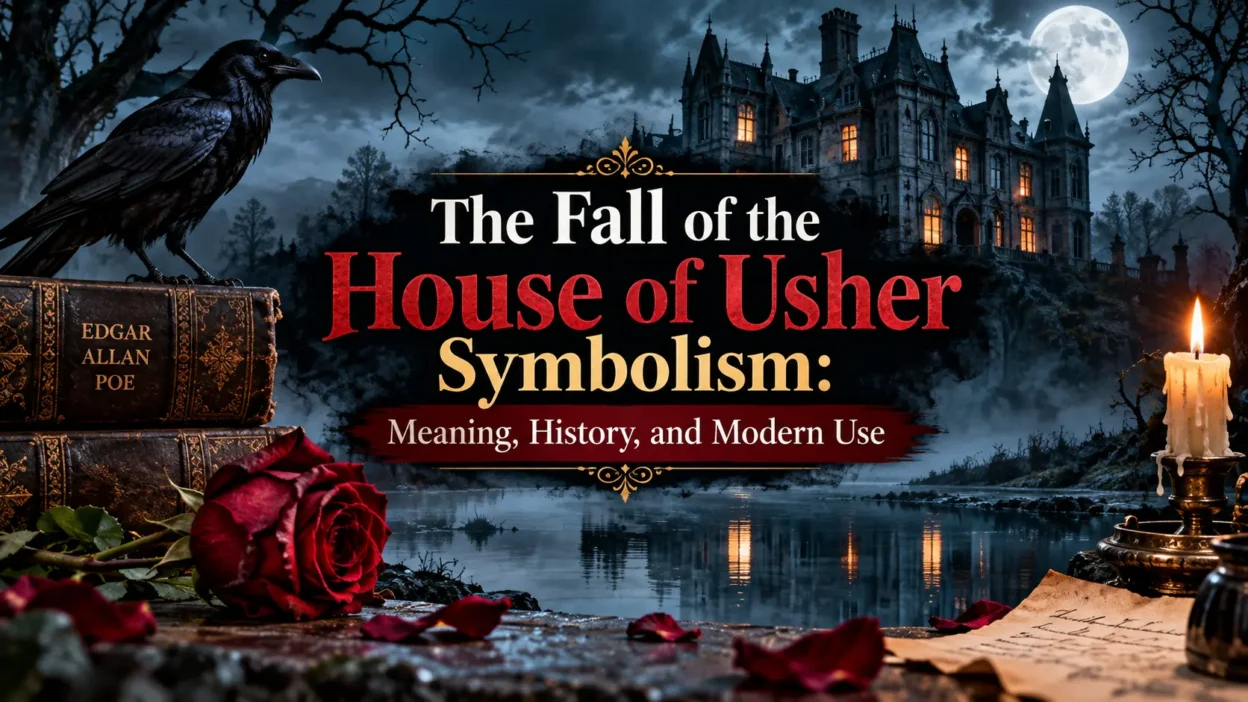
Edgar Allan Poe’s The Fall of the House of Usher symbolism centers on decay, isolation, fear, family collapse, and the dangerous connection between a person and the world around them. The story’s mansion is more than a setting: it reflects the damaged condition of the Usher family and the increasingly unstable mind of Roderick Usher.
First published in 1839, Poe’s Gothic tale follows an unnamed narrator who visits his childhood friend Roderick Usher at an old family estate. Roderick lives there with his twin sister, Madeline, whose mysterious illness becomes part of the story’s growing sense of dread.
The house, the family, the twins, the underground vault, the storm, the tarn, and the final collapse all work together. Poe repeatedly blurs the boundary between the physical world and the psychological world, leaving readers to ask whether the house is actually supernatural or whether much of its apparent power comes from the characters’ fears and perceptions.
That uncertainty is one reason the story remains important in American literature. Its symbols can be read as Gothic horror, psychological metaphor, criticism of inherited isolation, or a combination of all three.
Quick Answer
The Fall of the House of Usher symbolism commonly represents family decay, psychological isolation, fear, and the collapse of a closed way of life. The crumbling mansion mirrors the Usher family’s physical and emotional decline, while the twins, fissure, underground vault, and final destruction suggest divided identity, repression, mortality, and the consequences of refusing change.
TL;DR
- The house symbolizes the declining Usher family and its troubled legacy.
- The visible fissure represents hidden problems becoming impossible to contain.
- Roderick’s fear connects the mansion’s decay with psychological instability.
- Madeline and Roderick can symbolize two connected sides of one identity.
- The final collapse represents the destruction of the Usher lineage.
- Modern readers often interpret the story through psychological and family themes.
What the House of Usher Represents
The most important symbol in Poe’s story is the house itself.
At first glance, it is an old Gothic mansion. It has dark walls, vacant windows, decaying trees, a gloomy landscape, and a nearby tarn. But Poe makes the building feel almost inseparable from the Usher family.
The narrator explains that the name “House of Usher” refers both to the family and the mansion. That detail matters because it removes the usual separation between a household and the people who live in it.
The physical house becomes a representation of the family.
Its age suggests a long inheritance. Its decay suggests that this inheritance has become unhealthy. Its isolation reflects the family’s withdrawal from ordinary society. Its final destruction occurs alongside the deaths of Roderick and Madeline.
The house therefore symbolizes a family system that has survived for generations but has lost the ability to renew itself.
This is not simply a story about an old building falling apart. The building and the family deteriorate together.
Decay and the Failure of an Inherited Legacy
Decay is one of the story’s central ideas.
The Usher family possesses an ancient name, property, artistic traditions, and social history. Yet the family has failed to produce a healthy continuation of its lineage. Roderick and Madeline are described as the final direct members of the family.
This creates an important contrast: the Ushers have preserved their past, but they have not successfully created a future.
The mansion reflects the same problem. It remains standing, but it is visibly deteriorating. The structure has survived for generations while becoming increasingly damaged.
Poe uses this contrast to explore what happens when preservation becomes more important than adaptation.
The Ushers are trapped by their inheritance. Their identity is tied to their house, their name, their memories, and their isolated way of life. Instead of allowing those things to change, they remain inside them.
The result is stagnation.
The story therefore gives decay a broader meaning. It can represent a family, institution, tradition, or identity that continues to exist physically while losing the conditions necessary for healthy survival.
The Famous Fissure and Hidden Problems
One of the clearest symbols in the story is the narrow crack running down the front of the mansion.
At first, the narrator barely notices it. The house still appears structurally intact. But the fissure runs from the roof downward toward the tarn.
By the end, the crack widens and the entire building collapses.
The symbolism is straightforward but effective: a problem that appears small can reveal a much larger structural failure.
The fissure can represent the hidden weaknesses within the Usher family. Roderick appears physically present, intelligent, artistic, and wealthy, yet his mental condition is deteriorating. Madeline appears alive and present, but she is also seriously ill.
The family looks intact from a distance.
Inside, it is breaking apart.
The fissure also connects the top of the house to its foundation. Symbolically, the damage is not limited to one part of the family. It reaches through the entire structure.
This makes the final collapse feel less like a sudden event and more like the visible conclusion of a problem that existed from the beginning.
Roderick Usher as a Symbol of Fear
Roderick is not simply afraid of one particular monster or event. His fear becomes almost a complete way of experiencing reality.
He describes extreme sensitivity to light, sound, food, clothing, and smells. He also fears the consequences of events before they happen.
His greatest fear is fear itself.
This makes Roderick a useful symbol for psychological confinement. His world becomes smaller because he increasingly reacts to ordinary experiences as threats.
The house strengthens this condition. He rarely leaves it, and he believes that the building has developed an influence over his mind.
Poe deliberately leaves the exact cause uncertain. The house may seem supernatural, but Roderick’s own psychological state also shapes what the narrator experiences.
That ambiguity is important.
Roderick can be read as a person trapped by anxiety, inherited expectations, isolation, and obsessive thinking. His environment does not merely contain his fear. It reinforces it.
Madeline and the Symbolism of the Twins
Roderick and Madeline are twins, and their relationship gives the story another layer of symbolism.
They are physically separate people, but Poe presents them as unusually connected. Their resemblance and shared condition make them seem like two parts of the same family identity.
This has encouraged readers to interpret them as symbolic opposites or complementary halves.
Roderick can represent the conscious, intellectual, and fearful side of the Usher world. Madeline is more physically mysterious and less verbally expressive. She spends much of the story outside ordinary social interaction.
Together, they can represent a divided self.
Their relationship also reinforces the idea that the Usher family has become closed in on itself. There are no healthy outside branches extending the family into the wider world. Roderick and Madeline are left as the final representatives of an isolated lineage.
Their deaths therefore do more than end two lives. They mark the disappearance of the family itself.
The Underground Vault and Repressed Fear
The vault where Madeline is temporarily placed is another major symbol.
It is dark, enclosed, damp, and buried beneath the house. Its location gives it an obvious association with death, secrecy, and things people do not want to confront.
Symbolically, the vault can represent repression.
Something has been placed out of sight rather than fully dealt with.
Madeline’s supposed death is treated as a problem to be contained. Instead of immediately confronting the uncertainty surrounding her condition, Roderick and the narrator help move her into an enclosed space beneath the house.
The physical act mirrors the psychological structure of the story.
The Usher household repeatedly pushes uncomfortable realities inward: illness, fear, death, isolation, family history, and psychological instability. But hiding a problem does not necessarily eliminate it.
Madeline eventually returns from the vault.
The buried problem comes back to the surface.
The Tarn and the Mirror Image
The dark body of water beside the mansion is more than Gothic scenery.
The narrator looks into the tarn and sees a distorted reflection of the house and surrounding landscape. The reflected image creates a second version of the same world.
This reinforces one of Poe’s central concerns: the difference between reality and perception.
The tarn can symbolize reflection, psychological depth, and distorted self-knowledge. The house above it and the house reflected below appear connected, almost like two versions of the same structure.
That doubling fits the story’s larger pattern.
Roderick and Madeline are twins. The house has its reflection. The family and mansion share the same name. Reality and imagination repeatedly overlap.
The story keeps asking whether the characters are seeing the world as it actually is or as their troubled minds have shaped it.
The Storm and the Growth of Terror
The storm near the end of the story intensifies the symbolism of disorder.
Weather in Gothic fiction often reflects emotional tension, and Poe uses the storm to create a physical environment that matches the characters’ increasingly unstable condition.
Wind, darkness, strange sounds, and flashes of light make the mansion feel less like a safe home and more like a closed psychological space.
Yet the storm does not create the family’s problems.
Those problems were already present.
The weather acts more like an amplifier. It brings external disorder into alignment with the internal disorder of the Ushers.
This distinction matters because the story is not simply saying that bad weather causes tragedy. Instead, the storm provides an appropriate physical setting for fears that have been developing throughout the narrative.
The Usher Family as a Symbol of Isolation
Isolation is central to the Usher family’s tragedy.
The estate is geographically removed from ordinary society. Roderick rarely leaves. His friendships and outside connections are limited. His sister is his closest remaining relative.
The family has effectively turned inward.
Isolation can provide privacy, but in the story it also removes corrective influences. Roderick’s fears have little resistance from the outside world. His beliefs become increasingly self-reinforcing.
This makes the story relevant beyond Gothic fiction.
Modern readers can recognize a broader idea: a person or family can become trapped inside its own assumptions when there is little contact with people who offer different perspectives.
Poe pushes that idea to an extreme, turning social isolation into a Gothic nightmare.
The House as Psychological Space
The mansion can also be interpreted as a map of the human mind.
Different rooms, corridors, doors, chambers, and underground spaces create a physical representation of hidden psychological states.
The narrator moves deeper into the house as he becomes more involved in Roderick’s world. The deeper he goes, the further he moves from ordinary reality.
This is one reason the house remains such a memorable Gothic setting.
It is not frightening only because it looks old. It is frightening because the architecture seems to externalize the characters’ inner lives.
The walls contain memories. The vault contains death. The windows create distorted impressions of the outside world. The rooms isolate people from one another.
The building becomes psychological space made physical.
Art, Music, and the Symbolism of Imagination
Roderick is highly interested in art and music. These interests are not included merely to make him appear unusual.
Art becomes one of the ways he processes his fear.
His paintings are dark and abstract, while his music expresses emotional states that ordinary conversation cannot fully explain. The narrator also listens to Roderick’s guitar improvisations.
The story-within-the-story, “The Haunted Palace,” is especially important. Its beautiful palace gradually becomes a ruined place associated with disorder and loss.
The poem mirrors the larger story.
A once-glorious structure becomes damaged from within. The image of a palace losing its former harmony parallels the decline of the Usher family and mansion.
Art therefore becomes another reflection of the same symbolic pattern: beauty can coexist with deterioration, and imagination can reveal psychological conflict.
What the Fall Itself Symbolizes
The final destruction of the mansion gives the story its most direct symbol.
The house splits apart and falls into the tarn at almost the same moment that the Usher family comes to an end.
The “fall” can therefore represent several connected forms of collapse:
- the physical destruction of the mansion
- the death of Roderick and Madeline
- the end of the Usher lineage
- the breakdown of Roderick’s psychological world
- the failure of an isolated family system
- the destruction of an identity built entirely around the past
The ending also gives the title a double meaning.
“The House of Usher” means both the physical residence and the family itself.
When the house falls, the Usher family falls with it.
The collapse is therefore not an isolated supernatural event. It completes the symbolic relationship Poe has established from the opening pages.
The Symbolism of Death, Mourning, and Repression
Death appears throughout the story, but Poe does not treat it simply as an ending.
The Ushers struggle to accept mortality. Madeline’s illness dominates Roderick’s thoughts. Her apparent death leads to a temporary burial inside the house rather than a normal funeral process.
This creates an atmosphere in which mourning cannot properly occur.
The story can therefore be read as an exploration of what happens when death is denied, delayed, or psychologically resisted.
The vault becomes a place where the reality of death is hidden. Roderick’s fear grows rather than disappears.
For modern readers, this can make the story feel less like a simple ghost story and more like an examination of grief and avoidance.
The supernatural interpretation remains possible, but the psychological interpretation is equally important.
What the Story Symbolizes in American Culture Today
In the United States, Poe’s story is commonly encountered through literature classes, Gothic fiction, horror culture, theater, film, television, and Halloween-related media.
American readers often use the Usher mansion as a shorthand for a decaying family estate or a beautiful structure hiding serious problems underneath.
The story has also influenced the broader American Gothic tradition, where houses frequently represent family history, trauma, secrecy, or social decline.
Its themes fit modern conversations about inherited wealth, family expectations, isolation, mental distress, and the burden of maintaining an old identity.
The story’s imagery also remains recognizable in popular culture. Dark mansions, cracked walls, underground rooms, family secrets, twins, and stormy landscapes have become familiar Gothic devices partly because works such as Poe’s helped establish their literary power.
The 2023 television adaptation The Fall of the House of Usher brought Poe’s title and central ideas to a new audience, although it substantially reimagines the original story, characters, and plot. It should therefore be treated as an adaptation inspired by Poe rather than a direct representation of every meaning in the 1839 tale.
A Quick Comparison of Major Symbols
| Symbol | Meaning in the United States | Common Associations | Notes |
|---|---|---|---|
| Usher mansion | Family decline and psychological confinement | Decay, inheritance, isolation | The house mirrors its inhabitants |
| Fissure | Hidden structural weakness | Family problems, repression, instability | Small damage eventually becomes total collapse |
| Twins | Divided or connected identity | Duality, identity, family bonds | Roderick and Madeline are unusually connected |
| Underground vault | Repressed death and fear | Burial, secrecy, avoidance | Hidden problems return to the surface |
| Tarn | Reflection and distorted perception | Doubles, uncertainty, inner life | The house appears again in reflected form |
| Final collapse | End of the Usher lineage | Destruction, release, failure | The family and mansion fall together |
Why the Story Still Matters in 2025–2026
The continued interest in Poe’s story comes partly from its flexibility.
A reader interested in Gothic literature may focus on the haunted mansion. Another may focus on anxiety and perception. A literature student may examine doubling and symbolism. A reader interested in family systems may see the Usher lineage as an example of destructive isolation.
These interpretations do not necessarily cancel each other out.
Poe deliberately creates uncertainty. The narrator is not an all-knowing observer, and the story does not provide a simple explanation for every strange event.
That uncertainty is especially useful to modern readers because it allows the story to function on several levels at once.
The house can be both a physical building and a psychological metaphor. Madeline can be both a character and part of the story’s larger pattern of doubling. The supernatural can be taken literally or understood as an expression of fear.
That ambiguity is part of the design.
Common Misunderstandings About the Symbolism
One common mistake is to assume that every detail has one fixed symbolic meaning.
Poe’s story supports several interpretations, but not every interpretation has equal textual support. The strongest symbols are those repeatedly connected to the plot: the house, its decay, the fissure, the twins, the vault, the tarn, and the final collapse.
Another mistake is treating the story entirely as a supernatural tale.
The narrator repeatedly questions what he sees and hears. Roderick’s psychological condition also shapes the atmosphere. Poe leaves room for supernatural interpretation without requiring readers to accept it as the only explanation.
It is also misleading to reduce the story to “the house is haunted.”
The more important question is why the house feels haunted. Its atmosphere reflects the family’s isolation, fear, history, and inability to escape itself.
Frequently Asked Questions
What does The Fall of the House of Usher symbolize?
It primarily symbolizes the collapse of the Usher family and the psychological deterioration of its surviving members. The mansion’s decay, the family’s isolation, and the final destruction all reinforce this connection.
What does the cracked house symbolize in The Fall of the House of Usher?
The fissure can symbolize hidden weakness within the Usher family. It begins as a barely noticeable structural defect and eventually becomes part of the complete destruction of the house and lineage.
What do Roderick and Madeline symbolize?
The twins can symbolize divided identity, psychological duality, and the close connection between physical and mental suffering. Their relationship also emphasizes how isolated and closed the Usher family has become.
What does the house symbolize in Gothic literature?
A Gothic house often represents family history, secrecy, psychological conflict, or inherited problems. In Poe’s story, the mansion is especially important because the name “House of Usher” refers to both the building and the family.
Is The Fall of the House of Usher about mental illness?
Psychological instability is a major part of the story, particularly through Roderick’s extreme sensitivity, fear, isolation, and unusual beliefs. However, modern medical diagnoses should not simply be imposed on a fictional character written in the nineteenth century.
Does the house actually cause the Usher family’s problems?
The story deliberately leaves this uncertain. Roderick believes the house has an influence over him, but the narrator also observes serious psychological and family problems that could explain much of the atmosphere without requiring a supernatural cause.
What does the ending of The Fall of the House of Usher symbolize?
The ending symbolizes total collapse: the mansion, the family, and Roderick’s psychological world all reach their breaking points. The destruction completes the connection Poe establishes between the physical House of Usher and the Usher family itself.
Conclusion
The symbolism in The Fall of the House of Usher works because Poe connects nearly every major element to the same central pattern: a family that has become isolated, stagnant, fearful, and unable to escape its inherited problems. The mansion reflects that condition, while the fissure, twins, vault, tarn, storm, and final collapse add different dimensions to it.
For modern American readers, the story can be understood as more than a Gothic tale about a frightening mansion. It explores family identity, psychological confinement, mortality, repression, and what can happen when a closed system refuses to change.
Ultimately, The Fall of the House of Usher symbolism is less about one secret meaning than about the relationship between a damaged family and the environment it has created around itself. The house falls because the structure has already been weakened from within—and that idea remains one of Poe’s clearest images of psychological and family collapse.