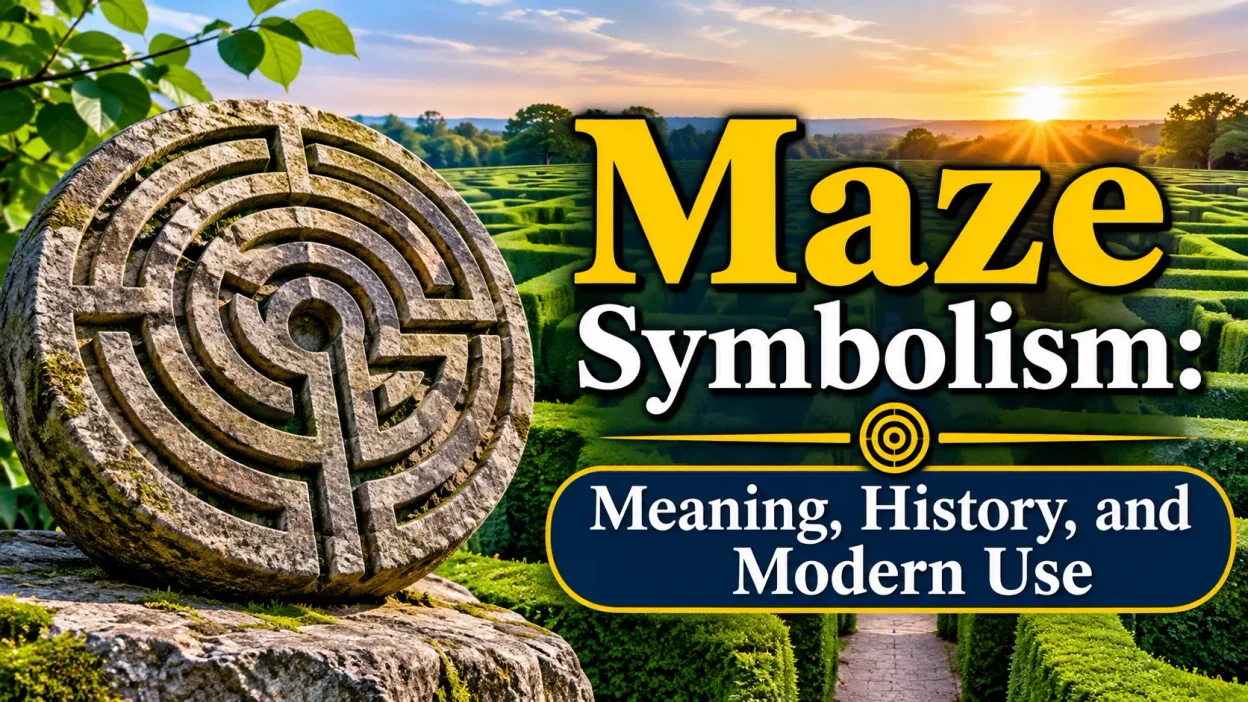
A maze is more than a complicated arrangement of paths and turns. Throughout history, it has represented the challenges of life, the search for direction, personal growth, and the journey toward understanding. Its winding passages can reflect the choices people make, the obstacles they face, and the uncertainty that often comes with finding their way.
Maze symbolism is closely connected with confusion, patience, perseverance, transformation, and self-discovery. Sometimes a maze represents feeling lost, while at other times it symbolizes the process of finding clarity and reaching an important goal.
Mazes appear in ancient art, mythology, religious traditions, literature, architecture, gardens, and modern popular culture. Their meanings can change depending on their design and context, but they often share one central idea: the journey toward an answer can be just as meaningful as reaching the destination.
Quick Answer: What Does a Maze Symbolize?
A maze primarily symbolizes life’s journey, confusion, choices, challenges, and self-discovery. Its winding paths can represent uncertainty and difficult decisions, while finding the exit may symbolize clarity, achievement, freedom, or personal transformation. Spiritually, a maze can represent an inward journey toward wisdom, truth, and understanding.
TL;DR: Maze Symbolism
- Life’s journey: The twists and turns of human experience.
- Confusion: Uncertainty and difficulty finding direction.
- Choices: Decisions and their possible consequences.
- Self-discovery: Learning about your identity and purpose.
- Perseverance: Continuing despite obstacles.
- Transformation: Personal change through experience.
- Spiritual growth: Searching for truth and inner understanding.
- Achievement: Finding a way forward after a difficult journey.
1. The History Behind Maze Symbolism
Mazes and labyrinths have appeared in different civilizations for thousands of years. Ancient designs have been discovered in rock carvings, pottery, architectural decorations, and other historical objects.
One of the most famous examples comes from ancient Greek mythology. The story of the Cretan Labyrinth describes an elaborate structure built by the craftsman Daedalus for King Minos. It was designed to contain the Minotaur, a creature with the body of a man and the head of a bull.
The hero Theseus eventually entered the structure to defeat the Minotaur. With help from Ariadne, who gave him a thread to guide his return, he successfully escaped.
This story helped establish the maze as a symbol of danger, courage, intelligence, and the struggle to overcome difficult situations.
Over time, maze designs also appeared in European gardens and religious buildings. They became associated with entertainment, contemplation, pilgrimage, and spiritual reflection.
2. Maze as a Symbol of Life’s Journey
One of the most meaningful interpretations of a maze is the journey of life. Its winding paths resemble the unpredictable experiences people encounter as they grow, make decisions, and pursue their goals.
Life rarely follows a perfectly straight path. People experience unexpected opportunities, disappointments, difficult decisions, and changes in direction. A maze reflects this uncertainty through its complicated network of passages.
In this context, a maze may symbolize:
- Different stages of human life.
- Unexpected challenges and opportunities.
- The search for purpose and direction.
- Lessons learned through experience.
- The importance of patience and persistence.
The maze reminds us that reaching a meaningful destination may require exploring different possibilities rather than following a simple route.
3. Confusion, Uncertainty, and Feeling Lost
A maze is often associated with confusion because its paths can make it difficult to understand where to go.
When someone enters a complicated maze, they may encounter dead ends, misleading turns, and repeated routes. This experience can reflect emotional or mental uncertainty in everyday life.
For example, a person who is unsure about a career, relationship, or important decision may describe their situation as being lost in a maze.
The maze can symbolize:
- Uncertainty about the future.
- Conflicting thoughts and emotions.
- Difficulty making decisions.
- Feeling overwhelmed by responsibilities.
- Searching for answers without knowing where to begin.
This interpretation does not always suggest failure. Confusion can be part of learning, and recognizing uncertainty may be the first step toward finding a clearer direction.
4. Choices and Decision-Making
A maze contains different routes, and each turn may influence how quickly someone reaches the destination.
This makes it a powerful symbol of human decision-making. Every choice can lead to a new opportunity, an unexpected problem, or a different experience.
In everyday life, people constantly make decisions about education, careers, relationships, family, and personal goals. Some decisions are straightforward, while others require careful thought.
Maze symbolism encourages us to consider the consequences of our choices.
It may represent:
- Freedom to choose different directions.
- The uncertainty of making important decisions.
- Learning from mistakes.
- Taking responsibility for personal choices.
- Finding alternative solutions when plans fail.
A maze also teaches that reaching a goal is not always about choosing the perfect path immediately. Sometimes it means recognizing a wrong turn and having the confidence to try another direction.
5. Self-Discovery and Personal Growth
A maze can represent an inward journey toward understanding yourself. Its winding paths may symbolize the experiences that help people discover their values, strengths, weaknesses, and desires.
Sometimes personal growth begins when familiar answers no longer feel satisfying. People may need to question their beliefs, examine their choices, and explore unfamiliar possibilities.
In this sense, navigating a maze resembles learning about yourself.
The symbolism may include:
- Discovering personal strengths.
- Understanding emotional needs.
- Recognizing harmful habits.
- Developing confidence.
- Finding a sense of identity and purpose.
The maze suggests that self-discovery is rarely immediate. It often requires reflection, patience, and the willingness to explore different aspects of life.
6. Perseverance and Overcoming Obstacles
Finding a way through a complicated maze often requires patience and repeated attempts. A person may reach several dead ends before discovering the correct route.
This makes the maze a symbol of perseverance and determination.
In life, people may face setbacks while pursuing education, building relationships, developing careers, or working toward personal goals. The maze represents the effort required to continue despite uncertainty.
Its message can be understood through several qualities:
- Patience: Progress may take longer than expected.
- Determination: Difficulties do not have to end the journey.
- Adaptability: A different approach may be necessary.
- Courage: Moving forward sometimes requires taking risks.
- Resilience: Mistakes can provide valuable lessons.
The maze reminds us that obstacles are not always signs that we should stop. They may simply indicate that we need a new strategy.
7. Spiritual Meaning of a Maze
Spiritually, a maze can symbolize the journey toward truth, wisdom, and deeper understanding. Its winding paths may represent the experiences through which people search for meaning and develop a stronger connection with their beliefs.
Walking through a maze or labyrinth can also be used as a reflective practice. Instead of focusing only on reaching an exit, a person may concentrate on each step, using the experience for prayer, meditation, or quiet contemplation.
Common spiritual interpretations include:
- Inner exploration: Understanding your thoughts and beliefs.
- Faith: Continuing a spiritual journey despite uncertainty.
- Reflection: Taking time to examine personal experiences.
- Transformation: Developing greater awareness through challenges.
- Guidance: Searching for wisdom and a meaningful direction.
The spiritual meaning depends on the tradition and the design being discussed. A traditional labyrinth with one continuous route may encourage meditation, while a branching maze may emphasize choices and uncertainty.
8. The Difference Between a Maze and a Labyrinth
Although the words maze and labyrinth are often used interchangeably, they can describe different designs.
A traditional labyrinth usually has one continuous path leading toward its center. It may contain many turns, but there are no branching routes or dead ends. A maze, in its common modern sense, has multiple paths, choices, and possible dead ends.
This difference creates an interesting distinction in symbolism.
| Feature | Maze | Labyrinth |
|---|---|---|
| Path design | Multiple possible routes | One continuous route |
| Dead ends | Often present | Not part of the traditional design |
| Main experience | Solving a puzzle | Following a journey |
| Symbolic meaning | Confusion, choices, and challenges | Reflection, pilgrimage, and inner growth |
| Main purpose | Finding the correct route | Experiencing the path toward the center |
A maze often symbolizes the uncertainty of making choices, while a labyrinth can represent a more focused journey toward understanding.
Both designs, however, can symbolize the challenges and experiences of human life.
9. The Minotaur and Greek Mythology
The Greek myth of Theseus and the Minotaur is one of the strongest historical associations behind maze symbolism.
According to the myth, King Minos ordered Daedalus to construct a complex labyrinth to imprison the Minotaur. The creature lived within the structure, making it a dangerous place for anyone who entered.
Theseus volunteered to confront the Minotaur. Ariadne helped him by providing a thread that allowed him to retrace his route and escape after defeating the creature.
The story creates several symbolic interpretations:
| Mythological element | Symbolic meaning |
|---|---|
| The labyrinth | Confusion, danger, and life’s challenges |
| The Minotaur | Fear, destructive forces, and inner struggles |
| Theseus | Courage, determination, and heroism |
| Ariadne’s thread | Guidance, hope, and direction |
| Escaping the labyrinth | Victory, freedom, and overcoming difficulties |
The myth suggests that difficult challenges can be overcome through courage, intelligence, and assistance from others.
10. Maze Symbolism in Christianity and Religious Traditions
Maze and labyrinth patterns have appeared in Christian religious architecture, particularly in medieval European churches and cathedrals.
The labyrinth at Chartres Cathedral in France is a well-known example. Built into the cathedral floor, it provides a winding path that can be walked as a form of pilgrimage and spiritual reflection.
The cathedral describes walking its labyrinth as an opportunity for meditation and contemplation on human existence and faith.
In Christian symbolism, a labyrinth may represent:
- The journey of faith.
- The challenges of spiritual life.
- Repentance and reflection.
- Seeking forgiveness and guidance.
- Moving toward spiritual understanding.
It is important to distinguish this historical Christian use of labyrinths from the broader symbolism of modern puzzle mazes. Religious interpretations depend on the particular design and tradition.
11. Maze Symbolism in Dreams
Dreaming about a maze is often interpreted through themes of uncertainty, difficult decisions, personal struggles, and the search for direction.
The details of the dream can influence its possible meaning. For example, escaping a maze may suggest overcoming a difficult situation, while remaining trapped may reflect feelings of frustration or confusion.
| Dream scenarioPossible symbolic meaning | |
|---|---|
| Walking through a maze | Searching for direction in life |
| Getting lost in a maze | Confusion or uncertainty |
| Finding the exit | Clarity, progress, or achievement |
| Reaching the center | Discovering an important truth |
| Being trapped in a maze | Feeling restricted or overwhelmed |
| Seeing a maze from above | Understanding a situation from a wider perspective |
| Running through a maze | Pressure, urgency, or avoidance |
| Helping someone escape | Supporting another person through difficulties |
Dream interpretations are personal and are not scientifically established predictions. A maze dream may reflect current emotions, memories, or challenges rather than reveal a fixed message about the future.
12. Maze Symbolism in Literature, Movies, and Popular Culture
Mazes are popular storytelling devices because they create suspense, mystery, and opportunities for character development.
In literature and film, a maze can represent a dangerous environment, a complicated problem, or a character’s internal struggle. The process of navigating it often becomes a test of courage and intelligence.
Some recognizable examples include:
- The Shining: The hedge maze becomes part of the film’s atmosphere of danger, isolation, and psychological tension.
- Labyrinth: The fantasy film uses a maze-like world to explore challenges, responsibility, and personal growth.
- Harry Potter and the Goblet of Fire: The Triwizard Tournament’s maze creates a dangerous challenge involving uncertainty and unexpected threats.
- The Maze Runner: The maze represents confinement, mystery, survival, and the search for freedom.
These stories use maze imagery to explore more than physical navigation. They also examine fear, identity, teamwork, and the struggle to understand an unfamiliar world.
13. Maze Symbolism in Tattoos
A maze tattoo can represent a personal journey, the complexity of life, or the determination to overcome obstacles.
Some people choose maze designs to express their experiences with difficult decisions or periods of personal transformation. Others use them as reminders that finding direction takes patience.
Different designs can communicate different meanings:
- Circular maze: Life cycles, continuity, and personal journeys.
- Maze with a visible center: Purpose, achievement, and self-discovery.
- Maze with an exit: Freedom, hope, and overcoming difficulties.
- Minimalist maze: Simplicity within complexity.
- Maze with a thread: Guidance, connection, and finding direction.
- Maze with a heart: Emotional challenges and the search for love.
A maze tattoo can also carry a personal meaning that is unique to the individual, making it a symbolic design for anyone who has experienced an important turning point in life.
14. Maze Symbolism in Art and Architecture
Mazes have appeared in art and architecture in many forms, including stone carvings, floor mosaics, garden designs, and decorative patterns.
Their complex geometry attracts attention because it combines order with apparent confusion. A maze may look chaotic at first, yet its paths follow a carefully planned structure.
Artists and architects can use maze imagery to express:
- The complexity of human experience.
- The relationship between order and disorder.
- Mystery and hidden knowledge.
- The passage of time.
- The search for balance and understanding.
In garden architecture, hedge mazes also create a physical experience in which visitors must explore different passages to reach their destination.
This combination of visual design and physical movement makes maze symbolism particularly powerful.
15. Positive and Negative Meanings of a Maze
Maze symbolism can communicate both encouraging and challenging ideas. Its meaning often depends on whether someone is navigating the paths successfully, feeling trapped, or discovering a new direction.
| Positive symbolism | Negative symbolism |
|---|---|
| Self-discovery | Confusion |
| Perseverance | Frustration |
| Personal growth | Feeling trapped |
| Courage | Fear of the unknown |
| Achievement | Repeated setbacks |
| Wisdom | Indecision |
| Freedom | Lack of direction |
These contrasting meanings show why a maze can represent different emotional experiences.
A person may see it as a symbol of hope and determination, while another may associate it with uncertainty and frustration. Both interpretations can be meaningful depending on the situation.
16. What a Maze Teaches Us About Life
The symbolism of a maze offers several useful lessons about how people approach challenges and decisions.
Its winding paths remind us that progress is not always straightforward. Sometimes we must explore different possibilities, recognize mistakes, and change our approach before reaching our goals.
A maze encourages us to:
- Be patient: Meaningful progress often takes time.
- Think carefully: Consider different possibilities before making important choices.
- Learn from mistakes: A wrong turn can provide useful information.
- Keep moving forward: Do not let temporary setbacks define your entire journey.
- Ask for guidance: Support from others can make difficult situations easier.
- Trust personal growth: Every experience can contribute to greater understanding.
The deeper message of maze symbolism is that finding direction is a process. Even when the path seems confusing, patience, courage, and thoughtful decisions can help us move toward a clearer future.
Frequently Asked Questions About Maze Symbolism
1. What does a maze symbolize?
A maze commonly symbolizes life’s journey, confusion, difficult choices, challenges, and self-discovery. Its winding paths represent the unpredictable experiences people encounter while searching for direction and purpose.
2. What is the spiritual meaning of a maze?
Spiritually, a maze can represent the search for truth, wisdom, faith, and inner understanding. Walking through a labyrinth may also be used as a practice of prayer, meditation, and personal reflection.
3. What does getting lost in a maze symbolize?
Getting lost in a maze may symbolize uncertainty, emotional confusion, difficult decisions, or feeling overwhelmed by life’s circumstances. It can also represent a period of exploration before discovering a clearer direction.
4. What does finding the exit of a maze symbolize?
Finding the exit may represent freedom, achievement, clarity, and overcoming obstacles. It can suggest that patience and persistence have helped someone move beyond a difficult situation.
5. What does a maze symbolize in Greek mythology?
In Greek mythology, the Cretan Labyrinth represents danger, mystery, and confinement. The story of Theseus and the Minotaur also connects it with courage, intelligence, guidance, and victory over difficult challenges.
6. What is the difference between a maze and a labyrinth in symbolism?
A maze generally has multiple paths and dead ends, symbolizing choices, confusion, and uncertainty. A traditional labyrinth has one continuous path leading to its center, often representing meditation, spiritual reflection, and a journey toward understanding.
7. What does a maze tattoo mean?
A maze tattoo often symbolizes life’s complexity, personal growth, perseverance, self-discovery, and the search for direction. Its meaning may also reflect an individual’s experiences and personal journey.
Conclusion
Maze symbolism represents the complicated nature of life and the experiences that shape personal growth. Its winding passages can reflect confusion, difficult choices, uncertainty, and the challenges people face while searching for their goals.
At the same time, a maze can symbolize courage, perseverance, self-discovery, and transformation. Its connection with Greek mythology, religious architecture, literature, and modern popular culture demonstrates how deeply this image has influenced human imagination.
Whether it appears in a dream, tattoo, artwork, garden, or story, a maze offers a meaningful reminder that finding the right direction often requires patience and determination. Its most important lesson is that every turn can teach us something, and even a difficult journey can lead to greater understanding.